

The Global Scholarly Directory.
Discover world-class academic programs curated for the modern intellectual. Search through 19877+ degrees and professional certificates.
 Coursera
Create Business Cards with a QR Code in Photoshop
**Enroll in this Guided Project before April 2026, for a free 1-month trial to the Creative Cloud Pro Plan!** In this project learners will know how to create professional business cards with the windows version of Photoshop. Learners will also learn how to create their personalized QR Code, which we will add to our business card. In this project you will also learn how to create the layout for standard size business cards. We will walk through each step, review how to select fonts, identify which font sizes to use, and identify colors that work well with your professional personally created business card. We will also go over the process of creating your personalized QR code, which we will place on our business card. Learning how to create your own business card with your QR code will allow you to create your own personal look, and the QR code will allow others to scan your card to electronically receive your contact information. Using Photoshop to create business cards is a great, flexible program for beginners to advanced users.
 EDUCBA
Dodd-Frank Act: Analyze, Evaluate & Reform
By the end of this course, learners will be able to analyze the foundations of the Dodd-Frank Act, evaluate its impact on financial markets, and apply key reforms in governance, transparency, and risk management. They will gain the ability to interpret the Volcker Rule, assess derivatives regulation, examine securitization reforms, and appraise executive compensation practices. This course provides a comprehensive exploration of one of the most transformative financial regulations in U.S. history. Learners will progress from understanding the Act’s origins and swap market reforms to evaluating securitization practices, capital standards, and bailout restrictions. Finally, the course delves into governance, hedge fund oversight, and compensation reforms that align executive incentives with shareholder and public interests. What makes this course unique is its step-by-step approach, blending regulatory theory with practical financial examples drawn from real market structures. Through structured modules, quizzes, and case-based insights, learners will build both conceptual clarity and applied knowledge, equipping them to interpret regulatory frameworks, evaluate compliance strategies, and design informed financial decisions in a global market context.
 University of Michigan
Strategizing the Use of Generative AI in Learning Design
In "Strategizing the Use of Generative AI in Learning Design," you’ll explore how learning designers can partner with various stakeholders to use generative AI responsibly during design. A policy expert will discuss important considerations for learning professionals integrating generative AI into their processes. You’ll determine the strengths and limitations of generative AI for use within design projects and learning situations. Finally, you’ll develop a strategy for using a custom GPT. This is the final course in the series "Generative AI as a Learning Design Partner," which introduces generative AI to the learning design process to support the creation of engaging instructional design. For educators in the state of Michigan: This series, "Generative AI as a Learning Design Partner," is approved in the state of Michigan for a maximum of 15 State Continuing Education Clock Hours (SCECHs) for educators. The successful completion of all 3 courses in the series will be required to claim SCECHs.
 Korea Advanced Institute of Science and Technology(KAIST)
Math for AI Beginner Part 2 : Vector Calulus
This course is for learning basic AI and related mathematical concepts and techniques needed for formulating and solving problems in engineering using AI. This course selects, introduces and explains AI concept, 4th industrial revolution, machine learning concept,and it's applications using vector calculus. To use vector calculus for AI, this course introduces gradient, divergence and curl of a vector point function and related identities including evaluation of line, surface and volume integrals using Gauss, Stokes and Green’s theorems and their verification with the physical interpretations of common forms of applications of partial differential equations in various disciplines of study for AI and Math beginners. Upon successful completion of the course, students should appreciate mathematics as a useful tool for formulating (modelling) and solving AI related engineering problems and have a basic understanding of some concepts in vector calculus for AI.
 University of Pennsylvania
Lending, Crowdfunding, and Modern Investing
In this course, you’ll learn the foundational theories behind robo-advising, crowdfunding, and marketplace lending, and how to apply these theories to optimize your investments. Professor David Musto of the Wharton School has designed this course to help you gain a practical understanding of the theoretical frameworks of Modern Portfolio Theory and Financial Technology. You’ll learn how to apply the ideas behind robo-advising and crowdfunding to better assess and leverage a more optimized portfolio while managing risks. You’ll also explore the current consumer credit landscape and learn how to utilize financial technologies in your business. You’ll analyze real-life examples by studying the cases of Square and CommonBond. By the end of this course, you’ll have honed your skills in calculating risks and returns in robo-advising and crowdfunding, and be able to assess the value of marketplace lending to achieve better returns on your investments. No prerequisites are required for this course, although "Fintech: Foundations, Payments, and Regulations" and "Cryptocurrency and Blockchain: An Introduction to Digital Currencies" from Wharton's Fintech Specialization are recommended.
 Technical University of Munich (TUM)
Digitalisation in Space Research
This course provides an overview of the most important digital applications in the field of aerospace research. The course instructors discuss how digitalisation is impacting and changing both satellite-based and manned spaceflight research. One unit is specifically devoted to exploring the use of artificial intelligence in the evaluation of satellite data.
 Columbia University
Supporting Veteran Success in Higher Education
This course is designed to be a training that familiarizes any faculty or staff member at a college or university with military and veteran culture as well as veteran-specific considerations in the areas of admissions, finances, academic and student life, and health and well-being. Our hope is that the information provided here will deepen the understanding of student veterans, resulting in a more veteran inclusive campus.
 Packt
Packt
Dify – Create No-Code Chatbots and AI Workflows
This course features Coursera Coach! A smarter way to learn with interactive, real-time conversations that help you test your knowledge, challenge assumptions, and deepen your understanding as you progress through the course. This course offers a hands-on, practical approach to learning how to create chatbots and AI workflows using the no-code platform, Dify. You will gain insights into how Dify empowers users to build sophisticated applications without requiring programming knowledge. By exploring different features, you will unlock the potential to automate tasks, integrate AI models, and optimize workflows. The course is structured around key sections that will guide you from beginner concepts to advanced applications. You will start by understanding the platform, including setting up your account and comparing the Cloud and Community editions of Dify. You will then dive into building your first chatbots and workflows, experimenting with variables, models, and AI agents. The journey continues with creating applications for specific use cases such as text generation, vision capabilities, and workflow automation. As you progress, you will learn to incorporate knowledge bases into your projects, syncing data from websites and building dynamic, intelligent systems. With practical workshops along the way, you'll build real-world applications, like an article reader, to consolidate your learning and develop hands-on expertise. The final section will guide you through deploying your applications, monitoring performance, and exploring the Explore tab for further enhancements. This course is ideal for those looking to dive into AI and automation without a technical background. It's perfect for business professionals, entrepreneurs, and anyone interested in building AI-driven chat applications. A basic understanding of AI concepts is helpful but not required, and the course is designed to be beginner-friendly. By the end of the course, you will be able to create no-code chatbots, integrate AI models into applications, automate workflows, and build knowledge bases that can dynamically adapt to real-time data.
 Fundação Instituto de Administração
Liderança Criativa e Inclusiva
Nossas boas-vindas ao Curso Liderança Criativa e Inclusiva. Neste curso, você aprenderá sobre conteúdos de liderança, bem como do pensamento criativo e inclusivo. Serão apresentados os conceitos básicos de liderança e as bases teóricas do processo criativo baseado na neurociência, ferramentas de desbloqueio criativo e como é possível trabalhar seus hábitos mentais. Ao final deste curso, você terá conhecimentos sobre a dinâmica do processo criativo e ferramentas que te permitirão aprimorar de forma contínua essa capacidade e poderão identificar melhor e reduzir seus bloqueios e inseguranças em relação a criatividade e inovação. Este curso é composto por quatro módulos, disponibilizados em semanas de aprendizagem. Cada módulo é composto por vídeos, leituras e testes de verificação de aprendizagem. Ao final de cada módulo, temos uma avaliação de verificação dos conhecimentos. Estamos muito felizes com sua presença neste curso e esperamos que você tire o máximo de proveito dos conceitos aqui apresentados. Bons estudos!
 Coursera
Diabetes Disease Detection with XG-Boost and Neural Networks
In this project-based course, we will build, train and test a machine learning model to detect diabetes with XG-boost and Artificial Neural Networks. The objective of this project is to predict whether a patient has diabetes or not based on their given features and diagnostic measurements such as number of pregnancies, insulin levels, Body mass index, age and blood pressure.
 University of California San Diego
Machine Learning With Big Data
Want to make sense of the volumes of data you have collected? Need to incorporate data-driven decisions into your process? This course provides an overview of machine learning techniques to explore, analyze, and leverage data. You will be introduced to tools and algorithms you can use to create machine learning models that learn from data, and to scale those models up to big data problems. At the end of the course, you will be able to: • Design an approach to leverage data using the steps in the machine learning process. • Apply machine learning techniques to explore and prepare data for modeling. • Identify the type of machine learning problem in order to apply the appropriate set of techniques. • Construct models that learn from data using widely available open source tools. • Analyze big data problems using scalable machine learning algorithms on Spark. Software Requirements: Cloudera VM, KNIME, Spark
 Coursera
Semantic Segmentation with Amazon Sagemaker
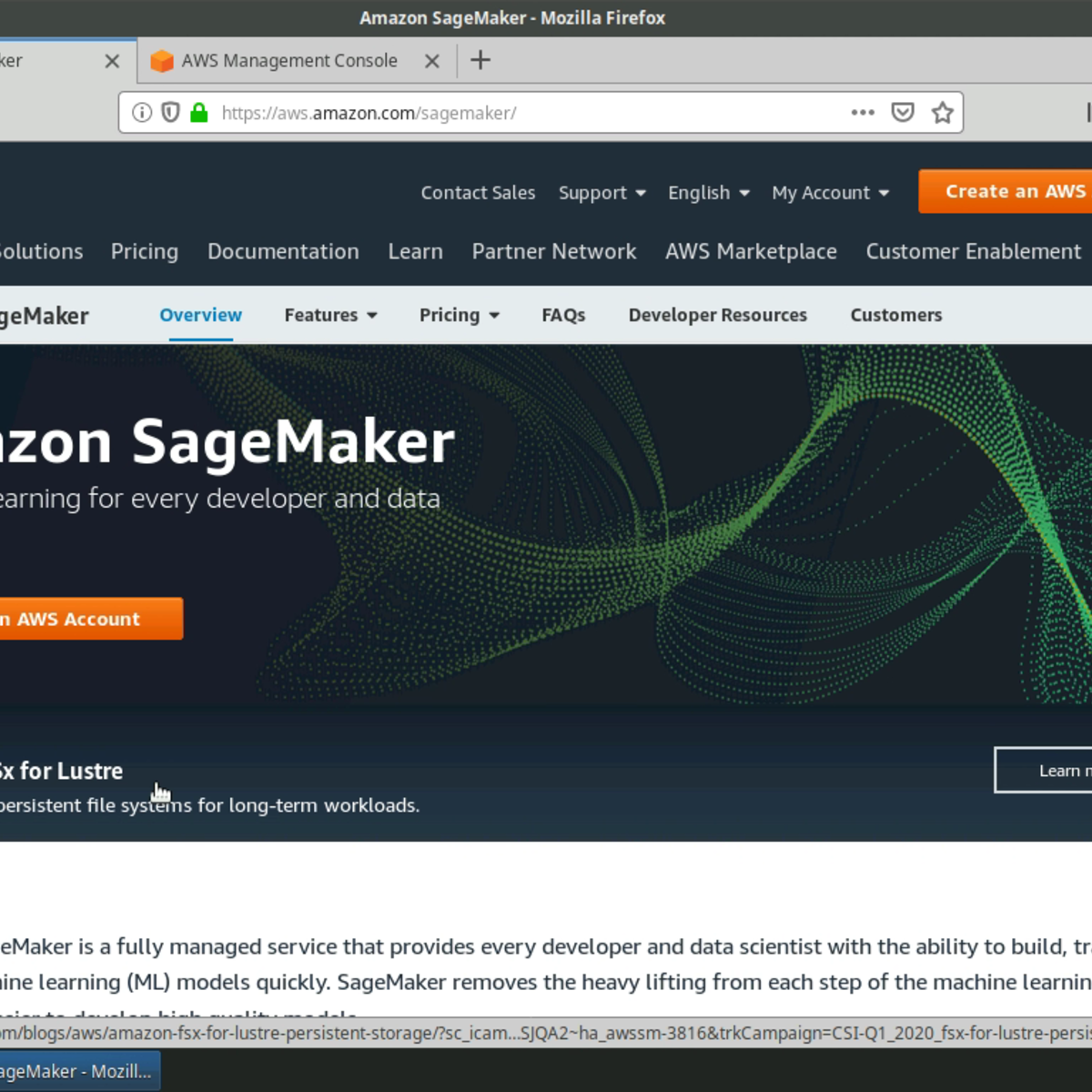
Please note: You will need an AWS account to complete this course. Your AWS account will be charged as per your usage. Please make sure that you are able to access Sagemaker within your AWS account. If your AWS account is new, you may need to ask AWS support for access to certain resources. You should be familiar with python programming, and AWS before starting this hands on project. We use a Sagemaker P type instance in this project, and if you don't have access to this instance type, please contact AWS support and request access. In this 2-hour long project-based course, you will learn how to train and deploy a Semantic Segmentation model using Amazon Sagemaker. Sagemaker provides a number of machine learning algorithms ready to be used for solving a number of tasks. We will use the semantic segmentation algorithm from Sagemaker to create, train and deploy a model that will be able to segment images of dogs and cats from the popular IIIT-Oxford Pets Dataset into 3 unique pixel values. That is, each pixel of an input image would be classified as either foreground (pet), background (not a pet), or unclassified (transition between foreground and background). Since this is a practical, project-based course, we will not dive in the theory behind deep learning based semantic segmentation, but will focus purely on training and deploying a model with Sagemaker. You will also need to have some experience with Amazon Web Services (AWS).
 SAE Institute México
Storytelling y medios digitales
"Este curso en línea va dirigido a todas aquellas personas que desean incursionar en el arte de generar emociones contando historias e inclusive personas del entorno profesional del marketing y la comunicación que quieran conocer un poco más."
 Edureka
Unit Testing & Test-Driven Development
Welcome to Unit Testing & Test-Driven Development, a practical, industry-focused course that teaches you how to build high-quality, reliable, and maintainable software using modern unit testing, Test-Driven Development (TDD), and Behavior-Driven Development (BDD) practices. In this course, you’ll master the fundamentals of unit testing, including test structure, naming conventions, and maintainable test design. You’ll learn how to isolate code using mocks and test doubles, apply dependency injection for testability, and confidently test asynchronous and event-driven logic. The course then dives deep into TDD workflows, helping you design features using the Red–Green–Refactor cycle and apply TDD in real-world projects such as APIs, services, and error-handling scenarios. Finally, you’ll explore BDD with Gherkin, writing readable scenarios and automating full feature implementations using testing frameworks. By the end of this course, you will be able to: -Understand why unit testing is essential for software reliability and long-term code quality -Write clean, maintainable, and scalable unit tests -Use mocking, test doubles, and dependency injection to isolate code under test -Test asynchronous, edge-case, and time-sensitive logic -Apply Test-Driven Development (TDD) to design and refactor production-ready features -Implement TDD for APIs, services, and error-handling workflows -Write and automate BDD scenarios using Gherkin for clear, behavior-focused testing Through guided demos and hands-on exercises, you’ll build test suites, refactor poorly testable code, develop features using TDD, and automate BDD scenarios end-to-end. These practical activities help bridge the gap between testing theory and real-world software development. This course is ideal for software developers, QA engineers, SDETs, and engineering students who want to improve code reliability, test automation skills, and development confidence. Basic programming knowledge is recommended, but no prior experience with unit testing, TDD, or BDD is required.
 EDUCBA
CSS: Design & Optimize Responsive Web Pages
By the end of this course, learners will be able to apply CSS rules, style text and layouts, create responsive designs, and implement animations and transformations to build professional websites. They will gain the ability to analyze design requirements, implement structured page layouts, and evaluate CSS techniques for modern web development. This course begins with the fundamentals of CSS, covering its history, syntax, and rule structure. Learners will then explore selectors, text formatting, spacing, and layout basics to enhance readability and visual hierarchy. In the next stage, they will design navigation menus, tables, forms, and graphics while learning how to apply transforms and animations for interactive experiences. Finally, learners will master responsive design techniques, media queries, positioning, and best practices for building flexible, device-friendly websites. What makes this course unique is its step-by-step, modular approach that blends practical coding exercises with conceptual clarity. Whether you are a beginner or looking to sharpen your skills, this course equips you with the essential CSS expertise to design modern, engaging, and responsive web pages.
 Coursera
Copy.AI for Beginners: Generate texts for various use cases
In this 1-hour long project-based course, you will practice generative text creation using CopyAI. We will cover this by exploring CopyAI's various features, creating customized prompts for different use cases, integrating content through Info Base, analyzing brand voice, and constructing efficient workflows. Through hands-on tasks, you will learn how to navigate the platform, utilize its features for text generation, organize your projects, and streamline your content creation process. This project is designed for individuals keen on leveraging Generative AI for personal or professional text creation. Ideal for those intrigued by AI's transformative potential in text generation, this project offers practical skills and insights. With no strict prerequisites, any competent computer user with a basic grasp of text generation concepts can successfully complete the project.