

The Global Scholarly Directory.
Discover world-class academic programs curated for the modern intellectual. Search through 19877+ degrees and professional certificates.
 Edureka
Getting Started with Angular
Getting Started with Angular is a beginner-friendly course that introduces you to the fundamentals of Angular, the powerful open-source framework used to build scalable, modern web applications. This course is designed to help you develop strong foundational knowledge in Angular development, covering everything from TypeScript essentials to Angular CLI, and the core architecture of Angular applications. Through hands-on exercises, real-world examples, and practical assignments, you will learn to: - Grasp essential Angular concepts such as components, templates, data binding, directives, and pipes. - Set up and manage your Angular development environment using the Angular CLI and best practices for project structure. - Understand the architecture of Angular applications, including services, routing, modules, and dependency injection. - Build dynamic, responsive single-page applications (SPAs) using Angular’s robust features and ecosystem. This course is ideal for web developers, software engineers, and front-end learners who want to start building apps with Angular. Familiarity with HTML, CSS, JavaScript, and frameworks like Bootstrap is recommended but not required. By the end of this course, you’ll be equipped with the skills and confidence to build your first Angular application and continue your journey into advanced Angular development.
 University of Copenhagen
Scandinavian Film and Television
In many ways Scandinavian film and television is a global cultural brand, connected with and exporting some of the cultural and social values connected to a liberal and progressive welfare society. This course deals with the social, institutional and cultural background of film and television in Scandinavia and in a broader European and global context.
 Google Cloud
Cloud Composer: Copying BigQuery Tables Across Different Locations
This is a self-paced lab that takes place in the Google Cloud console. In this advanced lab you will create and run an Apache Airflow workflow in Cloud Composer that exports tables from a BigQuery dataset located in Cloud Storage bucktes in the US to buckets in Europe, then import th0se tables to a BigQuery dataset in Europe.
 Google
Analizar datos para responder preguntas
Este es el quinto curso del certificado de Análisis computacional de datos de Google. En estos cursos obtendrás las habilidades necesarias para solicitar empleos de analista de datos de nivel introductorio. En este curso, explorarás la fase de “análisis” del proceso de análisis de datos. Aplicarás en tu análisis lo que aprendiste hasta el momento para darle sentido a los datos que recopilaste. Además, aprenderás cómo organizar y formatear tus datos por medio de hojas de cálculo y SQL para observarlos y analizarlos de diferentes maneras. También descubrirás cómo llevar a cabo cálculos complejos con respecto a los datos para lograr tus objetivos empresariales. Aprenderás a usar fórmulas, funciones y consultas de SQL a medida que lleves a cabo tu análisis. Los analistas de datos actuales de Google seguirán dándote instrucciones y te proporcionarán formas prácticas de llevar a cabo las tareas comunes de los analistas de datos con las mejores herramientas y recursos. Los alumnos que completen este programa de certificados estarán listos para solicitar trabajos de nivel introductorio como analistas de datos. No se requiere experiencia previa. Al final de este curso, serás capaz de: - Aprender cómo organizar los datos para analizarlos. - Descubrir los procesos de formateo y ajuste de datos. - Comprender cómo realizar la agregación de datos en hojas de cálculo y por medio de SQL. - Usar fórmulas y funciones en las hojas de cálculo para realizar cálculos en torno a los datos. - Aprender a realizar cálculos por medio de consultas de SQL.
 University of California, Irvine
Teaching Intermediate Grammar Project
This is the final project for the Teach English: Intermediate Grammar specialization. You should have basic knowledge of intermediate grammar and teaching methodology in order to complete this course. In this course, you will create a portfolio including all of the following for one specific intermediate grammar point: a lesson plan for the grammar point, a video of yourself introducing the grammar point, two related practice exercises or activities with handouts, an informal assessment, and a formal assessment with answer key. To do this, you will put into practice all of the skills that you have learned in the previous three courses. Finally, you will share your portfolio with other learners to demonstrate the skills you have learned and receive feedback, and you will get the chance to learn from others as you give them feedback on their portfolios. After you complete this course, you will have the skills you need to effectively create your own lesson plans, practice exercises and assessments needed to teach grammar to intermediate-level students. Learners in this course must be able to create a video using a webcam, video camera, or smart phone and upload the video files or share the video as a link.
 Infosec
C++ Lab Content
Explore the C and C++ languages. Look at the specificity of the C/C++ languages and how this impacts security, ways C/C++ can interact with the external world, error handling, the execution environment and much more.
 Simplilearn
Figma Micro Interaction Design Training
This Figma micro interaction design course equips you with the skills to craft seamless, intuitive digital experiences using micro interactions. Begin with foundational concepts and learn what micro interactions are, why they matter, and how they enhance user engagement. Explore key UI elements such as toggle switches and understand how subtle design details can improve functionality and user satisfaction. Delve into interactive navigation design by implementing sidebar and bottom bar menus that guide users effortlessly through interfaces. Progress to hands-on exercises that bring these concepts to life using popular design tools. To be successful in this course, you should have a basic understanding of UI/UX principles, wireframing, and familiarity with tools like Figma or Adobe XD. By the end of this course, you will be able to: - Understand the role of micro interactions in modern interface design - Implement UI components such as toggle switches to improve usability - Design interactive navigation systems using sidebar and bottom bar menus - Create engaging user flows that enhance overall user experience Ideal for aspiring UI/UX designers, product designers, and front-end developers.
 Google Cloud
Exploring NCAA Data with BigQuery
This is a self-paced lab that takes place in the Google Cloud console. Use BigQuery to explore the NCAA dataset of basketball games, teams, and players. The data covers plays from 2009 and scores from 1996. Watch How the NCAA is using Google Cloud to tap into decades of sports data.
 University of Manchester
Industrial Biotechnology
Fossil fuels have been the primary energy source for society since the Industrial Revolution. They provide the raw material for the manufacture of many everyday products that we take for granted, including pharmaceuticals, food and drink, materials, plastics and personal care. As the 21st century progresses we need solutions for the manufacture of chemicals that are smarter, more predictable and more sustainable. Industrial biotechnology is changing how we manufacture chemicals and materials, as well as providing us with a source of renewable energy. It is at the core of sustainable manufacturing processes and an attractive alternative to traditional manufacturing technologies to commercially advance and transform priority industrial sectors yielding more and more viable solutions for our environment in the form of new chemicals, new materials and bioenergy. This course will cover the key enabling technologies that underpin biotechnology research including enzyme discovery and engineering, systems and synthetic biology and biochemical and process engineering. Much of this material will be delivered through lectures to ensure that you have a solid foundation in these key areas. We will also consider the wider issues involved in sustainable manufacturing including responsible research innovation and bioethics. In the second part of the course we will look at how these technologies translate into real world applications which benefit society and impact our everyday lives. This will include input from our industry stakeholders and collaborators working in the pharmaceutical, chemicals and biofuels industries. By the end of this course you will be able to: 1. Understand enzymatic function and catalysis. 2. Explain the technologies and methodologies underpinning systems and synthetic biology. 3. Explain the diversity of synthetic biology application and discuss the different ethical and regulatory/governance challenges involved in this research. 4. Understand the principles and role of bioprocessing and biochemical engineering in industrial biotechnology. 5. Have an informed discussion of the key enabling technologies underpinning research in industrial biotechnology 6. Give examples of industrial biotechnology products and processes and their application in healthcare, agriculture, fine chemicals, energy and the environment.
 Johns Hopkins University
Mastering Software Development in R Capstone
R Programming Capstone
 Coursera
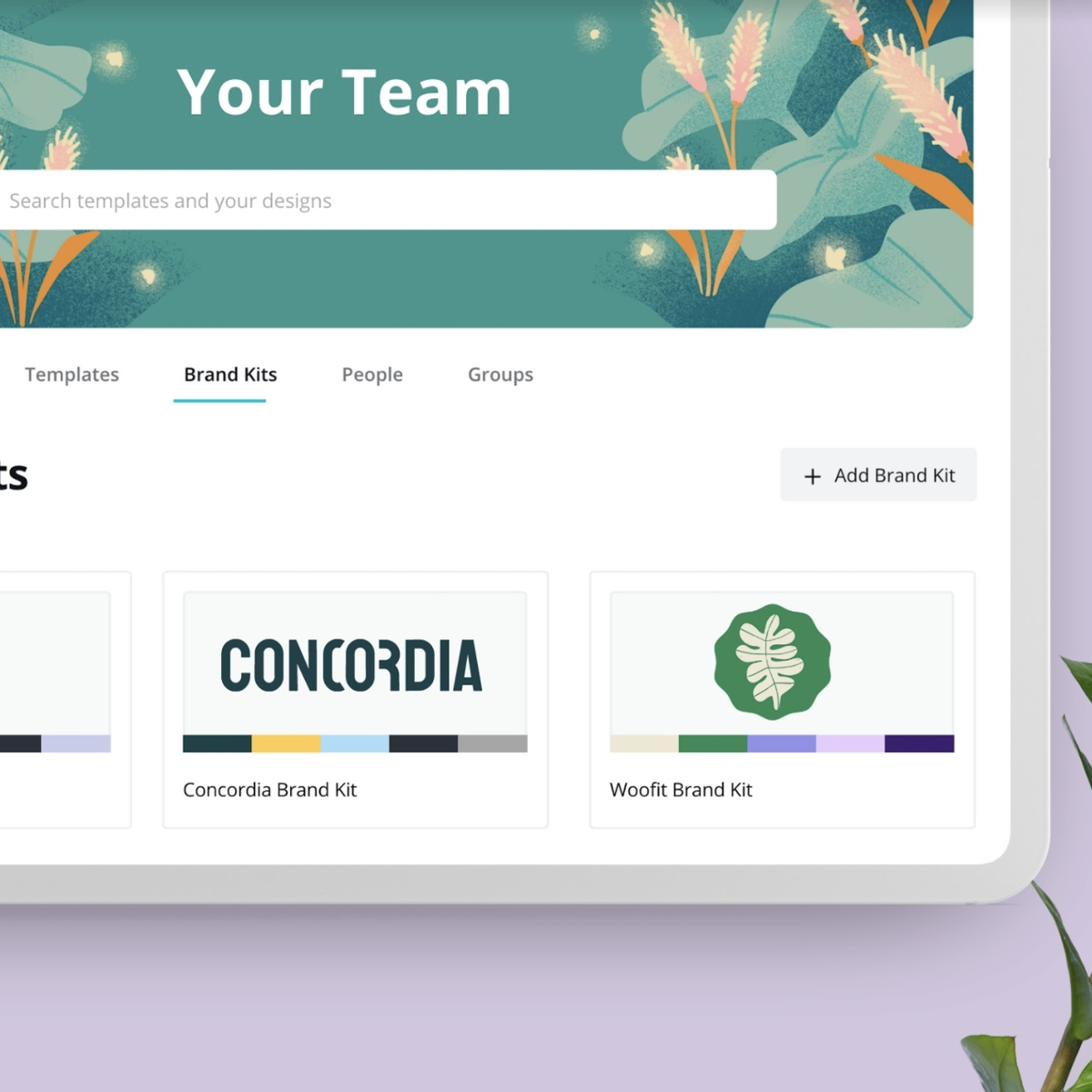
How to create and join teams using Canva
In this tutorial you will learn how to create and join teams using Canva. Note: This tutorial works best for learners who are based in the North America region. We're currently working on providing the same experience in other regions.
 Logical Operations
Microsoft Excel for Office 365 (Desktop or Online): Part 1
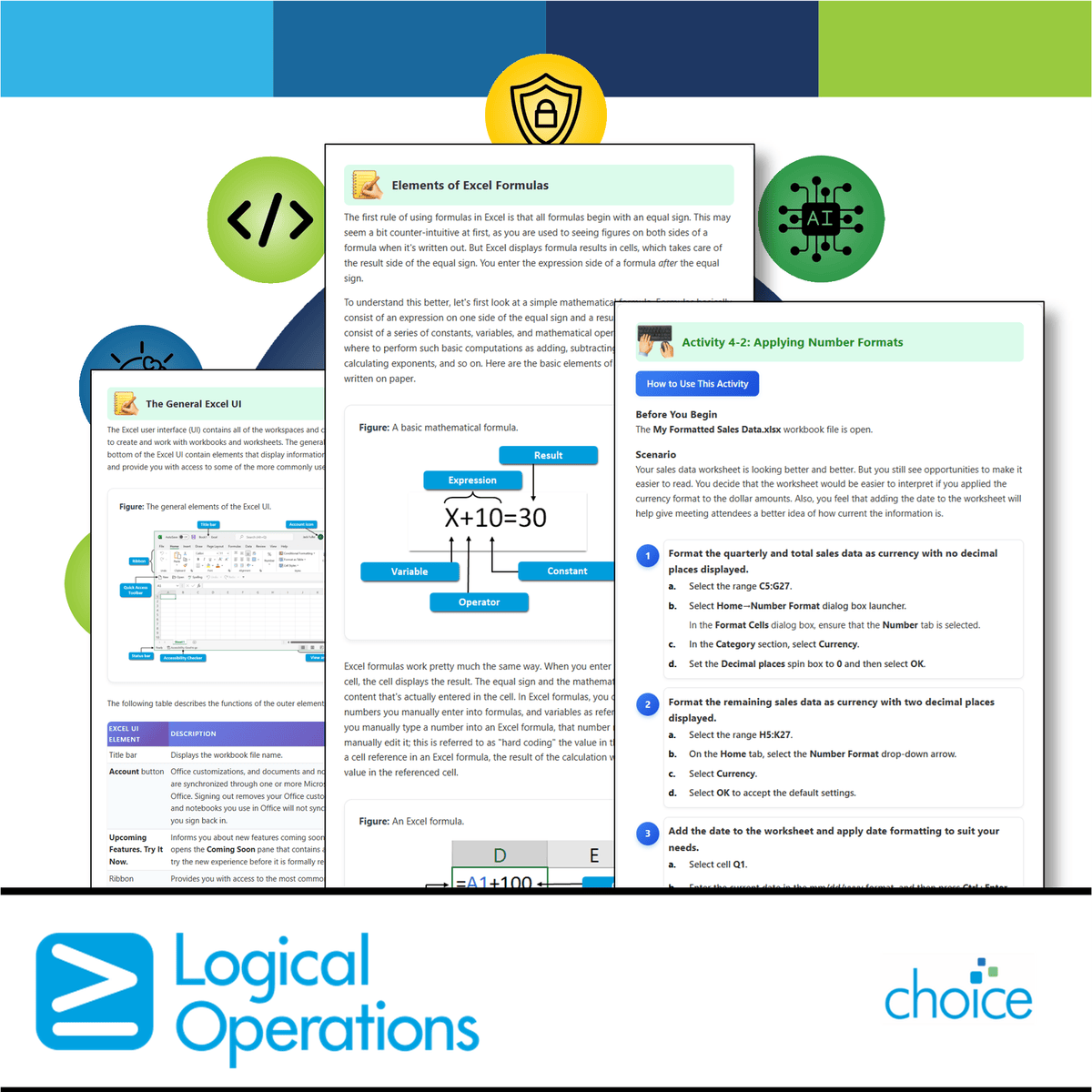
Organizations the world over rely on information to make sound decisions regarding all manner of affairs. But with the amount of available data growing on a daily basis, the ability to make sense of all of that data is becoming more and more challenging. Fortunately, this is where the power of Microsoft® Excel® can help. Excel can help you organize, calculate, analyze, revise, update, and present your data in ways that will help the decision makers in your organization steer you in the right direction. It will also make these tasks much easier for you to accomplish, and in much less time, than if you used traditional pen-and-paper methods or non-specialized software. This course aims to provide you with a foundation for Excel knowledge and skills, which you can build upon to eventually become an expert in data manipulation. Note: Most Office users perform the majority of their daily tasks using the desktop version of the Office software, so that is the focus of this training. The course material will also enable you to access and effectively utilize many web-based resources provided with your Microsoft 365 subscription. This includes brief coverage of key skills for using Excel for the Web and OneDrive. Helpful notes throughout the material alert you to cases where the online version of the application may function differently from the primary, desktop version. This course may be a useful component in your preparation for the Microsoft Excel (Microsoft 365 Apps): Exam MO-210 and Microsoft Excel Expert (Microsoft 365 Apps): Exam MO-211 certification exams. This course is intended for students who wish to gain the foundational understanding of Excel that is necessary to create and work with electronic spreadsheets. In this course, you will: familiarize yourself with Excel's layout, its various parts, its commands, and its terminology; outline Excel's abilities to quickly, efficiently, and accurately calculate data; update worksheets without throwing away all of the valuable work you've already done; format a worksheet and organize your data; print workbooks; and manage the overall structure of your workbooks. This course requires that you have Microsoft Excel installed on a Windows PC. The course setup instructions provided in the first module of the course go into more detail about the hardware and software requirements.
 Kennesaw State University
Cybersecurity and the Internet of Things
Welcome! You may have heard about the Internet of Things (IoT). But you may also have wondered about what it is. Or for that matter, what does it mean to you or an organization. This course is for you if you are curious about the most recent trends and activities in the internet capabilities and concerns about programmed devices. There are complexities and areas of necessary awareness when the industrial sector becomes connected to your home. Security policies and practices have not yet caught up to the internet capabilities of some of our most common products. The “connected home”, “consumer wearables”, or even an employee’s HVAC system may cause an unanticipated threat to your business environment. You will explore current security and privacy related concerns in each of these areas. Every module will include readings, videos, case studies, and a quiz to help make sure you understand the material and concepts we talk about. This course offers a place to learn, reflect, and plan for a smart community approach to IoT. Portions of this course may seem extremely technical in nature. That is because the “things” in IoT represents engineering. Try to grasp the concept in that case.
 Illinois Tech
Big Data Technologies
Big data is the area of informatics focusing on datasets whose size is beyond the ability of typical database and other software tools to capture, store, analyze and manage. This course provides a rapid immersion into the area of big data and the technologies which have recently emerged to manage it. We start with an introduction to the characteristics of big data and an overview of the associated technology landscape and continue with an in depth exploration of Hadoop, the leading open source framework for big data processing. Here the focus is on the most important Hadoop components such as Hive, Pig, stream processing and Spark as well as architectural patterns for applying these components. We continue with an exploration of the range of specialized (NoSQL) database systems architected to address the challenges of managing large volumes of data. Overall the objective is to develop a sense of how to make sound decisions in the adoption and use of these technologies as well as economically deploy them on modern cloud computing infrastructure.
 Google Cloud
Introduction to Data Engineering on Google Cloud
In this course, you learn about data engineering on Google Cloud, the roles and responsibilities of data engineers, and how those map to offerings provided by Google Cloud. You also learn about ways to address data engineering challenges.
 HEC Paris
Become a changemaker, build a career with purpose and impact
This course is designed to help anyone who wants to make a positive impact on society, but doesn't know how. Whatever your age, academic background or professional context, it will help you find the path that is right for you to make a difference. You will learn how to move from desire to idea, and from idea to action. Jointly developed by professors and experts from HEC Paris and Ticket for Change, the course is conceived as a learning journey guiding you through the different steps to find one’s way as an actor of change. Along three main phases - Inspiration - Introspection - Action – you will: - Develop awareness of the role and means of actions of social and environmental changemakers. - Take stock of your own aspirations, motivations and strengths. - Define your objectives towards a personal and professional transformation and initiate an effective transition to action. At every stage of the course, you will: - Gain concepts and methodologies from the fields of innovation, entrepreneurship and sustainability to help frame issues at stake, define and structure a viable project. - Develop self-awareness thanks to concrete self-development tools and exercises. - Get inspired by the testimonies of social entrepreneurs and corporate leaders sharing their experience. The last module can be customized to your professional context or project as you may choose between three tracks whether you are aiming at becoming a "social entrepreneur", an "impact employee", a "corporate changemaker".