

The Global Scholarly Directory.
Discover world-class academic programs curated for the modern intellectual. Search through 19877+ degrees and professional certificates.
 Google Cloud
Log Analytics on Google Cloud
This is a self-paced lab that takes place in the Google Cloud console. In this lab, you will learn how to use Cloud Logging to analyze your logs.
 Logical Operations
Adobe Illustrator CC: Part 1
To meet the demands of individuals and organizations for flexible, reusable, and easily modified visual content, Adobe Systems has created a cadre of applications that collectively provide a scalable, end-to-end solution for nearly every type of visual design project one can contemplate. Called Creative Cloud®, the collection of applications perform specialized design tasks while interoperating among each other to deliver content. This course focuses on Adobe® Illustrator® CC, the component within Creative Cloud used to create "drawn" graphics, while enabling its users to integrate content from other domains (such as photo-oriented graphics and animation, which belong to Adobe® Photoshop® and other applications). With Illustrator's many easily used tools, you will discover that not only can you unlock the same creative impulses you've always had as you've picked up a pencil to sketch out an idea, but also capture those multiple ideas and "what ifs" during the creative process in ways that you never imagined. And for those of you who are just embarking on building your creative skills, you will be surprised at "how good" your work will appear, even at the outset of your exploration of the world of graphic design. This course is a great component of your preparation for the Adobe Certified Professional in Graphic Design & Illustration Using Adobe Illustrator exam. This course is intended for designers, publishers, pre-press professionals, marketing communications professionals, or people switching to a design job or taking on design responsibilities and who need to use Illustrator to create illustrations, logos, advertisements, or other graphic documents. It is also useful for anyone interested in working toward the Adobe Certified Professional Graphic Design and Illustration Using Adobe Illustrator exam certification. In this course, you will: identify the components and capabilities of Illustrator, create basic shapes, create custom paths, create graphics that contain custom text, customize objects, customize basic shapes, and prepare documents for deployment. This course requires that you have Adobe Illustrator installed on a Windows PC. The course setup instructions provided in the first module of the course go into more detail about the hardware and software requirements.
 Georgia Institute of Technology
Mechanics of Materials II: Thin-Walled Pressure Vessels and Torsion
This course explores the analysis and design of thin-walled pressure vessels and engineering structures subjected to torsion. ------------------------------------------------ The copyright of all content and materials in this course are owned by either the Georgia Tech Research Corporation or Dr. Wayne Whiteman. By participating in the course or using the content or materials, whether in whole or in part, you agree that you may download and use any content and/or material in this course for your own personal, non-commercial use only in a manner consistent with a student of any academic course. Any other use of the content and materials, including use by other academic universities or entities, is prohibited without express written permission of the Georgia Tech Research Corporation. Interested parties may contact Dr. Wayne Whiteman directly for information regarding the procedure to obtain a non-exclusive license.
 Duke University
Managing Machine Learning Projects
This second course of the AI Product Management Specialization by Duke University's Pratt School of Engineering focuses on the practical aspects of managing machine learning projects. The course walks through the keys steps of a ML project from how to identify good opportunities for ML through data collection, model building, deployment, and monitoring and maintenance of production systems. Participants will learn about the data science process and how to apply the process to organize ML efforts, as well as the key considerations and decisions in designing ML systems. At the conclusion of this course, you should be able to: 1) Identify opportunities to apply ML to solve problems for users 2) Apply the data science process to organize ML projects 3) Evaluate the key technology decisions to make in ML system design 4) Lead ML projects from ideation through production using best practices
 Scrimba
Vibe Coding with Claude Code
Claude Code is more than just another tool, it’s an AI coding assistant designed to help you code faster, cleaner, and smarter. In this course, you’ll get hands-on with Claude Code from the very beginning. We’ll start with the setup and core ideas, then move into best practices so you can get the most out of your workflow. From there, we’ll explore some of Claude Code’s advanced features, including hooks, slash commands, and agents, which let you customize and extend how you code. You’ll also learn how to add images to your projects, automate tasks, and build a fully working calendar app that ties everything together. Finally, we’ll cover MCP (Model Context Protocol) integration, showing you how to connect Claude Code to broader systems and even set up your own MCP server. By the end of the course, you’ll not only understand how Claude Code works—you’ll have built real projects and picked up skills that make your day-to-day coding more efficient and enjoyable.
 Coursera
Evaluate Storage for Data Warehousing Success
Master the critical decision-making skills for optimizing data warehouse storage architecture. This course equips data professionals with the analytical expertise to evaluate columnar versus row-oriented storage formats based on workload characteristics, query patterns, and performance requirements. You'll learn to analyze compression ratios, assess ingestion performance implications, and conduct systematic benchmarking of formats like Parquet, ORC, and Avro. Transform your ability to make informed storage architecture decisions that directly impact analytical performance and cost-effectiveness in enterprise data warehousing environments. This course is unique because it combines theoretical understanding with hands-on benchmarking practice, giving you real-world experience in evaluating storage formats using actual performance metrics. To be successful in this project, you should have basic understanding of data warehousing concepts and familiarity with SQL queries.
 Google
Build Customer Loyalty
In this course, you will learn about the importance of loyalty in e-commerce and explore how to build strong customer relationships. You’ll explore techniques for retaining customers, such as offering loyalty programs, practicing dynamic remarketing, and implementing post-purchase follow-ups. You’ll also find out how to measure customer satisfaction. By the end of this course, you will be able to: - Identify common strategies for building customer loyalty in e-commerce - Understand how to measure customer satisfaction through surveys - Use client relationship skills to communicate with customers
 EDUCBA
Azure Practical - Developing Your Applications
This hands-on course enables learners to design, develop, and deploy cloud-based applications using Microsoft Azure’s Platform as a Service (PaaS) offerings. Through progressive modules, learners will identify core Azure services, configure Azure App Services, and implement secure identity management using Azure Active Directory. The course further explores how to integrate, test, and monitor automated background jobs with Azure WebJobs and connect applications to scalable storage systems including Azure SQL Database, Blob Storage, and Table Storage. Learners will actively apply connection strings, build real-world workflows for managing user data and media, and evaluate their deployments through portal logs and debugging tools. By the end of the course, participants will be able to construct end-to-end Azure application solutions, analyze WebJob outputs, and troubleshoot cloud-based deployments confidently using industry-standard practices.
 Coursera
Cree Increíbles Diseños de Mercadeo usando Canva
Al final del Proyecto usted podrá crear un gráfico/diseño de ejemplo/muestra de redes sociales para empresas. El gráfico se puede compartir en las plataformas de redes sociales de su empresa. Podrá incorporar la paleta de colores de su guía de estilo empresarial para crear el reconocimiento de la marca como parte de su estrategia de mercadeo en redes sociales. Este curso incluirá una introducción a Canva, cómo escoger el tamaño de su lienzo para una publicación en las redes sociales, incorporar imágenes específicas de su empresa en una publicación en las redes sociales y preparar una publicación para sus canales de redes sociales.
 Coursera
Kreiere animierte Posts für soziale Medien mit Canva
Nach Beendigung dieses Projekts, kannst du animierte Posts für soziale Medien mit Hilfe der gratis Version von Canva kreieren und gestalten. Egal, ob du eine neue Marke startest oder eine bestehende mithilfe deiner Social-Media-Strategie optimieren möchtest – visuelle Inhalte unterstützen dich bei der Etablierung deiner Online-Identität. User von sozialen Netzwerken werden im heutigen Zeitalter von Informationen und Bildern regelrecht überschwemmt. Aufgabe des Social Media Marketings ist es daher, kreative Wege zu finden um die Aufmerksamkeit der User für ihre Produkte und Dienstleistungen zu gewinnen. Die web basierte Plattform Canva bietet alle nötigen Werkzeuge um visuell attraktive und organisierte Produkte alleine, oder als Team zu kreieren und zu teilen. Am Ende dieses Projekts wirst du gelernt haben, Grafikdesign Tools anzuwenden um kreative und attraktive animierte Grafiken für soziale Medien zu gestalten.
 Peking University
社会调查与研究方法 (下)Methodologies in Social Research (Part 2)
社会调查与研究方法, 首先,是一套观察社会现象、测量社会现象的工具; 其次,是一套分析和运用社会现象数据的科学方法; 最高境界,则是一套针对社会、经济、教育、政治、法律、管理、公共卫生、新闻报道等人类的生产与生活现象,进行科学沟通的思维逻辑与表达方式。
 Google
Sécurité des TI : Défense contre les pratiques sombres du numérique
Ce cours couvre une grande variété de concepts, d’outils et de meilleures pratiques en matière de sécurité informatique. Il présente les menaces et les attaques et les nombreuses façons dont elles peuvent se manifester. Nous allons vous présenter les algorithmes de cryptage et la manière dont ils sont utilisés pour protéger les données. Ensuite, nous nous plongerons dans les trois A de la sécurité de l’information : authentification, autorisation et comptabilité. Nous aborderons également les solutions de sécurité du réseau, allant des pare-feu aux options de cryptage Wi-Fi. Le cours se termine par la mise en commun de tous ces éléments dans une architecture de sécurité multicouche et approfondie, suivie de recommandations sur la manière d’intégrer une culture de la sécurité dans votre organisation ou votre équipe. À la fin de ce cours, vous serez capables de comprendre : ● le fonctionnement des différents algorithmes et techniques de cryptage, ainsi que leurs avantages et leurs limites; ● divers systèmes et types d’authentification; ● la différence entre l’authentification et l’autorisation; ● comment évaluer les risques potentiels et recommander des moyens de réduire les risques; ● les meilleures pratiques pour sécuriser un réseau; ● comment aider les autres à appréhender les concepts de sécurité et à se protéger.
 Google Cloud
Using BigQuery Omni with AWS
This is a self-paced lab that takes place in the Google Cloud console. In this lab, you will run BigQuery analytics on data stored in AWS S3 using BigQuery Omni.
 Coursera
Build an AI-Powered App with Claude
Creating Interactive AI Apps with Claude is an intermediate-level course designed for developers and tech professionals who want to harness the power of conversational AI in their applications. In today's competitive digital landscape, AI-powered features are becoming essential for creating engaging user experiences. This course provides practical, hands-on training in building interactive applications using Claude's API, from basic text generation to sophisticated conversational systems. You'll explore real-world case studies, master prompt engineering techniques, and develop complete AI-powered applications. Through step-by-step tutorials, interactive exercises, and comprehensive projects, you'll learn to integrate Claude's capabilities into your development workflow. Whether you're building customer service bots, educational tools, or creative applications, this course gives you the skills to create AI experiences that users love and businesses value.
 Packt
Packt
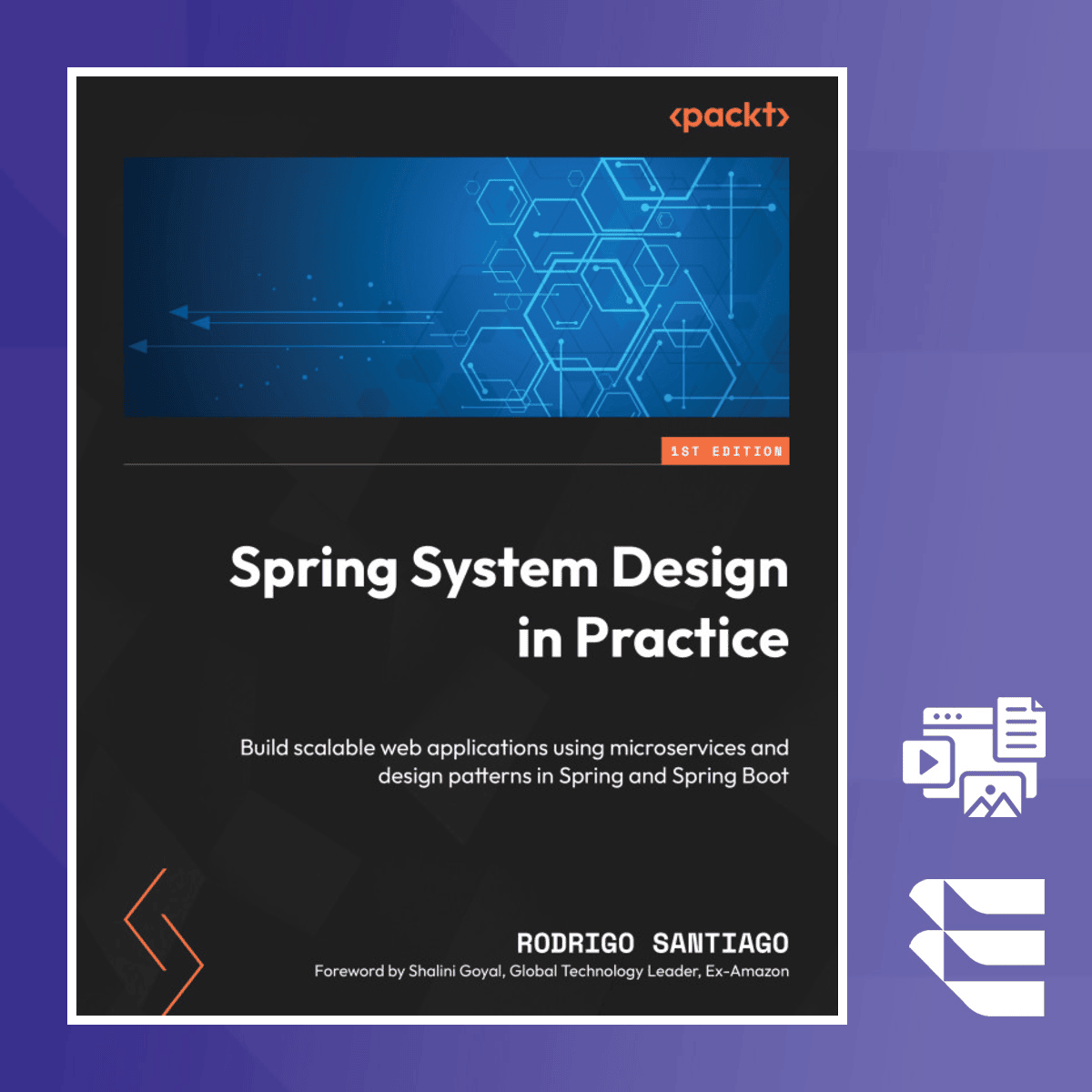
Spring System Design in Practice
This course offers a practical approach to system design with Java Spring, teaching you to build scalable, maintainable web applications. It covers microservices, Spring Boot, and key design patterns, ensuring you can apply these concepts to real-world projects. By the end of the course, you'll be proficient in designing complex systems, making strategic decisions about service architectures, and optimizing performance using both synchronous and asynchronous methods. What sets this course apart is its hands-on nature, where you’ll apply your learning to build a complete application while understanding core architectural principles. This course is perfect for developers with some Java and Spring experience who are looking to elevate their system design skills and prepare for more senior roles.
 Universidade Estadual de Campinas
Introdução ao Desenvolvimento de Aplicativos Android
Este curso tem como objetivo propiciar um primeiro contato com a Programação para Dispositivos Móveis que operam na plataforma Android. O Android Studio será utilizado como ambiente de desenvolvimento desde o início do curso e você receberá dicas de como obter ajuda quando alguma tarefa estiver consumindo mais tempo do que o necessário. Ao solucionar problemas por conta própria, você irá adquirir a autonomia necessária para concluir projetos de programação. Ao final do curso, você desenvolverá um aplicativo. Para que você seja capaz de concluir o projeto final, nós listaremos algumas ferramentas que estão a sua disposição, além de materiais que mostram como utilizar essas ferramentas. Dessa forma, ao final do curso, você terá aprendido a (i) utilizar o ambiente de desenvolvimento, (ii) desenvolver uma interface gráfica simples com elementos pré-definidos, (iii) adicionar comportamento a essa interface gráfica e (iv) criar um aplicativo que interage com o usuário. Você não precisa ter muita experiência na linguagem Java para concluir este curso. Entretanto, é recomendável que você tenha um conhecimento básico de programação em Java. Você pode optar por estudar esses conceitos antes do início do curso e ainda buscar informações online quando algum aspecto da linguagem Java não ficar muito claro apenas com o material do curso.