

The Global Scholarly Directory.
Discover world-class academic programs curated for the modern intellectual. Search through 19877+ degrees and professional certificates.
 Google Cloud
Membuat Sematan, Pencarian Vektor, & RAG dengan BigQuery
Kursus ini mengeksplorasi solusi Retrieval-Augmented Generation (RAG) di BigQuery untuk memitigasi halusinasi AI. Kursus ini akan memperkenalkan alur kerja RAG yang mencakup pembuatan embedding, penelusuran ruang vektor, dan pembuatan jawaban yang lebih baik. Kursus ini akan menjelaskan alasan konseptual di balik langkah-langkah ini dan implementasi praktisnya dengan BigQuery. Di akhir kursus, peserta akan dapat membangun pipeline RAG menggunakan BigQuery dan model AI generatif seperti Gemini dan model embedding untuk menangani kasus penggunaan halusinasi AI mereka sendiri.
 University of Colorado Boulder
BiteSize Python for Absolute Beginners: Essentials
Start your Python journey with this course, where you’ll gain a solid foundation in this powerful language. Learn how to work with variables and data types to store and process information, master operations to perform calculations and make comparisons, and unlock the power of strings for text manipulation. Through hands-on case studies, like creating a checkout system, splitting tips, and calculating compound interest, you’ll apply your skills to solve real-life problems. This beginner-friendly course is perfect for anyone looking to build practical coding skills and confidence in Python.
 Microsoft
Foundations of Coding Back-End
This course focuses on the fundamental concepts of back-end development. You'll learn to solve problems, design algorithms, and write efficient, modular code using industry-standard practices. By the end of the course, you will be able to… Summarize the foundational principles and practices of back-end development. Plan back-end projects using industry-standard tools and methodologies. Apply logical thinking and problem-solving techniques in programming. Design algorithms and flowcharts to represent logical steps in programming. Implement control structures and loops for repetitive tasks. Develop modular code using functions and methods.
 HRCI
HRCI
Learning and Development
This course presents an overview of best practices for creating effective training in your organization. You will learn different methods of identifying training needs and delivering training. You will also learn how to evaluate the effectiveness of training programs. By the end of this course, you will be able to: ● Create and deliver learning to your organization ● Explain and propose different methods to access the processes and outcomes of training ● Explain different ways to deliver training ● Evaluate key metrics that will demonstrate training outcomes and results No prior experience in Human Resources is needed to be successful in this course.
 University of Colorado Boulder
Be Your Best Creative Self
Welcome to Be Your Best Creative Self, the second course in the Personal Development for Professional Success Specialization. This course is for creative professionals who want to work more efficiently and at higher levels of both job satisfaction and success. As students work through this course, they will: • learn to make the creative state more reliable and productive • fine-tune their personal brand so that they present themselves positively and accurately • learn basic skills for working with others that will help to avoid traps as well as to enable success As much as anything, this is a survival-skills class designed to help creative professionals take control of their careers. The assignments and exercises are intended to build a creative community in which students gain confidence and grow together.
 Logical Operations
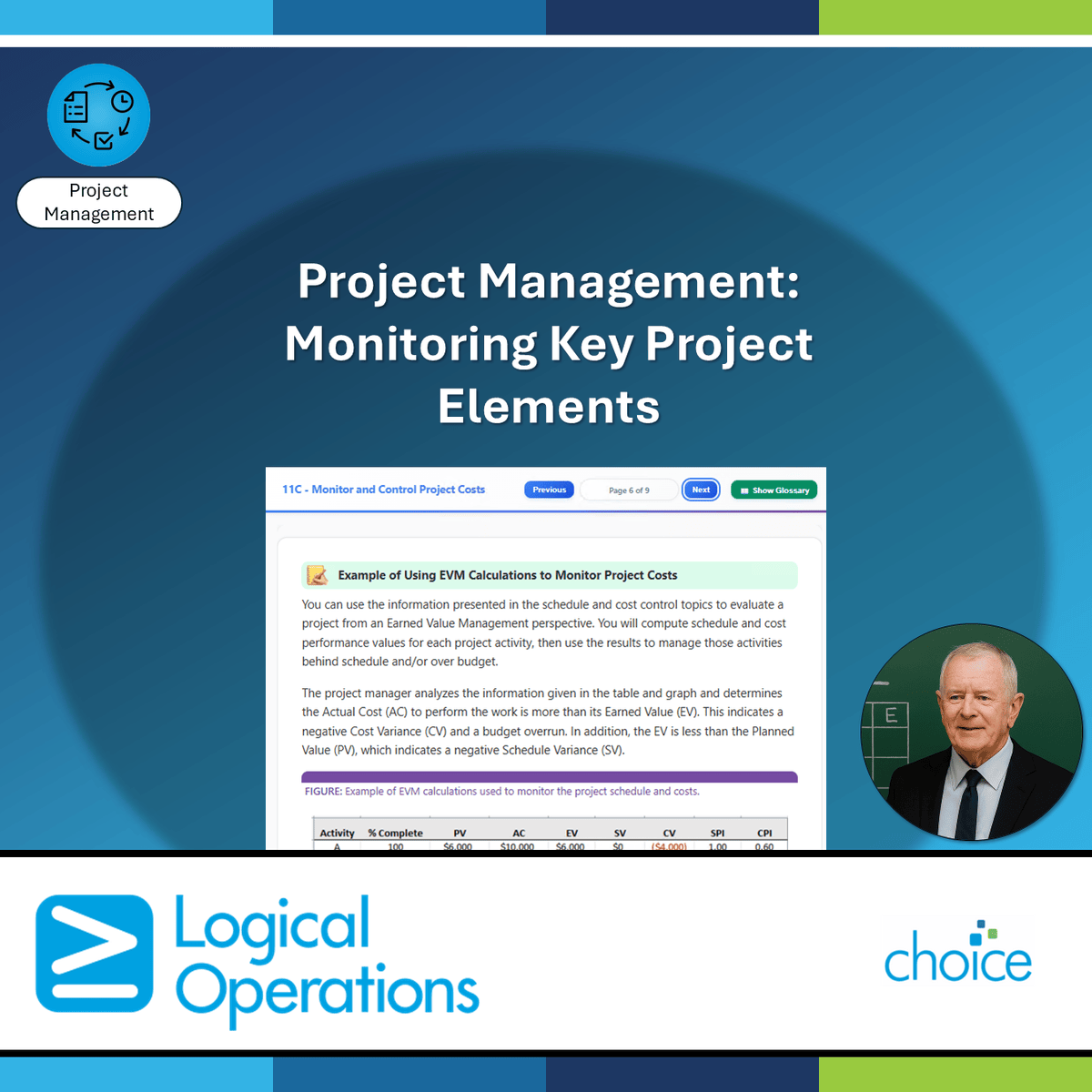
Project Management: Monitoring Key Project Elements
In this course, you'll continue developing your project management skills by monitoring and controlling the project schedule, optimizing a predictive schedule, and monitoring and controlling project costs. You'll also monitor and control risks, put quality plans into action, and control project quality. This is the fourth course in a multi-course Specialization. All of the courses in this Specialization require that you have a recent version of Microsoft Word and Excel installed in order to open the course data files. The course setup instructions provided in the first course go into more detail about the hardware and software requirements.
 Fundação Instituto de Administração
Sales & Marketing Alignment
Welcome to Course 4 – Sales & Marketing Alignment. This course focus on what is considered by most academics and practitioners as the biggest challenge that sales professionals have to face. As we discussed in Course 1 – Effective Sales, strategy, and sales must be integrated to support a high potential for value creation through the sales functions. We also mentioned that strategy and sales integration can be supported by marketing functions. The discussions then went through sales strategy supported by intelligence analysis (Course 2), sales models and frameworks to support sales planning (Course 3). By the consequence, at this point of this specialization, you are in a good position to go further in the sales planning and management functions. And this is the moment to tackle one of the biggest challenges that most sales professionals must address with diligence – Sales & Marketing Alignment. The primary learning outcome of this course is to prepare you to apply concepts to support this alignment, with prescriptions and recommendations that contribute to improving the alignment. The improvement in the knowledge, competencies, and skills regarding sales & marketing alignment will contribute to increasing the potential for value creation from a strategic sales planning approach.
 L&T EduTech
Planning of Metro Rail Systems
This course has been created for Civil and Transportation Engineers. The "Planning of Metros " course is intended for entry level graduates, those who want to comprehend and navigate the concepts in planning of Metro rail systems. Throughout this course, participants will learn about the fundamental principles of Metro Rail planning in six modules. Tailored by industrial experts, this course is for the consumption of entry level Engineers in the Indian Subcontinent. The "Introduction to Mass Rapid Transport Systems (MRTS)" module provides a comprehensive exploration of key topics essential to urban transportation. Encompassing the necessity of MRTS, Transit Oriented Development, feasibility studies, sustainable and smart technologies, and the historical evolution of metros, it equips learners with a holistic understanding of modern urban transit challenges and solutions. The module on planning of metros covers essential principles for interface design, emphasizing Urban Planning intricacies, constraints, and restrictions. It explores the seamless integration of diverse metro systems and gives an overview of Building Information Modeling (BIM) for comprehensive planning. Students gain insights into optimizing metro functionality while navigating urban challenges and technological advancements. The module on planning of metros covers essential principles for interface design, emphasizing Urban Planning intricacies, constraints, and restrictions. It explores the seamless integration of diverse metro systems and gives an overview of Building Information Modeling (BIM) for comprehensive planning. Students gain insights into optimizing metro functionality while navigating urban challenges and technological advancements. The module addressing elevated metro systems delves into the planning considerations involved in constructing elevated metro viaducts, encompassing aspects such as span configuration and foundation selection. Additionally, this module provides detailed insights into various techniques for erecting metro viaducts and explains the overall layout of metro stations. The module focusing on underground metros provides an in-depth exploration of diverse methods employed in the construction of metro tunnels. It also offers a comprehensive overview of station layouts, with a particular emphasis on tunnel failures and safety considerations. This module offers a comprehensive overview of critical components in metro systems. It covers HVAC systems, Tunnel ventilation systems, public health engineering aspects, electric systems, Fire safety, alarms, prevention, and emergency response. Overall, the module provides a thorough understanding of the intricate systems and safety measures integral to the efficient functioning and well-being of metro systems.
 Emory University
Marketing Channel Incentives
This specialization is ideal for individuals who currently work in or are targeting opportunities in consulting and strategy, industrial sales and buying, marketing management, entrepreneurship and business development. In this course, you will be exposed to the challenges of implementing a pricing strategy in your route-to-market and the necessity of becoming a "strategic skeptic." Questions such as, "how to ensure our partners do the right activity at the right price?" "how should my firm protect itself from channel partners who seek to cheat or free ride?" will be answered. You will also be exposed to direct selling channels, their incentive structures, and understand how and when they might represent a viable route-to-market.
 Coursera
Create a Facebook Business Page
This1.5-hour long project-based course is an introduction on how to create a Facebook business page. For this project, we will be working on Facebook. Facebook is a social media platform and a great resource for businesses looking to reach a wider audience. The following will be covered: - Create a Facebook page with descriptions, profile picture and a cover photo. - Edit Facebook page’s full info. - Create automated messages and automated responses. - Add Instagram handle and WhatsApp number to Facebook. - Add an admin to your Facebook Page. By the end of this project, you will create a Facebook business page. Note: If you don't have a Facebook account, you will need to create one to be able to complete the content.
 SAS
SAS
Predictive Modeling with Logistic Regression using SAS
This course covers predictive modeling using SAS/STAT software with emphasis on the LOGISTIC procedure. This course also discusses selecting variables and interactions, recoding categorical variables based on the smooth weight of evidence, assessing models, treating missing values, and using efficiency techniques for massive data sets. You learn to use logistic regression to model an individual's behavior as a function of known inputs, create effect plots and odds ratio plots, handle missing data values, and tackle multicollinearity in your predictors. You also learn to assess model performance and compare models.
 Universitat Politècnica de València
Basic Math: Algebra
This course will guide you through the fundamentals of linear equations, starting with a review of single-variable equations. Next, we'll delve into the world of matrices and systems of linear equations, covering: Systems of linear equations: Definition, classification, and step-by-step resolution using the Gauss method. Matrix fundamentals: Key concepts and essential operations. Inverse matrices: Learn how to calculate them using the Gauss and adjugate methods. Matrix equations: A practical introduction to this type of equation. Determinants and rank: Master the calculation of determinants and the concept of matrix rank. Cramer's rule: Discover its application for solving systems of linear equations.
 Packt
Packt
Concurrent Rendering Adventures in React 18
Updated in May 2025. This course now features Coursera Coach! A smarter way to learn with interactive, real-time conversations that help you test your knowledge, challenge assumptions, and deepen your understanding as you progress through the course. Embark on a journey through the cutting-edge capabilities of React 18 with this in-depth course. You'll start by understanding the fundamental concepts of concurrent rendering, including the role of Suspense in managing asynchronous operations seamlessly. Each module builds on the last, introducing you to practical examples and real-world scenarios where these features shine. The course then delves into the specific enhancements React 18 brings, such as new hooks like useTransition and useDeferredValue, which are designed to optimize your application's performance and user experience. Detailed explanations and hands-on exercises ensure you grasp the intricacies of each feature, from nesting Suspense components to coordinating them with SuspenseList for more complex UI structures. Finally, you'll learn to transition your existing projects to React 18 smoothly. The course covers everything from upgrading your codebase to implementing the new concurrent mode, ensuring your applications are future-proof. By the end of the course, you'll be proficient in using React 18’s latest tools to build fast, fluid, and scalable applications, ready to tackle the challenges of modern web development. This course is ideal for React developers looking to deepen their knowledge of React 18's advanced features, particularly those focused on performance optimization and concurrent rendering. A basic understanding of React is required to follow along but not mandatory.
 Coursera
Optimize and Manage Your ML Codebase
Are you deploying ML models that need to respond in milliseconds, not seconds? In production environments, even the most accurate model becomes worthless if it can't meet real-time performance demands. This Short Course was created to help ML and AI professionals accomplish systematic optimization of inference code and establish robust development workflows for production-ready ML systems. By completing this course, you'll be able to diagnose performance bottlenecks in your inference pipelines, apply advanced optimization techniques like quantization and pruning, and implement GitFlow or Trunk-Based Development strategies with automated CI/CD pipelines that you can deploy immediately in your workplace. By the end of this course, you will be able to: - Analyze inference code to optimize for real-time performance - Evaluate Git branching strategies and CI/CD pipelines for codebase management This course is unique because it bridges the gap between ML model development and production engineering, combining performance optimization techniques with software engineering best practices specifically tailored for ML workflows. To be successful in this project, you should have experience with Python, PyTorch or TensorFlow, TensorRT, Git version control, and basic understanding of ML model deployment.
 University of Colorado Boulder
Leadership Style and Building a High-Performance Team
Leadership of complex technical organizations is being challenged by the rapid pace of technology development, innovation and the new flexible workplace where employees working from anywhere demand to be engaged, motivated and recognized. This first Leading Technical Organizations course, "Leadership Style and Building a High-Performance Team", explores your personal leadership style, how value is created, how a leader multiplies their abilities by building high performance teams, and how your executive presence is essential to be a leader of leaders. This course can be taken for academic credit as part of CU Boulder’s Master of Engineering in Engineering Management (ME-EM) degree offered on the Coursera platform. The ME-EM is designed to help engineers, scientists, and technical professionals move into leadership and management roles in the engineering and technical sectors. With performance-based admissions and no application process, the ME-EM is ideal for individuals with a broad range of undergraduate education and/or professional experience. Learn more about the ME-EM program at https://www.coursera.org/degrees/me-engineering-management-boulder.
 University of Leeds
Programming for Data Science
Explore the basics of programming and familiarise yourself with the Python language. After completing this course, you will be able to write Python programs in Jupyter Notebook and describe basic programming. In this course, you will learn everything you need to start your programming journey. You will discover the different data types available in Python and how to use them, learn how to apply conditional and looping control structures, and write your own functions. This course provides detailed descriptions of new concepts and background information for additional context. The quizzes available will help you to develop your understanding. You will also complete exercises using Jupyter Notebook on your computer. By using Jupyter Notebook, you will be able to combine your notes with useful examples so that you develop the resources you need to program independently in the future. This course is a taster of the Online MSc in Data Science (Statistics) but it can be completed by learners who want an introduction to programming and explore the basics of Python.