

The Global Scholarly Directory.
Discover world-class academic programs curated for the modern intellectual. Search through 19877+ degrees and professional certificates.
 Johns Hopkins University
Principles of fMRI 2
Functional Magnetic Resonance Imaging (fMRI) is the most widely used technique for investigating the living, functioning human brain as people perform tasks and experience mental states. It is a convergence point for multidisciplinary work from many disciplines. Psychologists, statisticians, physicists, computer scientists, neuroscientists, medical researchers, behavioral scientists, engineers, public health researchers, biologists, and others are coming together to advance our understanding of the human mind and brain. This course covers the analysis of Functional Magnetic Resonance Imaging (fMRI) data. It is a continuation of the course “Principles of fMRI, Part 1”.
 DeepLearning.AI
PyTorch: Fundamentals
This course introduces you to the core principles of deep learning through hands-on coding in PyTorch. You’ll start by learning how PyTorch represents data with tensors and how datasets and data loaders fit into the training process. Step by step, you’ll build and train neural networks, experiment with different architectures, and explore how models learn from examples. You’ll also learn how to monitor training progress, interpret results, and evaluate performance. By the end of the course, you’ll understand PyTorch’s workflow and be ready to design, train, and test your own neural networks with confidence.
 Northeastern University
Data Management for Analytics Part 1
This course will offer you an opportunity to learn the fundamental concepts and emerging technologies in database design and modeling and database systems. It presents a balanced theory-practice focus and covers entity relationship model and UML model, relational model, and relational databases. By the end of this part 1 course on data analytics, you will have a foundational understanding of the theory and applications of database management to support data analytics, data mining, machine learning, and artificial intelligence.
 Google
Fast-Track Data Analysis and Presentations
Need to crunch data or pull together a presentation? In this course, you’ll design prompts that help you extract insights, understand spreadsheet formulas, and build graphs to visualize data. You'll also explore how to use AI tools to help with speaker notes and practice before your big day, once you’re ready to present your findings. By the end of this course, you will be able to: - Develop a responsible prompting practice when entering data into generative AI tools - Apply the prompting framework to extract insights from data, identify and fix spreadsheet formulas, and explore data visualization - Understand AI sampling parameters, how they work, and strategies for their use - Apply the prompting framework to level up your presentation skills
 Google Cloud
Evalúa tus necesidades con Cloud Next Generation Firewall
Identifica los recursos esenciales y sus requisitos de cumplimiento.
 University of Minnesota
Skills for Nursing Informatics Leaders
In this first of our five courses, Dr. Karen Monsen introduces the nursing informatics leadership essentials and skills that will guide you through your studies as you apply leadership principles to the nursing informatics specialty. Course Objectives: • Describe essentials of nursing informatics leadership to gain a foundation for study in this specialization • Reflect on your personal nursing informatics leadership goals to establish your plan to advance your nursing informatics leadership journey • Complete the Minnesota Nursing Informatics Leadership Inventory to increase self-knowledge regarding your leadership skills and how you prefer to use them • Join a nursing informatics organization or network to increase your nursing informatics collaboration and leadership opportunities
 Coursera
Leading Transformation: Driving Organizational Change
Did you know that only about 34% of significant change initiatives fully achieve their goals. That means more than two-thirds of efforts to transform and impact organizations fail. That’s a sobering realization. Are you ready to lead transformational change that lasts? This course will equip you with the tools, strategies, and confidence to overcome the most common pitfalls in organizational change. Designed for leaders at any level, it empowers you to tackle real-world challenges, build buy-in, maintain momentum, and achieve lasting results. This course cuts through the theory to give you battle-tested tools and frameworks you'll use immediately. We'll tackle your real challenges: How do you get buy-in from resistant team members? What's the right way to sequence your change initiatives? How do you maintain momentum when things get tough? In this hands-on course, you’ll learn to tackle real-world challenges head-on. Whether securing buy-in from skeptical stakeholders, maintaining momentum in tough times, or using tools like Trello and Google Workspace, you’ll gain practical experience that translates into immediate results. Through interactive exercises and real-world examples, you’ll learn to: 1. Analyze and address resistance before it derails your initiatives. 2. Build a sequenced, actionable roadmap that gets everyone on board. 3. Design communication strategies that inspire and drive action. 4. Leverage digital tools to accelerate and track transformation efforts. What makes this course different is its focus on practical application. Every framework and tool we discuss has concrete examples of how to use it in your organization tomorrow. Whether leading a team through digital transformation, restructuring a department, or changing company culture, you'll walk away with actionable steps and templates you can implement immediately. This course is designed for executives, change management professionals, project and program managers, HR and organizational development leaders, management consultants, senior managers, and team leaders who play a key role in driving organizational change and transformation. It is ideal for professionals responsible for shaping and implementing change initiatives, fostering team alignment, and ensuring successful outcomes across diverse business environments. To maximize the value of this course, learners should have a basic understanding of business operations and organizational structures, along with familiarity with core project management concepts. Experience working in collaborative team environments and basic proficiency with collaboration tools like Google Workspace and Trello will also help participants actively apply the tools and techniques covered. By the end of the course, learners will be able to design clear, actionable organizational change plans using Kotter’s Change Model, supported by practical tools like Trello and Google Workspace. They will also be equipped to evaluate stakeholder priorities, foster collaboration, and secure buy-in across the organization. Additionally, learners will apply targeted strategies to identify and mitigate resistance to change, while implementing communication approaches that enhance engagement, reduce uncertainty, and build trust throughout the transformation process.
 Alibaba Cloud Academy
Alibaba Cloud Native Solutions and Container Service
Course Description This course demonstrates how to use Alibaba Cloud Container Service and Container Registry Service to design and develop architectures related to cloud native applications, services, and security solutions. This course helps you understand the basic concepts of cloud native, the commercial implementation of container technology, and Kubernetes technology as well as extra benefits provided by Alibaba Cloud. This course is intended to prepare users to take the Alibaba Cloud Native ACA certification exam. To earn an official Alibaba Cloud certificate please join the Cloud Native courses on the Academy's website: DevOps Specialty: https://edu.alibabacloud.com/course/316 Using Kubernetes to Manage Containers: https://edu.alibabacloud.com/certification/clouder_kubernetes Alibaba Cloud and CNCF Cloud Native Open Class: https://edu.alibabacloud.com/course/312
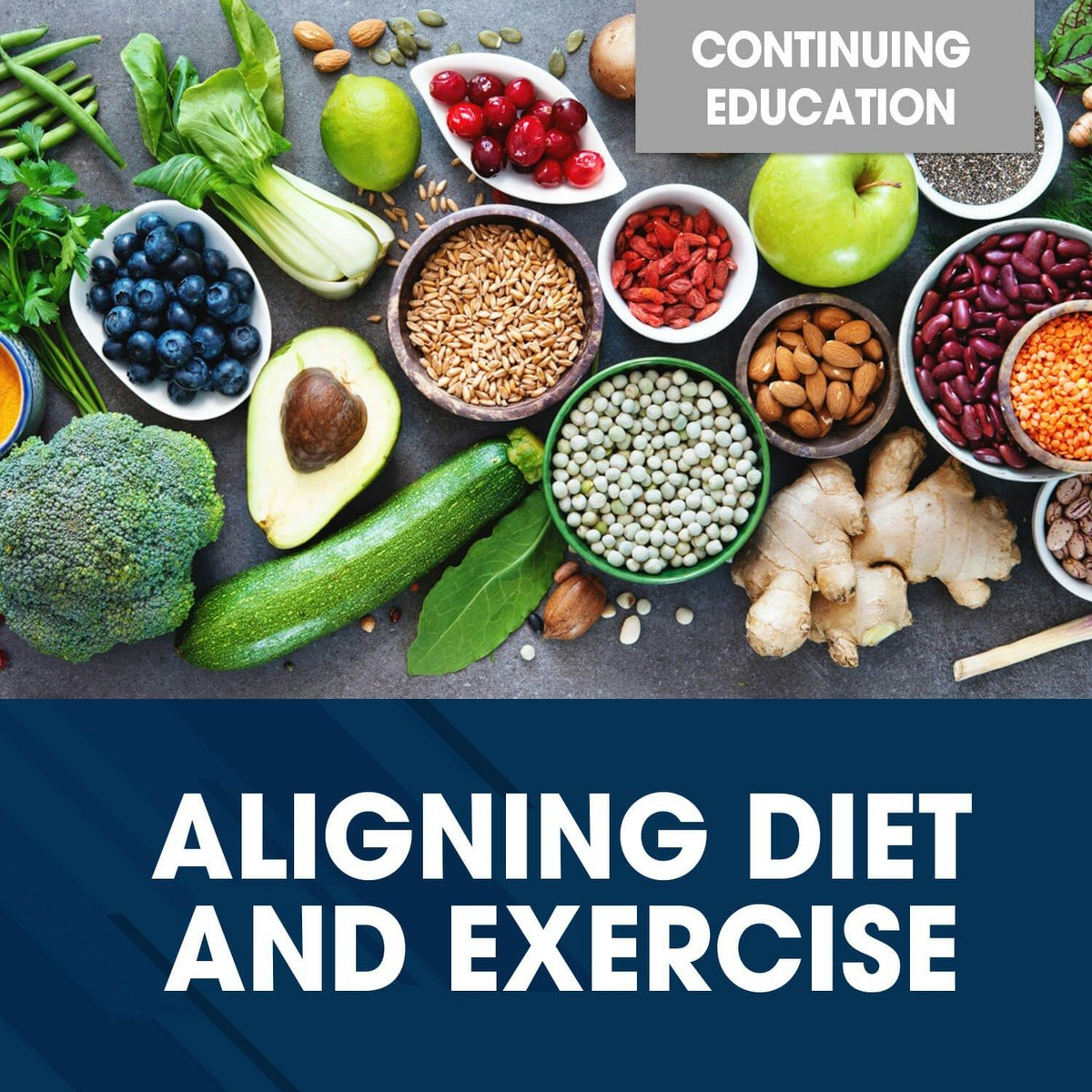 National Academy of Sports Medicine
Aligning Diet and Exercise
When considering body composition goals, modifications to both diet and exercise are inevitable. Most often, an individual’s dietary interventions do not align with their exercise regimen, which may diminish the potential for success. This course explores the energy pathways and how macronutrients fuel exercise across intensity and duration, in addition to popular dietary interventions and their alignment with exercise recommendations. After completing this course, students will have a clear understanding of the body’s energy pathways, the effects of various dietary interventions on these pathways, as well as aligned diet and exercise recommendations that will help maximize success. With over 30 years as a leader in fitness and wellness education, the National Academy of Sports Medicine (NASM) has built its reputation on providing an evidence-based curriculum that is both relevant and applicable for those seeking the skills and knowledge required to promote optimal health.
 Dassault Systèmes
SOLIDWORKS Advanced Sketching and Reference Geometry
Welcome to SOLIDWORKS Advanced Sketching and Reference Geometry, the second course in the SOLIDWORKS 3D CAD for Education Specialization. We recommend completing Course 1(SOLIDWORKS Foundations: Sketching and Extrusion) before starting this course. This course dives deeper into 2D sketching techniques and introduces reference geometry tools to enhance your modeling precision and flexibility. Upon completion of this learning module, you will be able to: - Create linear sketch patterns - Create circular sketch patterns - Create reference planes and axes. - Create slots in the sketch profile. This course is perfect for learners ready to level up from the basics and tackle more advanced modeling techniques. Software Prerequisites: SOLIDWORKS Desktop EDU Access powerful capabilities for Engineering with SOLIDWORKS Desktop at a low price, $60 (excluding taxes), follow this link : https://go.3ds.com/CSW1
 EDUCBA
Elasticsearch Joins & Parent-Child Queries
By the end of this course, learners will be able to apply nested queries, implement parent-child mappings, and execute relational-style joins in Elasticsearch for advanced data modeling. You will gain the skills to index event-driven data, use inner hits for detailed matches, and optimize query performance with global ordinals. This course is designed to bridge the gap between traditional relational databases and Elasticsearch’s document-oriented model. Through practical workshops and structured lessons, learners will explore application-side joins, nested queries, and indexing best practices. The course then advances into modeling complex one-to-many relationships using parent-child queries, with hands-on exercises for has_child and has_parent functionalities. What makes this course unique is its step-by-step alignment of relational concepts with Elasticsearch capabilities, ensuring you not only understand the theory but also practice real-world applications. Whether you are a data engineer, developer, or search specialist, this course equips you with essential strategies to analyze, structure, and query large-scale datasets efficiently in Elasticsearch.
 IBM
IBM
AI Workflow: Business Priorities and Data Ingestion
This is the first course of a six part specialization. You are STRONGLY encouraged to complete these courses in order as they are not individual independent courses, but part of a workflow where each course builds on the previous ones. This first course in the IBM AI Enterprise Workflow Certification specialization introduces you to the scope of the specialization and prerequisites. Specifically, the courses in this specialization are meant for practicing data scientists who are knowledgeable about probability, statistics, linear algebra, and Python tooling for data science and machine learning. A hypothetical streaming media company will be introduced as your new client. You will be introduced to the concept of design thinking, IBMs framework for organizing large enterprise AI projects. You will also be introduced to the basics of scientific thinking, because the quality that distinguishes a seasoned data scientist from a beginner is creative, scientific thinking. Finally you will start your work for the hypothetical media company by understanding the data they have, and by building a data ingestion pipeline using Python and Jupyter notebooks. By the end of this course you should be able to: 1. Know the advantages of carrying out data science using a structured process 2. Describe how the stages of design thinking correspond to the AI enterprise workflow 3. Discuss several strategies used to prioritize business opportunities 4. Explain where data science and data engineering have the most overlap in the AI workflow 5. Explain the purpose of testing in data ingestion 6. Describe the use case for sparse matrices as a target destination for data ingestion 7. Know the initial steps that can be taken towards automation of data ingestion pipelines Who should take this course? This course targets existing data science practitioners that have expertise building machine learning models, who want to deepen their skills on building and deploying AI in large enterprises. If you are an aspiring Data Scientist, this course is NOT for you as you need real world expertise to benefit from the content of these courses. What skills should you have? It is assumed you have a solid understanding of the following topics prior to starting this course: Fundamental understanding of Linear Algebra; Understand sampling, probability theory, and probability distributions; Knowledge of descriptive and inferential statistical concepts; General understanding of machine learning techniques and best practices; Practiced understanding of Python and the packages commonly used in data science: NumPy, Pandas, matplotlib, scikit-learn; Familiarity with IBM Watson Studio; Familiarity with the design thinking process.
 Google Cloud
Crea canalizaciones de datos por lotes en Google Cloud
Las canalizaciones de datos suelen realizarse según uno de los paradigmas extracción y carga (EL); extracción, carga y transformación (ELT), o extracción, transformación y carga (ETL). En este curso, abordaremos qué paradigma se debe utilizar para los datos por lotes y cuándo corresponde usarlo. Además, veremos varias tecnologías de Google Cloud para la transformación de datos, incluidos BigQuery, la ejecución de Spark en Dataproc, grafos de canalización en Cloud Data Fusion y procesamiento de datos sin servidores en Dataflow. Los estudiantes obtienen experiencia práctica en la compilación de componentes de canalizaciones de datos en Google Cloud con Qwiklabs.
 Johns Hopkins University
Introduction to Penetration Testing and Ethical Hacking
This Advanced Penetration Testing and Ethical Hacking course offers a deep dive into key cybersecurity concepts, providing you with hands-on experience in areas like penetration testing, cryptography, and social engineering. Through engaging modules, you will learn to conduct penetration tests using industry-standard methodologies, such as the Penetration Testing Execution Standard (PTES), and effectively communicate findings through professional reports and executive summaries. You’ll also gain a solid understanding of cryptographic principles, including public key infrastructure (PKI), while mastering techniques for ethical hacking and countering cryptographic attacks. Additionally, the course covers the art of information gathering and social engineering, equipping you to conduct reconnaissance and craft spear phishing attacks. With practical labs and real-world scenarios, this course will help you build the skills needed to protect mission-critical infrastructures and advance your career in cybersecurity.
 University of California, Irvine
Составление бюджета и графиков проектов
Хороший график помогает всем членам команды работать сообща для достижения целей проекта. Бюджет с реалистичными ограничениями на издержки также является неотъемлемой основой любого проекта. В этом курсе вы научитесь планировать и соблюдать временные и финансовые ограничения, чтобы обеспечить успех ваших проектов. По окончании этого курса вы сможете: 1. Определять потребности проекта в ресурсах 2. Раскладывать пакеты работ на операции 3. Определять, что нужно для оценки продолжительности операции 4. Определять контрольные события и составлять график контрольных событий 5. Определять критический путь и рассчитывать временной резерв 6. Объяснять цель использования опережений и задержек в графике проекта 7. Оценивать количество и стоимость ресурсов, необходимых для выполнения операций по проекту 8. Выбирать один из трех наиболее используемых методов оценки затрат для определения бюджета проекта 9. Использовать матрицу ответственности для распределения обязанностей 10. Распознавать компоненты плана управления качеством проекта
 Universitat Politècnica de València
Excel: Fundamentos y herramientas
Embárcate en este curso de iniciación a Excel, la potente herramienta de hojas de cálculo de Microsoft Office. Partiendo desde cero, descubrirás cómo organizar, manipular y analizar grandes volúmenes de datos con facilidad. Nos centraremos en las funciones más esenciales, incluyendo formatos personalizados, la visualización efectiva de resultados mediante gráficos, el uso de funciones clave y la gestión eficiente de tablas de datos.