

The Global Scholarly Directory.
Discover world-class academic programs curated for the modern intellectual. Search through 19877+ degrees and professional certificates.
 Google Cloud
Use Data Canvas to Visualize and Design Queries
This is a self-paced lab that takes place in the Google Cloud console. In this lab you learn how to use Data Canvas to visualize and design queries.
 Packt
Packt
ChatGPT and Prompt Engineering With Advanced Data Analysis
This course features Coursera Coach! A smarter way to learn with interactive, real-time conversations that help you test your knowledge, challenge assumptions, and deepen your understanding as you progress through the course. This course offers an in-depth journey into the world of ChatGPT, prompt engineering, and advanced data analysis techniques. You will explore how to leverage AI tools like ChatGPT in business, programming, social media, and machine learning, while gaining hands-on experience in crafting effective prompts, using AI for data analysis, and generating creative outputs. By the end of this course, you’ll be equipped to use AI for a range of practical tasks, boosting your productivity and creativity. Throughout the course, you will start with foundational concepts, learning about OpenAI, its capabilities, and how to set up your account to get started. You will then move into the core concepts of Large Language Models and the technology behind ChatGPT, exploring how these systems are built and how they power conversational AI. After that, you will dive into prompt engineering, discovering how to craft effective prompts for different purposes, from business analysis to machine learning models. Next, you'll explore practical use cases for ChatGPT, from automating tasks like generating blog summaries to creating social media hashtags, and even building machine learning models. You'll also get a chance to work on visual projects using tools like Streamlit and DALL-E. The course rounds out with lessons on integrating AI into your workflows, including Excel data analysis and creating visualizations. This course is ideal for professionals and enthusiasts looking to enhance their skills in AI tools, machine learning, and data analysis. It is suitable for those with basic programming and data analysis knowledge, though no advanced expertise is required. By the end of the course, you will be able to create custom prompts, use AI for business and data analysis, generate content and images, and integrate these technologies into various professional and personal projects.
 Coursera
Canva for college students
In this project the learner will learn how to use Canva for their college journey. Canva is an online graphic design program that allows you to create and design all types of documents, graphic design compositions and more. Canva is a great option for those looking for a user-friendly and easy-to-use platform to create attractive designs for their resumes. Canva has many elements that are free and it gives you a lot of freedom when designing. In addition to this, Canva has paid content that offers another endless number of elements and possibilities for the design but they are not mandatory or totally necessary, so the user has the freedom to choose how much content or elements they want to have at their disposal. Canva is an extremely useful tool for those who are just starting out and even becomes a very good tool for those who have spent years designing in more advanced programs. It is a fast option that does not need to be installed on your computer and as long as you have an Internet connection, it will be an accessible tool.
 Imperial College London
Introduction to Digital health
This course introduces the field of digital health and the key concepts and definitions in this emerging field. The key topics include Learning Health Systems and Electronic Health Records and various types of digital health technologies to include mobile applications, wearable technologies, health information systems, telehealth, telemedicine, machine learning, artificial intelligence and big data. These technologies are assessed in terms of the key opportunities and challenges to their use and the evidence of their effectiveness in the field of digital health in relation to public health and healthcare globally. The use and application of digital health for COVID-19 forms a case study demonstrating the use of different types of digital health technologies to address key aspects of the response to the virus globally.
 The University of Edinburgh
برمج بنفسك! مقدمة حول البرمجة
هل تمنيت من قبل تعلم البرمجة، ولكن لم تعرف من أين تبدأ؟ سوف تتعلم من خلال هذه الدورة التدريبية كيفية البرمجة بواسطة Scratch، وهي لغة برمجة مرئية سهلة الاستخدام. والأهم من ذلك، سوف تعرفك على المبادئ الأساسية للحوسبة وستساعدك على التفكير كمهندس برمجيات.
 Google Cloud
Introduction to Image Generation
This course introduces diffusion models, a family of machine learning models that recently showed promise in the image generation space. Diffusion models draw inspiration from physics, specifically thermodynamics. Within the last few years, diffusion models became popular in both research and industry. Diffusion models underpin many state-of-the-art image generation models and tools on Google Cloud. This course introduces you to the theory behind diffusion models and how to train and deploy them on Vertex AI.
 Korea Advanced Institute of Science and Technology(KAIST)
Chemical Engineering Thermodynamics 2
An appreciation of thermodynamics is required to become a chemical and biomolecular engineer. Thermodynamics can assess the viability of a process and is one of the curriculum's most essential topics. The principles are utilized in following engineering courses (kinetics, mass transfer, design, materials) and are applicable to numerous engineering disciplines. The increased emphasis on energy usage and transformation as a result of rising demand, diminishing supply, and global warming necessitates that the engineers who will tackle these issues have a firm grasp of thermodynamics. The first and second laws will be studied in this course. Non-ideal features of single-component and multicomponent systems will be emphasized. A substantial portion of the course is devoted to solution thermodynamics, which is crucial for separations (e.g., distillation, extraction, membranes), and chemical equilibrium, which is crucial for reaction engineering. "A theory is more striking when its premises are simpler, when it relates more diverse types of things, and when its scope of applicability is broader. Consequently, the profound impact that classical thermodynamics had on me. It is the only physical theory with universal content that I am confident, within the range of its applicability, will never be overthrown." — Albert Einstein
 Packt
Packt
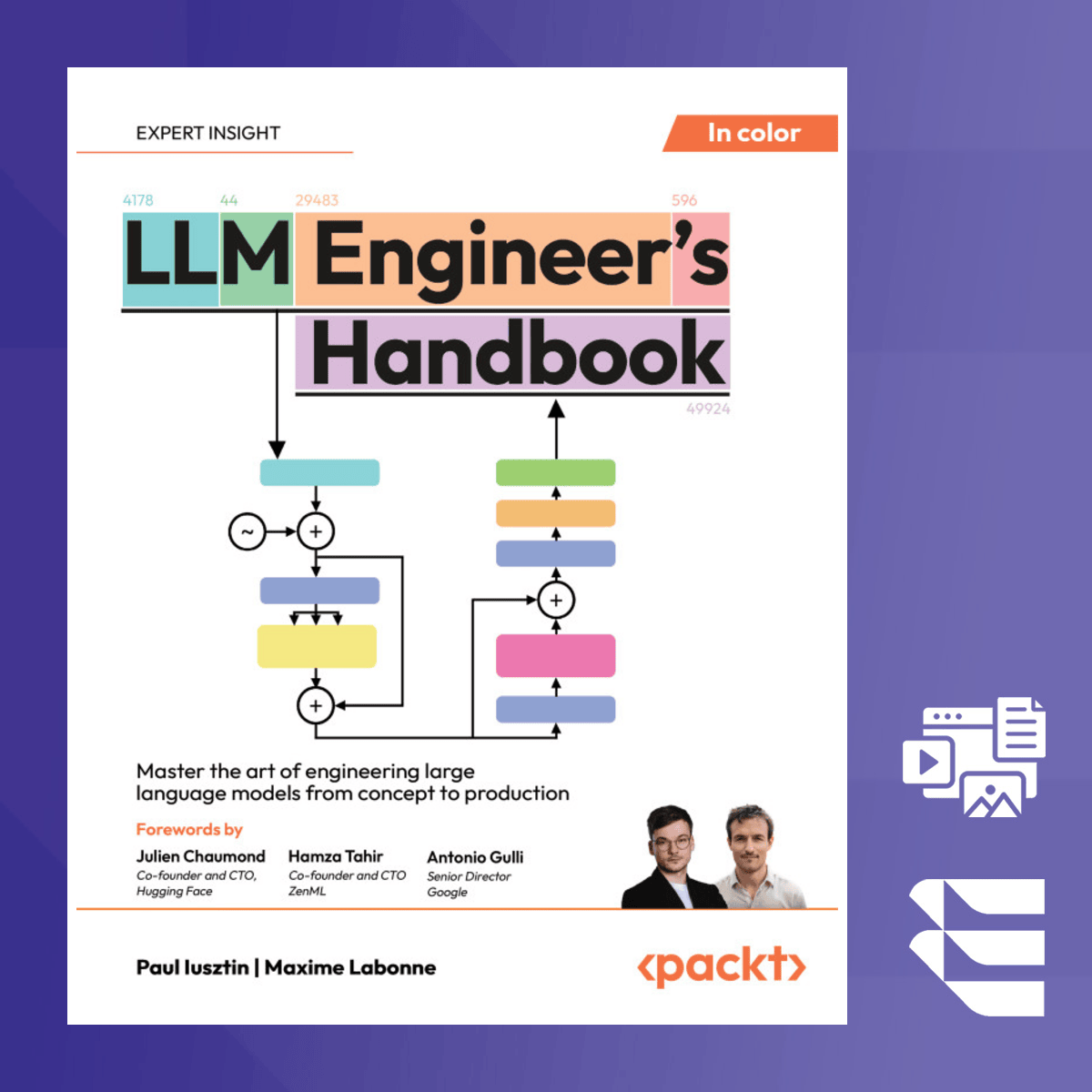
LLM Engineer’s Handbook
In this comprehensive course, you will explore the intricate world of Large Language Models (LLMs) and gain the skills to design, train, and deploy them using cutting-edge MLOps practices. LLMs are revolutionizing the AI landscape, and understanding how to develop and manage them is essential for AI professionals. This course is designed to help you not only grasp the core concepts behind LLMs but also give you hands-on experience to build production-grade LLM systems. You'll learn how to create scalable, efficient LLM systems from scratch, focusing on real-world applications that will make you stand out in the AI industry. What sets this course apart is its combination of in-depth theoretical insights and real-world, practical applications. You'll move beyond basic knowledge to master LLM architecture, supervised fine-tuning, and deployment on cloud platforms, ensuring that you’re fully equipped to build robust, production-ready systems. This course is ideal for AI engineers, NLP professionals, and anyone looking to deepen their expertise in LLM engineering. A basic understanding of LLMs, Python, and cloud platforms like AWS is recommended for optimal learning.
 Board Infinity
Deploying & Scaling Spring Boot Applications on AWS
Take your Spring Boot skills to the next level by learning how to deploy, scale, and monitor real-world applications using tools like Docker, AWS ECS, and Spring Security. In this hands-on course, you'll apply essential DevOps practices—CI/CD, containerization, and observability—to move confidently from local development to production-ready deployment. In the first module, you’ll explore modern deployment workflows, external configuration, and container fundamentals. You’ll also understand how Docker integrates into Spring Boot development. The second module guides you through building efficient Docker containers, connecting Spring Boot apps to databases, and managing multi-service systems with Docker Compose. In the third module, you’ll deploy your application to AWS ECS, learning best practices for load balancing, IAM roles, and secrets management. The final module focuses on scaling with ECS, implementing secure authentication using Spring Security and OAuth2, and monitoring your application using Spring Boot Actuator and AWS CloudWatch. By the end, you will: -Build Docker containers for Spring Boot applications with environment configs -Deploy containerized apps to AWS ECS with Fargate and secure IAM roles -Apply CI/CD pipelines using Jenkins and GitHub Actions for Spring Boot apps This course is ideal for: -Java/Spring developers ready to move beyond local environments -Backend engineers aiming to master scalable, containerized deployments -DevOps-focused developers working with ECS and automation tools -Software engineers preparing for cloud-native and full-stack roles Let’s bridge the gap between development and deployment—build, ship, and scale your Spring Boot apps like a pro. Disclaimer: This course is an independent educational resource developed by Board Infinity and is not affiliated with, endorsed by, sponsored by, or officially associated with Broadcom or any of its subsidiaries or affiliates. This course is not an official preparation material of Broadcom. All trademarks, service marks, and company names mentioned are the property of their respective owners and are used for identification purposes only.
 Adobe
Adobe
Social Media Content and Strategy
This Social Media Content Strategy course is built for aspiring and professional content creators who want to elevate their social media presence. In this course, you will learn how to create social media content that not only captures attention but compels your audience to act. This course focuses on social media content creation, giving you hands-on experience with Adobe Express and Adobe AI tools to develop scroll-stopping visuals, impactful messaging, and smart scheduling strategies. Explore social media design best practices, including layout fundamentals, brand consistency, and creative workflows that make your content stand out. Whether you’re a solo influencer or managing social media for a brand, you’ll gain the skills to plan, produce, and publish high-quality content across platforms. Each module dives into real-world content creation techniques, including how to optimize your work with AI-powered insights and templates. By the end of the course, you’ll be equipped to build a dynamic, engaging content strategy and become a confident leader in social media content creation.
 Google Cloud
Introduction to Controlled Generation with the Gemini API
This is a self-paced lab that takes place in the Google Cloud console. In this lab, you will learn how to use the controlled generation capability in the Vertex AI Gemini API.
 Coursera
Automate Financial Analysis with AI Pipelines
Automate Financial Analysis with AI Pipelines is an intermediate-level course designed for finance and data professionals who want to integrate artificial intelligence into their analysis workflows. You’ll start by evaluating multiple AI models—such as Random Forest, XGBoost, and Neural Networks—for credit-risk classification using real financial datasets. Then, you’ll design an automated pipeline that retrieves SEC filings, retrains models, and updates dashboards with no manual intervention. Through readings, videos, and hands-on labs, you’ll gain the practical skills to compare model performance using F1 and AUROC metrics and to deploy a continuously learning forecasting system. By the end, you’ll be able to build and explain AI-powered solutions that keep financial insights accurate, efficient, and up to date.
 University of Pennsylvania
Comparative Health Systems
This course uses comparative analysis of health care systems to gain a better understanding of health care systems in several high-income, middle-income and low-income countries. One focus of analysis in this course will therefore be to develop a better knowledge of these health care systems. A second focus will be to use to this analysis to gain a better understanding of the health care system in the United States. This analysis is relevant for those who are directly interested in the United States, but it is also relevant for those students who are seeking to enhance knowledge of the health care systems in their home countries by gaining a better understanding of the United States’ health care system. A comparative analysis of health systems will help managers and health care professionals who are responsible for optimizing organizational outcomes by improving the quality of health care and simultaneously reducing the costs of health care. The course will use of a combination of the World Health Organization building blocks framework along with theories of complex systems to establish a framework to compare health systems in a number of high-income, middle-income, and low-income countries. This analysis will develop the capacity of managers to critically evaluate relationships between their organizations and the broader set of interactions between the building blocks that make up particular health care systems.
 IBM
IBM
Building AI Powered Chatbots Without Programming
Chatbots can save businesses up to 30% on customer support costs alone (Shopify), and AI developers with strong chatbot skills are in high demand! This Building AI Powered Chatbots Without Programming course gives aspiring AI application developers and engineers the skills businesses need to build chatbots in just 6 weeks. No programming experience required! During this course, you’ll explore what chatbots are and how they benefit businesses and users. You’ll learn about action workflows and the key features of a chatbot. You’ll dive into the high-level differences between decision-tree chatbots and generative AI chatbots. Plus, you’ll look at the concept of actions within chatbots and learn to build them using IBM watsonx Assistant. Through interactive labs you’ll also gain valuable hands-on experience applying what you’ve learned to real-world scenarios, such as creating a customer care chatbot for a flower shop. Great for chatting about in interviews! If you’re looking to develop the chatbot skills employers are looking for, enroll today and get ready to power up your resume in just 6 weeks!
 Packt
Packt
Getting Started with JIRA
This course features Coursera Coach! A smarter way to learn with interactive, real-time conversations that help you test your knowledge, challenge assumptions, and deepen your understanding as you progress through the course. In this course, you will gain a comprehensive understanding of Jira, from basic concepts to advanced project management techniques. Whether you're new to Jira or aiming to refine your skills, you'll learn how to navigate and use Jira effectively for both team-managed and company-managed projects. This course will empower you to use Jira to manage tasks, workflows, and projects while aligning with Agile practices. The journey begins by exploring foundational concepts like Agile methodologies, Jira terminology, and the key elements of the Jira interface. As you progress, you'll dive into the details of managing projects in Jira, including creating and customizing boards, managing issues, and configuring workflows. You will also get hands-on experience with both team-managed and company-managed projects, learning how to create projects, manage tasks, and customize settings according to your team's needs. Throughout the course, you will be introduced to important features such as issue tracking, Agile boards, timelines, filters, and automation. The latter part of the course focuses on Jira's administrative backend, where you will learn about user management, permissions, and automation rules. By the end, you will feel confident managing projects using Jira's powerful tools to enhance team collaboration and productivity. This course is ideal for project managers, Scrum masters, or anyone working with Agile teams who want to leverage Jira for efficient project tracking and management. There are no prerequisites for this course, making it suitable for beginners, but a basic understanding of project management concepts would be beneficial. By the end of the course, you will be able to effectively manage Jira projects, set up Agile boards, navigate and configure issues, automate workflows, and understand Jira's backend administration for streamlined project management.
 Packt
Packt
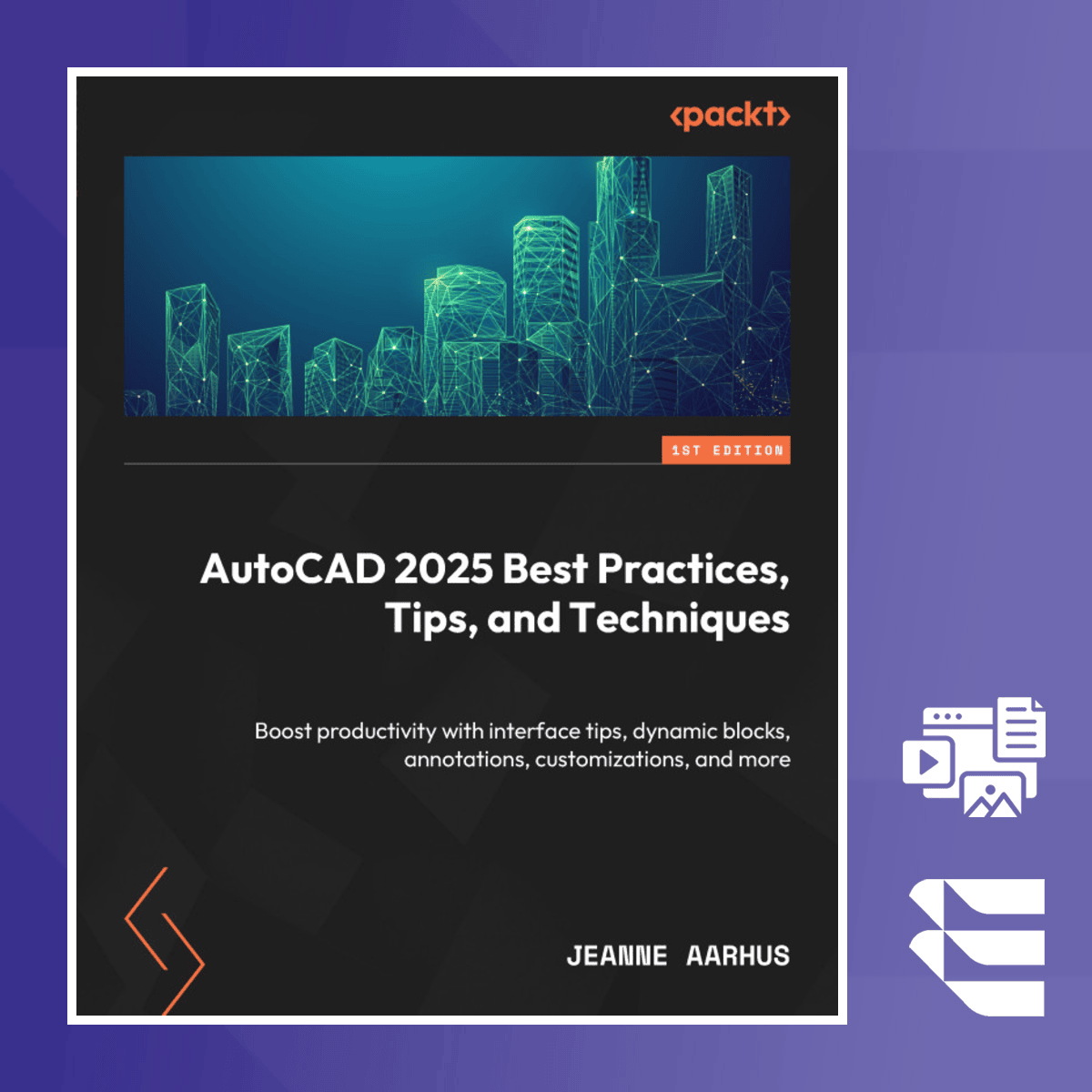
AutoCAD 2025 Best Practices, Tips, and Techniques
This course equips learners with the tools and knowledge needed to maximize productivity and enhance AutoCAD skills in real-world scenarios. By focusing on advanced techniques and AutoCAD-specific best practices, this course empowers professionals to streamline workflows, improve efficiency, and master the interface with ease. Throughout the course, learners will be introduced to powerful techniques for customizing AutoCAD’s environment and automating repetitive tasks. Practical examples and expert tips will guide students on how to optimize their use of dynamic blocks and commands, enabling them to work smarter and faster. What sets this course apart is its combination of theoretical understanding and practical application. You will gain expert insights into AutoCAD's capabilities, with step-by-step instructions to help you apply what you’ve learned to your daily tasks. Ideal for intermediate AutoCAD users, this course is designed for those who want to refine their skills and work more efficiently. A basic understanding of AutoCAD is recommended for maximum benefit.