

The Global Scholarly Directory.
Discover world-class academic programs curated for the modern intellectual. Search through 19877+ degrees and professional certificates.
 Xi'an Jiaotong University
基于.Net的Web开发技术
《基于.NET的Web开发技术》是.NET环境下进行Web编程的一门重要课程。内容包括Web原理及环境部署、HTML基础、CSS应用、JavaScript基础、ASP.NET技术;重点介绍ASP.NET技术及相关的数据库应用开发,通过实例介绍各种技术的特点及应用。 通过本课程的学习,使学员了解Web应用开发技术的发展与现状,了解WEB原理、开发过程和环境部署;能够熟练掌握HTML语言,CSS,JavaScript,掌握利用ASP.NET进行Web应用开发的特点;掌握各种控件的用法和ADO.NET相关技术,掌握数据源控件和数据绑定控件的用法;具备运用面向对象的思想和ASP.NET相关知识对Web网站进行需求分析、进而进行设计和开发的能力。学员学完该课程后,应能利用ASP.NET开发简单的Web应用程序。
 Skillshare
Graphic Design Theory - Print Design
From instructor Martin Perhiniak, this course is an in-depth guide on printing techniques, products, workflows and terminology. If you are like so many of us, amazed by a beautifully designed poster or magazine cover, buying a chocolate just because of its cool packaging, if you love design in print form, then you’ve come to the right place. Print design focuses on producing designs printed onto tangible surfaces and products, and we can say that it is the oldest, classic field of Graphic Design, as old as the profession itself. With this rich history, we have a long way to look back, and even more to look forward to as new trends arise and more and more industries modernize their look and appeal, and professional printing and packaging services become more accessible to small brands. Because of this, learning the key terms, best practices and industry standards of printing is very important for any professional designer. The greatest benefits of completing this course: By the end of this course, you will be equipped with all the knowledge you need to accept print design projects (given that you have the skills in the software). You will be able to confidently interact with printer services and clients, knowing how to prepare your work professionally, from adjusting your colors to setting your bleeds. What will we cover: In this course we will be covering everything you need to know about printing techniques and processes, including: * All the essential print terminology like bleed, color separation, RIP, spot colors etc. * All the most common printing methods (offset, digital, screen, 3D printing) and the differences between them * Special printing techniques (foil stamp, varnish, lamination, coating, emboss) * Color management, calibration and proofing * Binding methods (stiching, thread sewn, spiral, EVA, PUR, tape bond etc.) * Checklist for a successful print job (overprinting, trapping, flattening, knockout etc.) * Paper types, sizes with resolution settings and so much more. We will also dive deep into all the specialized areas within this field, like: * Logo design, * Packaging design, * Editorial design, * Environmental design, * Posters, * Brochures, * Business Cards, * Stationery and Books * Mastering by visual examples We will analyze hundreds of print design projects to give you a solid understanding of the important rules and terms you need to be familiar with as a print designer. Who is this course for? * Anyone planning to get into the creative industry * Creative professionals aiming to improve their compositions * Marketing managers working with agencies & printing services Practical advice with invaluable industry insight: This is not an abstract theory course at all, but a very practical one. As a professional freelance designer myself, I will give you all my 20+ years of experience in managing 100s of high-paying projects from simple to complex, from small shops to global brands like Disney and Lego. In fact, I was working in a special consultant role for Adobe for more than a year, teaching design workflow and process practices to their most esteemed clients. And I can promise you with confidence, this part of the Graphic Design Theory Series, will literally elevate you to the next level as a designer, giving you a huge advantage whether you're just starting out, or already working as a designer for years. Come, join me, Martin Perhiniak, on this exciting journey, let’s explore the amazing world of Graphic Design together! Instructor bio: Martin Perhiniak is a Certified Adobe Design Master and instructor with extensive experience working for top companies including Disney, Warner Brothers, Cartoon Network, Sony Pictures, Mattel, and DC Comics. Based in London, he teaches design and provides live online training and consultancy services to students and professionals worldwide. Martin’s teaching emphasizes hands-on learning and personal growth, guided by his motto: “Do not compare yourself to your role models. Work hard and wait for the moment when others will compare themselves to you.”
 University of Houston
American Deaf Culture
This is a six-week course providing a historical overview of the American Deaf community and its evolving culture. Theoretical frameworks from sociology are explored. Deafness as a culture and not a disability is explained as participants are guided into the world of Deaf culture.
 EDUCBA
Agile Projects with Pivotal Tracker: A Hands-On Guide
This course equips learners with practical skills to identify, set up, manage, and integrate agile project workflows using Pivotal Tracker—an industry-standard project management tool designed for agile development teams. Learners will demonstrate how to create user accounts and projects, construct and categorize user stories, and organize tasks using collaborative features like panels, labels, epics, and workspaces. Through hands-on walkthroughs and structured lessons, students will analyze project data using built-in analytics, interpret team velocity, and evaluate integrations with platforms such as GitHub, Jira, and time-tracking systems. The course is ideal for beginners and intermediate professionals looking to apply agile practices in real-world software or product development environments using a single, unified platform. By the end of this course, learners will be able to: • Set up and configure a Pivotal Tracker environment tailored to team and project needs. • Construct and prioritize user stories and features using agile methodology. • Apply real-time project organization tools to enhance team collaboration and visibility. • Analyze productivity metrics to improve team performance. • Integrate third-party tools to streamline development workflows.
 Packt
Packt
Data Structures Using Python - An Introduction
Updated in May 2025. This course now features Coursera Coach! A smarter way to learn with interactive, real-time conversations that help you test your knowledge, challenge assumptions, and deepen your understanding as you progress through the course. This course will help you master essential data structures in Python, enabling you to write efficient code, optimize memory, and solve complex problems. By the end, you’ll be proficient in implementing arrays, linked lists, stacks, queues, trees, and graphs, along with recursion, searching, and sorting techniques. You’ll start with fundamental data structures like arrays, lists, tuples, sets, and dictionaries, learning operations such as insertion, deletion, and searching. Next, you’ll explore dynamic structures like linked lists, stacks, and queues, followed by recursion for problem-solving. The course then covers hierarchical structures like binary trees and binary search trees, focusing on traversal and search optimization. Finally, you’ll dive into graphs, learning representation techniques for network-based data structures. Ideal for students and aspiring developers, this course strengthens problem-solving skills. A basic understanding of Python is recommended as the course progresses from fundamentals to advanced topics.
 University of Colorado Boulder
Pressure, Force, Motion, and Humidity Sensors
"Pressure, Force, Motion, and Humidity Sensors" can also be taken for academic credit as ECEA 5342, part of CU Boulder’s Master of Science in Electrical Engineering degree. This is our third course in our specialization on Embedding Sensor and Motors. To get the most out of this course, you should first take our first course entitled Sensors and Sensor Circuits. Our first course gives you a tutorial on how to use the hardware and software development kit we have chosen for the lab exercises. This third course assumes that you already know how to use the kit. After taking this course, you will be able to: ● Understand how to specify the proper pressure, force, strain, position, motion, acceleration, occupancy, and humidity sensors for taking real-time process data. ● Implement these sensors into an embedded system in both hardware and software. ● Add the sensor and sensor interface into a microprocessor based development kit. ● Create hardware and firmware to process sensor signals and feed data to a microprocessor for further evaluation. In this course you will build the circuit from Video 7 (Lab Exercise on strain gauges), Module 2 (Force and Strain Sensors and Touch Screens), and use it to make screen shots of the timing of the switch. If you haven't already wired up the system and written all the software per the instructions of Video 7, please do so now. This course includes specific hardware and software requirements. Please review the FAQ below for complete details.
 Coursera
كيفية إنشاء قصة على الانستغرام باستخدام كانفا
قصة الإنستغرام هي صورة أو مقطع فيديو يختفي تلقائيًا في غضون 24 ساعة. عندما تنشر قصة، تظهر حلقة ملونة حول صورة ملفك الشخصي تخبر متابعيك أنه يمكنهم النقر على صورة ملفك الشخصي لمعرفة ما قمت بنشره للتو. ومن خلال هذه الدورة التدريبية، سنتعلم كيفية إنشاء قصة عادية على الإنستغرام أو قصة متحركة، وسنرى أيضًا كيفية إنشاء قصة الإنستغرام باستخدام قالب موجود بالفعل في كانفا. في نهاية هذه الدورة، ستصبح قادرًا على إنشاء قصة الإنستغرام مؤلفة من مقطع الفيديو
 Coursera
Tweet Emotion Recognition with TensorFlow
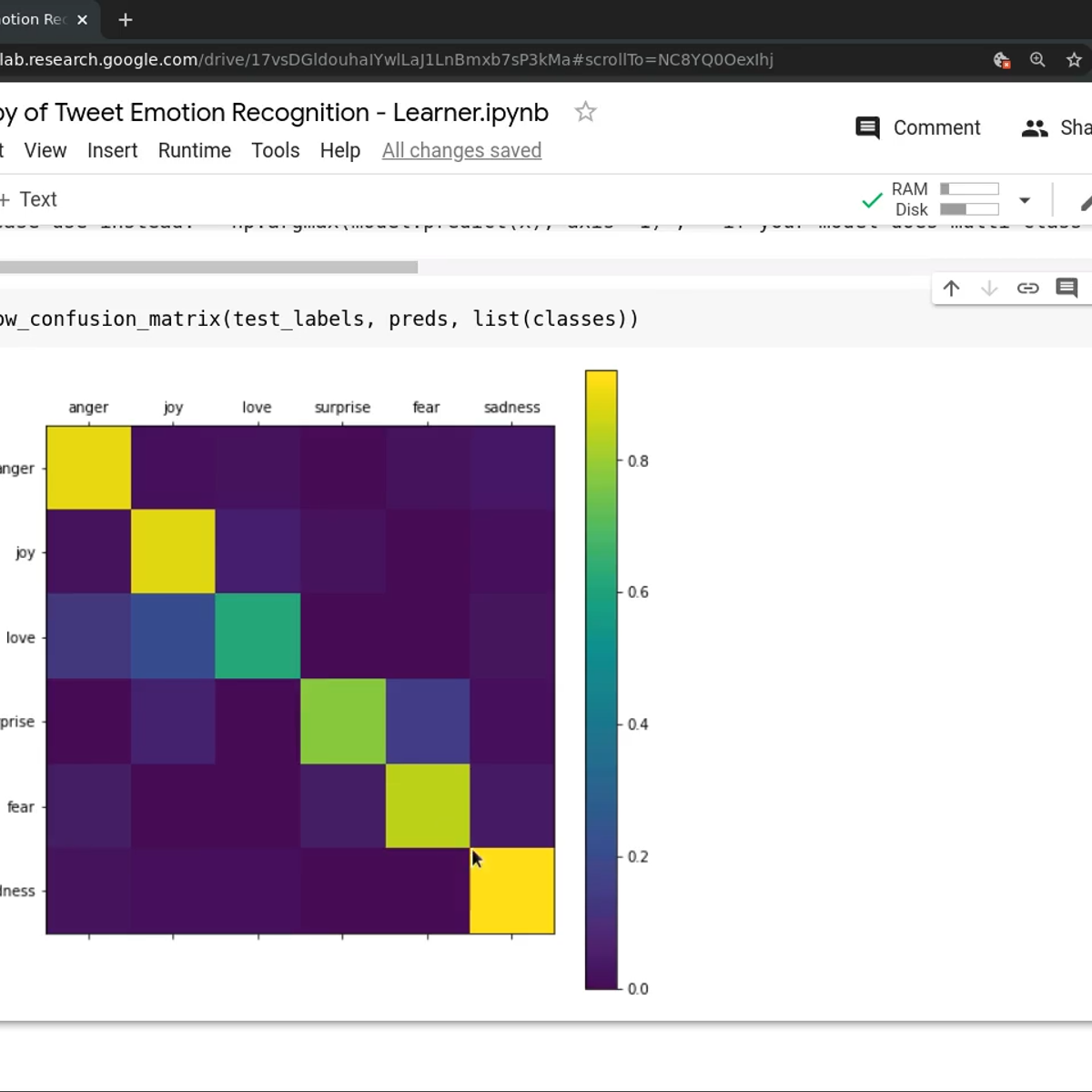
In this 2-hour long guided project, we are going to create a recurrent neural network and train it on a tweet emotion dataset to learn to recognize emotions in tweets. The dataset has thousands of tweets each classified in one of 6 emotions. This is a multi class classification problem in the natural language processing domain. We will be using TensorFlow as our machine learning framework. You will need prior programming experience in Python. This is a practical, hands on guided project for learners who already have theoretical understanding of Neural Networks, recurrent neural networks, and optimization algorithms like gradient descent but want to understand how to use the Tensorflow to start performing natural language processing tasks like text classification. You should also have some basic familiarity with TensorFlow. Note: This course works best for learners who are based in the North America region. We’re currently working on providing the same experience in other regions.
 CertNexus
IoT Security: Access Control and Network Security
In this course, you'll continue developing your IoT security skills by implementing secure authentication, authorization, and monitoring of IoT systems. You'll also ensure the security of IP networks, wireless networks, mobile networks, and edge networks. This is the second course in a multi-course Specialization. All of the courses in this Specialization require that you use the provided virtual machines, which include all of the necessary tools and system configurations for the activity environment. The course setup instructions provided in the first course go into more detail about the hardware and software requirements.
 University of Michigan
The Finite Element Method for Problems in Physics
This course is an introduction to the finite element method as applicable to a range of problems in physics and engineering sciences. The treatment is mathematical, but only for the purpose of clarifying the formulation. The emphasis is on coding up the formulations in a modern, open-source environment that can be expanded to other applications, subsequently. The course includes about 45 hours of lectures covering the material I normally teach in an introductory graduate class at University of Michigan. The treatment is mathematical, which is natural for a topic whose roots lie deep in functional analysis and variational calculus. It is not formal, however, because the main goal of these lectures is to turn the viewer into a competent developer of finite element code. We do spend time in rudimentary functional analysis, and variational calculus, but this is only to highlight the mathematical basis for the methods, which in turn explains why they work so well. Much of the success of the Finite Element Method as a computational framework lies in the rigor of its mathematical foundation, and this needs to be appreciated, even if only in the elementary manner presented here. A background in PDEs and, more importantly, linear algebra, is assumed, although the viewer will find that we develop all the relevant ideas that are needed. The development itself focuses on the classical forms of partial differential equations (PDEs): elliptic, parabolic and hyperbolic. At each stage, however, we make numerous connections to the physical phenomena represented by the PDEs. For clarity we begin with elliptic PDEs in one dimension (linearized elasticity, steady state heat conduction and mass diffusion). We then move on to three dimensional elliptic PDEs in scalar unknowns (heat conduction and mass diffusion), before ending the treatment of elliptic PDEs with three dimensional problems in vector unknowns (linearized elasticity). Parabolic PDEs in three dimensions come next (unsteady heat conduction and mass diffusion), and the lectures end with hyperbolic PDEs in three dimensions (linear elastodynamics). Interspersed among the lectures are responses to questions that arose from a small group of graduate students and post-doctoral scholars who followed the lectures live. At suitable points in the lectures, we interrupt the mathematical development to lay out the code framework, which is entirely open source, and C++ based. Books: There are many books on finite element methods. This class does not have a required textbook. However, we do recommend the following books for more detailed and broader treatments than can be provided in any form of class: The Finite Element Method: Linear Static and Dynamic Finite Element Analysis, T.J.R. Hughes, Dover Publications, 2000. The Finite Element Method: Its Basis and Fundamentals, O.C. Zienkiewicz, R.L. Taylor and J.Z. Zhu, Butterworth-Heinemann, 2005. A First Course in Finite Elements, J. Fish and T. Belytschko, Wiley, 2007. Resources: You can download the deal.ii library at dealii.org. The lectures include coding tutorials where we list other resources that you can use if you are unable to install deal.ii on your own computer. You will need cmake to run deal.ii. It is available at cmake.org.
 EDUCBA
Master Unity: Build, Animate & Script Interactive Games
By completing this course, learners will be able to analyze Unity’s environment, implement interactive 2D and 3D assets, construct animations, and apply scripting techniques to create immersive games. Through a structured, case-study style approach, they will design modular scripts, implement AI-driven navigation, and evaluate physics-based interactions for dynamic gameplay. This course benefits learners by providing hands-on, project-based learning that blends visual design with programming essentials. Beginners will gain the confidence to manage assets, control characters, and build environments, while intermediate learners will sharpen their coding and AI skills. Unlike generic tutorials, this course integrates real-world scripting challenges, showing how Unity’s powerful tools—such as prefabs, animator controllers, and NavMesh—work together in professional workflows. What makes this course unique is its gradual progression from fundamental Unity setup to advanced scripting and AI implementation. Each module combines theory with practice, ensuring learners not only understand Unity concepts but also apply them in interactive projects. By the end, students will have mastered the essential skills to design, animate, and script engaging games, preparing them to innovate in the fast-growing world of game development.
 Kennesaw State University
How Competition Impacts Markets - Jagdish Sheth
This course explores the logic of competitive strategy through the lens of industry structure and evolving business models. Led by renowned scholar Professor Jagdish Sheth, learners will understand how Porter’s Five Forces and the Rule of Three influence industry attractiveness, firm behavior, and customer-centric growth. The course examines both generalist and specialist strategies, shared services, structural transformation, and the role of government in reshaping markets. Through a progression of theoretical concepts and real-world examples, learners will gain tools to assess competitive dynamics and identify paths to sustainable differentiation and profitability. Ideal for strategists, marketers, and policy thinkers alike, this course reveals how competition drives change—and how companies can adapt and thrive.
 Packt
Packt
Cold Calling & Prospecting
Updated in May 2025. This course now features Coursera Coach! A smarter way to learn with interactive, real-time conversations that help you test your knowledge, challenge assumptions, and deepen your understanding as you progress through the course. Master the art of cold calling and prospecting with this comprehensive course designed to elevate your sales techniques. Gain actionable insights into setting appointments, overcoming objections, and crafting authentic, engaging sales scripts. This course equips you with the tools to convert calls into opportunities, build stronger relationships, and achieve measurable results. Your journey begins with foundational strategies for pre-call planning, including objective setting and developing a calling framework. Progress through techniques to confidently approach gatekeepers, handle objections and deliver compelling voicemails. From identifying decision-makers to securing appointments, each module provides practical tips and examples to sharpen your skills. Later, dive into advanced techniques like uncovering client needs, mastering social selling, and avoiding common prospecting pitfalls. Learn to maintain a full pipeline, foster trust without over-contacting, and successfully navigate follow-up calls. The course emphasizes creating a seamless, confident sales process tailored to different scenarios. This course is ideal for sales professionals, entrepreneurs, and anyone involved in client acquisition. Whether you're a beginner or seeking to refine your skills, no prior experience is needed—just a willingness to learn and practice.
 Packt
Packt
Segment Routing in MPLS Networks
This course provides a deep dive into segment routing (SR) and TI-LFA, essential technologies for modern networking. It bridges traditional MPLS with SR-MPLS, offering a clear path to mastering network reliability and performance. This is a vital skill for network professionals, as segment routing optimizes data flow and enhances network resiliency. The course will guide learners through the intricacies of MPLS networks, including hands-on labs for configuring and troubleshooting SR-MPLS and fast rerouting (FRR) with TI-LFA. Learners will be equipped with practical skills to implement these technologies in real-world scenarios, improving network uptime and performance. What sets this course apart is its hands-on, lab-focused approach, combining theoretical knowledge with practical applications. Learners will gain real-world experience in configuring SR-MPLS and implementing TI-LFA, empowering them to solve complex networking challenges effectively. This course is ideal for network engineers and professionals with a basic understanding of MPLS who wish to advance their expertise in SR-MPLS and TI-LFA. A foundational knowledge of networking concepts will be beneficial.
 New York University
Cyber Attack Countermeasures
This course introduces the basics of cyber defense starting with foundational models such as Bell-LaPadula and information flow frameworks. These underlying policy enforcements mechanisms help introduce basic functional protections, starting with authentication methods. Learners will be introduced to a series of different authentication solutions and protocols, including RSA SecureID and Kerberos, in the context of a canonical schema. The basics of cryptography are also introduced with attention to conventional block ciphers as well as public key cryptography. Important cryptographic techniques such as cipher block chaining and triple-DES are explained. Modern certification authority-based cryptographic support is also discussed and shown to provide basis for secure e-commerce using Secure Sockets Layer (SSL) schemes.
 National Academy of Sports Medicine
Protein Intake for Vegan Diets
This guide is focused on helping you develop an understanding of how to think about protein intake while following a vegan diet. Vegan diets have been utilized as effective tools to help people manage their weight, reduce overall disease risk, and increase feelings of vitality. The National Academy of Sports Medicine is the leader in educating and credentialing fitness, wellness, and performance professionals across the globe. Join NASM in this comprehensive guide.