

The Global Scholarly Directory.
Discover world-class academic programs curated for the modern intellectual. Search through 19877+ degrees and professional certificates.
 Coursera
SQL CASE Statements
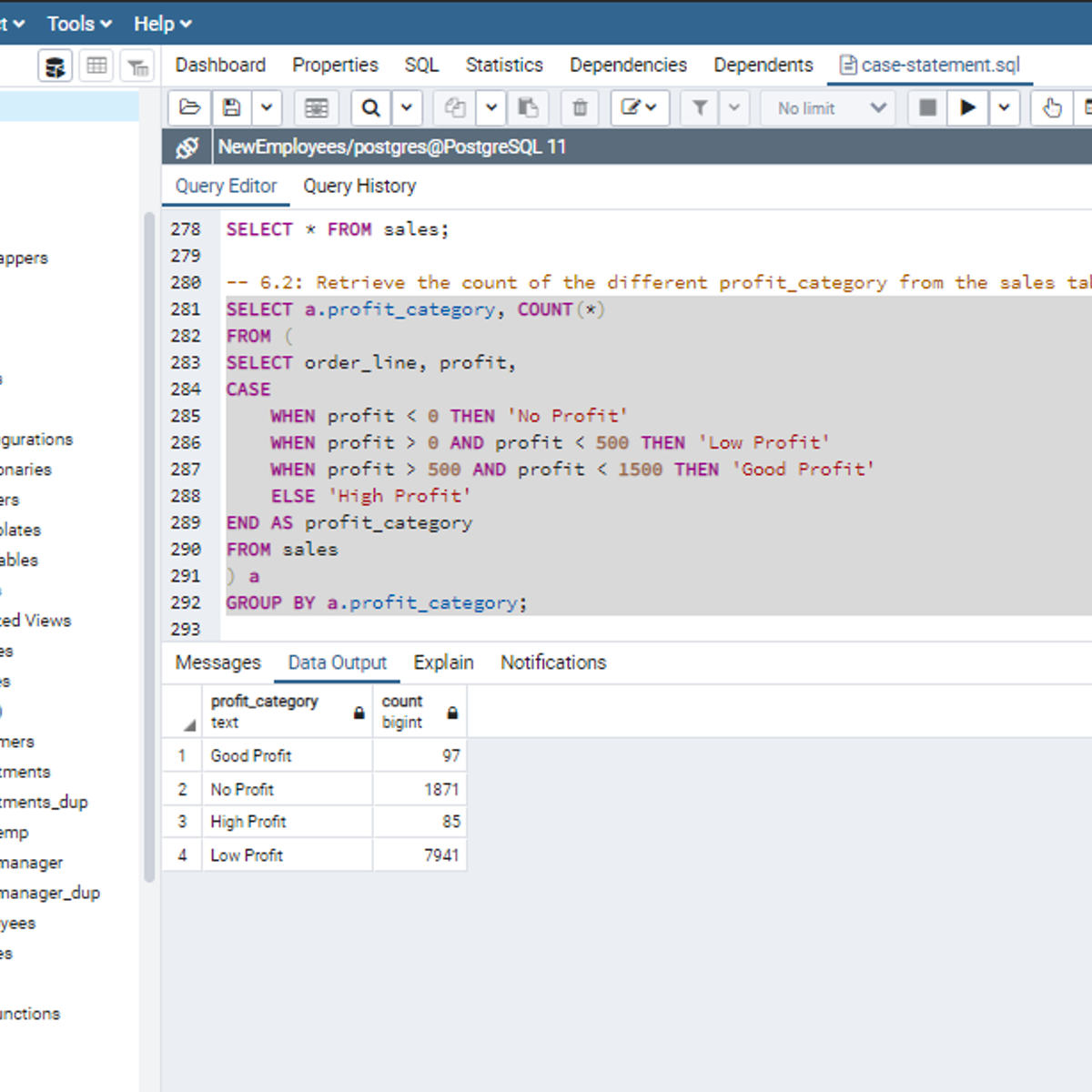
Welcome to this project-based course, SQL CASE Statements. In this project, you will learn how to use SQL CASE statements to query tables in a database. By the end of this 2-hour long project, you will be able to write simple CASE statements to retrieve the desired result from a database. Then, we will move systematically to write more complex SQL CASE statements. Furthermore, we will see how to use the CASE clause together with aggregate functions, and SQL joins to get the desired result you want from tables in a database. Also, you will learn how to use the CASE clause to transpose the result of a query. Also, for this hands-on project, we will use PostgreSQL as our preferred database management system (DBMS). Therefore, to complete this project, it is required that you have prior experience with using PostgreSQL. Similarly, this project is an advanced SQL concept; so, a good foundation for writing SQL queries, and performing joins in SQL is vital to complete this project. If you are not familiar with writing queries in SQL and SQL joins and want to learn these concepts, start with my previous guided projects titled “Querying Databases using SQL SELECT statement", “Performing Data Aggregation using SQL Aggregate Functions” and “Mastering SQL Joins”. I taught these guided projects using PostgreSQL. So, taking these projects will give the needed requisite to complete this project on SQL CASE Statements. However, if you are comfortable writing queries in PostgreSQL, please join me on this wonderful ride! Let’s get our hands dirty!
 Politecnico di Milano
Reaching Vulnerable Groups through Pandemic Policy
This course aims to provide an in-depth reflection on social work in different contexts, hereby focusing on their needs, the way the contexts have been influenced, and different challenges that have occurred during the last two years. It aims to set up conversations with multiple professionals where they give information about the hurdles on their path, the lessons learned from these turbulent times, and to give an overview of important ideas and practices that could help reshape the future of social work. In the end, the goal is to provide specific, hands-on, best practices collected from literature and professionals in Belgium and Europe that help organise social work, both during and after a pandemic. This course was developed as part of the research project 'Pan-European Response to the Impacts of the COVID-19 and future Pandemics and Epidemics' (PERISCOPE, https://www.periscopeproject.eu/). Funded by the European Commission Research Funding programme Horizon 2020 under the Grant Agreement number 101016233, PERISCOPE investigates the broad socio-economic and behavioural impacts of the COVID-19 pandemic, to make Europe more resilient and prepared for future large-scale risks.
 EDUCBA
Analyze & Visualize Data Using Advanced Excel
By completing this course, learners will be able to analyze structured datasets, apply Pivot Tables for meaningful summaries, design effective charts, interpret data using advanced visualization techniques, and perform dynamic calculations using Excel equations and intelligent analysis tools. This Advanced Excel course is designed to help learners move beyond basic spreadsheet usage and develop strong analytical and visualization skills required in today’s data-driven roles. Learners will gain hands-on experience in understanding dataset structure, building Pivot Tables, and transforming raw data into clear, insightful charts. The course also explores advanced chart formatting, dataset parameters, and Excel’s smart features such as Analyze Data and recommended charts to enhance accuracy and efficiency. What makes this course unique is its structured, outcome-driven approach that connects data preparation, visualization, and analysis into a single learning journey. Each concept is reinforced through practical examples that mirror real-world business scenarios, enabling learners to make confident, data-backed decisions. Whether for reporting, analytics, or dashboard creation, this course equips learners with practical Advanced Excel skills that are immediately applicable in professional environments.
 New York University
Richard Schechner's Introduction to Performance Studies
Performance Studies: An Introduction explores the wide world of performance--from theatre, dance, and music to ritual, play, political campaigns, social media, and the performances of everyday life. Performance studies also ranges across cultures--Asia, Africa, the Caribbean, Europe, the Americas. And it spans historical periods from the art of the paleolithic caves to YouTube and the avantgarde. This course is devised by Richard Schechner, one of the pioneers of performance studies, in dialogue with more than a dozen expert scholars and artists. Performance Studies: An Introduction puts students in dialogue with the most important ideas, approaches, theories, and questions of this dynamic, new academic field. Learning Objectives By the end of this course, you should be able to: Articulate and analyze the major concepts of performance studies Identify and analyze performances within the “broad spectrum of performance”--from everyday life and social media to performance art and global spectacles such as the Olympics Comprehend key terms of performance studies, including is/as performance, restored behavior, ritual, play, make-belief/make-believe, performance in everyday life, the performative, and intercultural performance Produce collaborative work that demonstrates teamwork in applying ideas learned in the course Compare, analyze, and interpret performances of their own and other cultures Articulate how the major concepts of the course relate to their own experiences and worldviews Analyze and criticize in a constructive way the work of classmates The lessons present Schechner’s concept of performance studies along with online assignments. In the assignments, students apply what they are learning by composing short responses to materials, writing in their NYU Classes Forums, and by reviewing other students’ forum posts each week. Students choose either to work in groups of 3 to 5 on a term-long project maintaining a project portfolio in NYU Classes or to write a research paper. During the term, each group will lead an in-class 25-minute discussion of their project-in-progress. During the last face-to-face class, each group will present their project. The weekly content is: What is Performance? What is Performance Studies? Performance Processes From Not Performing to Performing Ritual Play Performing in the Paleolithic Ramlila of Ramnagar The Performing Brain Performativity Constructing Social Roles Social Media Intercultural, Transcultural, Global Group Projects & Wrap Up Course Requirements Each student is required to complete the week’s online lesson prior to the class session, attend and participate in the class sessions, complete the weekly assignments, participate and present the group project or submit a final paper. Required Readings See weekly online lessons. Required Viewings (Videos) See weekly online lessons. Written work Each student will either participate in a group project or write a research paper due at the end of the term, submitted electronically. Your professor will confer online and/or face-to-face during office hours to help students develop their writing and their projects. If you do a group project your professor may ask you to do some writing in relationship to your project. Academic Integrity The policy on plagiarism and academic honesty is posted on Classes. Read this document carefully, and be guided by it. Copyright Keep in mind the material you find in the online lessons is subject to copyright. You may not reproduce, reuse, or distribute it without permission outside of your work in this course. For more information on copyright and how it applies to course materials, see the Copyright Basics research guide.
 University of Virginia Darden School Foundation
Advertising in the Age of Generative AI
The Advertising in the Age of Generative AI course provides you with the knowledge, skills, and tools needed to build and maintain a clear and strong brand that is distinguishable from the competition and builds customer loyalty, familiarity, and comfortability. This course will allow for you to appropriately practice using Generative AI to generate compelling and effective logos as part of a brand strategy. This course is ideal for marketing professionals looking to create and establish a strong brand identity for their organization and want to gain valuable insights on how Generative AI is used in brand awareness and logo generation.
 Coursera
Software Development with ChatGPT: Generating Code with AI
In this 1-hour long project-based course, you will learn how to: 1) Set up a development environment incorporating ChatGPT, 2) Generate and integrate AI-assisted code into a Python project, 3) Debug and refine your application using AI guidance, and 4) Write comprehensive documentation with the help of ChatGPT. To achieve these goals, you will create a functional Python To-Do List Manager by working through a series of practical, real-world scenarios. This project is unique because it not only enhances your Python coding skills but also introduces you to the revolutionary world of AI-assisted programming, providing a glimpse into the future of software development. This course is tailored for those with a basic understanding of Python who are keen to explore AI applications in programming. No prior experience with ChatGPT is necessary, making it a perfect opportunity for anyone familiar with core programming concepts to step into the AI-assisted coding arena.
 Coursera
Unify Multimodal Data with Automated ETL
Did you know that multimodal AI systems often fail not because of weak models, but because their underlying data pipelines cannot reliably unify text, image, audio, and tabular features? A strong multimodal infrastructure is the foundation of advanced AI. This Short Course was created to help professionals in this field build robust data infrastructure for multimodal AI applications and automate the processing of diverse data types including text, images, and audio. By completing this course, you will be able to design unified schemas for multimodal feature storage and implement automated ETL pipelines using workflow orchestration tools, giving you the ability to support scalable, production-ready multimodal AI systems. By the end of this 4-hour long course, you will be able to: Create a unified data schema for storing multimodal machine learning features. Implement automated ETL pipelines using a workflow orchestration tool. This course is unique because it combines multimodal feature engineering with automation and orchestration, equipping you to transform fragmented datasets into cohesive, high-quality pipelines that power next-generation AI models. To be successful in this project, you should have: Database design fundamentals Basic ETL concepts SQL proficiency Familiarity with cloud storage ML feature engineering basics
 Coursera
How to Set Up a Facebook Ads Campaign
By the end of this project, you will be able to set up a Facebook Ads campaign. Throughout the project, you will be able to create a Business Manager account and an Ad account. We will also be able to create a new Facebook Ads campaign and to select the right objective for it. Moreover, you will create the Ad Sets and set its elements: the budget, the duration, the audience, and the placement. Finally , you will be able to select an existing Ad to boost or to create an Ad from scratch which is the last step before launching the Facebook Ads campaign. This project is for intermediate Social Media Managers, who already have the basics of how to manage a Facebook page, can deal with Facebook Business and posts easily, and who are interested in setting up Facebook Ads campaigns in a correct way. Learning to use Facebook Ads enables you to have control over your spending on Social Media, get clear insights about the performance of your Facebook Ads campaigns and finally reach your perfect audience easily.
 Association of International Certified Professional Accountants
Making the Case for Robotic Process Automation
Overview Robotic Process Automation (RPA) is reshaping the accounting and finance profession. 40% of transactional accounting work is expected to be automated by 2020 and predicted to touch 230 million knowledge workers, 9% of the global workforce, according to McKinsey Research. Driven by the need to stay competitive, decrease costs and increase efficiency, RPA is quickly making a significant impact on the profession. Companies no longer think about "if" but "when" to implement RPA. Short Description: • Robotic Process Automation (RPA) can transform business processes by eliminating the mundane, time-consuming, manual tasks that professionals complete; enabling them more time to focus on critical thinking. This course for accounting and finance professionals worldwide will show through use cases how robotic process automation can be utilized to decrease errors and increase productivity. Course description/ Overarching Learning Goal This course is intended to provide accounting and financial professionals with practical literacy on robotic process automation through a real-world, relevant data preparation use case. It will help identify potential uses and the benefits and considerations for robotic process automation. This course will help you make the business case by helping you assess requirements, define proof of value and measure and validate the ROI for automation.
 Knowledge Accelerators
Promoting Accessible Workplaces with Assistive Technology
Workplaces and educational institutions are becoming increasingly aware of the importance of inclusivity in their forces, and there are significant efforts being made to promote cultures of inclusivity. Despite that, the needs of disabled workers and students remain largely overlooked by a working society of abled persons even though great advances have been made in widely available Assistive Technology. In this course, learners will gain increased awareness of many types of disabilities represented in the workforce and educational institutions. Learners will learn about the Assistive Technology (AT) tools built into Microsoft and Windows products, including screen readers, Immersive Reader, Accessibility Checker, etc. as well as how to instruct in their use. Learners will become proficient in inclusive communication practices in the workplace or classroom by learning to construct accessible written materials and presentations. The course will offer audiovisual storytelling to encourage active learning about a world outside of “abled privilege.”
 University of Virginia
Customer-Centric IT Strategy
Now more than ever, corporations are investing heavily in IT. The quality of these investments affect the daily work of millions, yet it’s not uncommon to see industry surveys where the failure rates for IT projects is over 50%. It’s possible to do better and it’s possible to do so consistently. In this two-week course, we’ll step through major challenges within corporate IT and how to address them with the disciplined use of design thinking, Lean Startup, and agile as a team framework. By the end of this course, developed at the Darden School of Business at the University of Virginia and taught by top-ranked faculty, you’ll be able to: Use the Business Model Canvas to focus your company strategy and facilitate buy-in from stakeholders Translate your work on the Canvas to specific charters in IT Rapidly prototype strategically-aligned processes for implementation within your IT infrastructure Please Note: This is a short-form course, two weeks in duration.
 Coursera
Analyze Economic Signals for Financial Success
Financial forecasting depends on more than projecting numbers—it requires knowing how to read the economic signals that influence them. This intermediate-level course introduces you to the indicators and market dynamics that shape business performance. You’ll begin by examining how movements in interest-rate curves influence borrowing costs and future interest-expense assumptions. From there, you’ll work with leading indicators such as PMI, CPI, and consumer-confidence measures to understand how demand may be changing before it shows up in company results. The course combines short videos, focused readings, and hands-on exercises that let you practice turning market data into concrete forecasting insights. By the end, you’ll be equipped to explain how broader economic trends affect revenue, margins, and financial planning—skills that help analysts, planners, and decision-makers build forecasts that are credible, grounded, and ready for real-world use.
 EDUCBA
Build Practical Ruby Projects Using Core Programming Skills
Learners will be able to build structured Ruby projects, apply core programming constructs, implement object-oriented principles, and deliver a complete, working Ruby application by the end of this course. This course is designed to take learners from foundational Ruby concepts to the successful completion of a real-world Ruby project. Beginning with environment setup and basic syntax, learners progressively work through variables, control flow, data structures, object-oriented programming, file handling, and modular code design. Each module builds logically on the previous one, ensuring steady skill development through hands-on project work. By completing this course, learners gain practical experience writing clean, reusable, and maintainable Ruby code, while also developing problem-solving skills essential for real programming tasks. The course emphasizes applied learning through structured lessons, practice quizzes, graded assessments, and a full project walkthrough. What makes this course unique is its project-first approach—every concept is taught in direct context of building and refining a Ruby project. This ensures learners not only understand Ruby concepts, but can confidently apply them in real development scenarios, making the course ideal for beginners seeking practical, job-ready Ruby skills.
 The University of Melbourne
Alternative Approaches to Valuation and Investment
In this course, participants will develop an understanding of the intuitive foundations of asset and investment valuation, and how alternative valuation techniques may be used in practice. This is part of a Specialization in corporate finance created in partnership between the University of Melbourne and Bank of New York Mellon (BNY Mellon). View the MOOC promotional video here: http://tinyurl.com/h75pzt6
 Alex Genadinik
Create An AI Agent With Replit That Automates Your Sales
Use AI software development called Vibe Coding to create a fully autonomous AI agent using Replit that handles outreach, follow-ups, and closes sales for you. Imagine an AI agent that sends emails, follows up with leads, books calls, and even closes sales, all without you lifting a finger. In this hands-on course, you’ll learn how to build your own autonomous AI agent using Replit’s Vibe coding environment. This is not just a chatbot. It’s a smart, action-taking, goal-driven sales assistant that runs in the background - prospecting, pitching, and selling for your business 24/7. What You’ll Learn: How to architect a fully autonomous AI agent from scratch Step-by-step walkthrough of Replit's Vibe environment How to give your agent memory, goals, and decision-making logic Writing prompts and API logic to make the agent: Find leads Write email outreach Follow up based on lead behavior Close or escalate deals How to integrate with tools like Gmail, Zapier, CRMs, and scheduling links Testing and deploying your AI agent on autopilot Why Take This Course? You're tired of manual sales and outreach You want to use AI for more than just generating content You’re ready to build something that acts, adapts, and drives real revenue You want to learn LLM agent design, not just GPT chat prompts Whether you’re a marketer, freelancer, startup founder, or agency owner, this course gives you a plug-and-play framework to automate your sales using cutting-edge AI agent tech. Requirements: No advanced coding needed (we use Replit’s beginner-friendly Vibe interface) Basic familiarity with AI tools or APIs helpful but not required Disclaimer: Replit is a paid service, so expect to pay their minimum usage fees. Start automating your outreach and let your AI agent sell while you sleep.
 University of Colorado Boulder
Climate Resilience and Urban Sustainability
Welcome to Climate Resilience and Urban Sustainability, the first course in the Building Sustainable Cities Specialization. By completing Climate Resilience and Urban Sustainability, you will gain the ability to apply a comprehensive toolkit of case studies to address urban resilience and sustainability. You will be empowered to create and advocate for policy, technological, and other changes aimed at improving these outcomes within their communities. You will also develop the skills to analyze and understand the origins, causes, and consequences of current sustainability and resilience challenges. You will benefit from a deeper understanding of the challenges cities face today, particularly in the context of global climate change and social equity. The course provides insights into the history of land use and urban development in the United States, highlighting the rise of automobile dependence and the impact of fossil fuels. It also explores the policies and politics that contribute to unsustainable development patterns. What makes this course unique is its focus on practical application. Through quizzes and real-world examples, you will engage with topics such as urban heat, flood risk, and climate costs, gaining the knowledge needed to identify and address these issues in your own community. The course also covers innovative planning frameworks like New Urbanism and Smart Growth, offering you a forward-thinking approach to urban development.