

The Global Scholarly Directory.
Discover world-class academic programs curated for the modern intellectual. Search through 19877+ degrees and professional certificates.
 Coursera
5G Open RAN Essentials: Architecture & Ecosystem Basics
5G Open RAN Essentials: Architecture & Ecosystem Basics is a hands-on course designed for engineers, analysts, and telecom professionals who want to understand the building blocks and business case behind Open RAN. You’ll start by exploring what sets Open RAN apart from traditional RAN—from modular architecture to open interfaces—using simple, visual walkthroughs. As you move forward, you’ll dive into the core components of O-RAN—RU, DU, CU, and RIC—and learn how they work together to enable vendor interoperability and flexible deployments. Through real-world case studies, interactive labs, and industry-aligned design tasks, you’ll apply your learning in practical ways—from designing pilot architectures to making a strategic pitch for O-RAN adoption. By the end, you’ll be able to confidently explain how Open RAN works, why it matters, and how it’s being deployed around the world to drive innovation, cost-efficiency, and supply chain diversity.
 University of Colorado Boulder
Defining, Describing, and Visualizing Data
As leaders in your chosen field, you need to not only know how to ask the right questions but also answer them using data-based methods. Through this class, you will be able to get to the bottom of what you really want to know, describe the associated data related to that question, and visualize the information from that data to understand and explain the results. This course can be taken for academic credit as part of CU Boulder’s Master of Engineering in Engineering Management (ME-EM) degree offered on the Coursera platform. The ME-EM is designed to help engineers, scientists, and technical professionals move into leadership and management roles in the engineering and technical sectors. With performance-based admissions and no application process, the ME-EM is ideal for individuals with a broad range of undergraduate education and/or professional experience. Learn more about the ME-EM program at https://www.coursera.org/degrees/me-engineering-management-boulder.
 Coursera
Accounting: Balance Ledgers & Adjust Entries
Master the fundamental building blocks of accurate financial record-keeping that every accounting professional needs. This course empowers you with essential double-entry bookkeeping knowledge to recognize normal account balances and execute precise month-end adjusting procedures using QuickBooks. This Short Course was created to help accounting professionals accomplish reliable ledger maintenance and month-end closing procedures. By completing this course, you'll be able to confidently identify whether major account categories carry debit or credit balances, calculate and record adjusting entries for accruals and prepaids, and ensure your general ledger remains balanced after posting transactions. By the end of this course, you will be able to: Recognize the normal debit or credit balance for major general ledger account categories. Apply standard procedures to post month-end adjusting entries and balance the ledger. This course is unique because it combines foundational accounting theory with hands-on QuickBooks practice, ensuring you develop both conceptual understanding and practical skills that translate directly to workplace success. To be successful in this project, you should have a background in basic accounting concepts and access to QuickBooks.
 Packt
Packt
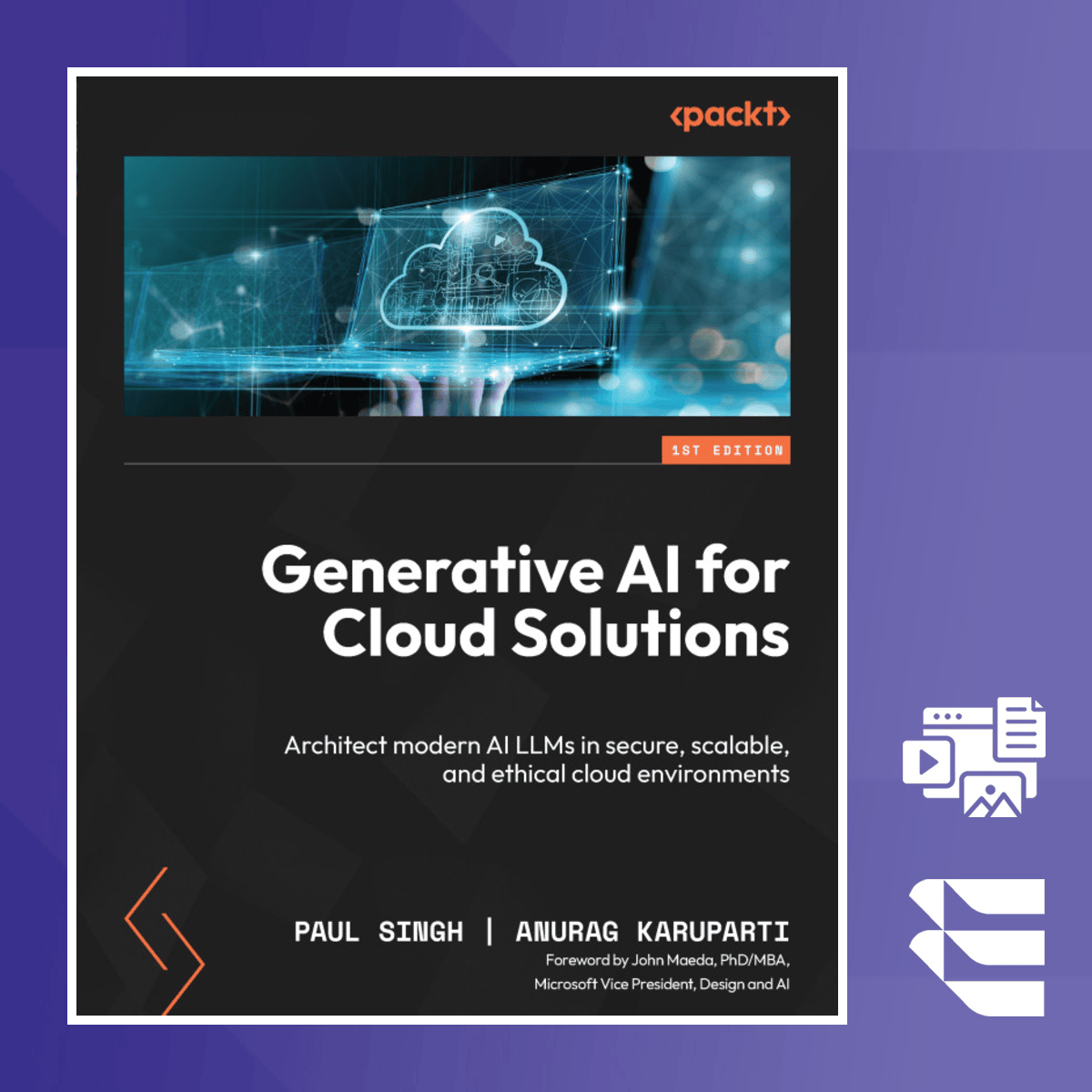
Generative AI for Cloud Solutions
This course explores how Generative AI is transforming modern cloud solutions by combining large language models with scalable cloud architectures. Learners gain a strategic understanding of how AI-driven systems are designed, deployed, and governed in real-world cloud environments. Through a structured journey from NLP foundations to advanced LLM-based application development, the course helps learners build practical skills in fine-tuning models, retrieval-augmented generation, and prompt engineering. You will learn how to design, deploy, and scale AI-powered cloud applications while addressing operational and performance challenges. What sets this course apart is its balance of conceptual depth and hands-on architectural thinking. It connects core AI concepts with real-world cloud deployment patterns, Dev frameworks, and LLMOps practices. This course is ideal for cloud engineers, software developers, architects, and technology professionals looking to integrate Generative AI into cloud solutions. A basic understanding of cloud computing and software development concepts is recommended.
 University of Colorado Boulder
Security & Ethical Hacking: Attacking Web and AI Systems
In this course you will learn how the security of web-based software, including deployed AI agents, can be compromised. Real-world attacks we study are conducted against a variety of web technologies and frameworks. In addition, we will introduce the topic of Adversarial Machine Learning (exploiting algorithms and learning techniques) in the Artificial Intelligence domain, including Language Models. We will review and study modern, cutting-edge research in this area. Course assessments are through quizzes, hands-on exercises and an exam. This course can be taken for academic credit as part of CU Boulder’s MS in Data Science or MS in Computer Science degrees offered on the Coursera platform. These fully accredited graduate degrees offer targeted courses, short 8-week sessions, and pay-as-you-go tuition. Admission is based on performance in three preliminary courses, not academic history. CU degrees on Coursera are ideal for recent graduates or working professionals. Learn more: MS in Data Science: https://www.coursera.org/degrees/master-of-science-data-science-boulder MS in Computer Science: https://coursera.org/degrees/ms-computer-science-boulder
 Coursera
Agentic AI Content for Practitioners: Marketing
Enhance Marketing with AI: Tools for Optimal Campaigns is an intermediate-level course designed for marketing professionals ready to harness artificial intelligence for transformative campaign results. In today's data-driven marketing landscape, AI tools are no longer optional—they're essential for competitive advantage. This course equips you with practical skills to implement AI agents for automation, master prompt engineering for brand-aligned content creation, and integrate analytics tools for comprehensive performance tracking. Through real-world case studies from Nike, Coca-Cola, and IBM Watson, you'll learn to transform manual marketing processes into intelligent, data-driven workflows. The course combines strategic frameworks with hands-on applications, enabling you to immediately apply AI tools to your marketing challenges. By completion, you'll have the knowledge to design AI-powered campaigns that save time, improve targeting, and deliver measurable business results. Whether you're optimizing social media strategies, creating compelling content, or analyzing customer journeys, this course provides the AI marketing foundation you need to lead in the digital age.
 DeepLearning.AI
Knowledge Graphs for RAG
Knowledge graphs are used in development to structure complex data relationships, drive intelligent search functionality, and build powerful AI applications that can reason over different data types. Knowledge graphs can connect data from both structured and unstructured sources (databases, documents, etc.), providing an intuitive and flexible way to model complex, real-world scenarios. Unlike tables or simple lists, knowledge graphs can capture the meaning and context behind the data, allowing you to uncover insights and connections that would be difficult to find with conventional databases. This rich, structured context is ideal for improving the output of large language models (LLMs), because you can build more relevant context for the model than with semantic search alone. This course will teach you how to leverage knowledge graphs within retrieval augmented generation (RAG) applications. You’ll learn to: 1. Understand the basics of how knowledge graphs store data by using nodes to represent entities and edges to represent relationships between nodes. 2. Use Neo4j’s query language, Cypher, to retrieve information from a fun graph of movie and actor data. 3. Add a vector index to a knowledge graph to represent unstructured text data and find relevant texts using vector similarity search. 4. Build a knowledge graph of text documents from scratch, using publicly available financial and investment documents as the demo use case 5. Explore advanced techniques for connecting multiple knowledge graphs and using complex queries for comprehensive data retrieval. 6. Write advanced Cypher queries to retrieve relevant information from the graph and format it for inclusion in your prompt to an LLM. After course completion, you’ll be well-equipped to use knowledge graphs to uncover deeper insights in your data, and enhance the performance of LLMs with structured, relevant context.
 Sungkyunkwan University
How to Tune Our Emotions: Seongho's New Proposal 2
This lecture series explores our emotional landscape through the thought of Seongho Yi Ik (1683- 1761), one of the most original Confucian thinkers of late Joseon Korea. Rooted in the Confucian project of “Learning to be Human,” the course examines how emotional cultivation is essential not only to moral development but also to understanding others and living well in community. Centered on Seongho’s New Compilation of the Four-Seven Debate (Sachil sinpyeon), the lectures trace his major philosophical innovations: his vivid social metaphors of emotion, his naturalistic and embodied account of emotional life, his creative engagement with Western learning, and his expanded view of the emotional spectrum through both philosophical and digital approaches. The course also considers his reflections on the emotions of sages, the emergence of public emotions from private life, the role of ritual in cultivating shared moral feeling, and the continuing relevance of his thought to the Korean concept of Jeong today. Through these lectures, Seongho’s insights offer both a deeper understanding of Confucian moral psychology and practical wisdom for tuning our own emotions.
 Google
Segurança de TI: defesa contra as artes negras digitais
Este curso abrange uma grande variedade de conceitos, ferramentas e práticas recomendadas ao nível da segurança de TI. Aborda ameaças e ataques e as várias formas através das quais podem surgir. Vamos fornecer-lhe algumas informações gerais sobre o que são os algoritmos de encriptação e como são utilizados para salvaguardar dados. Em seguida, vamos analisar detalhadamente os três aspetos mais importantes da segurança das informações: autenticação, autorização e contabilidade. Também vamos abordar soluções de segurança de rede, desde firewalls a opções de encriptação de Wi-Fi. Por último, vamos analisar um caso prático, no qual examinamos o modelo de segurança do Chrome OS. O curso conclui ao reunir todos estes elementos numa arquitetura de segurança detalhada e de várias camadas, apresentando depois recomendações sobre como integrar uma cultura de segurança na sua entidade ou equipa. No final deste curso, vai saber mais sobre: ● como funcionam vários algoritmos e técnicas de encriptação, bem como as respetivas vantagens e limitações ● vários tipos e sistemas de autenticação ● a diferença entre autenticação e autorização ● como avaliar potenciais riscos e recomendar formas de reduzir o risco ● práticas recomendadas para proteger uma rede ● como ajudar as outras pessoas a entender conceitos de segurança e a protegerem-se
 Johns Hopkins University
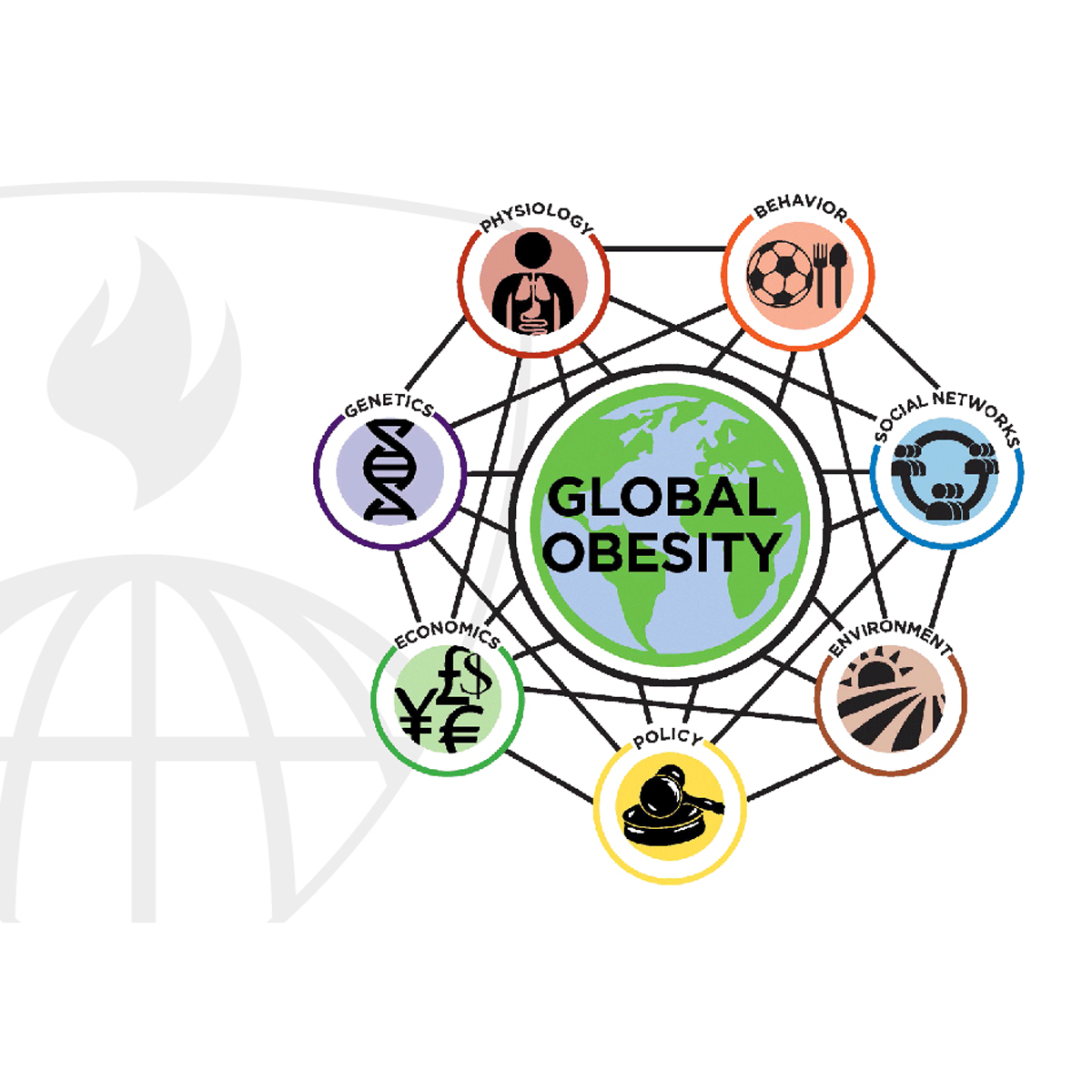
Systems Science and Obesity
Systems science has been instrumental in breaking new scientific ground in diverse fields such as meteorology, engineering and decision analysis. However, it is just beginning to impact public health. This seminar is designed to introduce students to basic tools of theory building and data analysis in systems science and to apply those tools to better understand the obesity epidemic in human populations. There will also be a lab in which students will use a simple demonstration model of food acquisition behavior using agent-based modeling on standard (free) software (netlogo). The central organizing idea of the course is to examine the obesity epidemic at a population level as an emergent properties of complex, nested systems, with attention to feedback processes, multilevel interactions, and the phenomenon of emergence. While the emphasis will be on obesity, the goal will be to explore ways in which the systems approach can be applied to other non-communicable diseases both nationally and internationally. Topics will include: a) the epidemiology of obesity across time and place, b) theories to explain population obesity, c) the role of environments and economic resources in obesity c) basic concepts and tools of systems science, d) modeling energy-balance related behaviors in context, e) agent-based models, systems dynamic models, and social network models
 University of Maryland, College Park
Leading with Power Skills: Building Self-Awareness in Teams
Unlock the power of self-awareness—the ultimate leadership skill and the foundation for all other essential skills. Recruiters and hiring managers highly seek leaders who understand their strengths, manage their emotions, and make thoughtful decisions. Developing self-awareness boosts your effectiveness, communication, and ability to inspire and lead teams to success. This course will help you master this vital skill to stand out and excel in your career. Power skills are key to becoming a great leader. This course helps you truly know yourself by identifying your core strengths, personality traits, and decision-making style. You’ll learn how to accurately assess your soft skills, focus on what you can change, and build the essential skills that fuel professional and life success. With self-awareness as your foundation, this course will give you the tools to grow as a leader and unlock your full potential.
 University of Colorado Boulder
Applying Systems Engineering to the Design Process
In this course, you will learn what a systems engineer does. Following the conceptual foundations from The Need for Systems Engineering, you will perform requirements analysis and functional analysis on engineering programs. You will learn how to perform a trade study using a methodical, quantitative approach that is universal in application. This course also covers preparing design reviews, focusing on coordinating the inputs of multiple engineering disciplines into a cohesive description of the design approach. This course can be taken for academic credit as part of CU Boulder’s Master of Engineering in Engineering Management (ME-EM) degree offered on the Coursera platform. The ME-EM is designed to help engineers, scientists, and technical professionals move into leadership and management roles in the engineering and technical sectors. With performance-based admissions and no application process, the ME-EM is ideal for individuals with a broad range of undergraduate education and/or professional experience. Learn more about the ME-EM program at https://www.coursera.org/degrees/me-engineering-management-boulder.
 École Polytechnique Fédérale de Lausanne
Parallel programming
With every smartphone and computer now boasting multiple processors, the use of functional ideas to facilitate parallel programming is becoming increasingly widespread. In this course, you'll learn the fundamentals of parallel programming, from task parallelism to data parallelism. In particular, you'll see how many familiar ideas from functional programming map perfectly to to the data parallel paradigm. We'll start the nuts and bolts how to effectively parallelize familiar collections operations, and we'll build up to parallel collections, a production-ready data parallel collections library available in the Scala standard library. Throughout, we'll apply these concepts through several hands-on examples that analyze real-world data, such as popular algorithms like k-means clustering. Learning Outcomes. By the end of this course you will be able to: - reason about task and data parallel programs, - express common algorithms in a functional style and solve them in parallel, - competently microbenchmark parallel code, - write programs that effectively use parallel collections to achieve performance Recommended background: You should have at least one year programming experience. Proficiency with Java or C# is ideal, but experience with other languages such as C/C++, Python, Javascript or Ruby is also sufficient. You should have some familiarity using the command line. This course is intended to be taken after Functional Program Design in Scala: https://www.coursera.org/learn/progfun2.
 SkillUp
Employment Law for Managers
Managing people effectively requires not only leadership skills but also a solid understanding of employment law and managerial responsibilities. The course offers a clear and practical overview of the legal principles that guide managers in supporting employees while maintaining compliance with organizational and regulatory requirements. Designed for people managers and team leads, this course emphasizes real-world application rather than legal theory. You will explore key federal regulations, such as the Americans with Disabilities Act (ADA) and the Family and Medical Leave Act (FMLA), and learn how they apply to everyday management situations. The course explains how to recognize and respond appropriately to accommodation and leave requests, manage sensitive employee disclosures with empathy and confidentiality, and determine when issues must be escalated to human resources or legal teams. Throughout the course, the focus remains on striking a balance between employee support and consistent adherence to company policies and legal obligations. Through interactive activities, scenario-based videos, and reflective exercises, you’ll practice identifying red flags, navigating complex employee situations, and making informed decisions aligned with legal and ethical standards. By the end of the course, you’ll feel confident handling employment-related legal concerns while fostering a respectful, compliant workplace.
 Duke University
Data Visualization and Modeling in Python
Put the keystone in your Python Data Science skills by becoming proficient with Data Visualization and Modeling. This course is suited for intermediate programmers, who have some experience with NumPy and Pandas, that want to expand their skills for any career in data science. Whether you come to data science through social sciences and Statistics, or from a programming background, this course will integrate the two perspectives and offer unique insights from each. You’ll begin by becoming adept with matplotlib, an essential plotting library in Python that will enable you to discover and communicate insights about data effectively. You’ll progress to classification algorithms by creating a K-Nearest Neighbors (KNN) classifier, a foundational algorithm used in data science and machine learning. Finally, you will write Python programs that leverage your newfound data science skills based on inferential statistics, and be able to describe relationships between variables in your data. By the end of the course, you’ll be able to quickly visualize a dataset, explore it for insights, determine relationships between data, and communicate it all with effective plots. In the last module of this course, you’ll produce a publication-quality figure based on data that you’ve prepared and cleaned yourself; the first artifact in your data science portfolio. Throughout this course you’ll get plenty of hands-on experience through interactive programming assignments, live coding demos from data scientists, and analyzing the data behind important real-world problems (like carbon emissions, real estate prices, and infant mortality). Guided activities throughout each module will reinforce your proficiency with data science techniques and analytical approach as a data scientist. Solidify your understanding of these critical data science concepts and begin your data science portfolio by mastering visualization and modeling. Start this integrative and transformative learning journey today!
 Microsoft
Data Modeling in Power BI
This course forms part of the Microsoft Power BI Analyst Professional Certificate. This Professional Certificate consists of a series of courses that offers a good starting point for a career in data analysis using Microsoft Power BI. In this course, you'll learn how to use Power BI to create and maintain relationships in a data model and form a model using multiple Schemas. You'll explore the basics of DAX, Power BI's expression language, and add calculations to your model to create elements and analysis in Power BI. You'll discover how to configure the model to support Power BI features for insightful visualizations, analysis, and optimization. After completing this course you'll be able to: ● Create and maintain relationships in a data model. ● Form a model using a Star Schema ● Write calculations DAX to create elements and analysis in Power BI ● Create calculated columns and measures in a model ● Perform useful time intelligence calculations in DAX ● Optimize performance in a Power BI model This is also a great way to prepare for the Microsoft PL-300 exam. By passing the PL-300 exam, you’ll earn the Microsoft Power BI Data Analyst certification.