

The Global Scholarly Directory.
Discover world-class academic programs curated for the modern intellectual. Search through 19877+ degrees and professional certificates.
 Coursera
تصميم عروض تقديمية للمبيعات من خلال موقع Canva
المشروع ده بيستهدف الناس إللي بتشتغل في الجوانب التسويقية المختلفة، إللي بنقول عليهم في منتصف الحياة المهنية، يعني مش المبتدئين في المجال ولكن إللي عندهم سنتين خبرة فأكثر، سواء في إدارة التسويق الإلكتروني أو إدارة المبيعات وتطوير الأعمال أو العلاقات العامة أو إدارة التمويل. أي حد بيحتاج يعرض شغل شركته ومنتجاتها وخدماتها قصاد عملاء أو مستثمرين أو شركاء أو رعاة أو مسؤولين حكوميين. تمكُنك من استخدام موقع Canva هيِغنيك عن الاحتياج لمصممين في شغلك، مش هتحتاج تطلب تعديلات وتصميمات من إدارة تانية غير إدارتك أو تطلب جمايل من أصحابك المصممين، هتقدر تعمل التصميمات إللي أنت محتاجها بسهولة وبسرعة، ودي في حد ذاتها ميزة كبيرة جداً لإنك أكتر واحد هتكون فاهم انت عايز إيه بالظبط في التصميم وبالتالي هتعمله بطريقة مناسبة لشغلك و تحقق لك نتائج أفضل.
 Board Infinity
Build Real-world Projects Using Replit and Ghostwriter
Welcome to "Build Real-world Projects Using Replit and Ghostwriter", the introductory course to understand the basics of Replit and Ghostwriter. This course will introduce you to the essentials of using Replit as an integrated development environment (IDE) and code automation with Ghostwriter. By the end of this course, you will be able to: 1. Navigate the Replit dashboard and utilize its range of features 2. Write, debug, and run code using Replit's user-friendly interface 3. Understand Ghostwriter's capabilities in code generation, transformation, and explanation 4. Collaborate on coding projects with peers using Replit's integrated tools For the final project in this course, you will utilize both Replit and Ghostwriter to develop a mini software project. You will create, modify, and understand code using Ghostwriter and run your project in the Replit environment. This hands-on project will solidify your understanding of both platforms and demonstrate the convenience and efficiency they bring to the coding process. This is an introductory course, ideal for learners who are either entering the field of Computer Science and Engineering or looking for a quick start in coding. No prior experience is necessary, although familiarity with basic computer operations is helpful. Step into the future of coding with this unique course that combines the streamlined coding environment of Replit with the code-automation powers of Ghostwriter. Join us to gain the foundational skills that will serve you well in any software development endeavor. Disclaimer: This is an independent educational resource created by Board Infinity for informational and educational purposes only. This course is not affiliated with, endorsed by, sponsored by, or officially associated with any company, organization, or certification body unless explicitly stated. The content provided is based on industry knowledge and best practices but does not constitute official training material for any specific employer or certification program. All company names, trademarks, service marks, and logos referenced are the property of their respective owners and are used solely for educational identification and comparison purposes.
 University of Colorado System
SRS Documents: Requirements and Diagrammatic Notations
As requirements are being gathered and prioritized, they also need to be documented. In Diagrammatic Notations and Software Requirements Specification Writing, we discuss and practice the process of turning requirements into something readable to the customers at a high level, and the developers. When a designer or developer reads your document, they should be able to understand the overall idea, the scope, the domain, the resources, the expectations, and why alternative choices are not selected. To create a document in this way, you use a balance between storytelling (with pictures!) and complex diagrams.
 Intel
Intel
Establishing Effective Educator-Machine Partnerships
Technology has become increasingly integrated with the provision of adequate education for learners worldwide. There is a need to study the advantages and shortcomings of this integration to provide educators with optimal teaching and learning practices. This course supports the educator's adaptation of education technology, understand skills development for innovation in their learning experiences, and the opportunities and threats of using technology in classrooms. It also helps educators understand the education industry changes, identify their professional development goals, and acknowledge technology advancements in education. Course Theme: Impact of Fourth Industrial Revolution on education Development of innovation skills through learning experiences Best practices in technology-supported learning experiences Desired Outcomes: At the end of this course, educators will be able to: Identify the changes in the education industry and utilize the Educator 4.0 competencies to improve their learning and teaching strategies. Create a comprehensive map that aligns their development goals with student learning needs. Differentiate clearly between education technology and technology education. Identify the skills and context for meaningful technology integration. Analyze learning experiences with SWOT. Demonstrate the best ways to adopt technology to improve learning. A course certificate will be awarded upon completion of course content and assigned tasks for each course.
 University of Colorado System
Electric Utilities Fundamentals and Future
THIS COURSE GIVES YOU THE INSIDE TRACK TO A COMPLICATED INDUSTRY. The approach of this course is truly unique in how it approaches and engages learners. It looks at the electric utility industry, which has remained critical to our quality of life, health and comfort from the eyes of numerous industry experts through on-location interviews, compelling visuals, and animation. You will benefit from having the inside track because you see some behind-the-scenes information not covered in news stories, social media or even if we are in the business ourselves. EACH WEEK YOU NOT ONLY LEARN WHAT IS CHANGING, BUT WHY. As this industry continues to unfold at an unprecedented pace, you will be armed with knowledge and insights to form informed opinions supporting decisions you will increasingly make for your energy-dependent homes and businesses. This course kicks off with animated crash course on industry history, highlighting aspects of the structure, governance, and technology that remain today, despite the passage of time. Then, throughout the modules, you will build some basics about how electricity gets to you, who watches over decisions, including setting rates. This information establishes a knowledge foundation so that when we explore some of the most critical topics, like renewable energy, smart grid, battery storage, and you can think about it from a much more analytical and critical viewpoint. YOU WILL DEVELOP A FRAMEWORK FOR MAKING SENSE OF THIS INDUSTRY THAT WILL BENEFIT YOU BEYOND THIS COURSE. This industry can get pretty complicated, and this course will help you make more sense of it. Electric Utilities Fundamentals and Future is the course for you whether you’re just curious about the industry or an industry veteran looking to grow – or, thinking about joining the industry. (Hint: now is a good time. You'll learn why in this course.) No prior education or experience required. You just need a healthy curiosity and an open mind to learn about an industry that I think a lot of us, including myself sometimes, take for granted.
 University at Buffalo
The Roles and Responsibilities of Nonprofit Boards of Directors within the Governance Process
This course provides a more in-depth look at the roles and responsibilities of boards of directors in the governance of nonprofit organizations. While the course has been developed with North American culture in mind, we do appreciate that in other parts of the world, the nature of the roles and responsibilities of boards of directors may not be the same. Nevertheless,it is our hope that much of the course content will still be of value to those in other parts of the world. To learn more about this course, please watch the overview video by copying and pasting the following link into your web browser: https://goo.gl/SXZEZS. Keywords: Nonprofit; Nonprofit Sector; Voluntary Sector; Nonprofit Organizations, Non-Governmental Organizations, Volunteer Organizations, Leadership, Management, Governance, Board, Board of Directors, Performance, Effectiveness Course 2 Overview: Week 1: Some of the questions to be explored this week are: What is the board's role in planning for the organization's future and why is it important for nonprofit organizations to do it? What is strategic planning and what can boards do to carry this out effectively? Week 2: This week's questions: What is the board's role in assessing the performance of the organization? Why is performance assessment important? Why do many boards have difficulty meeting their performance assessment responsibilities? Week 3: This week's questions: What are the elements of the fundraising/resource development process? What is the board's role in ensuring the organization has adequate funding? What information should be in a resource development plan? Week 4: At this stage, you are asked to review the course content, submit a written assignment (known lightheartedly as a BEAR (Board Effectiveness Readiness Assessment), and take two multiple choice Readiness Assurance Tests (known similarly as RATs). One RAT will assess knowledge and reading comprehension and the other will test application of knowledge within a practical case. Week 5: We will encourage you to discuss the RATs in the discussion forums and take them again should you wish to change any of your answers based on the information exchanged.
 Google Cloud
Orchestrating a TFX Pipeline with Airflow
This is a self-paced lab that takes place in the Google Cloud console. In this lab, you'll learn to create your own machine learning pipelines using TensorFlow Extended (TFX) and Apache Airflow as the orchestrator.
 University of Michigan
Applied Unsupervised Learning in Python
In “Applied Unsupervised Learning in Python,” you will learn how to use algorithms to find interesting structure in datasets. You will practice applying, interpreting, and refining unsupervised machine learning models to solve a diverse set of problems on real-world datasets. This course will show you how to explore unlabelled data using several techniques: dimensionality reduction and manifold learning for condensing and visualizing high-dimensional data, clustering to reveal interesting groups and outliers, topic modeling for summarizing important themes in text, methods for dealing with missing data, and more. This course also covers best practices associated with different techniques, as well as demonstrating how unsupervised learning can be used to improve supervised prediction. This is the second course in “More Applied Data Science with Python,” a four-course series focused on helping you apply advanced data science techniques using Python. It is recommended that all learners complete the Applied Data Science with Python specialization prior to beginning this course.
 DeepLearning.AI
Prompt Engineering with Llama 2&3
Open up your prompt engineering to the Llama 2 & 3 collection of models! Learn best practices for prompting and building applications with these powerful open commercial license models. Interact with the Llama 2 and Llama 3 models with a simple API call, and explore the differences in output between models for a variety of tasks. What you’ll do: 1. Learn best practices for prompting and selecting among the Llama 2 & 3 models by using them as a personal assistant to help you complete day-to-day tasks. 2. Experiment with advanced prompt engineering techniques, like few-shot prompting to get Llama 2 to classify the sentiment of text messages, and chain-of-thought prompting to solve logic problems. 3. Treat Code Llama as a pair programming partner to both learn to write and improve code. 4. Promote safe and responsible use of LLMs by having Llama Guard check user prompts and model responses for harmful content. Llama 2 and Llama 3 models and model weights are free to download, including quantized model versions that can run on your local machine. Join a thriving community of open source developers that is building applications powered by Llama 2 and Llama 3.
 Coursera
Critical Path Analysis Using Lucidchart
‘Critical Path Analysis Using Lucidchart ” guided project is for anyone who wants to learn the Critical Path Method for project schedule planning. This project will benefit professionals wanting to broaden their knowledge and skillset in the area of project management. Project Coordinators and entry-level managers seeking to obtain project management certifications will also find this project complementary to their studies. To complete the project you will need a Lucidchart account. In this project we are going to focus on three main learning objectives: creating a Precedence Diagram using Lucidchart, learning how to use the Critical Path Method for project planning, and performing Critical Path calculations. By the end of the project, you will learn how to create a precedence diagram using Lucidchart and will be able to perform critical path calculations to analyze your project schedule.
 Google Cloud
Introduction to AI and Machine Learning on GC - Italiano
Questo corso presenta le offerte di intelligenza artificiale (AI) e machine learning (ML) su Google Cloud per la creazione di progetti di AI predittiva e generativa. Esplora le tecnologie, i prodotti e gli strumenti disponibili durante tutto il ciclo di vita data-to-AI, includendo le basi, lo sviluppo e le soluzioni di AI. Ha lo scopo di aiutare data scientist, sviluppatori di AI e ML engineer a migliorare le proprie abilità e conoscenze attraverso attività di apprendimento coinvolgenti ed esercizi pratici.
 Coursera
Plan, Estimate, and Break Down Sprints
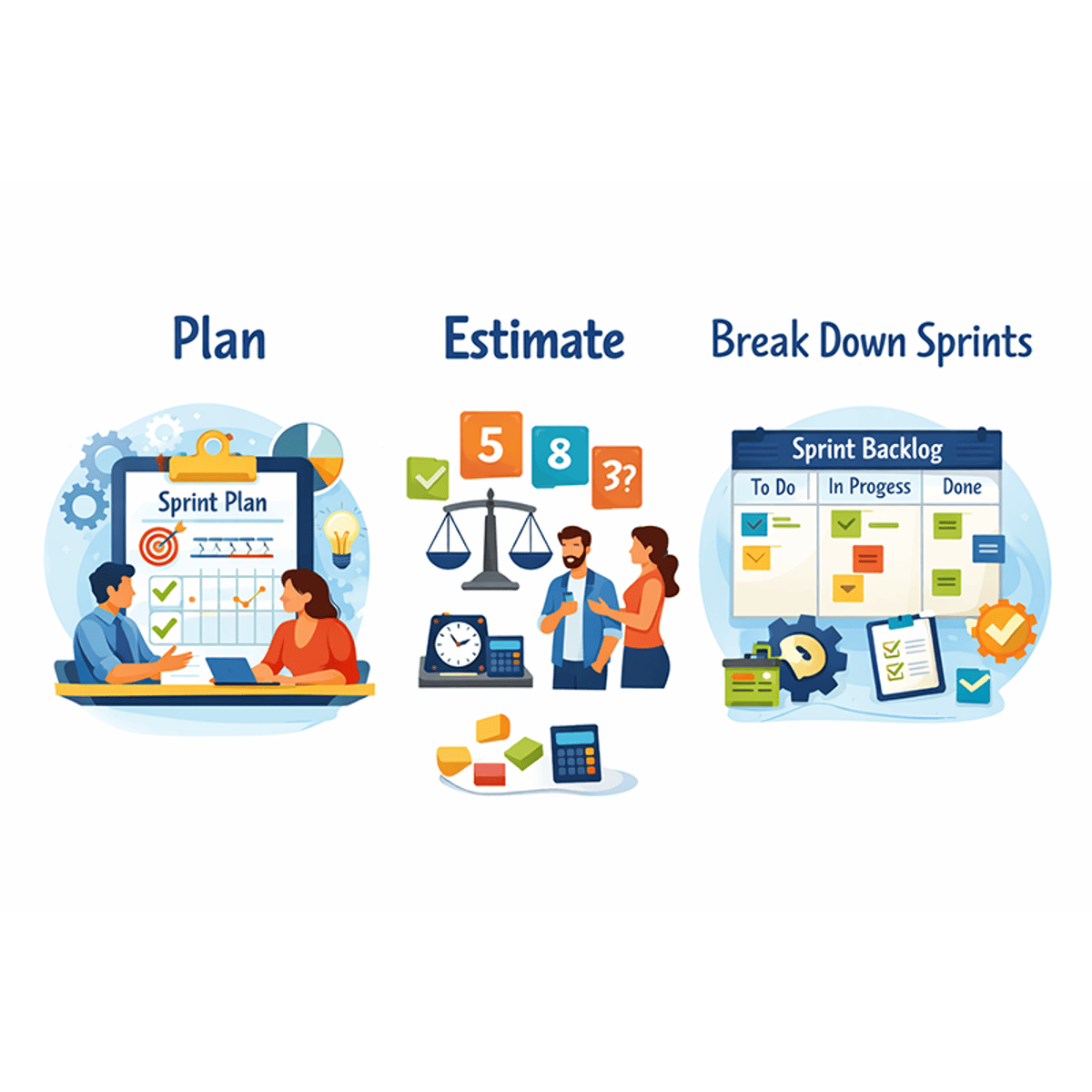
Move from participating in sprints to actively planning them with Plan, Estimate, and Break Down Sprints. This course is designed for any agile team member who wants to master the core mechanics of creating a predictable and successful sprint. You will learn to facilitate and execute the key ceremonies and practices that turn a backlog of ideas into a committed and actionable plan. You will begin by mastering the Sprint Planning ceremony, learning to leverage its structure and time-boxes to drive focus and commitment. Next, you will dive into the art of agile estimation, using story points and collaborative techniques to assess complexity and build a shared understanding of the work. Finally, you will learn the critical skill of deconstruction, breaking down user stories into granular sub-tasks to improve visibility and workflow. By the end of this course, you will be able to analyze, estimate, and structure a sprint backlog in Jira, ensuring your team starts every sprint with a plan that is clear, realistic, and built for success.
 University of Illinois Urbana-Champaign
Travail d'équipe et créativité
Dans ce cours, vous améliorerez votre capacité de travailler de manière créative au sein de n'importe quelle organisation, vous apprendrez à comprendre l'importance et le rôle du travail d'équipe au sein de l'organisation et vous développerez des compétences qui vous différencieront en tant que membre d’une équipe. Les compétences professionnelles liées au travail d'équipe et à la créativité que vous allez acquérir grâce à ce cours vous aideront à réussir dans n'importe quelle organisation.
 Johns Hopkins University
Getting and Cleaning Data
Before you can work with data you have to get some. This course will cover the basic ways that data can be obtained. The course will cover obtaining data from the web, from APIs, from databases and from colleagues in various formats. It will also cover the basics of data cleaning and how to make data “tidy”. Tidy data dramatically speed downstream data analysis tasks. The course will also cover the components of a complete data set including raw data, processing instructions, codebooks, and processed data. The course will cover the basics needed for collecting, cleaning, and sharing data.
 Universidad de los Andes
Sexualidad y educación
La mayor parte de las personas tenemos inquietudes sobre cómo, cuándo y para qué educar a niñas, niños, jóvenes y adultos acerca de la sexualidad. Ya sea como madres, padres, cuidadores, profesores, profesionales de la salud, interesados en los medios de comunicación o en el tema de la sexualidad, con frecuencia nos planteamos preguntas como las siguientes: ¿Para qué educar sobre sexualidad, si existe abundante información al respecto? ¿La educación de la sexualidad debería brindarla la familia o la escuela? ¿A qué edad es adecuado iniciar la educación de la sexualidad? ¿La educación de la sexualidad aumenta la curiosidad sobre este tema? Para responder estos y otros interrogantes planteados por quienes participan en nuestras iniciativas de investigación y en los diferentes procesos educativos que llevamos a cabo, hemos diseñado este segundo curso con respecto a la educación de la sexualidad en diferentes ámbitos. De esta manera también queremos responder a las solicitudes de quienes ya tomaron nuestro primer Curso “Sexualidad… mucho más que sexo” de facilitar el acceso a otros cursos que profundicen en este tema. Si decides realizar este curso, esperamos que al final puedas reconocer claramente qué significa educar en el campo de la sexualidad así como identificar en qué contextos y en qué momentos ocurre esta labor. Igualmente, aspiramos que al terminar este curso, te sientas con mayor seguridad de tu capacidad para garantizar este derecho a otras personas en cualquier contexto en el que vivas o trabajes. En el grupo de Investigación Familia y Sexualidad de la Universidad de los Andes en Colombia tenemos un sueño: Que a todas las personas, sin distinción de ningún tipo, se nos garantice el derecho a contar con información oportuna, útil, confiable y basada en evidencia sobre los diferentes aspectos que nos interesan de la sexualidad. Esperamos que decidas unirte a este desafío, si compartimos el mismo ideal podemos construir una red en la que gracias a tu complicidad y la de otras personas que toman nuestros cursos podemos lograr la transformación social que se requiere para que muy pronto el ejercicio del derecho a la educación de la sexualidad sea una realidad en tú país, en el nuestro y, por qué no, a nivel global. Organizaciones aliadas: La producción de este curso ha contado con el apoyo del Fondo de Población de las Naciones Unidas - UNFPA
 Arizona State University
Managing Conflict
Do you want the best strategies for handling conflict in person, over the phone or in an email? Learn the skills to recognize and address conflicts from this Managing Conflict course!