

Every year, millions of students compete for a coveted seat in a government medical college, but only a fraction make it to the top. When we look at the students who score in the 700+ range, it is easy to assume they possess some superhuman intellect. However, when you dissect a NEET topper's journey, you realize that genius has very little to do with it.
The secret to cracking the National Eligibility cum Entrance Test (NEET) lies in ruthless consistency, strategic planning, and a deep understanding of one's own weaknesses. If you are gearing up for NEET 2026, here is the unfiltered roadmap of how toppers build their success from the ground up.
Phase 1: The Foundation (NCERT Mastery)
The biggest mistake average students make is hunting down complex reference books before mastering the basics. For a topper, the NEET preparation strategy begins and ends with the NCERT textbooks.
- Biology: Toppers don't just read the Biology NCERT; they memorize the diagrams, the image captions, and the summary paragraphs. Every single line is a potential multiple-choice question (MCQ).
- Chemistry: While Physical Chemistry requires practice, Inorganic Chemistry requires pure recall. Toppers often create a dedicated "short notes" notebook specifically for p-block trends, coordination compounds, and periodic properties, revising it endlessly.
- Physics: NCERT is used for understanding core concepts and points to ponder, but the heavy lifting is done through extensive numerical practice.
Phase 2: The Daily Routine of a NEET Topper
A NEET topper's daily routine is a masterclass in time management. They don't study for 18 hours a day; instead, they optimize their cognitive peaks. Most successful candidates aim for 6 to 7 hours of sleep to ensure memory consolidation and avoid burnout.
Here is how a highly optimized study schedule typically looks:
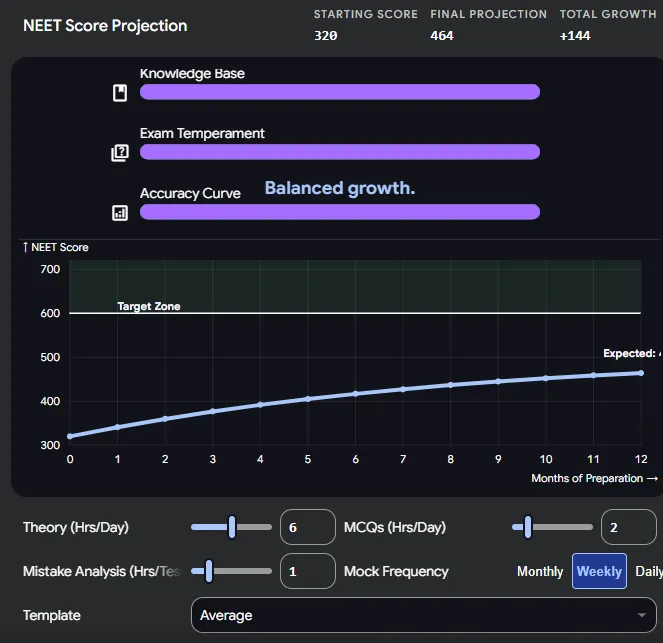
Time BlockFocus AreaWhy It WorksMorning (5:30 AM – 8:30 AM)Biology & Theory RevisionThe brain is fresh, making it the best time to memorize high-yield facts and diagrams.Mid-Day (10:00 AM – 4:00 PM)Classes / CoachingFocused learning of new concepts and taking running notes.Evening (5:00 PM – 8:00 PM)Subject-wise MCQ PracticeApplying what was learned. Toppers aim to solve 100+ MCQs daily across subjects.Night (8:30 PM – 10:30 PM)Physics Numericals & ReviewProblem-solving requires less raw memorization and keeps the mind active.See how small shifts in daily habits compound over an academic year:
Key insight: The gap between an average student and a topper isn't hours spent at the desk—it is the ratio of active recall (MCQs) to passive reading.
Phase 3: Subject-Wise Execution
To crack NEET, you cannot afford to have a "weak" subject. Each requires a distinct tactical approach:
Physics: The Rank Decider
For many medical aspirants, Physics is a nightmare. Toppers treat it like a sport. You cannot learn to swim by reading a book about swimming, and you cannot learn Physics by just reading formulas. They build a customized formula sheet and prioritize high-weightage topics like Mechanics, Thermodynamics, and Modern Physics.
Chemistry: The Bridge Subject
Chemistry connects the logic of Physics with the memory demands of Biology.
- Organic: Master reaction mechanisms and name reactions.
- Inorganic: Rote learning via spaced repetition flashcards.
- Physical: Daily numerical practice, similar to Physics.
Biology: The Score Booster
Accounting for 50% of the total marks (360/720), Biology is where speed matters. Toppers train themselves to read and solve Biology MCQs in under 45 minutes during the actual exam, buying them precious extra time for Physics calculations.
Phase 4: Mock Tests and the "Mistake Book"
If there is one universal secret in every NEET topper success story, it is the "Mistake Book."
Taking NEET mock tests is only half the battle. Average students look at their score and move on. Toppers spend as much time analyzing the test as they did writing it. For every incorrect answer, they log it in a dedicated notebook and identify the root cause:
- Was it a conceptual gap? (Go back to the textbook).
- Was it a silly mistake? (Reading "incorrect" as "correct").
- Was it a time-pressure guess? (Improve time management).
In the final weeks leading up to the exam, this Mistake Book becomes their primary revision material, ensuring they never repeat the same error twice.
Phase 5: The Exam Hall Mindset
The final test is psychological. You can know everything, but if you panic, your rank plummets. In the actual exam hall, time management is ruthless. A proven strategy is the 55-50-45 rule:
- Biology: 45 minutes
- Chemistry: 50 minutes
- Physics: 55 minutes
They never change their answering sequence on the final day. If they always attempted Biology first in mocks, they do Biology first in the real exam. Furthermore, they fill the OMR sheet meticulously—reading every question twice, confirming the answer, and only then bubbling the sheet. Carelessness kills ranks.
The Final Word
The journey of a NEET topper is not glamorous. It is a grind of early mornings, endless MCQs, and the mental resilience to bounce back from low mock test scores. By prioritizing NCERT, maintaining a disciplined daily routine, and religiously analyzing your mistakes, you are not just studying for an exam; you are training to be a doctor.