

The Global Scholarly Directory.
Discover world-class academic programs curated for the modern intellectual. Search through 19877+ degrees and professional certificates.
 Microsoft
Create Machine Learning Models in Microsoft Azure
Machine learning is the foundation for predictive modeling and artificial intelligence. If you want to learn about both the underlying concepts and how to get into building models with the most common machine learning tools this path is for you. In this course, you will learn the core principles of machine learning and how to use common tools and frameworks to train, evaluate, and use machine learning models. This course is designed to prepare you for roles that include planning and creating a suitable working environment for data science workloads on Azure. You will learn how to run data experiments and train predictive models. In addition, you will manage, optimize, and deploy machine learning models into production. From the most basic classical machine learning models, to exploratory data analysis and customizing architectures, you’ll be guided by easy -to-digest conceptual content and interactive Jupyter notebooks. If you already have some idea what machine learning is about or you have a strong mathematical background this course is perfect for you. These modules teach some machine learning concepts, but move fast so they can get to the power of using tools like scikit-learn, TensorFlow, and PyTorch. This learning path is also the best one for you if you're looking for just enough familiarity to understand machine learning examples for products like Azure ML or Azure Databricks. It's also a good place to start if you plan to move beyond classic machine learning and get an education in deep learning and neural networks, which we only introduce here. This program consists of 5 courses to help prepare you to take the Exam DP-100: Designing and Implementing a Data Science Solution on Azure. The certification exam is an opportunity to prove knowledge and expertise operate machine learning solutions at cloud scale using Azure Machine Learning. This specialization teaches you to leverage your existing knowledge of Python and machine learning to manage data ingestion and preparation, model training and deployment, and machine learning solution monitoring in Microsoft Azure . Each course teaches you the concepts and skills that are measured by the exam.
 University of Colorado Boulder
International Finance and Accounting
This course provides a thorough introduction to international finance and accounting — the nervous system of global business! You will begin by exploring the global financial system and important topics in financial management, including cross-border payment methods, tax planning, and transfer pricing. You will then cover the fundamentals of the foreign currency exchange (forex) market, addressing its size, scope, and key risk management "hedging" strategies. Next, you will turn to international financial accounting, with a comparative look at GAAP and IFRS accounting standards. Finally, the course discusses international accounting management, focusing on tax and forex accounting and the importance of strong international accounting systems. Upon completion of the course, you will be empowered with actionable expertise in international finance and accounting management! This course is designed to benefit anyone engaged in or curious about international business, especially those interest in foreign currency exchange, international finance, or cross-border transactions. Only a basic understanding of business concepts is required; key topics are briefly reviewed to accommodate participants with diverse backgrounds. This approach ensures that anyone interested in international business can participate confidently and succeed in the course.
 Johns Hopkins University
Registro civil y estadísticas para la salud de la población
En este curso, aprenderá sobre el papel y la importancia de los sistemas de registro civil y estadísticas vitales (CRVS) que se utilizan para hacer un seguimiento de los nacimientos, las defunciones y los acontecimientos vitales. Expertos de todo el mundo explicarán qué son los sistemas CRVS, cómo se utilizan, las bases jurídicas para registrar acontecimientos vitales y los retos que plantean los sistemas CRVS. Aprenderá cómo se pueden utilizar los datos de la CRVS para fundamentar la toma de decisiones a nivel poblacional, incluso en torno a métodos específicos como la certificación médica de la causa de la muerte (MCCOD) y la autopsia verbal, y la aplicación de una perspectiva de género y equidad a los sistemas de datos para garantizar que responden a las necesidades de las poblaciones. Nuestros objetivos generales para el curso son apoyar la recopilación de datos sobre defunciones y nacimientos a nivel nacional, mejorar el uso de los datos para fundamentar las prioridades políticas, seguir las tendencias y planificar las intervenciones, y mejorar el seguimiento de los principales factores de riesgo de muerte prematura, especialmente por enfermedades no transmisibles. El curso es el resultado de la colaboración entre varios colaboradores, como Vital Strategies, los Centros para el Control y la Prevención de Enfermedades (CDC), la Fundación CDC, la Escuela Bloomberg de Salud Pública de Johns Hopkins, Global Health Advocacy Incubator y la Universidad de New South Wales, en Sídney. Este curso ha sido financiado por Bloomberg Philanthropies, con cofinanciación del gobierno australiano y la Fundación Bill y Melinda Gates.
 University of Pennsylvania
ESG Impact: Investor Perspective
In this course, you will analyze the importance of assessing stakeholder interest or salience in different ESG factors and industry variances. You will also evaluate the importance of ESG factors in your investment decisions, including how you can use them to create socially responsible portfolios with better-than-average returns. You will also examine the risks associated with ESG investing and how they can affect the corporation’s profitability. Next, you will review the concepts of positive and negative screening and identify the ESG factors that cause investors to divest from or negatively screen certain assets. You will review ESG risks associated with climate, diversity, executive compensation, governance issues, and evaluate how corporate performance and stock prices correlate to ESG scores. You will also examine how ESG adoption could accelerate the growing trend of fossil fuel divestment, its minimal impact on returns, and what this means long term. Finally, you will analyze quantitative and qualitative measurements and explore different protocols, such as MSCI, to evaluate and provide ESG ratings that can affect stakeholder and investor interest. By the end of this course, you will have explored how ESG investing has grown, assessed the variety of ways it has been integrated into the market, and analyzed the complex indexing and measurement techniques employed in the ESG space today.
 EDUCBA
Analyze Money Markets and Short-Term Financial Instruments
By the end of this course, learners will be able to analyze the structure and purpose of money markets, identify and evaluate key money market instruments, explain Treasury Bill issuance and auction mechanisms, and assess the role of repurchase agreements in global financial systems. This course provides a clear and practical understanding of money markets, which are essential to short-term financing, liquidity management, and monetary policy transmission. Learners will explore how financial institutions, governments, and central banks use money market instruments to manage cash flows and mitigate risk. The course covers core instruments, U.S. Treasury Bills, auction processes, and repo market operations, along with a comparative view of U.S. and European repo markets. Designed for finance professionals, students, and aspiring investment banking or operations roles, the course emphasizes real-world market practices rather than abstract theory. What makes this course unique is its structured progression from foundational concepts to applied market mechanisms, supported by practice quizzes and graded assessments that reinforce decision-making skills. By completing this course, learners will gain industry-relevant knowledge that strengthens their understanding of short-term markets and enhances their readiness for roles in banking, treasury, and financial operations.
 University of Michigan
Community Awareness: Negotiating for Financial Success
Most financial literacy courses teach you how to budget, save, invest, and manage credit. But they overlook one critical skill that determines whether you actually gain value from those decisions: negotiation. Every major financial milestone involves negotiation—buying a car, renting an apartment, negotiating a salary, or launching a business. You may understand the numbers, but without the ability to negotiate effectively, you risk leaving money and opportunity on the table. This course bridges that gap by showing you how to turn financial knowledge into financial success. In Negotiation for Financial Success, you will focus on the most important stage of any negotiation: preparation. You’ll learn how to identify your reservation price, target, stretch goal, and BATNA (Best Alternative to a Negotiated Agreement), and how to use these tools to strengthen your bargaining position. You’ll also explore ethical considerations, cross-cultural negotiations, and strategies for assessing your negotiation style. This course serves as unit one of the highly popular Successful Negotiation: Essential Strategies and Skills program, giving you a strong foundation for preparing to negotiate the deal, close the agreement, and manage performance.
 LearnQuest
Combining Scrum with Other Agile Methodologies
This course is designed to help Scrum beginners become more proficient with Agile Scrum. This course explores layering other Agile methodologies on top of Scrum. This is the fourth course in the Certified Scrum Master specialization. We recommend completing the first three courses before beginning this one.
 IE Business School
From Brand to Image: Creating High Impact Campaigns That Tell Brand Stories
There are many different ways to approach clients to assess their needs and develop creative campaigns which fulfill your creative desires. Many agencies have established methodology, terminology and processes, and oftentimes, have spent decades or even years developing these processes. However, whether you are a freelancer, designer, illustrator, photographer or marketing director, or perhaps a small business owner, you will be looking to develop a simple process to create campaigns for yourself or your client. In this course I am offering you a methodology which you can easily put into practice. Then, as your needs change and grow, you might decide that you want to incorporate other techniques as well. I hope this course serves as a launchpad for you to go out and win new creative projects as well as make the ones that you are currently working on even better. And most of all, I hope you have FUN! Because remember, if you're not having fun, it's not worth it!
 Illinois Tech
Communicating Science
This course presents strategies for scientists to use when engaging a variety of audiences with scientific information. Students will learn to communicate their knowledge through both textual and visual strategies, as well as practice document preparation using appropriate formatting, style, and graphics. Written assignments, discussion questions, and communication exercises will provide students with a better understanding of the relationship between scientists and diverse audiences, whether in the workplace, laboratory, or other environments. Upon successful completion of this course, you will be able to: - Explain key strategies for communicating scientific information to a variety of audiences. - Analyze a communicative situation and its context to determine audience needs. - Design visual and textual forms of scientific communication that meet the needs of a diverse range of audiences. - Prepare documents using formatting, style, and graphics that are appropriate for the situation. Software Requirements: R (preferably RStudio), document creation software (Microsoft Word, LaTeX, Google Docs, etc.)
 University of California San Diego
Genomic Data Science and Clustering (Bioinformatics V)
How do we infer which genes orchestrate various processes in the cell? How did humans migrate out of Africa and spread around the world? In this class, we will see that these two seemingly different questions can be addressed using similar algorithmic and machine learning techniques arising from the general problem of dividing data points into distinct clusters. In the first half of the course, we will introduce algorithms for clustering a group of objects into a collection of clusters based on their similarity, a classic problem in data science, and see how these algorithms can be applied to gene expression data. In the second half of the course, we will introduce another classic tool in data science called principal components analysis that can be used to preprocess multidimensional data before clustering in an effort to greatly reduce the number dimensions without losing much of the "signal" in the data. Finally, you will learn how to apply popular bioinformatics software tools to solve a real problem in clustering.
 Universidades Anáhuac
Maya Culture in Yucatan
Explore the essence of one of Latin America’s most significant civilizations: the Mayans. This course takes you on a journey through the key elements of Mayan culture in Yucatán, offering essential insights into their society, history, religion, the role of women, traditions, attire, and architecture, along with the enduring legacies that remain today. Dive into the heart of their development in the Yucatán Peninsula, home to iconic archaeological sites such as Chichén Itzá, Uxmal, Edzná, and Calakmul. This remarkable civilization that made these lands their own, left an indelible mark on history. You’ll explore the Mayans’ worldview, their religious beliefs, their unique numerical and writing systems, and their intricate calendars. Delve into the various theories about their decline following the arrival of the Spanish. Learn how the descendants of this ancient culture live today, how they’ve preserved their heritage, and the challenges they face in modern Yucatán. Be inspired and join us on this fascinating journey!
 Universidades Anáhuac
Filosofía, Ciencia y humanidad
¡Bienvenido a un viaje de reflexión y descubrimiento! Este curso es una invitación a explorar las grandes preguntas que nos definen como seres humanos. A través de la filosofía, la ciencia y las ideas que han dado forma a nuestra historia, descubrirás nuevas perspectivas sobre la existencia, la sociedad y nuestra relación con el mundo.Aquí, más que buscar respuestas definitivas, aprenderás a cuestionar, analizar y conectar ideas que te permitirán entender mejor quién eres y cuál es tu lugar en el universo. Este es un espacio para desafiar tus propias creencias, expandir tu pensamiento y encontrar nuevas formas de mirar el mundo y a ti mismo.Prepárate para sumergirte en un aprendizaje transformador que te acompañará más allá del aula. ¡Comencemos!
 Koç University
Doğrusal Cebir II: Kare Matrisler, Hesaplama Yöntemleri ve Uygulamalar / Linear Algebra II: Square Matrices, Calculation Methods and Applications
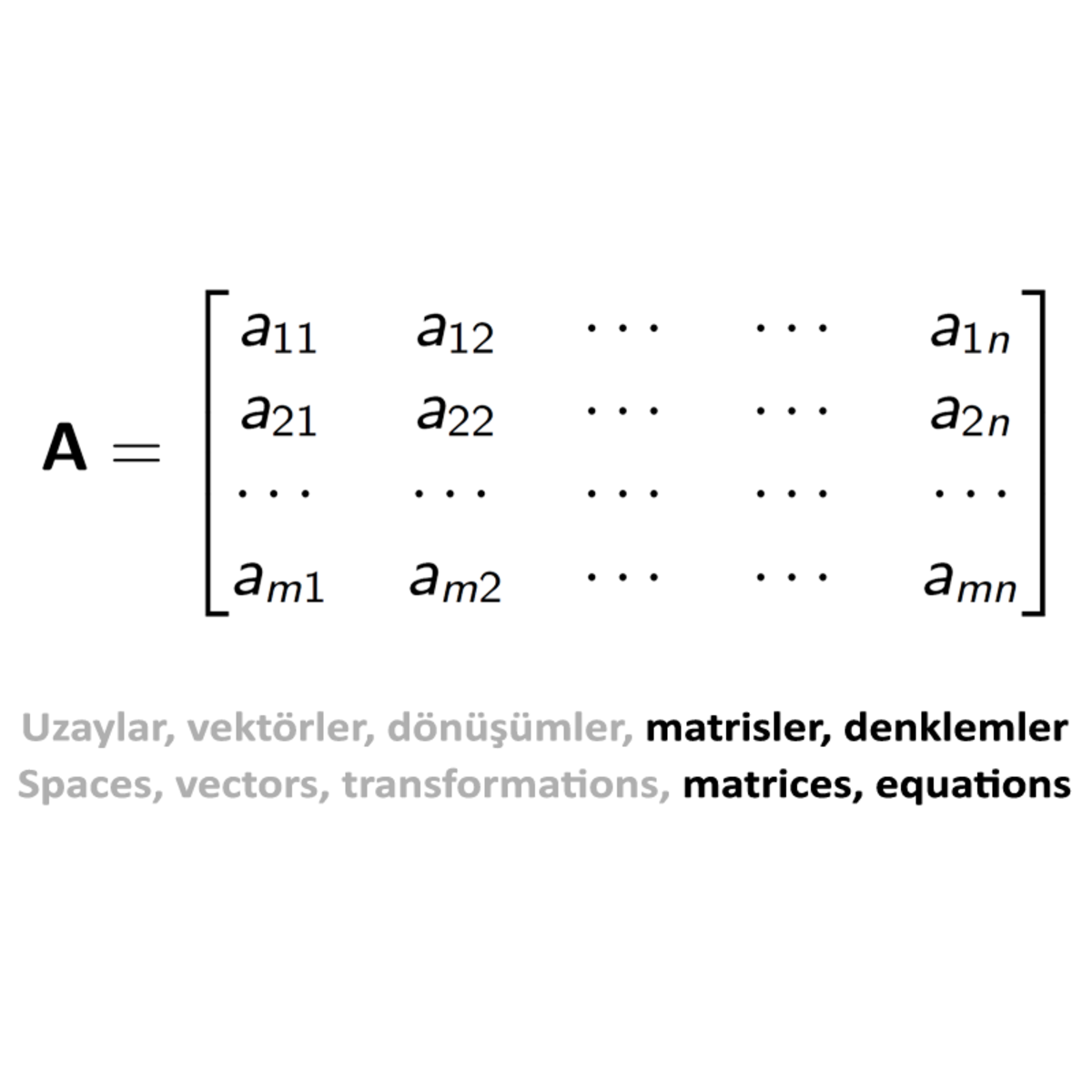
Doğrusal cebir ikili dizinin ikincisi olan bu ders birinci derste verilen temel bilgilerin üzerine eklemeler yapılarak tamamen matris işlemleri ve uygulamalarını kapsamaktadır. Cebirsel denklem sistemleri, sonuçların tekilliği ve var olup olmadığı, determinantlar ve onların doğal olarak nasıl oluştuğu, öz değer problemleri ve onların matris fonksiyonlarına uygulanışı vb. konulara derste değinilmektedir. Ders gerçek yaşamdan gelen uygulamaları da tanıtmaya önem veren “içerikli yaklaşımla” tasarlanmıştır. Bölümler: Bölüm 1: Doğrusal Cebir I'in Özeti Bölüm 2: Kare Matrislerde Determinant Bölüm 3: Kare Matrislerin Tersi Bölüm 4: Kare Matrislerde Özdeğer Sorunu Bölüm 5: Matrislerin Köşegenleştirilmesi Bölüm 6: Matris Fonksiyonları Bölüm 7: Matrislerle Diferansiyel Denklem Takımları ----------- This second of the sequence of two courses builds on the fundamentals of the first course, is entirely on matrix algebra and applications. Specifically, the studies include systems of algebraic equations including the existence and uniqueness of solutions, determinants and how they arise naturally, eigenvalue problems with their applications to diagonalization and matrix functions. The course is designed in the same spirit as the first one with a “content based” emphasis, answering the “why” and “where“ of the topics, as much as the traditional “what” and “how” leading to “definitions” and “proofs”. Chapters: Chapter 1: Summary of Linear Algebra I Chapter 2: Determinant Chapter 3: Inverse of Square Matrices Chapter 4: Eigenvalue Problem in Square Matrices Chapter 5: Diagonalization of Matrices Chapter 6: Matrix Functions Chapter 7: Matrices and Systems of Differential Equations ----------- Kaynak: Attila Aşkar, “Doğrusal cebir”. Bu kitap dört ciltlik dizinin üçüncü cildidir. Dizinin diğer kitapları Cilt 1 “Tek değişkenli fonksiyonlarda türev ve entegral”, Cilt 2: "Çok değişkenli fonksiyonlarda türev ve entegral" ve Cilt 4: “Diferansiyel denklemler” dir. Source: Attila Aşkar, Linear Algebra, Volume 3 of the set of Vol1: Calculus of Single Variable Functions, Volume 2: Calculus of Multivariable Functions and Volume 4: Differential Equations.
 Packt
Packt
Cyber Security for Absolute Beginners – Part 1
This course features Coursera Coach! A smarter way to learn with interactive, real-time conversations that help you test your knowledge, challenge assumptions, and deepen your understanding as you progress through the course. This course offers a comprehensive introduction to cyber security, focusing on key concepts such as computer networks, hacking techniques, cyber attacks, malware, and defenses. By the end, you'll gain a solid understanding of cyber security's core principles and how to protect systems from threats. The course covers essential topics like information security vs. cyber security, the CIA triad, and the basics of networking. You'll also explore common cyber attacks, such as brute force, phishing, and SQL injections, while delving into the types of malware and various protective measures. Throughout your journey, you'll learn about the role of hackers, their tactics, and methodologies, as well as the impact of cyber attacks like DDoS and ransomware. You'll also gain knowledge of the tools used to safeguard systems, including firewalls, encryption, antivirus software, and multi-factor authentication. The course will also touch on cyber security in the workplace, exploring policies and strategies organizations use to protect their data and networks. This course is ideal for those starting their cyber security journey, with no prior technical knowledge required. Whether you're looking to break into the field of cyber security or simply want to understand how to protect yourself and your data, this course is for you. By the end of the course, you will be able to differentiate between information security and cyber security, identify various types of cyber attacks and malware, implement basic defenses to protect systems, and understand the significance of cyber security in modern workplaces.
 DeepLearning.AI
Нейронные сети и глубокое обучение
Этот курс поможет вам ознакомиться с новейшими технологиями искусственного интеллекта. Инженеры по глубокому обучению сейчас широко востребованы, освойте методы глубокого обучения и перед вами откроются многочисленные карьерные возможности. Глубокое обучение также можно считать новой «сверхспособностью», с помощью которой вы будете строить такие ИИ-системы, которые невозможно было создать еще пару лет назад. В этом курсе вы познакомитесь с основами глубокого обучения. После завершения курса вы: - будете иметь представление об основных технологических тенденциях, движущих вперед область глубокого обучения; - сможете строить, обучать и применять полносвязные глубокие нейронные сети; - будете знать, как реализуются эффективные (векторизованные) нейросети; - получите представление о ключевых параметрах архитектуры нейронной сети Данный курс также позволяет разобраться, как в реальности действует глубокое обучение, а не просто дает его поверхностное описание. Поэтому после завершения курса вы сможете применять глубокое обучение в собственных приложениях. Если вы ищете работу в области ИИ, то после прохождения данного курса вы также сможете ответить на простые вопросы в ходе собеседования. Это первый курс специализации «Глубокое обучение».
 Packt
Packt
Advanced Networking Services and Routing
This course features Coursera Coach! A smarter way to learn with interactive, real-time conversations that help you test your knowledge, challenge assumptions, and deepen your understanding as you progress through the course. This advanced course covers key networking services and routing concepts, providing a deeper understanding of how modern networks operate. You will explore routing techniques, dynamic protocols, and the role of multiple routers in complex networks, along with how routers make routing decisions and utilize different routing tables. We will also dive into network address translation (NAT), DHCP, and DNS, explaining how they support network management and domain name resolution. You’ll understand the importance of VPNs for secure communication, learn about IP packet transmission, and the differences between static and dynamic routes. Ideal for IT professionals and network engineers, this course requires foundational networking knowledge. By the end of the course, you will be able to configure dynamic routing, use NAT for efficient IP management, implement DNS for network resolution, and ensure secure communications with VPN technologies.