

The Global Scholarly Directory.
Discover world-class academic programs curated for the modern intellectual. Search through 19877+ degrees and professional certificates.
 Coursera
Crea un mapa mental interactivo usando Canva
Al final de este proyecto, usted creará un mapa mental interactivo que será compatible con equipos, organizaciones empresariales o con el público al que usted quiera comercializar. Usted podrá incorporar un esquema de colores, imágenes y otros elementos de diseño que atraerá su público. Usted aprenderá a incorporar tanto diseños cómo elementos audiovisuales y acústicos su mapa mental. Al final preparará su mapa mental para compartir y publicarlo incorporando enlaces URL. Este proyecto incluirá una introducción a Mindmaps en Canva, un uso para Canva que no es tan conocido, es muy útil para crear ideas y estrategias y efectivamente comunicarlas. Usted también aprenderá cómo agregar funciones interactivas a su mapa mental . Nota: Este curso es de mayor utilidad para estudiantes que residen en la región de América del Norte. Actualmente, estamos trabajando para proporcionar la misma experiencia en otras regiones.
 Khalifa University
AI for Executives: The Basics
AI for Executives: The Basics gives managers a practical, non-technical introduction to artificial intelligence and machine learning for business decision-making. You’ll learn how AI fits into executive strategy, what ML models can and can’t do, and how to lead data-driven initiatives that create measurable value. Starting with the fundamentals, the course explains algorithms vs. models, core ML tasks, and the lifecycle for building and governing solutions. You’ll then design a data strategy—covering data quality, privacy, and responsible use—before applying techniques such as regression, decision trees, and modern large language models (LLMs) to real executive-level use cases. Finally, you’ll put it together by planning AI pipelines, evaluating model performance and non-functional properties, and knowing when to customize or reuse off-the-shelf models. Hands-on assignments use familiar tools and require no coding. By the end, you’ll be able to map business problems to the right AI approach, communicate with technical teams, and build an informed roadmap for adopting AI across your organization.
 Skillshare
Figma UI UX Design Essentials Pt.2: Layout & Components
In Part 2 of the Figma UI UX Design Essentials series, you’ll take your design skills to the next level by learning how to build clean, flexible layouts and reusable components. With Dan Scott as your instructor, you’ll move beyond the basics and explore powerful features like Auto Layout, Constraints, and Component Variants—tools essential for designing responsive, scalable UI. You’ll also dive deeper into visual design, learning how to use color styles, text styles, grids, and effects to bring consistency and polish to your work. Along the way, you’ll complete hands-on class projects that mimic real design challenges, giving you practical experience you can use in client work or your portfolio. This course is ideal for learners who already understand Figma’s interface and want to start designing like a professional. What sets it apart is its step-by-step approach to demystifying more advanced tools—so even intimidating concepts like nested components and naming conventions feel approachable and manageable. Instructor bio: Daniel Walter Scott is a digital designer, Adobe Certified Instructor, and founder of Bring Your Own Laptop (BYOL). With over 14 years of teaching experience, he has helped thousands of learners worldwide master design and creative software across print, web, video, and now 3D. Daniel is an Adobe Certified Expert and Adobe Certified Instructor who combines industry expertise with a teaching style that’s practical, engaging, and memorable. Originally from New Zealand, Daniel has lived and taught across Australia, Ireland, and beyond—sharing his skills with a truly global creative community. He’s passionate about helping students build real-world skills they can carry into their careers and creative projects. When he’s not teaching, Daniel enjoys life with his Irish wife and kids. He brings this personal, down-to-earth perspective into his courses, making complex tools feel approachable and fun to learn.
 University of Michigan
Climate Change, Sustainability, and Global Public Health
The third course of the Impacts of the Environment on Global Public Health specialization will introduce you to two major environmental health challenges facing the world today. The first is climate change –the preeminent threat to public health today, and a threat that will impact every human and ecosystem on the planet. We will evaluate the causes and impacts of climate change, as well as policies and approaches that can be used to reduce the impacts of climate change on human health. The second is sustainability, a concept that can be applied to reduce the impacts of human activities on the environment as well as human health. We will explore different sustainability frameworks, as well as the effects of different energy generation sources on the environment and public health.
 Google Cloud
Sécuriser GKE avec Cloud Next Generation Firewall
Ce cours, le dernier de la série "Configurer le pare-feu nouvelle génération", vous montre comment sécuriser votre infrastructure GKE à l'aide des stratégies Cloud Next Generation Firewall (NGFW). Vous apprendrez à utiliser les stratégies Cloud NGFW pour protéger les clusters et les pools de nœuds individuels.
 Coursera
Advanced Tricentis Tosca Automation Strategies
Advanced Strategies for Tricentis Tosca Automation Mastery is an advanced-level course designed to help experienced test automation engineers enhance their skills in using Tricentis Tosca for complex automation scenarios. As testing environments become more intricate, success depends on your ability to optimize automation workflows, integrate with CI/CD pipelines, and ensure robust, failure-resilient test execution. In this course, you'll learn to master advanced Tosca features such as distributed execution (TCI), API testing, database validation, and the implementation of recovery scenarios. Through hands-on activities, interactive discussions, and real-world case examples, you'll explore tools like retry mechanisms, error handling, and dynamic data management to build scalable and resilient automation processes. Whether you're streamlining automation pipelines or handling complex test environments, this course will help you develop strategies to optimize, scale, and recover from test failures—ensuring consistent, reliable test results in unpredictable conditions.
 EDUCBA
Build iOS Apps with Swift UI Components
Learners will build, implement, and manage core iOS user interface components using Swift and UIKit to create functional, data-driven mobile applications. By the end of this course, learners will be able to design table views and collection views, navigate between view controllers, manage application lifecycle events, validate user input, and implement dynamic layouts programmatically. This course provides a structured, hands-on introduction to iOS development fundamentals, focusing on real-world UI patterns such as lists, grids, headers, footers, segmented controls, and reusable cells. Learners gain practical skills in displaying and managing data, customizing table and collection views, and handling user interactions efficiently using industry-standard UIKit practices. What makes this course unique is its strong emphasis on progressive UI complexity—starting from basic table views and app lifecycle concepts, then advancing to dynamic layouts, custom cells, and programmatic UI creation. Each concept is reinforced through clearly sequenced lessons and applied use cases aligned with professional iOS development workflows. This course is ideal for beginners and aspiring iOS developers who want to confidently build scalable, well-structured iOS interfaces using Swift and UIKit, preparing them for further mobile app development or entry-level iOS roles.
 LearnQuest
Object-Oriented Hierarchies in Java
Object-Oriented Hierarchies in Java is the third of a series of courses in the Core Java Specialization. The Core Java Specialization is part of a series of programming specializations, derived from LearnQuest's private Java Bootcamps, designed to provide the skill set necessary to be hired as an IT developer using Java in many corporate environments. This course includes hands-on practice and will help you build on your knowledge of the Java language. After completing this course, you will have a deeper understanding of how to effectively implement and use inheritance and polymorphism in Java. To be successful in this course, you should have taken: - Course 1: Introduction to Java - Course 2: Introduction to Object-Oriented Programming with Java or have equivalent knowledge.
 Starweaver
Influencing, Collaboration and Decision Making
This course explores strategies for influencing others, collaborating effectively, and making informed decisions. Students will learn how to build credibility, negotiate effectively, and analyze information to make sound judgments and decisions. The course covers techniques to foster a culture of trust and cooperation, resolve conflicts, and make consensus-based decisions. Through interactive exercises and case studies, students will develop their influencing and collaboration skills, enabling them to work effectively with stakeholders at different levels. The course emphasizes the importance of effective communication and the ability to analyze complex information to reach optimal decisions. By the end of the course, students will be equipped with the tools and techniques to influence others, build strong collaborative relationships, and make informed decisions that contribute to organizational success. This course is designed for front-line, junior to mid-level supervisors and manager roles, responsible for leading teams, projects, and processes in a diverse range of organizations. Participants should have a minimum of 3-5 years experience in roles that require leading, supervising, and managing people, projects, and processes critical within organizations.
 Starweaver
Hybrid Electric Vehicles Technical System
Our course, "Hybrid Electric Vehicles Technical System (Operation and Service)," offers a comprehensive understanding of HEVs, covering technical fundamentals, operational characteristics, maintenance protocols, and diagnostic methodologies. Participants will delve into the inner workings of hybrid systems, exploring how electric and internal combustion engines synergize to optimize fuel efficiency and reduce emissions. Through practical application and real-world examples, learners gain insights into maintenance and diagnostic challenges faced in hybrid car servicing, enabling them to tackle diverse issues with confidence and proficiency. The curriculum emphasizes the distinct advantages of HEVs over conventional vehicles, such as regenerative braking and power-split architectures, contributing to efficiency and sustainability. Safety practices and environmental considerations in HEV servicing are highlighted, including protocols for handling high-voltage components and optimizing battery performance. Whether you're an automotive service technician, student, or professional, our course equips you with the skills needed to navigate the complexities of hybrid technology and meet the demands of the evolving automotive landscape.
 Microsoft
Performance Domains in Project Management
This course will teach you how to apply the eight Project Performance Domains throughout the project lifecycle. By understanding these domains, you'll be equipped to effectively manage various aspects of project execution, monitoring, and control. Additionally, you will learn how to implement these domains as an integrated system. You’ll also learn how to tailor your approach, focusing on activities that drive value while recognizing those that may be less relevant in specific project contexts. These skills will help you to steer your projects towards successful outcomes, meeting stakeholders' expectations and delivering tangible results. After completing this course, you’ll be able to: • Identify the Eight Project Performance Domains. • Apply the Eight Project Performance domains throughout a project. • Implement the domains as an integrated system to enable the successful completion of a project. • Recognize each domain will differ from project to project, with some activities proving irrelevant in some project situations. This is a great way to prepare for some useful certifications, such as PgMP - Program Management Professional from PMI, and MSP Practitioner - Managing Successful Programs from AXELOS. Note: This course is also part of the Microsoft Project Management Professional Certificate. If you've already completed this course as part of that program, your progress will be saved and will count towards your completion in this program.
 Coursera
Tirer Parti des Listes Pour un Code Python Plus Simple
À la fin de ce projet, vous serez en mesure de maîtriser les utilisations de la Liste sous python. Tout au long du projet, vous allez apprendre à coder une liste , apprendre à intégrer les structures conditionnelles dans une Liste ,arriver à intégrer la fonction Map dans une liste et finalement d'intégrer Les Listes Python avec les Dictionnaires.
 University at Buffalo
Solar Energy Systems Overview
By the end of this course, learners will have acquired a broad understanding of the history and mechanics behind converting light into electricity, commonly known as photovoltaics (PV). They are empowered to recognize and describe elements of a PV system, enabling them to: compare the most common types of solar cells, sketch a solar PV system, and analyze differences between rooftop and ground mounting configurations. The course explores economic considerations, touching on solar PV costs for residential and commercial use, incentives, and contrasts solar power with fossil fuel and nuclear plants. This course is ideal for anyone interested in entering the solar power sector, whether fresh to the workforce or switching industries. The curriculum is especially useful for engineers, HVAC installers, architects, and building code inspectors. Material includes online lectures, videos, demos, project work, readings and discussions. This is the first course in the Solar PV for Engineers, Architects and Code Inspectors specialization. To learn more about the specialization, check out a video overview at https://youtu.be/XjkKzbXqA6s.
 University of Illinois Urbana-Champaign
Governmental Accounting II and Nonprofit Accounting
This course includes -8 graded quizzes, which are required for completion, and -71 optional practice quizzes for you to check your understanding of key concepts. In this comprehensive course, you will cover a range of topics related to financial reporting for state and local governments. You'll explore fiduciary funds, reconciliation statements, government-wide financial statements, and financial performance analysis. These modules provide a deep dive into the financial reporting requirements and analysis for state and local governments. The course also shifts the focus to nonprofit organizations, regulatory requirements, and financial reporting. You'll learn about nonprofit entities, standards-setting bodies, financial reporting objectives, and various aspects of accounting and financial reporting for nonprofit organizations. Additionally, you'll delve into regulatory, taxation, and performance issues specific to nonprofit entities, including governance and financial statement analysis. These modules provide a comprehensive understanding of the unique financial reporting and regulatory aspects of nonprofit organizations.
 Packt
Packt
Advanced Networking, Security, and Traffic Management in AKS
This course features Coursera Coach! A smarter way to learn with interactive, real-time conversations that help you test your knowledge, challenge assumptions, and deepen your understanding as you progress through the course. In this course, you will gain hands-on experience configuring and securing an Azure Kubernetes Service (AKS) environment, focusing on advanced networking, security, and traffic management. By diving deep into topics like HTTP proxies, egress traffic filtering, and preserving client IP addresses, you'll develop the skills to manage secure and efficient networking solutions in AKS. The course is designed to help you leverage powerful tools such as Calico, Cilium, and Cilium’s Hubble for granular traffic management, as well as integrating security measures like TLS/HTTPS for inter-pod communication and ingress controllers. The course begins with foundational lessons on managing outbound traffic using HTTP proxies and progresses into more complex scenarios like filtering egress traffic and assigning static IPs. You’ll also explore how to secure communications within the AKS environment, from preserving client IP addresses to managing secrets through Azure Key Vault and Kubernetes CSI Volumes. Each module is complemented by detailed demonstrations and real-world scenarios to help reinforce key concepts and provide practical, actionable knowledge. This course is ideal for IT professionals, network engineers, and cloud architects looking to deepen their understanding of Kubernetes security and networking in a cloud-native environment. It is especially beneficial for individuals working with AKS in production environments, or those planning to manage secure and scalable applications using Kubernetes on Azure. By the end of the course, you will be able to confidently configure and secure AKS environments, manage traffic and network policies, ensure data persistence, and implement best practices for securing your Kubernetes workloads.
 Coursera
Building a Business Presence With Facebook Marketing
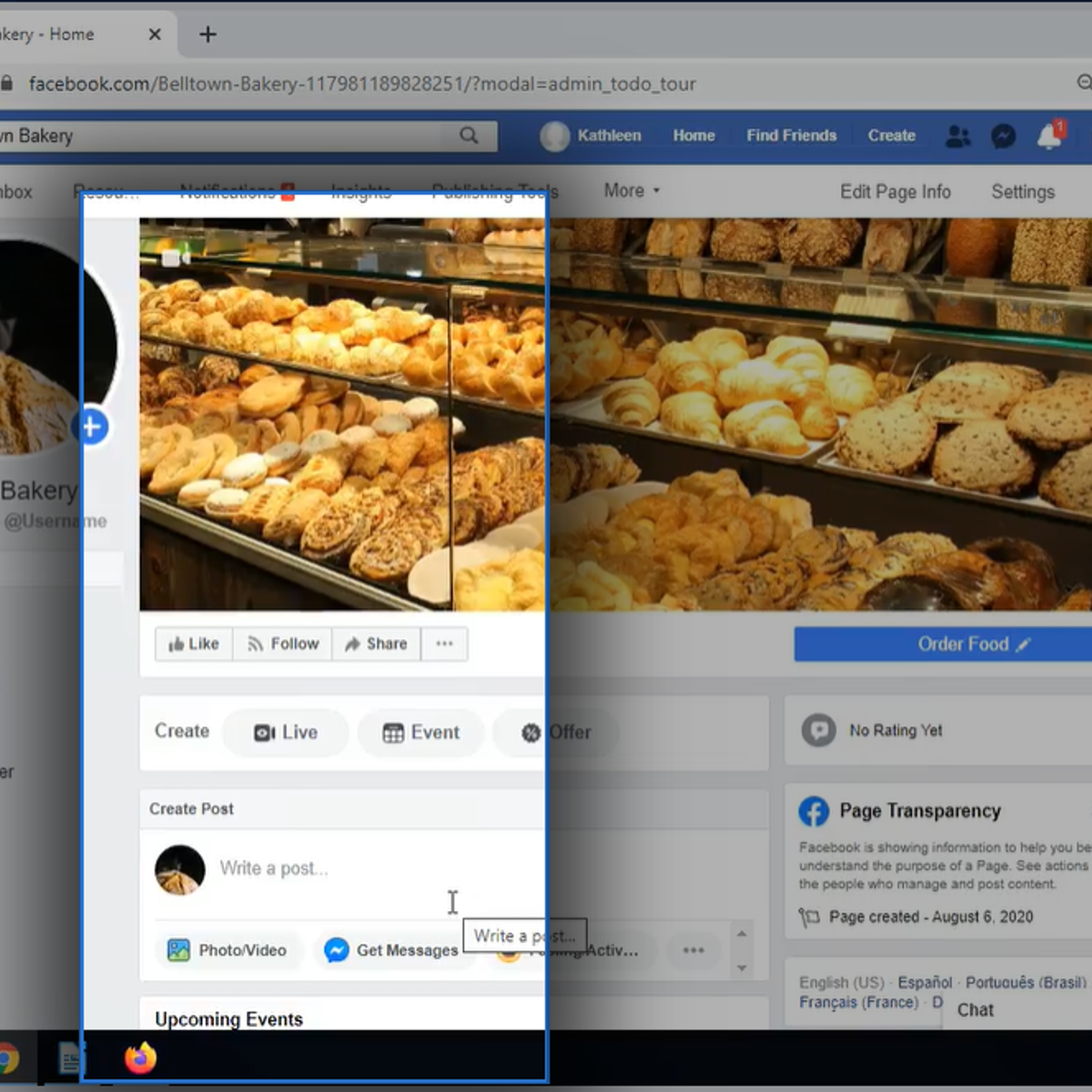
By the end of this project-based course, you will understand the basics of applying Digital Marketing on Facebook. The course will walk you through setting up digital marketing for a fictitious company, the Belltown Bakery in downtown Seattle. The course begins with setting up a fictitious business page on Facebook. You will then learn how to navigate your Facebook account, including setting up advertisements. You will then learn how to post content and boost a post. We will then cover tools available to engage with Facebook users and grow your audience on Facebook.