

The Global Scholarly Directory.
Discover world-class academic programs curated for the modern intellectual. Search through 19877+ degrees and professional certificates.
 LearnQuest
Fundamentals of Kubernetes Deployment
This course is designed to give you a deeper understanding of Kubernetes. Over the next few weeks, you'll learn about several features of Kubernetes, the Kubernetes Architecture, how to create clusters, and different installation configurations. We'll also explore deployments and how they are scaled, updated, and rolled back. We will discuss clusters, pods, and nodes, and dive into Persistent Volumes as well as Kubernetes Authorization and Authentication. Lastly, we'll show you how it all comes together in a Kubernetes demo, so you can see it in action.
 EDUCBA
Master Branch Accounting: Analyze, Apply & Consolidate
Learners will analyze branch structures, apply core accounting methods, evaluate branch profitability, and translate foreign branch results into consolidated financial statements. This course equips participants with the practical and conceptual skills needed to manage dependent and independent branch accounts, reconcile head office–branch discrepancies, and handle advanced adjustments such as loading, stock reserves, and abnormal losses. Through clear explanations, real-world examples, and structured problem-solving, learners gain confidence in preparing Trading and Profit & Loss Accounts, incorporating branch Trial Balances, and performing currency translations for foreign branches. By the end of the course, students will be able to manage incomplete information, conduct reconciliation with accuracy, and prepare consolidated reports that reflect a unified financial view of the enterprise. What makes this course unique is its step-by-step progression from foundational principles to complex scenarios, its use of industry-relevant examples, and its integration of both domestic and international branch accounting techniques. Learners walk away with practical insights that are immediately applicable in accounting, finance, audit, and corporate reporting roles.
 ISC2
ISC2
Risk Identification, Monitoring, and Analysis
Course 3 - Risk Identification, Monitoring and Analysis This is the third course under the specialization SSCP In this course, we will explore how to manage the risks related to information systems. It is time to bring these ideas together in a context of continuous maturity modeling, measuring, and monitoring, which we will see is focused on the here and now. Risk alignment works best at the strategic, long-term level of planning; risk maturation, by contrast, can be most effective when considered in the day-to-day of business operations. This is sometimes called operationalizing the approach to risk management and maturation. Course 3 Learning Objectives After completing this course, the participant will be able to: - Identify common risks and vulnerabilities. - Describe risk management concepts. - Recognize risk management frameworks. - Provide examples of appropriate risk tolerance. - Provide examples of appropriate risk treatment. - Identify risks of noncompliance with laws and regulations. - Identify appropriate methods for risk management frameworks implementation. - Indicate the range and scope of risk review. - Identify the components of risk review. - Describe vulnerability assessment activities used to examine all aspects of network and system security. - Review the steps for monitoring, incident detection, and data loss prevention. - Classify the use of tools that collect information about the IT environment to better examine the organization’s security posture. - Identify events of interest to focus on those that may be part of an attack or intrusion. - Select methods for managing log files. - Describe tools and methods for analyzing the results of monitoring efforts. - Identify communication requirements when documenting and reporting the results of monitoring security platforms. Who Should Take This Course: Beginners Experience Required: No prior experience required
 Board Infinity
Product Manager's Interview Playbook: Strategies for Success
Course Description: This course provides an in-depth examination of the product management interview process, equipping participants with insider strategies for success. Learners will explore the various rounds of product management interviews, emphasizing the importance of behavioral interviews and case studies. The course covers crafting compelling personal narratives and building impactful portfolios to showcase experiences effectively. Participants will master the art of behavioral interviews, develop frameworks for solving product management cases, and navigate analytical and product design questions. Additionally, learners will gain valuable insights into guesstimate questions and receive essential interview tips to enhance their preparation. Designed for aspiring product managers, this course empowers participants to present themselves confidently and effectively during interviews. Learning Objectives: 1. Analyze the stages of the product management interview process to develop tailored preparation strategies for each interview round. 2. Create compelling STAR stories and a professional portfolio that effectively highlight significant achievements and contributions in product management roles. 3. Evaluate various interview techniques for behavioral questions, applying effective communication strategies to demonstrate leadership and problem-solving skills. 4. Apply appropriate frameworks and methodologies to successfully tackle case interviews and guesstimate questions, demonstrating analytical thinking and decision-making abilities. Target Audience: This course is tailored for students seeking a career in Product Management and professionals looking to transition into Product Management roles. It is ideal for individuals who wish to enhance their interviewing skills and deepen their understanding of the product management landscape, preparing them effectively for product management interviews. Prerequisites: -Engineering Degree preferable - not necessary -Basic knowledge of technology company operations Disclaimer: This is an independent educational resource created by Board Infinity for informational and educational purposes only. This course is not affiliated with, endorsed by, sponsored by, or officially associated with any company, organization, or certification body unless explicitly stated. The content provided is based on industry knowledge and best practices but does not constitute official training material for any specific employer or certification program. All company names, trademarks, service marks, and logos referenced are the property of their respective owners and are used solely for educational identification and comparison purposes.
 LearnQuest
Writing Java Application Code
This is the third course in a Specialization titled Java as a Second Language. This course presents instruction to IT professionals for developing Java applications. The material targets professional that are familiar with application programming, but do not have strong Java skills. The type of Java applications focus on: Console based Java applications, Java windows applications, and Java web and mobile applications. This course presents material on developing real applications, and includes hands-on application development labs. Learners will gain strong Java application development skills. The courses in this specialization are cumulative, so you should take courses 1 and 2 prior to this one. This course contains Coursera labs so students can practice their new Java skills. The instructor also provides offline instructions in case you prefer to use your own local Java environment. It is recommended that you take the courses in this Specialization in order because the knowledge is cumulative.
 University of California, Irvine
Fundamentos del Emprendimiento: Pensamiento y Acción
El éxito en los negocios puede aumentar enormemente cuando se comprenden las características de emprendimiento claves y las soluciones basadas en las competencias. En este curso interactivo se brinda el conocimiento que los emprendedores potenciales necesitan para tener éxito en una oportunidad empresarial. Entre los temas se incluyen los siguientes: cómo evaluar de la mejor manera posible la creatividad, la oportunidad y la viabilidad; estrategias de negocios para nuevos emprendimientos; la importancia de un plan de negocios; cómo alcanzar el éxito en un nuevo negocio. Al finalizar el curso, los estudiantes contarán con las aptitudes y la confianza necesarias para evaluar la puesta en marcha de un negocio, y adquirirán un enfoque más emprendedor respecto de la manera de aproximarse al papel que desempeñarán si deciden trabajar en organizaciones.
 Coursera
ArgoCD Essentials: Automating Kubernetes Deployments
In this course, you’ll explore how to automate Kubernetes deployments using ArgoCD, a powerful tool built on GitOps principles. You’ll dive into practical, hands-on activities designed to simplify the complexities of Kubernetes. Whether you’re managing one cluster or many, ArgoCD helps you automate, monitor, and streamline application deployment processes. With real-world examples, configuration walkthroughs, and guided tutorials, you'll be ready to reduce manual tasks and deploy like a pro. This course is designed for professionals working in cloud-native and DevOps environments who are looking to streamline and automate Kubernetes deployments. Ideal participants include DevOps Engineers, System Administrators, Software Developers, and Site Reliability Engineers. If you're someone responsible for managing containerized applications and are eager to adopt GitOps practices to simplify deployment workflows, this course is tailored for you. To get the most out of this course, learners should have a foundational understanding of Kubernetes, including experience using the kubectl command-line tool. Additionally, familiarity with Git version control and working with Git repositories is required, as these are integral to understanding and implementing GitOps workflows with ArgoCD. By the end of this course, you will have the confidence and skills to automate Kubernetes deployments using ArgoCD, transforming complex deployment processes into streamlined, efficient workflows. You’ll understand how to integrate GitOps into your DevOps practices, manage multiple clusters, configure automatic rollbacks, and monitor deployments using Prometheus. Whether you're deploying a single application or managing a fleet of services, you’ll walk away with practical, real-world knowledge to elevate your deployment strategy and reduce operational overhead.
 INSEAD
Web3 and Blockchain Leadership for Transformation
For most of the last century, critical advances in technology were happening inside large, well-funded industrial R&D machines that dotted the Western world. Today’s landscape, however, is very different. Even the largest and most sophisticated corporate leaders can no longer dominate their fields or dictate the pace of development. With companies across sectors seeking to harness the transformative potential of blockchain technologies, the blockchain ecosystem is an exemplar of new models of industry collaboration. In this course you will learn about various stakeholders in the blockchain ecosystem and the leadership roles they need to play in order to steward the blockchain revolution in global commerce. You will discuss various organizational models and best practices for industry consortia and will explore several examples of consortium projects that are at the forefront of the blockchain ecosystem. You will also explore the themes of standardization and interoperability—two major challenge areas concerning the scalability and throughput limitations inhibiting mainstream enterprise adoption of blockchain in global commerce. Development of this course was made possible thanks to the generous support of FedEx. Dale Chrystie, Business Fellow & Blockchain Strategist at FedEx, delivers three of the course videos, bringing a real-world industry perspective to the course. The scripts for these videos have been written and/or reviewed by the Blockchain Research Institute and approved by INSEAD to ensure that this content is pedagogically sound, unbiased, and academically rigorous.
 EDUCBA
Apply Selenium WebDriver with Java for Web Automation
By the end of this course, learners will be able to apply Selenium WebDriver using Java to automate real-world web applications, implement reliable locator strategies, handle dynamic web elements, perform data-driven testing with Excel, and design maintainable automation frameworks using the Page Object Model. This course is designed to help learners transition from understanding Selenium basics to confidently building practical automation workflows. Through a structured, hands-on approach, learners work with a realistic e-commerce case study to automate search functionality, extract and validate dynamic data, and simulate complete user journeys such as adding items to a shopping cart. The course emphasizes best practices for synchronization, data handling, and scalable test design, ensuring learners develop industry-relevant automation skills. What makes this course unique is its strong focus on real-world implementation rather than isolated examples. Learners gain experience with end-to-end automation scenarios, progressive complexity from basics to optimization, and framework-level thinking using proven design patterns. Upon completion, learners will be well-prepared to extend their skills into advanced Selenium frameworks, real project environments, and professional test automation roles.
 Packt
Packt
Splunk Core Certified User (SPLK-1001) Training & Prep Guide
This course features Coursera Coach! A smarter way to learn with interactive, real-time conversations that help you test your knowledge, challenge assumptions, and deepen your understanding as you progress through the course. In this comprehensive training program, you will master the essential skills required to become a certified Splunk Core User. Through hands-on experience and detailed video modules, you will learn to utilize Splunk’s features and functionalities, from basic searching to creating reports and alerts. This course focuses on key concepts like data ingestion, search language fundamentals, and creating meaningful visualizations, making it an ideal choice for anyone aiming to work with Splunk in their career. You will begin by exploring the Splunk interface and understanding its components. The course progresses into more advanced topics, such as using fields in searches, mastering search language commands, and creating powerful dashboards and reports. Along the way, you will practice real-world scenarios using training data, which will help you confidently apply your new knowledge. This course is perfect for aspiring Splunk users, data analysts, and IT professionals seeking to improve their data analytics and reporting skills. There are no strict prerequisites, though familiarity with data management or basic IT concepts can be helpful. It is designed for users at the beginner to intermediate level. By the end of the course, you will be able to navigate the Splunk interface, perform searches, work with data, create reports and dashboards, and configure alerts, empowering you to harness the full potential of Splunk in your organization.
 Banco Interamericano de Desarrollo
¿Qué financiar en salud y a qué precio?
Este curso está dedicado principalmente dirigido a tomadores de decisión y funcionarios públicos que actúan en las áreas de políticas de salud y financiamiento de servicios, especialistas en economía, medicina y derecho a la salud, académicos (investigadores, profesores, estudiantes), formadores de opinión, ciudadanos interesados en aprender acerca de los procesos de decisión y las políticas disponibles, para mejorar la efectividad, calidad y cobertura de los servicios de salud.
 Lund University
Introduction to Particle Accelerators (NPAP MOOC)
Welcome to the Nordic Particle Accelerator Program's (NPAP) Massive Open Online Courses and to the fascinating world of particle accelerators! Did you know that in the year of 2000 there were more than 15 000 particle accelerators in the world? Yet, today it has grown to more than 30 000 of them! A third of the particle accelerators are dedicated to medical applications, such as radio therapy, and a half are used for ion implantation in semiconductor devices. Also numerous particle accelerators are used for sterilizing food. Despite these everyday life examples of small particle accelerators, it is the large accelerators, like the Large Hadron Collider at CERN, that most people associate with particle accelerators. There will be many new applications for particle accelerators in the future and by that there is a need for MOOCs that describe the techniques and applications of these machines.. The NPAP series of MOOCs consists of three MOOCs designed to disseminate knowledge about particle accelerator technology to impacted fields. The courses have been made possible thanks to the support of the Erasmus Plus, Strategic Partnership funding of the European Commission and thanks to the dedicated lecturers from the universities of Lund, Uppsala, Arhus, Oslo and Jyväskylä, and by experts from the MAX IV Laboratory and European Spallation Source (ESS), both in Lund, Sweden. In many of the lectures we detail the MAX IV Laboratory and ESS - currently hosting the most powerful synchrotron light source and neutron source in the world. In the MAX IV Laboratory intense X-ray beams are produced by electrons that are first accelerated to almost the speed of light, and at ESS protons will be accelerated and, by a process called spallation, generate intense beams of neutron. The X-ray and neutron beams are used for looking into matter, down to the atomic level. The MAX IV Laboratory and ESS form a unique European center of excellence for thousands of scientists that together build the world of tomorrow. We also take a closer look at the Large Hadron Collider, at CERN, in Geneva. This powerful machine has already had an immense impact on theoretical physics and will continue to contribute to our knowledge of nature for quite some time. The first course in our NPAP series is the Introduction to Particle Accelerators. It explains how a particle accelerator can generate light of wavelengths down to one Angstrom. It also explains how the ESS facility can create a massive flux of neutrons by accelerating protons and let them smash into a disk of tungsten. The initial modules provide the basic knowledge about linear and circular accelerators that is required to understand other types of accelerators, like the Large Hadron Collider (LHC), at CERN in Geneva. We describe LHC and give an introduction to the elementary particle physics it is used for. We continue by describing some new concepts for future particle accelerators, like plasma driven accelerators. The second MOOC in the series is called "Fundamentals of Particle Accelerator Technology (NPAP MOOC)" and offers four modules: The Radio Frequency (RF) System of Accelerators; Magnet technology for accelerator; Beam Diagnostics; Basics of Vacuum techniques. The third MOOC is - Medical Applications of Particle Accelerators, which offers the four modules: Introduction to the course and radiotherapy; Linear electron accelerators for radiotherapy; Proton therapy part I; Proton therapy part II and the production of medical radionuclides. The three MOOCs can be taken either separately or as a package. For students that intend to take all three courses we recommend that they are taken in order. Get started and join us on this journey through the world of particle accelerators and be amazed by their importance for our lives and societies! Best Regards, The NPAP Team!
 Coursera
AI Model Risk Management
AI models create value, but they also create risks — from data drift and bias to regulatory non-compliance. In this short, practical course, you’ll learn how to make those risks visible, measurable, and governable. First, you’ll explore the main categories of model risk and practice mapping them to governance controls and KPIs. Next, you’ll learn how to evaluate model validation results against standards such as SR 11-7, the Basel Principles, and the EU AI Act, identifying compliance gaps and recommending corrective actions. Finally, you’ll draft a simple model-risk control framework with clear documentation standards, escalation paths, and review cadences. By the end, you’ll be able to demonstrate governance skills that help organizations deploy AI responsibly and maintain trust.
 EDUCBA
Apply SQL Server Fundamentals for Relational Databases
By the end of this course, learners will be able to explain relational database concepts, configure MS SQL Server, create databases and tables, enforce data integrity using constraints, and retrieve data using structured SQL queries. This beginner-friendly course provides a comprehensive introduction to MS SQL Server and relational database management. Learners start with core database concepts such as RDBMS principles and database planning, then progress to installing and navigating SQL Server tools like SQL Server Management Studio. The course systematically builds practical skills in defining databases and tables, applying constraints, inserting records, and writing SQL queries ranging from basic SELECT statements to advanced joins and aggregations. Designed with a clear modular structure, the course balances conceptual understanding with hands-on SQL practice, reinforced through video-wise MCQs, lesson-level practice quizzes, and graded module assessments. Each topic follows a logical progression, making it ideal for learners with no prior database experience. What makes this course unique is its end-to-end beginner pathway—covering not just SQL syntax, but also SQL Server architecture, tools, and real-world database design considerations. Upon completion, learners will have a strong foundation to pursue advanced SQL, data analysis, or database development roles.
 Erasmus University Rotterdam
Business Model Innovation for Sustainable Landscape Restoration
Land degradation is a widespread problem across the globe with serious consequences for the environment and all of society. Worsening land degradation caused by human activities is undermining the well-being of two-fifths of humanity, driving species extinctions and intensifying climate change. But there’s a huge potential for restoring landscapes: around two billion hectares of land, about two times the size of China, can be restored. In this MOOC we focus on the potential of business model innovation for the challenge of large-scale landscape restoration. We take a partnership approach and make a bridge between ecology and economy. Learners get to design their own innovative business model for landscape restoration with 4 returns: return of natural capital, return of social capital, return of inspiration and return of financial capital. You move from ideation towards successful implementation. Each step is illustrated with three real-life cases of landscape restoration in Spain, Iceland and Portugal. We highlight the following elements over a period of 8 weeks: 1. Vision Formulation 2. Systems Analysis 3. Stakeholder Analysis 4. Opportunity Analysis 5. Business Model Design 6. Solution Validation 7. Assessment & Monitoring 8. Reflection & Iteration This MOOC provides you with a meaningful opportunity to start contributing to the UN Decade on Ecosystem Restoration (https://www.decadeonrestoration.org/ ), which aims to prevent, halt and reverse the degradation of ecosystems on every continent and in every ocean. Your participation is more relevant now than ever! This MOOC builds on the MOOC "A Business Approach to Sustainable Landscape Restoration" but can also be followed as a stand-alone. In the first MOOC you get comprehensive knowledge of landscape degradation and landscape restoration from both the perspective of natural science and from an economics and management perspective. (https://www.coursera.org/learn/landscape-restoration-sustainable-development/home/welcome ) These MOOCs are designed by ENABLE, a consortium of: Erasmus University Rotterdam, Commonland, United Nations University Land Restoration Training Programme, Spanish National Research Council (CSIC-CEBAS), and Nova School of Business & Economics. ENABLE was co-funded by the Erasmus+-programme of the European Union.
 Coursera
Prototypes in Figma: Creating an Initial Low Fidelity Design
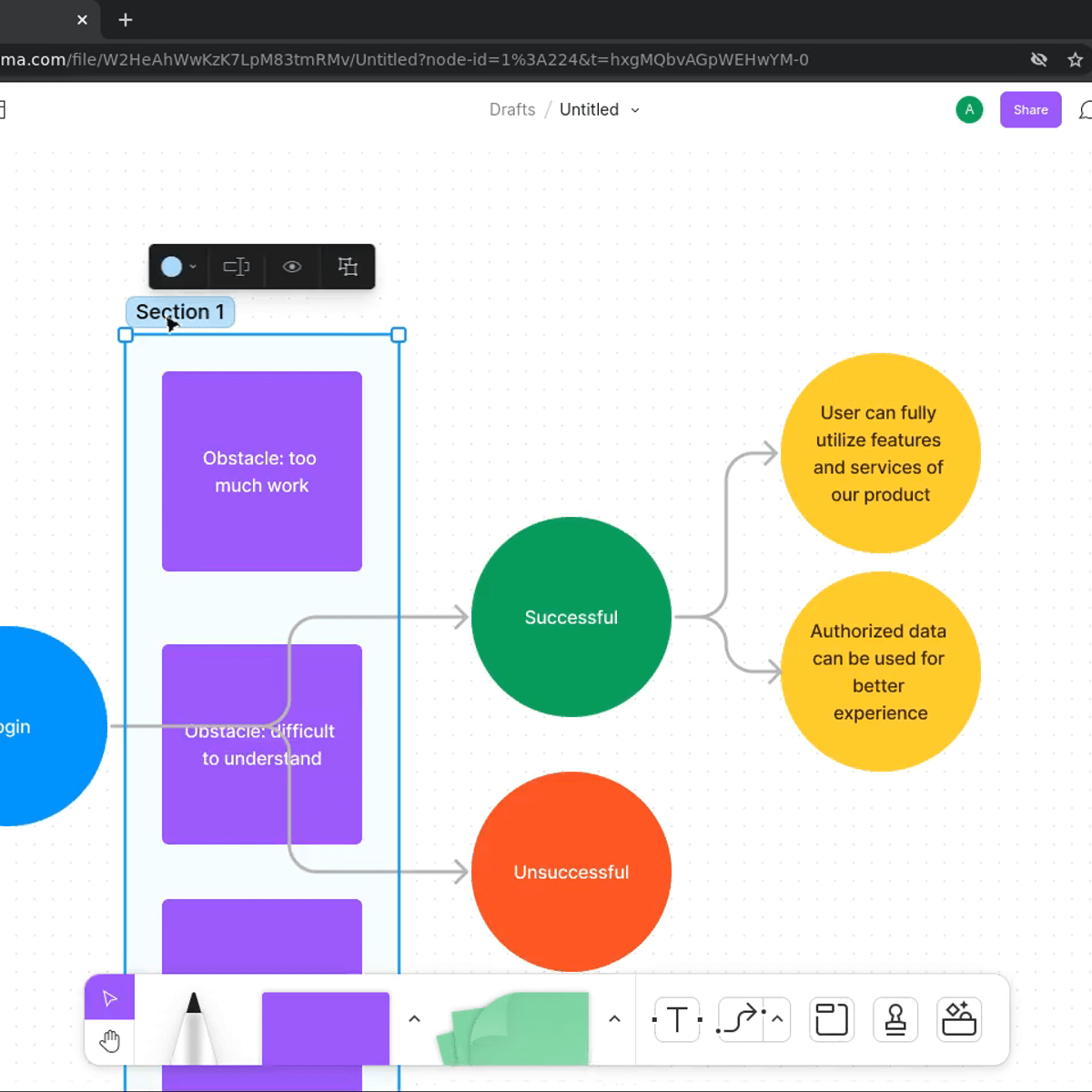
Why should you learn Figma, and UX/UI design and process principles? Figma is currently one of the most used tools in the UX/UI design field, it's simple and powerful. Having solid design and process skills will help you interpret the user's needs and remove roadblocks, creating a smooth and simple user flow. In this 1.5 hours long Guided Project you will learn how to identify and build a user experience process, how to design a user interface and implement a functional user experience prototype. To achieve this we will work through. This project is really unique as it enables you, in a very short time, to think critically and cover all aspects of UX/UI design, building a concrete output for your study and work portfolio. In order to be successful in this project, it will be preferable, however not mandatory, for you to have a basic understanding of UX/UI fundamental principles, and an introductory knowledge of Figma.