

The Global Scholarly Directory.
Discover world-class academic programs curated for the modern intellectual. Search through 19877+ degrees and professional certificates.
 Microsoft
Copilot for Advanced Collaboration in Teams and Outlook
This course is for professionals new to Microsoft 365 Copilot who want to build confidence using AI for communication and collaboration. No prior experience is needed, but you’ll need access to Microsoft 365 with Copilot enabled. A free 30-day trial is available via the course link. You’ll learn how to use Copilot in Outlook and Teams to enhance communication and collaboration. This includes techniques for managing emails, organizing meetings, and analyzing conversations. The course also covers best practices and advanced tips to help you boost productivity with Copilot across Microsoft 365. By the end of the course, you'll be able to: • Manage emails effectively using Copilot in Outlook, including drafting, summarizing, and organizing. • Streamline meeting scheduling and agenda creation with Copilot's assistance. • Analyze and summarize conversations and meeting transcripts in Teams. • Apply advanced usage techniques and best practices for Copilot across Microsoft 365 applications. • Develop strategies to maximize productivity and efficiency using Copilot in various work scenarios. Start building your skills with hands-on, practical guidance.
 Packt
Packt
Data Visualization & Advanced App Logic
This course features Coursera Coach! A smarter way to learn with interactive, real-time conversations that help you test your knowledge, challenge assumptions, and deepen your understanding as you progress through the course. Unlock the power of data visualization and advanced app logic with this hands-on course. You'll learn to convert HTML to dynamic color extensions, explore SwiftUI, and dive into advanced chart-building techniques using frameworks like SciChart. This course empowers you to craft professional charts and alarms apps, with real-world applications and tools to create meaningful and interactive designs. Throughout the course, you’ll be introduced to a series of progressive challenges and practical exercises that enhance your understanding of creating complex app logic. From building random color extensions to mastering SwiftUI charts and alarms, you'll refine your skills with each video, culminating in a fully functional alarm app with integrated notifications. With a blend of theory and hands-on coding exercises, you'll grow your proficiency in mobile development and data visualization. This course is ideal for developers and data enthusiasts who want to integrate visual storytelling and intuitive app design. Whether you're a beginner or intermediate developer, you’ll acquire the skills needed to design impactful apps with advanced visualization features. A basic understanding of app development and Swift programming is recommended. By the end of the course, you will be able to create dynamic data visualizations, generate Swift code for color extensions, develop interactive chart interfaces, and build fully functional alarm apps with integrated notifications.
 EDUCBA
Apply Quantitative Data Analysis Using R
Apply foundational statistical techniques, analyze quantitative datasets, and visualize data-driven insights using the R programming language. In this course, learners will develop the ability to structure data, compute descriptive statistics, measure variability, evaluate relationships between variables, and present analytical results through clear numerical outputs and visualizations. This course is designed to help learners build practical, job-relevant skills in quantitative analysis using R, one of the most widely used tools for statistical computing and data analysis. Learners will benefit by gaining hands-on experience with real analytical workflows, including project setup, dataset import, dataframe creation, and statistical interpretation. By progressing from basic descriptives to correlation analysis and scatter plot visualization, learners develop a complete analytical mindset rather than isolated technical skills. What makes this course unique is its structured, step-by-step approach that connects statistical concepts directly to R implementation. Each module emphasizes clarity, interpretation, and practical application, making the course suitable for beginners as well as professionals seeking to strengthen their analytical foundations. By the end of the course, learners will be equipped to confidently perform and communicate quantitative analysis using R in academic, business, or research contexts.
 Fundação Instituto de Administração
O Futuro do trabalho e o novo papel do executivo
Este programa aborda temas fundamentais para todos que querem se atualizar e aumentar sua empregabilidade. Apresenta tendências e os mais avançados temas sobre trabalho, robótica, inteligência artificial, metaverso e transformação digital, para que o participante possa entender como elaborar um plano de desenvolvimento para sua carreira, voltado para os próximos anos de sua atividade profissional. Ao longo de quatro semanas – de uma forma prática e objetiva - o participante aprende conceitos e reflete sobre os novos caminhos profissionais, identificando estratégias e os novos paradigmas que afetarão empresas públicas e privadas, colaboradores, investidores e empreendedores, no novo mundo do trabalho. O programa é muito útil tanto para profissionais já estão na vida profissional quanto para aqueles que estão concluindo cursos de graduação e pós-graduação, mas é aplicável a investidores e empreendedores - todos que desejam entender o futuro do trabalho para planejar sua carreira e para conhecer as tendências nesta área.
 University of Colorado Boulder
산업용 IoT 시장 및 보안
이 과정은 CU Boulder의 전기 공학 석사 과정의 일부인 ECEA 5385로 학점을 이수할 수도 있습니다. 미래의 산업 인프라를 개발하는 것은 중요한 과제입니다. 이 과정은 임베디드 시스템 애플리케이션의 잠재성 및 성장을 위해 더욱 광범위한 공간을 강조하기 위해 소비자 IoT를 실제적으로 보여줍니다. 산업용 사물 인터넷(IIoT)은 Industry 4.0이라고도 합니다. Cisco의 CEO는 다음과 같이 말했습니다. “IoT는 전체 19조 달러의 시장입니다. IIoT는 디지털 유전, 첨단 제조, 전력망 자동화 및 스마트 시티를 포함하는 중요한 하위 집합입니다.” 이것은 전문화의 1부입니다. 이 전문화의 주요 목표는 엔지니어링 학생 또는 엔지니어에게 필요한 신흥 시장, 기술 동향, 적용 분야 및 기술을 면밀히 조사하고 IIoT 분야에서 일할 기회를 탐색하는 것입니다. 과정의 구조는 의도적으로 넓지만 얕게 설계되었습니다. 많은 주제를 다룰 것이지만 한 주제 영역에 대해 극도로 깊이 다루지는 않을 것입니다. 한 가지 예외가 있습니다. 보안은 모든 "사물 인터넷" 제품 개발에서 가장 중요한 주제이므로 보안에 대해 좀 더 깊이 살펴볼 것입니다. 이 과정에서 학생들은 다음을 배웁니다. * Industry 4.0의 정의 및 IIoT를 가능하게 한 요인 * IIoT 분야에서 취업하기 위해 개발해야 할 핵심 기술 * 사용되는 플랫폼 및 소프트웨어 및 서비스에 대한 시장 정보 * 주요 적용 분야(예: 제조 및 석유 및 가스) * IIoT 배포에 사용되는 주요 운영 체제 * 네트워킹 정보 및 IIoT 배포에 사용되는 무선 통신 프로토콜 * 컴퓨터 보안 정보: 데이터 무결성 및 인증을 보장하기 위한 암호화 기술 및 보안 방법
 Coursera
Advanced Negotiation and Conflict Resolution for Leaders
Mastering Negotiation and Conflict for Leaders is an intermediate-level course designed for experienced managers and leaders who need to navigate complex organizational dynamics with strategic intelligence and collaborative skill. In today's interconnected business environment, your success depends not just on what you know, but on how effectively you can influence outcomes, resolve disputes, and build sustainable agreements across diverse stakeholder groups. This course equips you with advanced frameworks for analyzing multi-party negotiations, transforming conflicts into collaboration opportunities, and building systematic influence capabilities that enhance your long-term leadership effectiveness. Through real-world case studies, interactive simulations, and hands-on toolkit development, you'll master interest-based bargaining, cultural intelligence in conflict resolution, and strategic relationship management. Whether you're mediating between competing departments, negotiating with external partners, or building consensus around strategic decisions, you'll develop the mindset and methods to succeed even when dynamics are complex and stakes are high.
 IBM
IBM
Introduction to HTML, CSS, & JavaScript
Want to take the first steps to become a Web Developer? This course will help you discover the languages, frameworks, and tools you will need to create interactive and engaging websites right from the beginning. You’ll begin by understanding the roles of front-end, back-end, and full-stack developers and how they collaborate, along with the terminology and skills essential for a web development career. Next, you’ll dive deep into HTML5—learning about structural elements like section, article, header, footer, and form controls such as input, fieldset, and legend. You’ll also explore the Document Object Model (DOM), scripting basics, and browser compatibility. Moving on to CSS, you’ll learn how to style and format web pages using selectors, IDs, and classes. You’ll explore layout tools like Flexbox and gain hands-on experience with responsive design using frameworks such as Tailwind CSS and Bootstrap. In JavaScript, you'll learn about variables, control structures, functions, prototypes, and how to interact with the DOM, along with practical experience using APIs and client-side scripting techniques to enhance user interaction. By learning the fundamentals of HTML5, CSS, and JavaScript, you will be able to combine them to: - Create the basic structure of a website - Create format and layout for web applications - Enhance your website and create rich, interactive applications - Increase user interactivity and enhance user experience - Give your website a real wow factor! Throughout the course, you'll apply your learning through numerous hands-on labs and conclude with a final project where you'll build a webpage to showcase your skills and strengthen your portfolio.
 Coursera
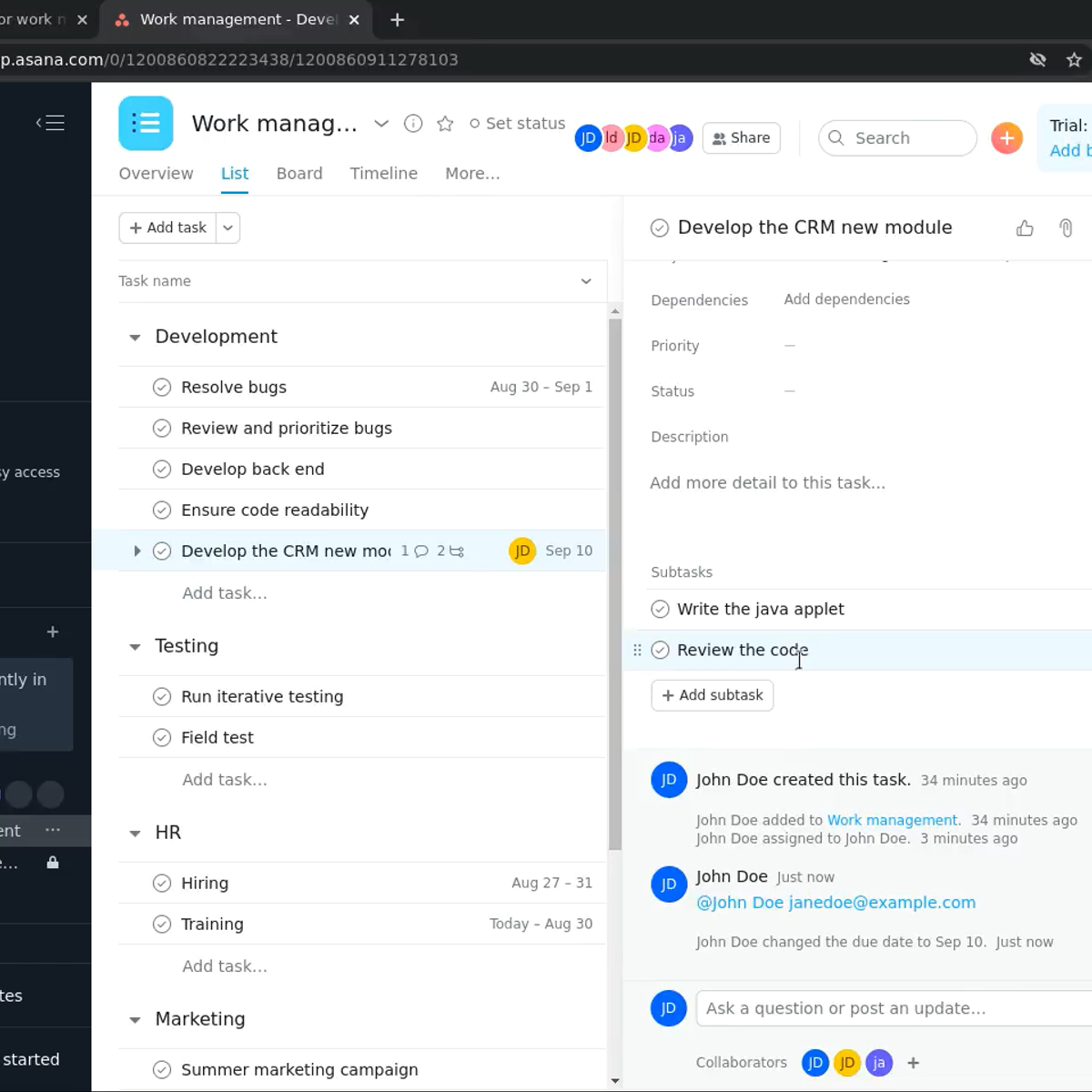
Use RACI charts for work management with Asana
In this guided project we will learn about cross-functional work management and RACI charts. We will use Asana managing tasks, subtasks and assignees to implement RACI charts and practices in work and project management.
 Packt
Packt
Accelerate Terraform Development with GitHub Copilot and AI
Updated in May 2025. This course now features Coursera Coach! A smarter way to learn with interactive, real-time conversations that help you test your knowledge, challenge assumptions, and deepen your understanding as you progress through the course. This course is designed to supercharge your Terraform development workflow using GitHub Copilot and AI tools. You will learn how to harness the power of GitHub Copilot to streamline the process of writing, managing, and enhancing Terraform configurations. By the end, you will be able to leverage Copilot's AI-driven code suggestions, automate mundane tasks, and improve your productivity. You’ll begin with an introduction to GitHub Copilot, exploring its capabilities and limitations, and how it can elevate your coding experience. The course also covers Terraform basics, including how it works with Infrastructure as Code (IaC) and offers hands-on demos to solidify your understanding of its core functionality. Next, you will dive into the setup process, learning how to integrate Copilot into your IDE and configure Terraform on both MacOS and Windows. With these tools in place, you’ll start a new Terraform project using Copilot’s guidance, refining your code, and utilizing Copilot’s features like documentation generation and test creation. The course concludes with a focus on advanced Copilot features such as Copilot Chat for real-time assistance and Copilot’s role in code management, including automating .gitignore file creation and commit message drafting. By the end, you will have a fully functional Terraform development environment optimized with GitHub Copilot.
 Kennesaw State University
Growing Your Core Business with Jagdish Sheth
This course explores why growing the core business is now a more viable strategy than unrelated diversification. Learners will understand how shareholder value is created through both cash flow and strategic positioning for growth. Drawing on decades of corporate examples and financial analysis, Professor Jagdish Sheth outlines the limitations of the portfolio model and presents a framework for growing the core through multiple channels, product extensions, and emerging markets. Through case studies of companies like Monsanto, 3M, IBM, and Dinol, learners will discover how to avoid strategic missteps and identify synergistic opportunities that align with their company’s competencies and market access. This course empowers learners to think critically about growth, profitability, and how to leverage core strengths to meet modern shareholder expectations.
 Eindhoven University of Technology
Ethics, Technology and Engineering
There is an increasing attention to ethics in engineering practice. Engineers are supposed not only to carry out their work competently and skilfully, but also to be aware of the broader ethical and social implications of engineering and to be able to reflect on these. According to the Engineering Criteria 2000 of the Accreditation Board for Engineering and Technology (ABET) in the US, engineers must have “an understanding of professional and ethical responsibility” and should "understand the impact of engineering solutions in a global and societal context.” This course provides an introduction to ethics in engineering and technology. It helps engineers and students in engineering to acquire the competences mentioned in the ABET criteria or comparable criteria formulated in other countries. More specifically, this course helps engineers to acquire the following moral competencies: - Moral sensibility: the ability to recognize social and ethical issues in engineering; - Moral analysis skills: the ability to analyse moral problems in terms of facts, values, stakeholders and their interests; - Moral creativity: the ability to think out different options for action in the light of (conflicting) moral values and the relevant facts; - Moral judgement skills: the ability to give a moral judgement on the basis of different ethical theories or frameworks including professional ethics and common sense morality; - Moral decision-making skills: the ability to reflect on different ethical theories and frameworks and to make a decision based on that reflection. With respect to these competencies, our focus is on the concrete moral problems that engineers encounter in their professional practice. With the help of concrete cases is shown how the decision to develop a technology, as well as the process of design and production, is inherently moral. The attention of the learners is drawn towards the specific moral choices that engineers face. In relation to these concrete choices learners will encounter different reasons for and against certain actions, and they will discover that these reasons can be discussed. In this way, learners become aware of the moral dimensions of technology and acquire the argumentative capacities that are needed in moral debates with stakeholders (e.g. governments, users, and commercial business departments).
 Coursera
Optimizing Models for Production
The Optimizing Models for Production course is designed for developers, engineers, and technical product builders who are new to Generative AI but already have intermediate machine learning knowledge, basic Python proficiency, and familiarity with development environments such as VS Code, and who want to engineer, customize, and deploy open generative AI solutions while avoiding vendor lock-in. The course prepares learners to make generative AI models more efficient, scalable, and cost-effective for real-world deployment. Learners begin with quantization, applying INT8 and INT4 precision reduction using tools like bitsandbytes while balancing accuracy and efficiency. Next, they explore inference optimization strategies, including batching, KV-cache management, and token-level computation scheduling to reduce latency in interactive applications. The course also covers memory footprint reduction and adaptive batch sizing for dynamic workloads. In the final module, learners apply practical hardware optimization techniques such as GPU memory tuning, mixed precision inference, and profiling tools like nvidia-smi and PyTorch Profiler to identify bottlenecks. By the end, learners will be able to deliver optimized models across diverse hardware environments, supported by performance benchmarks and reproducible deployment pipelines.
 Vanderbilt University
Change Management for Generative AI
Generative AI is revolutionizing industries and transforming the way we work. As organizations embrace these cutting-edge technologies, effective change management becomes crucial to ensure a smooth transition and maximize the benefits of generative AI. In this course, "Change Management for Generative AI," we will delve into the strategies and frameworks necessary to successfully implement and adapt to these transformative technologies. You will learn about the FASTER framework, a comprehensive approach to managing change in the era of generative AI. We will explore each component of the framework, including establishing a strong foundation, aligning stakeholders, implementing safeguards, providing training, embracing evolution, and enabling replication. Through real-world examples and practical insights, you will gain the skills to lead change initiatives and drive the adoption of generative AI in your organization.
 Coursera
Schedule Social Content
Ready to move beyond random posts and start driving real results? Social Media Strategy: Scheduling & Optimization is an intermediate course designed for marketers and content creators who want to master the art of strategic social media management. This course will teach you to stop guessing and start planning, using data to inform every decision. You will learn to build a comprehensive, 30-day cross-platform content calendar that's perfectly synchronized with key business events, like a product launch, using methodologies from industry-leading tools like Sprout Social. You'll go beyond surface-level metrics to analyze what truly matters: understanding the key campaign KPIs and understanding the relationship between reach and engagement. Through hands-on assignments and engaging real-world examples from brands like Apple and Marvel, you'll learn to calculate performance ratios, pinpoint opportunities, and revise your posting schedule to achieve a measurable 10% boost in audience engagement. By the end of this course, you'll be equipped to develop, manage, and continuously optimize a social media content strategy that not only builds hype but also delivers quantifiable results.
 Google Cloud
Gemini for Application Developers - 한국어
이 과정에서는 Google Cloud의 생성형 AI 기반 공동작업 도구인 Gemini가 개발자의 애플리케이션 빌드에 어떤 도움이 되는지 알아봅니다. Gemini에 프롬프트를 입력하여 코드에 대한 설명을 얻고 Google Cloud 서비스를 추천받고 애플리케이션의 코드를 생성하는 방법을 배울 수 있습니다. 실무형 실습을 통해 Gemini로 애플리케이션 개발 워크플로가 얼마나 개선되는지 경험할 수 있습니다. Duet AI의 이름이 Google의 차세대 모델인 Gemini로 변경되었습니다.
 The Hong Kong University of Science and Technology
Chinese Politics Part 1 – China and Political Science
This course offers a conceptual framework for understanding China that highlights the intersection of politics and economics. It shows that rather than develop into a full blown market economy, state and party officials at all levels of the political system maintain significant influence in economic development. Such a “political” economy has had both positive and negative outcomes, which we will assess in detail. We also look at the origins, views, backgrounds and relations among leaders, and how those leaders make decisions about public policy and try to get those decisions implemented down through the system. China has few formal institutions through which citizens can participate in politics, but we will study the strategies Chinese people use to try to influence their leaders’ decisions. Finally, we assess China’s future and whether rapid economic development and the emergence of a vibrant middle class will push China towards greater democracy or whether the single party system is likely to survive into the future. The course is a quite useful background for Chinese Politics Part 2 – China and the World. Course Overview video: https://youtu.be/7FpNL67EbE4