

The Global Scholarly Directory.
Discover world-class academic programs curated for the modern intellectual. Search through 19877+ degrees and professional certificates.
 Alex Genadinik
How To Ask Great Sales Questions That Lead To Closing
In sales, asking the right questions is more than just gathering information—it’s about building trust, uncovering needs, and creating meaningful connections that drive successful outcomes. Whether you’re new to sales or looking to elevate your skills, this course, Mastering the Art of Asking Great Sales Questions, will equip you with the tools to lead compelling conversations, uncover deep customer insights, and close deals effectively. Sales is no longer about pushing products; it’s about understanding the customer and solving their problems. This course focuses on crafting thoughtful, strategic questions that engage prospects, reveal their pain points, and highlight how your solution meets their unique needs. By asking the right questions, you’ll not only position yourself as a trusted advisor but also build lasting relationships that lead to repeat business and referrals. What You’ll Learn: 1. The Science and Psychology Behind Effective Questions Understand why certain types of questions resonate more with prospects. Learn how to use open-ended questions to encourage dialogue, closed-ended questions to clarify details, and follow-up questions to delve deeper into customer needs. We’ll explore how thoughtful questioning creates an emotional connection and positions you as a problem-solver, not just a salesperson. 2. The Key Types of Sales Questions Discover the different categories of questions every salesperson should master, including: Discovery Questions to understand the customer’s goals, challenges, and current situation. Pain Point Questions to reveal frustrations and areas where they need help. Qualifying Questions to assess readiness, budget, and decision-making authority. Solution-Oriented Questions to align your offering with their needs. Closing Questions to move the conversation toward a decision confidently. 3. Customizing Questions for Every Stage of the Sales Cycle Learn how to adapt your questions depending on where you are in the sales process. Whether it’s the initial outreach, a deeper needs assessment, or the closing conversation, this course teaches you to tailor your approach for maximum impact. 4. Building Rapport Through Strategic Questioning Sales success starts with trust. Master the art of asking relationship-building questions that show genuine interest, foster credibility, and encourage prospects to open up about their goals and challenges. 5. Overcoming Objections with Insightful Questions Objections are inevitable, but they can be opportunities. Learn to reframe objections by asking insightful questions that address concerns, uncover the root issues, and guide the conversation back on track. 6. Practicing Active Listening and Question Follow-Up Asking great questions is only half the equation—listening to the answers is just as important. This course will teach you how to listen actively, pick up on subtle cues, and ask follow-up questions that deepen the conversation and uncover actionable insights. Interactive, Hands-On Learning This course is highly interactive, featuring role-playing exercises, case studies, and real-world scenarios. You’ll practice asking strategic questions, handling objections, and tailoring conversations to different buyer personas. Each lesson is designed to help you internalize these skills and apply them confidently in your sales interactions. Who Should Take This Course? This course is ideal for: Sales professionals looking to refine their communication skills. Entrepreneurs who want to better connect with potential clients. Customer-facing teams aiming to improve their consultative approach. Outcomes You Can Expect: By the end of this course, you’ll be able to: Ask questions that reveal deeper customer needs and priorities. Build trust and rapport with prospects through meaningful conversations. Handle objections and hesitations with confidence. Guide sales conversations toward successful outcomes. Unlock the power of great questions to transform your sales approach. Join this course today and learn how to lead smarter, more impactful sales conversations!
 Northwestern University
The Business of Social
In a 2014 study of CEOs and CMOs, IBM found 63% wanted social strategies which generate business metrics while only 20% of businesses worldwide actually have them. This means strategies which not only grow your company’s social footprint but link to your sales and marketing systems. With this critical linkage, your social and mobile strategies will provide you with the ability to engage consumers at a 1-to-1 level and measure your social investments in terms of costs, revenues, profits and ROI. In this fifth MOOC of the Social Marketing Specialization - "The Business of Social" - you will learn how to transform your organization's social marketing from an untracked investment to an integral part of your company’s marketing strategy. You will learn the legal considerations involved as well as proven performance metrics and management tactics for success. Additional MOOC 5 faculty include: * Rich Gordon (Professor & Director of Digital Innovation, Medill, Northwestern) * Tom Collinger (Executive Director Spiegel Research Center and Senior Director Distance Learning, Medill Integrated Marketing Communications, Northwestern) * Seth Redmore (CMO, Lexalytics, Inc.) * Jeff Davidoff (CMO, Donuts.Domains) * Matt Krull (Business Unit Executive, IBM Security) * Frank Mulhern (Associate Dean, Department Chair, and Professor, Integrated Marketing Communications, Northwestern)
 University of California, Santa Cruz
C for Everyone, Part 1: Programming Fundamentals
This course is for everyone. In the new world we live in, coding is a universally valuable skill, whether you're a scientist, artist, or a humanist. Algorithms are everywhere, and we all have to understand how they work. The C language is particularly well suited as an introduction to coding: It's a tried-and-true language, and it allows you to understand computing processes at a deep level. This course is the first part of a two-course sequence. It is a hands-on introduction to programming in C, designed to guide learners step by step from the basics of syntax and data types to more advanced concepts such as control flow, functions, recursion, arrays, and pointers. Through video lessons, quizzes, programming exercises, and real debugging tasks, learners build foundational concepts and good coding practices. By the end, learners will be able to write clear C programs, debug effectively, and build the knowledge base needed for more advanced computer science and software development.
 University of Virginia
Design Thinking: Insights to Inspiration
Welcome Designers! In this course, developed at the Darden School of Business at the University of Virginia, we will introduce you to the design thinking process. It is a project-based course in which you will identify a human-centered problem that you want to solve. We will focus our attention on the first seven steps of our 14-Step design thinking process. We’ll guide you through crafting and carrying out a research plan that helps you answer the question, “What is?” You will gather and identify important insights about the needs and wants of others and use this information to identify the attributes of an ideal solution.
 Cisco Learning and Certifications
Network Security Principles
In today’s interconnected world, securing networks is more critical than ever. This course empowers learners to gain essential tools and strategies needed to defend computer networks and data from cyber threats. You’ll dive into key topics such as firewalls, VPNs, access controls, and security monitoring, learning how each one contributes to a safe and resilient IT environment. Beyond foundational knowledge, you’ll gain experience understanding advanced techniques like Authentication, Authorization, and Accounting (AAA) and Role-Based Access Control (RBAC). Through guided content, you’ll build confidence in implementing strong security measures and responding to potential incidents. Whether you’re starting your cybersecurity journey or looking to deepen your expertise, this course provides a comprehensive and up-to-date foundation to help you safeguard networks in the digital age.
 University of Colorado Boulder
Moneyball and Globalization
This course will explore baseball’s historical connections to money and globalization, two of the most powerful forces in the modern era. Baseball may be a child’s game, but it has been inextricably intertwined with money and profit since its very inception in the late nineteenth century. The Reserve Clause, world tours, collective bargaining, expansion, bringing players from abroad, and realignment have always been driven as much or more by money than anything else.
 Google Cloud
利用 Cloud Run 部署和扩缩 AI 模型
AI 推理是指利用经过训练的机器学习模型,通过应用其学习到的模式,对新的、未见过的数据进行预测的过程。本课程专为有兴趣在 Cloud Run 上快速部署 AI 推理服务的开发者、数据科学家和机器学习工程师而设计。对于熟悉基于云的无服务器应用部署解决方案,但可能没有使用 Google Cloud 无服务器产品运行 AI 推理经验的学员来说,本课程非常有用。 本课程包含使用 GPU 部署 AI 推理模型,以及将生成式 AI 应用与数据存储服务集成的示例。
 Alex Genadinik
Google Citations: Boost SEO For New Local Websites
You will learn how to use Google Citations to boost the SEO of your local business websites. Even if your business is not a local business, Google Citations can help you begin showing up in Google search faster, and get your website to rank better. Most people who launch their website wonder when that website will begin to show up in Google search. It can take a considerable amount of time to have your website show up in Google search, but if you use Google Citations, you can expedite the process. The reason Google introduced Google citations was because there was not much information it had about new sites, and mere mentions of your website and business helped its search engine understand what your website is all about. In this course I also explain what to do if your business isn't necessarily a local business. Sign up today, and get your website ranking in Google faster. RESPONSIVE AND CARING INSTRUCTOR: WORLD-CLASS STUDENT SUPPORT If you have questions, know that I am here to help! I answer 99% of student questions within 24 hours. Many students tell me that other instructors don't respond. Well, I do because 1) I care about my students. 2) I feel a responsibility to make sure that students get their money's worth from the course. Join me and my community of successful students, right now. See you in class.
 Duke University
Linux and Bash for Data Engineering
In this second course of the Python, Bash and SQL Essentials for Data Engineering Specialization, you will learn the fundamentals of Linux necessary to perform data engineering tasks. Additionally, you will explore how to use both Bash and zsh configurations, and develop the syntax needed to interact and control Linux. These skills will allow you to manage and manipulate databases in a Bash environment.
 EDUCBA
Apply Generative AI to Build a Powerful Personal Brand
Learners will explain core Generative AI concepts, design a differentiated personal brand, create AI-powered content across formats, analyze brand performance using data, and apply ethical practices in AI-driven branding. This course equips learners with the practical and strategic skills needed to build, grow, and optimize a personal brand using Generative AI. Learners will explore how AI can support visual design, written communication, audio branding, storytelling, and audience engagement while maintaining authenticity and human creativity. Through structured modules, real-world case studies, and hands-on workflows, learners will gain the ability to translate AI capabilities into actionable personal branding strategies. By completing this course, learners will be able to create consistent, scalable, and audience-focused brand content, measure impact using key performance indicators, and continuously refine their brand strategy in a rapidly evolving digital landscape. The course uniquely integrates Generative AI literacy with personal branding fundamentals, ethical considerations, and future-ready insights, ensuring learners are not only skilled in using AI tools but also prepared to apply them responsibly and strategically. This combination of creativity, analytics, and ethics makes the course especially valuable for professionals, creators, entrepreneurs, and aspiring thought leaders seeking long-term brand relevance.
 Logical Operations
Crystal Reports: Subreports and Drill-Downs
In this course, you'll continue developing your data-reporting skills in Crystal Reports by inserting, editing, and sharing subreports. You'll also create drill-downs in reports to make larger reports easier to interpret at a glance. This is the second course in a multi-course Specialization. All of the courses in this Specialization require that you have SAP Crystal Reports 2020 installed. You also need to have an installation of Office 2019 apps or later, particularly Access. The course setup instructions provided in the first course go into more detail about the hardware and software requirements.
 Snowflake
Building AI Agents with Snowflake
This course is for AI engineers, application developers, data engineers, data analysts, other data professionals, and students who want to build autonomous AI agents that work with enterprise data. Whether you're looking to move beyond basic chatbots, create intelligent systems that can query both structured databases and unstructured documents, or integrate AI capabilities into existing business workflows, this course provides the hands-on foundation you need. By the end of this course, you will be able to: - Distinguish between AI assistants and AI agents, and identify when autonomous agent capabilities are the right solution for your use case - Build Cortex Analyst and Cortex Search that enable agents to query structured metrics and search unstructured content using natural language - Configure and deploy Cortex Agents that autonomously plan tasks, select appropriate tools, and synthesize insights from multiple data sources - Write effective orchestration instructions that guide agent behavior and optimize response quality - Evaluate agent reliability using observability features and implement improvements based on performance metrics - Connect agents to external applications using Model Context Protocol for broader integration To be successful in this course, you should have basic familiarity with SQL and understand how data is organized in databases. Prior experience with AI or machine learning is helpful but not required, as the course covers foundational agent concepts before moving into implementation. This is a hands-on course where you'll build alongside the instructor, so you'll use a free Snowflake trial account.
 Starweaver
AI Agents for Cybersecurity
The cybersecurity field is rapidly evolving, with AI agents emerging as a critical force in defending against advanced cyber threats. This course explores the shift from manual security methods to intelligent automation, highlighting how AI agent, powered by Large Language Models, can reason, act autonomously, and integrate deeply within Security Operations Canters (SOCs). You’ll begin with foundational concepts in AI agent design and progress toward real-world applications, including threat detection, vulnerability analysis, incident response, and proactive threat hunting. Alongside technical implementation, the course addresses essential topics in security governance, operational risk, and the ethical deployment of autonomous systems. Designed for SOC analysts, managers, and cybersecurity professionals, this course offers actionable insights into deploying AI agents to improve speed, precision, and scalability in cyber defence. Whether you're enhancing current operations or preparing for the AI-driven future of cybersecurity, you'll gain the knowledge to use these systems responsibly and effectively.
 Packt
Packt
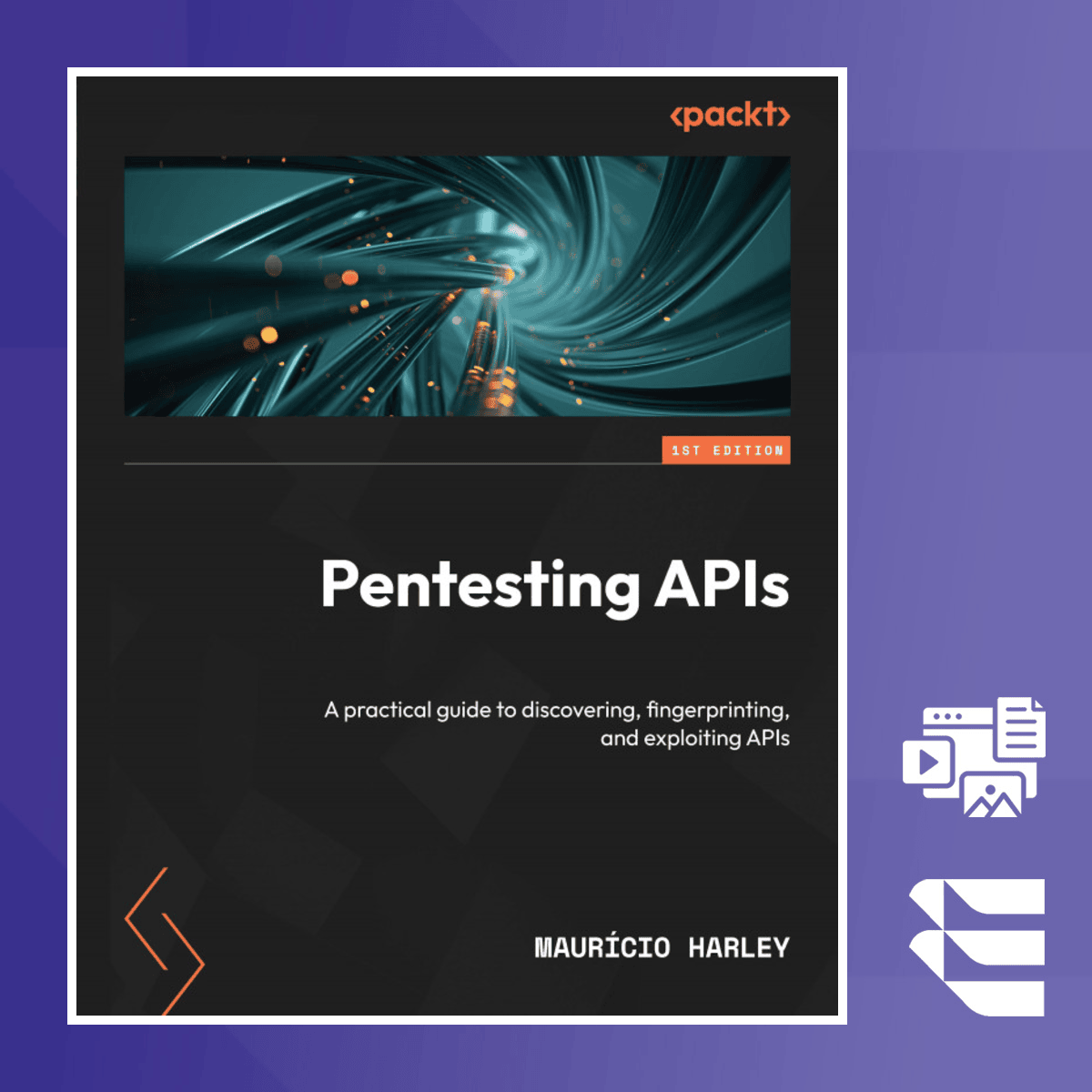
Pentesting APIs
This course provides learners with the essential skills to secure APIs against evolving cyber threats. You will master real-world techniques for discovering vulnerabilities, fingerprinting, and exploiting APIs to identify weaknesses and implement effective security measures. API security is critical in today’s digital world, where APIs are core components of modern applications. You will learn how to set up an environment for penetration testing, assess API security, and apply expert techniques to protect APIs from common threats. Practical exercises focus on real-world scenarios, equipping you with the skills to proactively defend APIs against exploitation. The course stands out by combining theory with hands-on practice, offering a comprehensive guide to identifying, testing, and securing APIs. You’ll explore vulnerabilities in both RESTful and GraphQL APIs, gaining expert insights into real-world cybersecurity challenges. This course is ideal for security engineers, developers, and analysts with a basic understanding of web development and cybersecurity. It’s designed for those looking to enhance their skills in API security and protection.
 University of New Mexico
International Business I
We live in a world of intensifying global relationships, one in which international business has become the key determinant of economic development and prosperity. This course, Global Business Environment, Part I, introduces students to a fundamental understanding of the socioeconomic political, cultural, and linguistic environment in which international businesses operate. This course utilizes an inquiry-based approach to understanding country level relationships in the Global Business Environment. It surveys the global business environment by asking and answering key questions about society, the global economy, cultures, institutions and languages. The questions we will ask are: 1. What is Globalization?, 2. Is Globalization New?, 3. How do Political and Social Institutions impact National Economic Development?, 4. What is the role of Culture?, 5. What are the Gains from Trade?6. Free Trade, Free-r Trade or Managed Trade?, 7. What are Foreign Currencies and how are Exchange Rates Determined?, 8. What does the Current Global Business Environment look like? This inquiry-based approach creates reflective opportunities for students to better understand the environment in which businesses operate. Lectures are delivered in an engaging manner, which encourages reflection and inquiry.
 Google Cloud
Introduction to Responsible AI
This is an introductory-level microlearning course aimed at explaining what responsible AI is, why it's important, and how Google implements responsible AI in their products. It also introduces Google's 7 AI principles.