

The Global Scholarly Directory.
Discover world-class academic programs curated for the modern intellectual. Search through 19877+ degrees and professional certificates.
 Coursera
Using Animations and Transitions in Microsoft PowerPoint
At the end of this project, you will be able to create an exciting PowerPoint presentation using visuals, animations, and transitions. First, you will use a basic existing PowerPoint presentation or create a basic PowerPoint presentation with just text yourself. Then, you will get to know options to improve your presentation by adding visuals, animations, and transitions. You will learn all about animations and how to best use them. You will also learn a few easy methods to make your slide transitions smoother and more appealing to your audience. Creating a Microsoft PowerPoint using these features will allow you to be able to have the best visual support possible during your presentation. Visual support, animations, and good transitions via Microsoft PowerPoint will ensure your audience stays engaged and attentive as well as interested. The goal of this project is to teach you how to be successful with your presentations and how to make them more interesting so your audience can digest the information you are providing more easily and will also retain more of the information provided.
 EDUCBA
Embedded C Programming Essentials
Welcome to our comprehensive course on mastering STM32CubeIDE and C programming for embedded systems development! Throughout this journey, you'll delve into the intricacies of STM32CubeIDE and C programming fundamentals, gaining the ability to navigate this development environment effortlessly. Starting with 'C' programming basics, you'll grasp concepts such as data types, variables, storage classes, and advance to more complex topics. Dive into the foundational aspects of embedded systems development, including build processes and memory management, crucial for efficient programming. One unique aspect of this course is its emphasis on practical application. You'll learn to leverage microcontrollers effectively, honing your skills in debugging and analysis techniques. By the course's conclusion, you'll emerge with a robust understanding of embedded systems development, equipped with the skills necessary to excel in creating efficient and reliable embedded systems. Benefit from hands-on experience and expert guidance, and embark on a journey toward becoming a proficient embedded systems developer. Join us and unlock your potential in the exciting world of embedded systems! Target Learners: This course is ideal for beginners and intermediate learners aspiring to become proficient in embedded systems development. It is suitable for: 1) Students pursuing degrees in computer science, electrical engineering, or related fields seeking to build a strong foundation in embedded systems. 2) Professionals transitioning into embedded systems development or looking to enhance their skills in this domain. 3) Hobbyists and enthusiasts interested in learning about microcontroller programming and embedded systems design. Prerequisites: 1) To fully benefit from this course, learners should have: 2) Basic programming knowledge: Familiarity with programming concepts such as variables, loops, functions, and conditional statements is recommended. 3) Understanding of C programming language: While not mandatory, having some prior experience or knowledge of C programming will ease the learning curve. 4) Basic understanding of electronics: A rudimentary understanding of electronic components and circuits will be helpful in comprehending certain concepts related to embedded systems development. Hardware and software requirements: HARDWARE 1) STM32F407G-DISC1 DISCOVERY board: This is the main development board for which drivers are developed. SOFTWARE 1) STM32CUBEIDE - Eclipse based IDE. Provided by ST. Multi OS support (Windows / Linux / Mac) This is available for FREE
 Google Cloud
Work with Gemini Models in BigQuery - 한국어
이 과정은 BigQuery에서 생성형 AI 작업에 AI/ML 모델을 사용하는 방법을 보여줍니다. 고객 관계 관리와 관련된 실제 사용 사례를 통해 Gemini 모델로 비즈니스 문제를 해결하는 워크플로를 설명합니다. 이해를 돕기 위해 SQL 쿼리와 Python 노트북을 사용하는 코딩 솔루션을 단계별로 안내합니다.
 Packt
Packt
Introduction to Rust Programming and Core Concepts
Updated in May 2025. This course now features Coursera Coach! A smarter way to learn with interactive, real-time conversations that help you test your knowledge, challenge assumptions, and deepen your understanding as you progress through the course. Begin your journey into Rust programming with this all-encompassing course designed for developers looking to grasp the power and efficiency of Rust. Start with the essentials, including setting up your development environment and running your first program. As you progress, delve into basic programming constructs such as variables, data types, and functions, building a strong foundation for more complex concepts. The heart of Rust lies in its unique ownership model, which ensures memory safety and concurrency. This course provides a thorough exploration of ownership, including heap and stack memory management, and the intricacies of mutable and immutable references. You'll gain a deep understanding of how Rust handles memory, helping you write robust and efficient code. As you advance, the course introduces control structures, allowing you to write more flexible and powerful programs. Learn through hands-on projects, like implementing a stack, which reinforce the theoretical knowledge with practical application. Finally, tackle advanced topics like lifetimes, closures, and iterators, rounding out your expertise in Rust and preparing you for real-world programming challenges. This course is ideal for developers with basic programming knowledge who want to learn Rust. No prior Rust experience is required, but familiarity with programming concepts will be beneficial.
 IBM
IBM
Machine Learning Rapid Prototyping with IBM Watson Studio
An emerging trend in AI is the availability of technologies in which automation is used to select a best-fit model, perform feature engineering and improve model performance via hyperparameter optimization. This automation will provide rapid-prototyping of models and allow the Data Scientist to focus their efforts on applying domain knowledge to fine-tune models. This course will take the learner through the creation of an end-to-end automated pipeline built by Watson Studio’s AutoAI experiment tool, explaining the underlying technology at work as developed by IBM Research. The focus will be on working with an auto-generated Python notebook. Learners will be provided with test data sets for two use cases. This course is intended for practicing Data Scientists. While it showcases the automated AI capabilies of IBM Watson Studio with AutoAI, the course does not explain Machine Learning or Data Science concepts. In order to be successful, you should have knowledge of: Data Science workflow Data Preprocessing Feature Engineering Machine Learning Algorithms Hyperparameter Optimization Evaluation measures for models Python and scikit-learn library (including Pipeline class)
 Arizona State University
The Limits of Human Perception
Course 3 explores the perceptual capacities and limitations of humans and computers. It discusses various types of visual, auditory, and tactile displays and how they can be used to create effective interfaces.
 Packt
Packt
Advanced Gatling for Stress Testing Web Applications
This course features Coursera Coach! A smarter way to learn with interactive, real-time conversations that help you test your knowledge, challenge assumptions, and deepen your understanding as you progress through the course. Unlock the full potential of performance testing for web applications with Gatling! This advanced course will guide you through the process of stress testing, building, and optimizing frameworks for real-world applications like Ace Toys. You'll start by setting up a Gatling development environment, recording user journeys, and implementing robust testing strategies. As you move through the days, you will explore data management using CSV, JSON, and custom feeders, and master programmatic logic with session variables, dynamic configurations, and complex test scenarios. By Day 7, you'll have gained invaluable skills in integrating continuous integration and delivery (CI/CD) tools, using Jenkins for automating your Gatling tests. Along the way, you will enhance your scripting techniques, track real-time data, and create efficient, reusable frameworks that perform well under pressure. This course is designed to give you hands-on experience while tackling complex load simulation challenges. Ideal for experienced testers, developers, and DevOps professionals, this course will help you take your performance testing skills to the next level. Some prior knowledge of Gatling and performance testing concepts is recommended.
 LearnQuest
Mastering Digital Prospecting Foundations
Gain the edge in modern sales by developing advanced digital prospecting skills essential for today's competitive global environment. This course unpacks the core strategies and tools needed to efficiently identify, engage, and qualify high-value leads in both established and emerging markets. Learners will adopt market-specific techniques for India, the USA, and Spanish-speaking US, master digital channel utilization, and explore cross-cultural communication. You will learn to personalize outreach at scale, stand out in crowded inboxes, and build a high-performing prospecting playbook for your business goals. By course end, you’ll have a multi-channel pipeline for ongoing growth and be ready to convert prospects into long-term relationships.
 University of Alberta
Agile Planning for Software Products
This course covers the techniques required to break down and map requirements into plans that will ultimately drive software production. Upon successful completion of this course, you will be able to: - Create effective plans for software development - Map user requirements to developer tasks - Assess and plan for project risks - Apply velocity-driven planning techniques - Generate work estimates for software products
 Princeton University
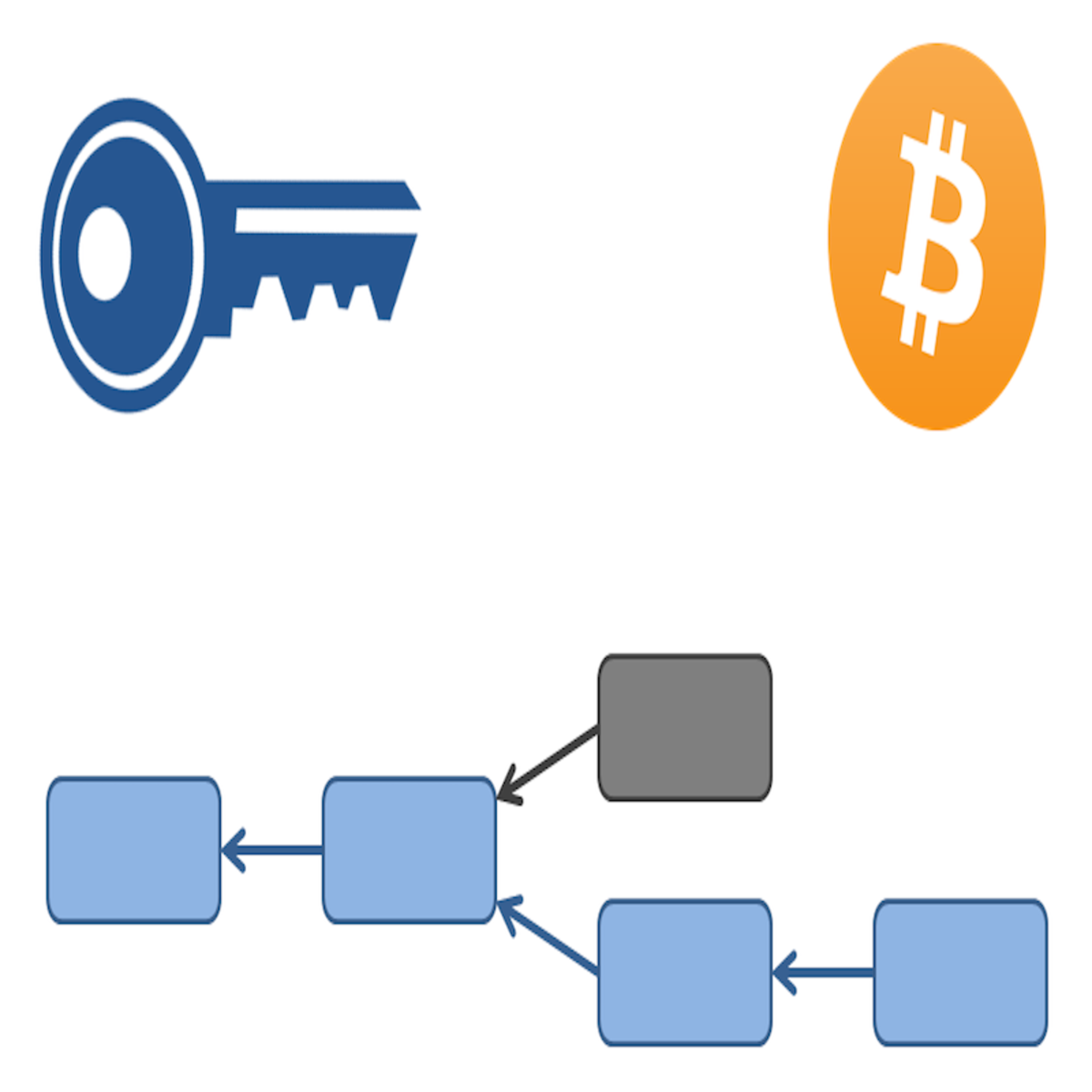
비트코인 및 암호화폐 기술
비트코인의 특수성을 이해하기 위해서는 기술적 측면에서 비트코인이 어떻게 작동하는지를 알아야 합니다. 비트코인과 관련하여 다음과 같은 핵심 질문을 다루게 됩니다. 비트코인은 어떻게 작동하나요? 비트코인에는 어떤 차별점이 있나요? 여러분의 비트코인 보안은 어떠한가요? 비트코인 유저들의 익명성은 얼마나 보장되나요? 비트코인의 가격을 결정하는 요소는 무엇인가요? 암호화폐 규제가 가능할까요? 미래는 어떻게 될까요? 이 강좌를 수강하고 나면, 비트코인과 기타 임호화폐에 대한 주장들을 접할 때 사실과 허구를 구별하는 데 필요한 모든 지식을 알게 됩니다. 또한 비트코인과 상호작용하는 보안 소프트웨어를 엔지니어링하는 데 필요한 기본 개념을 얻게 됩니다. 아울러 여러분의 프로젝트에 비트코인 개념을 통합할 수 있게 될 것입니다. 강사: Arvind Narayanan, Princeton University 모든 강의 내용은 무료로 제공됩니다. 강좌를 마치더라도 수료증 등을 제공하지는 않습니다.
 Google
Analisar os dados para responder às perguntas
Este é o quinto curso do Certificado de Data Analytics do Google. Estes cursos darão a você as habilidades necessárias para se candidatar a cargos empregos de analista de dados de nível inicial. Neste curso, você explorará a etapa de análise do processo de análise de dados. Você aplicará o que aprendeu até agora na análise para interpretar os dados coletados. Você aprenderá como organizar e formatar seus dados usando planilhas e SQL para ajudar você a observar e interpretar os dados de diferentes maneiras. Você também descobrirá como fazer cálculos complexos sobre seus dados para cumprir os objetivos de negócios. Você aprenderá a usar fórmulas, funções e consultas SQL conforme você realiza suas análises. Os analistas de dados do Google vão instruir e oferecer maneiras práticas de realizar tarefas comuns de analistas de dados com as melhores ferramentas e recursos. Os alunos que concluírem este programa de certificação poderão se candidatar a empregos de nível inicial para analista de dados. Nenhuma experiência anterior é necessária. Ao final deste curso, você poderá: - Organizar dados para análise. - Dominar os processos para formatar e ajustar os dados. - Compreender como agregar dados em planilhas e usando SQL. - Usar fórmulas e funções em planilhas para cálculos de dados. - Fazer cálculos completos usando consultas SQL.
 Edge Impulse
Computer Vision with Embedded Machine Learning
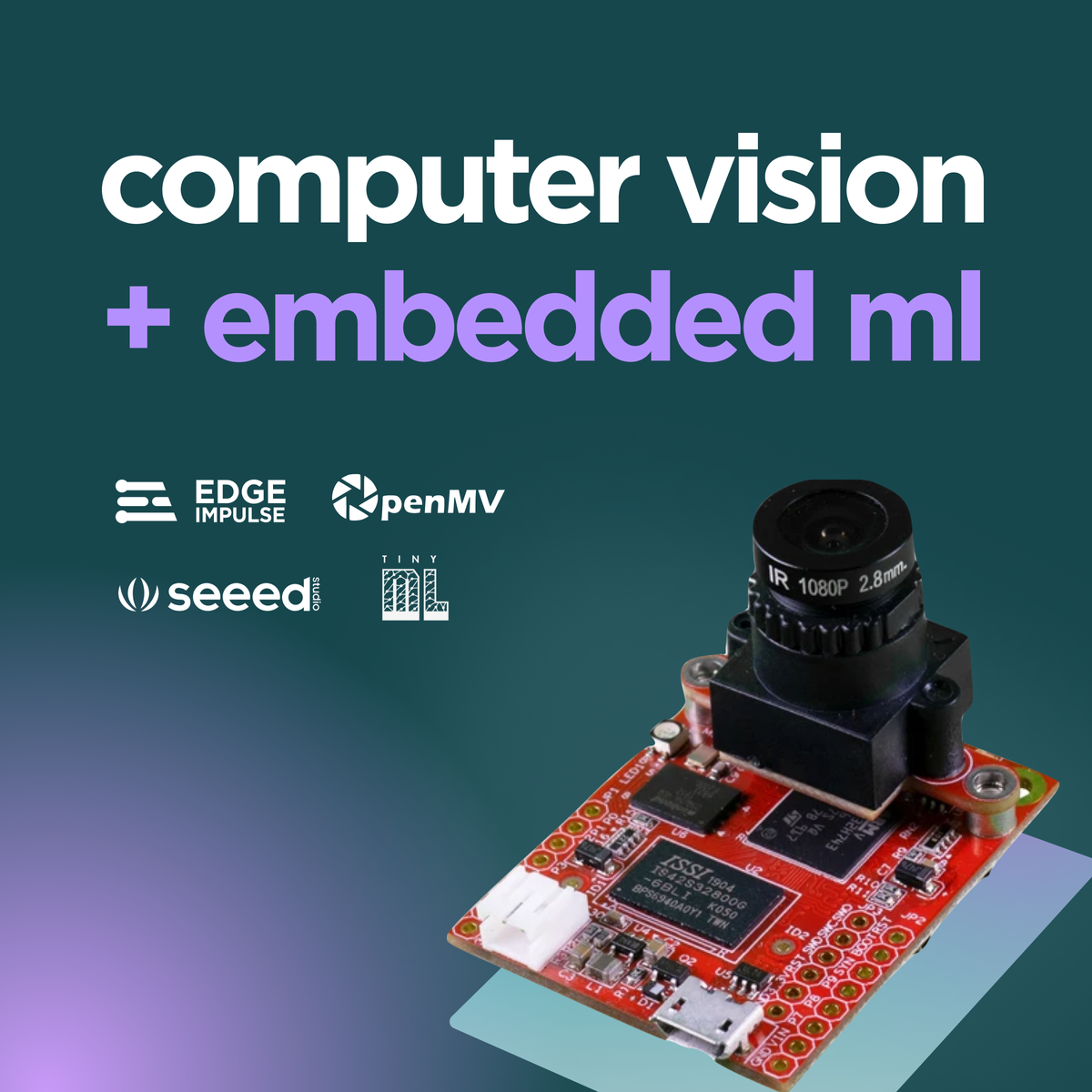
Computer vision (CV) is a fascinating field of study that attempts to automate the process of assigning meaning to digital images or videos. In other words, we are helping computers see and understand the world around us! A number of machine learning (ML) algorithms and techniques can be used to accomplish CV tasks, and as ML becomes faster and more efficient, we can deploy these techniques to embedded systems. This course, offered by a partnership among Edge Impulse, OpenMV, Seeed Studio, and the TinyML Foundation, will give you an understanding of how deep learning with neural networks can be used to classify images and detect objects in images and videos. You will have the opportunity to deploy these machine learning models to embedded systems, which is known as embedded machine learning or TinyML. Familiarity with the Python programming language and basic ML concepts (such as neural networks, training, inference, and evaluation) is advised to understand some topics as well as complete the projects. Some math (reading plots, arithmetic, algebra) is also required for quizzes and projects. If you have not done so already, taking the "Introduction to Embedded Machine Learning" course is recommended. This course covers the concepts and vocabulary necessary to understand how convolutional neural networks (CNNs) operate, and it covers how to use them to classify images and detect objects. The hands-on projects will give you the opportunity to train your own CNNs and deploy them to a microcontroller and/or single board computer.
 EDUCBA
Apply Business & Data Analytics for Smarter Decisions
By the end of this course, learners will be able to explain core business analytics concepts, apply structured problem-framing techniques, analyze business processes, evaluate data readiness, and illustrate how analytics drives real-world business decisions. This beginner-friendly course is designed to build a strong foundation in Business and Data Analytics without requiring prior technical or statistical knowledge. Learners will understand how analytics fits into organizational decision-making, how to translate business challenges into analytical questions, and how data is prepared, evaluated, and deployed to create measurable impact. Through structured frameworks and real-world examples—including a major health insurance case—learners will see how analytics moves from insight to action. What makes this course unique is its business-first approach. Instead of focusing on tools or coding, it emphasizes thinking like an analyst, understanding processes, and aligning data insights with business objectives. The course follows a clear, end-to-end analytics lifecycle, helping learners connect strategy, data, and outcomes. Upon completion, learners will gain practical analytical thinking skills that are highly valuable across industries such as finance, marketing, operations, healthcare, and consulting—making this course ideal for aspiring analysts, managers, and data-driven professionals.
 Universiteit Leiden
Population Health: Governance
How can we organise care in such a way that we optimize experience, quality and costs? What type of governance is needed? And how should healthcare organisations collaborate? These are central questions in this course. In answering them, we depart from a recognition of the impact of three crucial global shifts in health care governance: 1) the change in focus from cure to population health, 2) the increased attention to social determinants of health, and 3) the stronger involvement of non-governmental healthcare organisations in service delivery networks. The course is unique in combining the Population Health perspective with theories of healthcare system governance. It takes a ‘multi-level’ perspective: the participant will look at healthcare governance from different angles in the healthcare system as a whole: from the global and national level, to networks of organisations, to individual care organisations, and finally to the healthcare professional. All these actors should function well to optimize accessible, affordable and high quality of care. To attain these goals, specific managerial network and leadership skills are required.
 Scrimba
Open-source AI Models
Upon completing this course, learners will understand the distinctions between open-source and closed-source frameworks and their impact on development. The course offers hands-on experience with HuggingFace.js, enabling learners to perform inference tasks and apply AI solutions in real scenarios. Participants will gain the skills to implement text-to-speech and image transformations using HuggingFace's libraries. The focus on the HuggingFace.js interface provides direct access to leading open-source AI tools, standing out in its practical approach. A key section is on navigating the HuggingFace.js Hub, where learners discover how to access free models, essential for cost-effective AI deployment. The course culminates with insights into AI’s future in browser-based applications, preparing learners for the next wave of AI integration. What distinguishes this course is its blend of theoretical knowledge and practical application, equipping learners to effectively utilize AI models in their projects. It's ideal for those aiming to pioneer in open-source AI application development.
 The University of Sydney
Academic Skills for University Success: Capstone
This Specialization is aimed at preparing students for undergraduate study in an English-speaking university. The course equips you for full participation and engagement with your studies by building awareness and understanding of the core values and expectations of academic culture, and providing you with practical strategies to apply to your studies. In the Capstone Project, you will apply the academic knowledge and skills you have learnt throughout courses 1-4 to research, write and present a project proposal that addresses a complex, real-world problem related to your field of interest and/or future study. After completing this course, you will be able to: 1. Apply a range of idea generation techniques 2. Apply research strategies to search, collect, select, process, and cite information 3. Use the research process to develop and critically analyse ideas 4. Apply critical thinking skills to evaluate and analyse ideas and evidence 5. Use problem-solving skills to identify gaps in knowledge and define issues 6. Develop creative and innovative solutions to real-world problems 7. Use appropriate academic genres for written texts and multi-media presentations 8. Use written and oral skills to communicate ideas effectively for academic contexts