

The Global Scholarly Directory.
Discover world-class academic programs curated for the modern intellectual. Search through 19877+ degrees and professional certificates.
 Real Madrid Graduate School Universidad Europea
Análisis de fútbol aplicado - Mirando a los casos reales
Este curso explora cómo se aplica la analítica del fútbol en entornos profesionales reales, pasando de la teoría a la práctica en el análisis del rendimiento, el scouting, la estrategia de club y los medios de comunicación. Los alumnos seguirán los flujos de trabajo utilizados por analistas de élite, desde la preparación previa al partido y la evaluación en directo hasta el informe posterior, y comprenderán cómo los clubes construyen procesos basados en datos para apoyar decisiones deportivas. A través de estudios de caso, el curso analiza cómo se diseñan bases de datos de scouting, cómo se construyen métricas clave y sistemas de clasificación, y cómo los clubes integran evaluaciones cualitativas con modelos avanzados como xG, xT, packing, clustering y sistemas de puntuación ponderada. Los alumnos también estudiarán cómo los clubes evalúan el rendimiento mediante Expected Points, simulaciones Monte Carlo, análisis por fases de juego, modelos de balón parado, planificación de plantilla, curvas de edad y evaluación contractual. Por último, el curso aborda cómo la analítica influye en los medios, desde gráficos radar hasta superposiciones en directo, y la psicología detrás de los datos, ayudando a identificar interpretaciones erróneas y construir argumentos más sólidos. Al finalizar, los alumnos comprenderán cómo la analítica apoya la táctica, el reclutamiento, la predicción y la narrativa en el ecosistema futbolístico.
 Duke University
Python and Rust with Linux Command Line Tools
This course is designed for beginners and those with some programming experience in either Python or Rust that want to implement automation and utilities in the command-line. Although no prior knowledge of Python or Rust is required, basic programming knowledge is recommended as well as some familiarity with the command-line interface (CLI). Throughout the course, you will gain a solid foundation for building efficient, reliable, and high-performance command-line tools that can help you automate tasks for data engineering, systems engineering, and DevOps. By completing this course, you will have the skills to develop and distribute sophisticated and efficient command-line tools.
 Coursera
Tackle Client Objections
With this course designed for those who have moved beyond the beginner level, you will be able to overcome the obvious objections and get at the true business concerns that cause the customer to hesitate. Rather than relying on gut feelings, you will be using a structured approach to answer objections with a sense of strategy and consistency. Objections are not obstacles; they are actually guides to the true issues at play. By asking the right questions and identifying the true causes of objections, you will be able to develop a unique advantage in any negotiation. You will also be working on the creation of an objection resolution matrix, the tool you need to link objections with personalized and trust building responses. You are required to have basic negotiation experience, familiarity with client-facing sales conversations, and comfort asking probing questions. It is a way for you to apply the knowledge you acquire directly into the real world.
 Google
Projeyi Başlatma: Projeye Başarıyla Adım Atma
Google Proje Yönetimi Sertifika Programı’nın ikinci kursundasınız. Bu kursta, proje yaşam döngüsünün ilk aşaması olan projeyi başlatma aşamasında projenizi başarıya ulaştıracak adımlar atmayı öğreneceksiniz. Bu aşamanın temel bileşenlerini keşfederken proje hedeflerini, teslimatları, kapsamı ve başarı kriterlerini tanımlamayı ve yönetmeyi öğreneceksiniz. Paydaş analizi çizelgeleri ve proje başlatma belgeleri gibi hem proje beklentilerini belirlemenize hem de rolleri ve sorumlulukları paylaştırmanıza yardımcı olacak araç ve şablonları nasıl kullanacağınızı keşfedeceksiniz. Google proje yöneticileri, bir yandan sizi yararlanabileceğiniz en iyi proje yönetimi araç ve kaynaklarıyla buluştururken diğer yandan bahsettiğimiz bu görevleri yerine getirmeniz için size yol göstermeye ve uygulamalı yaklaşımlar sunmaya devam edecek. Bu programı tamamlayan öğrenciler, proje yöneticisi olarak giriş seviyesindeki pozisyonlara başvurmak için gerekli donanıma sahip olacaklar. Herhangi bir deneyiminiz olmasına gerek yok. Bu kursun sonunda: - Projeyi başlatma aşamasının proje yaşam döngüsündeki önemini kavramış olacaksınız. - Projeyi başlatma aşamasının temel bileşenlerini açıklayabileceksiniz. - Projelerin fayda ve maliyetlerini belirleyebileceksiniz. - Ölçülebilir proje hedeflerini ve teslimatları tanımlayabilecek ve belirleyebileceksiniz. - Proje kapsamını tanımlayabilecek ve kapsam içi ve kapsam dışı görevleri birbirinden ayırabileceksiniz. - Kapsam kaymasını yöneterek proje hedeflerinin etkilenmesini önleyebileceksiniz. - Bir projenin başarı kriterlerini tanımlayabilecek ve ölçebileceksiniz. - Paydaş analizi yapabilecek ve bu analizin önemini açıklayabileceksiniz. - Proje ekibinin sorumluluklarını tanımlamak ve üyelere iletmek için RACI matrislerini kullanabileceksiniz. - Proje başlatma belgelerinin temel bileşenlerini anlayabilecek ve projeyi başlatmak için proje başlatma belgesi oluşturabileceksiniz. - Projedeki ihtiyaçları karşılamak için çeşitli proje yönetimi araçlarını değerlendirebileceksiniz.
 Coursera
Digital Campaign Tracking and Optimization Fundamentals
You'll gain practical skills to track, analyze, and optimize digital marketing campaigns across multiple channels. Learn to implement UTM parameters for accurate campaign tracking, navigate social media management platforms to schedule content with strategic hashtags, and use email marketing tools to create engaging newsletters while measuring key performance indicators. You'll also conduct keyword research and analyze cost-per-click data to inform paid advertising decisions. This hands-on course uniquely combines technical tracking implementation with performance analysis, giving you the complete skillset needed to measure campaign effectiveness and make data-driven marketing decisions. By integrating analytics tools with content creation and campaign management, you'll develop the cross-functional expertise that makes digital marketing professionals valuable in today's data-driven landscape.
 Coursera
Introduction to Regular Expressions in SQL
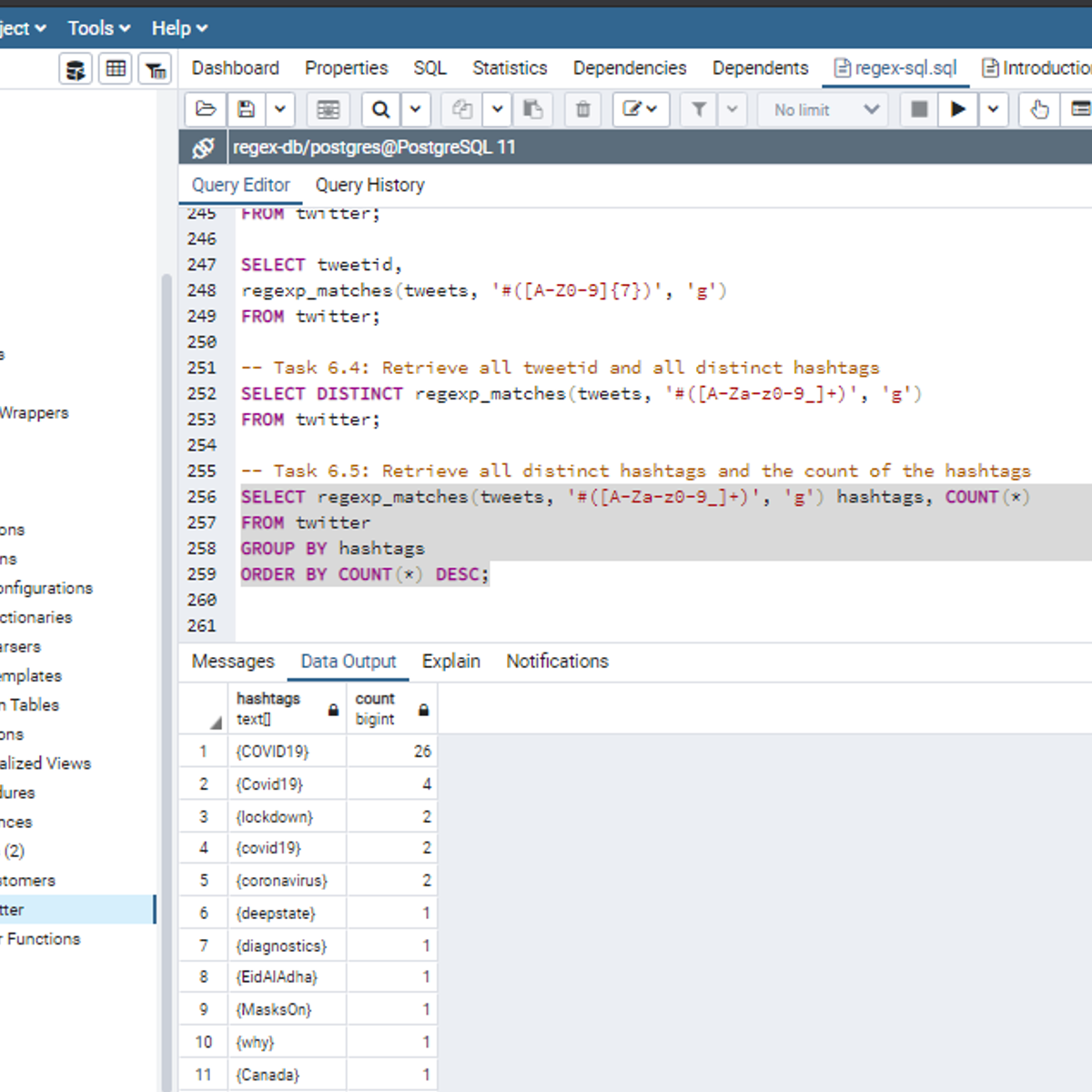
Welcome to this project-based course, Introduction to Regular Expressions in SQL. In this project, you will learn how to use SQL regular expressions extensively for pattern matching to query tables in a database. By the end of this 2-and-a-half-hour-long project, you will be able to use POSIX regular expressions together with meta (special) characters in the WHERE clause and the SELECT clause to retrieve the desired result from a database. In this project, we will move systematically by first revising the use of the LIKE and NOT LIKE operators in the WHERE clause. Then, we will use different regular expression metacharacters together with POSIX operators in the WHERE clause. Also, we will use regular expressions to work on tweets from Twitter data. Be assured that you will get your hands really dirty in this project because you will get to work on a lot of exercises to reinforce your knowledge of the concepts. Also, for this hands-on project, we will use PostgreSQL as our preferred database management system (DBMS). Therefore, to complete this project, it is required that you have prior experience with using PostgreSQL. Similarly, this project is an intermediate SQL concept; so, a good foundation for writing SQL queries is vital to complete this project. If you are not familiar with writing queries in SQL and want to learn these concepts, start with my previous guided projects titled “Querying Databases using SQL SELECT statement." I taught this guided project using PostgreSQL. So, taking these projects will give the needed requisite to complete this Introduction to Regular Expressions in SQL project. However, if you are comfortable writing queries in PostgreSQL, please join me on this wonderful ride! Let’s get our hands dirty!
 Packt
Packt
AWS Serverless Development and Automation
This course features Coursera Coach! A smarter way to learn with interactive, real-time conversations that help you test your knowledge, challenge assumptions, and deepen your understanding as you progress through the course. Learn how to leverage AWS services to automate deployments and create serverless applications. This course covers a range of AWS tools including CloudFormation, Elastic Beanstalk, Lambda, API Gateway, and DynamoDB, with hands-on projects to build and deploy real-world applications. By the end of the course, you will be able to manage your infrastructure as code, deploy applications, and harness the power of serverless computing. Through practical demonstrations and guided lessons, you will explore CloudFormation and learn how to automate infrastructure provisioning. You will gain insights into Elastic Beanstalk for app deployments and experiment with the Elastic Beanstalk CLI to automate workflows. Moving into serverless computing, you’ll explore AWS Lambda, API Gateway, and Step Functions to build scalable applications that require minimal infrastructure management. The course also delves into DynamoDB for non-relational databases and Key Management Service (KMS) for encryption, rounding out your knowledge of AWS's essential tools. By the end, you will be equipped to build serverless applications and deploy them efficiently using modern cloud technologies. This course is ideal for developers looking to expand their cloud computing skills and anyone interested in automating deployment processes on AWS. Familiarity with basic cloud computing concepts is recommended, but no prior AWS experience is necessary.
 University of Colorado Boulder
Our Place in the Cosmos
Come aboard! If you decide to take this course, you will expand your horizon of what is possible for you in the cosmos. In Course 1 (Our Place in the Cosmos) of this four course specialization, there are 39 learning objectives spread out over 4 weeks and 10 lessons. Week 1 - You will learn about the course and the specialization as a whole as well as the method used to guide you through the material. You will also get to meet the crew of the USS Pathway to Space. As your instructor and captain, I will create a unique and hopefully fun learning environment full of surprises and moments of connection with the material. We will also discuss how wonder started it all with our first guest, Dr. Valerio Ferme with Space and Wonder. Week 2 - We have two topics and two guests this week. In A Tour of the Cosmos, with Dr. Erica Ellingson, we will guide you through all the grandeur of the cosmos from the size and scale to the timeline of its existence. In Astrophysics, with Dr. Kevin France, we will explore concept and merger of two great fields of study: Astronomy and Physics. The tools used by an astrophysicists are key to unlocking the cosmos. At the end of this week, you will have a better understanding of the cosmos and your place in it. Week 3 - Space exploration can happen in two ways. By viewing there and going there. This week we will explore both methods. Our first lesson is with Dr. Paul Hayne and Dr. Carolyn Crow on Space Exploration-Going There. We will look at the stages of exploration and how the science changes at each point. Next, we will meet Dr. Kristy Tiampo as we discuss Space Exploration-Viewing There. We will dive deep into remote sensing work around Earth and how that technique of viewing can be applied throughout the cosmos. Week 4 - This week, we will discuss some of the great science being conducted in the cosmos as well as our species search life elsewhere in the universe. We have three lessons this week. The first two are in two parts. Extending Science Beyond Earth. In Part 1, we meet Dr. Nick Schneider and discuss how the different wavelengths of light have allowed us to understand other planets like Mars but also Earth. In Part 2, we meet Dr. Dave Brain and discuss what we have learned about other planets in our solar system and compare those discoveries with our home planet. We will end with the Search for Life Elsewhere where our guest, Dr. Bruce Jakosky, and I discuss what is needed for life in the cosmos and where we might find it. In these lessons, you will become a member of the crew of the USS Pathway to Space and together we will make the unknown, known. Your journey to discovering your pathway to space begins now.
 Google Cloud
Data Publishing on BigQuery using Authorized Views for Data Sharing Partners
This is a self-paced lab that takes place in the Google Cloud console. In this lab you will learn how Authorized Views in BigQuery can be used to share customer specific data from a Data Sharing Partner.
 Rice University
Anatomy & Physiology: Filtration and Reproduction
This course of the second A&P specialization concludes with a systems-based approach to human anatomy and physiology at the organ, organ system, and organism level with the major body systems related to blood filtration and continuity of life: the urinary and reproductive systems. Course material will cover both the structure (anatomy) and function (physiology) of each system with direct application to human development and disease. After completing this course, you will be able to: 1. Identify the major parts of the urinary and reproductive systems; 2. Describe normal human anatomy structure and function for the urinary and reproductive systems; 3. Relate anatomical structure and function at the cellular, tissue, organ, and body system levels to clinical diagnoses and dysfunction of the urinary system; and 4. Explain the process of typical human gestation and delivery.
 EDUCBA
Apply Fund Accounting for Mutual and Hedge Funds
By the end of this course, learners will be able to apply fund accounting principles, calculate Net Asset Value (NAV), analyze hedge fund strategies, evaluate management and incentive fees, and prepare compliant financial and regulatory reports for mutual funds and hedge funds. This course provides a comprehensive, end-to-end understanding of fund accounting, starting from foundational concepts and fund structures to advanced topics such as valuation, performance fees, equalisation methods, and regulatory reporting. Learners gain practical insight into how accounting supports investment operations, ensures fair investor treatment, and meets global compliance standards. Through structured modules and real-world examples, the course bridges theory and practice, enabling learners to interpret financial statements, apply accounting policies, and understand the full reporting lifecycle of investment funds. What makes this course unique is its integrated approach—combining accounting fundamentals, hedge fund strategies, NAV calculation, fee mechanics, and regulatory frameworks within a single learning journey. Designed for finance professionals, accountants, and aspiring fund administrators, this course equips learners with job-ready skills that are directly applicable in asset management, fund accounting, and investment operations roles.
 Coursera
Apply SCD2 to Build Dynamic Data Models
Did you know that without historical data tracking, over 40% of business insights can become inaccurate or misleading? Implementing Slowly Changing Dimension (SCD) Type 2 ensures every change in your data tells the full story over time. This Short Course was created to help professionals in this field implement robust historical data tracking systems that maintain complete audit trails and support accurate trend analysis in enterprise data warehouses. By completing this course, you will be able to apply SCD Type 2 logic to build dynamic data models that capture historical changes, enabling reliable reporting, timebased analysis, and improved business intelligence accuracy. By the end of this 3hour long course, you will be able to: Apply slowlychanging dimension (SCD) Type 2 logic to build data models that track historical changes. This course is unique because it connects data modeling theory with practical warehouse implementation, giving you the skills to design scalable, auditready models that preserve data integrity across time. To be successful in this project, you should have: Basic SQL knowledge Understanding of data modeling concepts Familiarity with dbt fundamentals Data warehouse basics
 Coursera
Introduction to JavaScript Arrays
By the end of this project you will understand how data is stored in and retrieved from arrays in JavaScript. You will use the Notepad++ editor to write JavaScript code to work with arrays. In addition to creating and populating an array, you will learn multiple methods of accessing data from arrays using JavaScript code. Arrays are a great way to store multiple values of a similar type and are commonly used in programming. Note: This course works best for learners who are based in the North America region. We’re currently working on providing the same experience in other regions.
 Google
أمان تكنولوجيا المعلومات: الحماية من الهجمات الرقمية
تغطي هذه الدورة مجموعة متنوعة من المفاهيم والأدوات وأفضل الممارسات المتعلقة بأمان تكنولوجيا المعلومات. وهي تتناول التهديدات والهجمات والأشكال العديدة التي قد تتخذها. سنقدم لك بعض المعلومات التمهيدية عن خوارزميات التشفير وكيفية استخدامها لتأمين البيانات. ثم نستعرض بالتفصيل ثلاثة من جوانب أمان المعلومات، وهي المصادقة والترخيص والمحاسبة. سنغطي أيضًا حلول أمان الشبكات المتنوعة التي تشمل جدران الحماية وخيارات تشفير الشبكات اللاسلكية Wifi. وتكتمل الدورة بتجميع كل هذه العناصر معًا في بنية أمنية عميقة ومتعددة الطبقات، يلي ذلك توصيات حول كيفية دمج ثقافة الأمان في مؤسستك أو لدى أعضاء فريقك. في نهاية هذه الدورة، ستفهم ما يلي: ● طريقة عمل خوارزميات وتقنيات التشفير المختلفة فضلًا عن مزاياها وعيوبها. ● أنظمة وأنواع المصادقة المختلفة. ● الفرق بين المصادقة والترخيص ●كيفية تقييم المخاطر المحتملة والتوصية بالطرق التي من شأنها تقليل المخاطر. ● أفضل الممارسات الخاصة بتأمين الشبكة. ● كيفية مساعدة الآخرين في فهم مصطلحات الأمان وحماية أنفسهم.
 Tecnológico de Monterrey
Inteligencia Artificial centrada en el ser humano
Este curso presenta los fundamentos conceptuales de la inteligencia artificial. Comienza con los antecedentes históricos. Los principales conceptos se desarrollarán de forma sistemática y se analizarán desde una perspectiva filosófica. Las preguntas principales son: ¿Qué es la inteligencia y qué significa pensar y hablar un idioma?, ¿Cuáles son las implicaciones éticas y sociales de la inteligencia artificial? Los objetivos son los siguientes: 1. Reconocer y comprender las ideas principales de la IA. 2. Analizar los conceptos fundamentales de la IA. 3. Evaluar estos conceptos fundamentales desde una perspectiva filosófica, ética y social
 Coursera
Introduction to Generative AI in Finance
Are you aware that generative AI is rapidly reshaping the financial services landscape? This groundbreaking technology is transforming how we analyze markets, manage risks, and tailor financial products, opening up unprecedented avenues for efficiency and innovation in the finance sector. We've designed this concise course to equip finance professionals and business leaders with a solid understanding of generative AI's fundamentals and its potential in the financial industry. Whether you're in banking, investment management, insurance, or fintech, this course will provide you with the knowledge to harness AI in your financial operations. Upon completing this course, you'll be equipped to spot strategic opportunities for AI implementation in your financial processes, utilize basic AI tools for financial modeling and investment strategy personalization, and formulate plans to incorporate AI into your existing workflows, enhancing risk management and decision-making. By the end of this 3-hour course, you will be able to: LO1: Evaluate the capabilities and applications of generative AI to identify strategic opportunities in various financial contexts. LO2: Apply basic generative AI tools to create simple financial models and personalize investment strategies. LO3: Analyze the potential impact of generative AI on existing financial workflows to develop integration plans that enhance risk management and decision-making processes. What sets this course apart is its beginner-friendly approach to generative AI in finance, featuring practical examples and hands-on experience with popular AI tools. You'll gain insights into not just the "what" and "why" of AI in finance, but also the practical "how" to implement it in your daily operations.