

The Global Scholarly Directory.
Discover world-class academic programs curated for the modern intellectual. Search through 19877+ degrees and professional certificates.
 University of Colorado Boulder
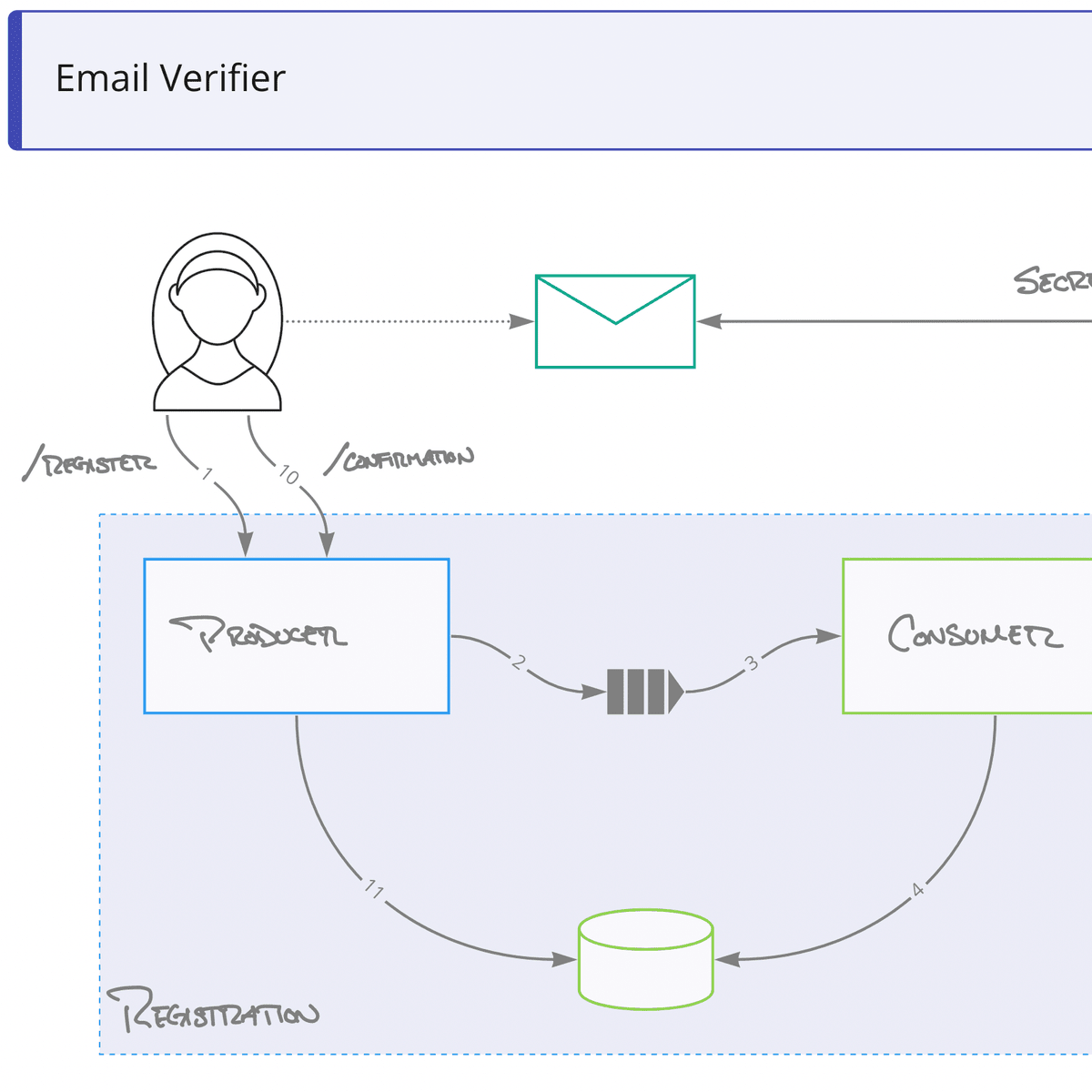
Software Architecture Patterns for Big Data
The course is intended for individuals looking to understand the architecture patterns necessary to take large software systems that make use of big data to production. You will transform big data prototypes into high quality tested production software. After measuring the performance characteristics of distributed systems, you will identify trouble areas and implement scalable solutions to improve performance. Upon completion of the course you will know how to scale production data stores to perform under load, designing load tests to ensure applications meet performance requirements. This course can be taken for academic credit as part of CU Boulder’s MS in Data Science or MS in Computer Science degrees offered on the Coursera platform. These fully accredited graduate degrees offer targeted courses, short 8-week sessions, and pay-as-you-go tuition. Admission is based on performance in three preliminary courses, not academic history. CU degrees on Coursera are ideal for recent graduates or working professionals. Learn more: MS in Data Science: https://www.coursera.org/degrees/master-of-science-data-science-boulder MS in Computer Science: https://coursera.org/degrees/ms-computer-science-boulder
 Simplilearn
Foundations of Six Sigma Define Phase Training
This Lean Six Sigma course equips you with the skills to define improvement opportunities, select the right projects, and apply Lean principles for measurable business impact. Begin by learning the essentials of Six Sigma and Lean, including the Define phase, continuous improvement evolution, problem-solving strategies, and Six Sigma roles. Build a strong foundation with VoC, VoB, VoE, CTQ, COPQ, Pareto analysis, and core metrics to clearly identify and define high-impact improvement initiatives. Next, move into Lean Six Sigma project selection and execution. Learn how to develop effective project charters by defining business cases, problem and goal statements, scope, milestones, KPIs, and expected financial benefits. Explore Lean methodology, the 3Ms, waste reduction using TIMWOODS and DOWNTIME, and 5S practices to create efficient, value-driven processes and support sustainable enterprise-wide improvement. By the end of this course, you will be able to: - Understand Six Sigma Fundamentals: Apply Six Sigma, Lean concepts, and the Define phase - Select the Right Projects: Identify and prioritize high-impact Lean Six Sigma initiatives - Build Project Charters: Define scope, goals, KPIs, and financial benefits - Apply Lean Principles: Reduce waste using TIMWOODS, DOWNTIME, and 5S practices No prior Six Sigma experience required; ideal for beginners, aspiring Six Sigma professionals, and business teams seeking foundational continuous improvement skills.
 Coursera
Discover Spatial Basics
Through short lessons, practical examples, and hands-on decision-making activities, this course introduces the core ideas behind spatial thinking and Geographic Information Systems (GIS). You’ll learn how to recognize spatial patterns, understand how location adds meaning to data, and explain foundational spatial concepts clearly to non-GIS teammates. The course emphasizes why spatial thinking matters, not just what GIS tools do, helping you connect maps, data, and decisions in real-world contexts. As you work through guided scenarios and interactive labs, you’ll practice evaluating spatial problems, making informed choices, and reflecting on how GIS supports decision-making across industries such as urban planning, public health, environmental management, and business operations. You’ll also explore common GIS workflows, data types, and use cases at a conceptual level—no prior GIS experience required. By the end of the course, you’ll have a solid conceptual foundation in spatial thinking, increased confidence discussing GIS concepts with diverse stakeholders, and the ability to make and communicate basic, evidence-based GIS decisions in professional settings.
 Google
Operating Systems and You: Becoming a Power User
Through a combination of video lectures, demonstrations, and hands-on practice, this course will teach learners about the main components of an operating system and how to perform critical tasks like managing software and users and configuring hardware. By the end of this course you’ll be able to: ● navigate the Windows and Linux filesystems using a graphical user interface and command line interpreter ● set up users, groups, and permissions for account access ● install, configure, and remove software on the Windows and Linux operating systems ● configure disk partitions and filesystems ● understand how system processes work and how to manage them ● work with system logs and remote connection tools ● utilize operating system knowledge to troubleshoot common issues in an IT Support Specialist role
 Google Cloud
Gemini in Google Slides
Google Workspace with Gemini provides customers with generative AI features in Google Workspace. In this mini-course, you learn about the key features of Gemini and how they can be used to improve productivity and efficiency in Google Slides.
 Coursera
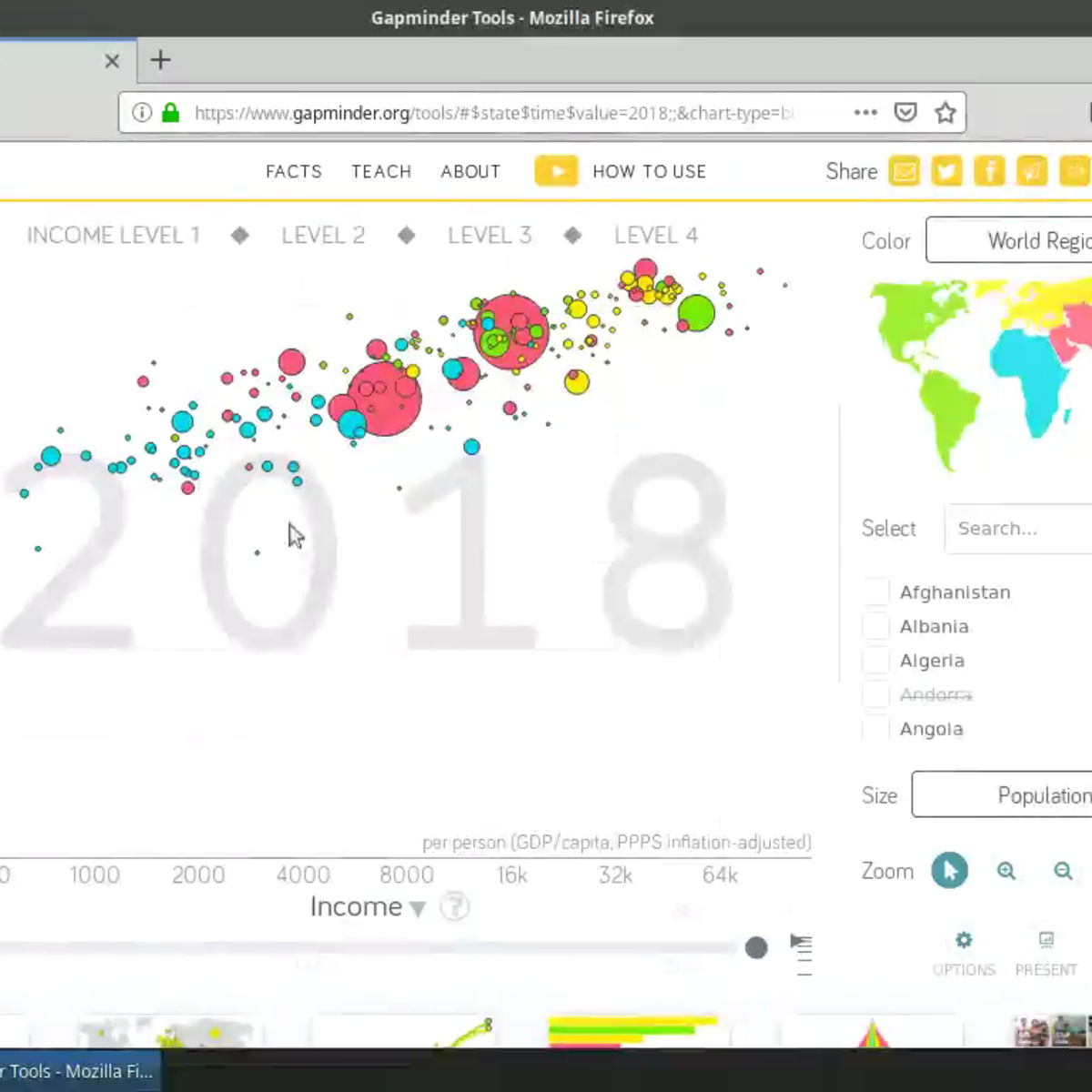
Data Visualization with Plotly Express
Welcome to this project-based course on Data Visualization with Plotly Express. In this project, you will create quick and interactive data visualizations with Plotly Express: a high-level data visualization library in Python inspired by Seaborn and ggplot2. You will explore the various features of the in-built Gapminder dataset, and produce interactive, publication-quality graphs to augment analysis. This course runs on Coursera's hands-on project platform called Rhyme. On Rhyme, you do projects in a hands-on manner in your browser. You will get instant access to pre-configured cloud desktops containing all of the software and data you need for the project. Everything is already set up directly in your internet browser so you can just focus on learning. For this project, you’ll get instant access to a cloud desktop with Python, Jupyter, and Plotly Express pre-installed. Notes: - You will be able to access the cloud desktop 5 times. However, you will be able to access instructions videos as many times as you want. - This course works best for learners who are based in the North America region. We’re currently working on providing the same experience in other regions.
 Birla Institute of Technology & Science, Pilani
Cloud Computing Fundamentals
This comprehensive course provides a structured and practice-oriented introduction to cloud computing fundamentals, guiding learners from core theoretical concepts to real-world cloud system implementation. Beginning with distributed computing principles, virtualisation, and containerisation, the course establishes the technological foundations that enable modern cloud infrastructures. Learners gain clarity on cloud characteristics, deployment models, and service models (IaaS, PaaS, SaaS), supported by the 3-4-5 rule for conceptual coherence. The curriculum then progresses into hands-on exploration of cloud infrastructure using Amazon Web Services (AWS). Students work with compute, storage, networking, identity, and access management services, learning to launch and manage EC2 instances, configure storage solutions, and apply pricing and responsibility models. Advanced modules emphasise SaaS architectures, cloud data storage economics, capacity management, auto-scaling, load balancing, and scheduling mechanisms, including Kubernetes-based workload scheduling and CloudWatch-driven monitoring. Practical case studies—centred on a cloud-hosted Learning Management System—anchor abstract concepts in realistic deployment and optimisation scenarios. The course concludes by addressing critical challenges in cloud computing, such as availability, fault tolerance, security, multi-tenancy risks, compliance, and SLA enforcement. Through simulations, labs, and assessments, learners develop the ability to design resilient, scalable, and cost-efficient cloud solutions while applying best practices in monitoring, access control, and reliability engineering. By the end of the course, learners are equipped to understand cloud architectures end-to-end, deploy and manage cloud-based applications, and reason critically about performance, cost, and risk trade-offs in real-world cloud environments.
 Coursera
Tag Content Smartly
Tag Content Smartly is an intermediate, hands-on course for professionals who want to improve search, collaboration, and content discovery in shared workspaces. Rather than relying on titles or keywords alone, this course focuses on how thoughtful labeling creates structure that helps teams find the right information faster and with more confidence. In this course, you will explain how clear, consistent labels improve search results and why search becomes less reliable without them. You will add three relevant labels to a page and confirm it appears in label-based search results. Using realistic workplace scenarios, you will practice explaining the value of labeling, applying labels correctly, and validating search outcomes. By the end of the course, you will be prepared to use labeling strategically to reduce search friction, support team alignment, and improve content organization over time. This course is designed for learners who already have basic experience navigating workplace content tools and using search, and who are familiar with pages, documents, and team collaboration workflows.
 Packt
Packt
GitHub Actions Masterclass: From Beginner to Advanced
This course features Coursera Coach! A smarter way to learn with interactive, real-time conversations that help you test your knowledge, challenge assumptions, and deepen your understanding as you progress through the course. Master GitHub Actions from the ground up in this comprehensive masterclass! Whether you’re just starting or aiming to deepen your expertise, this course will take you step-by-step through GitHub Actions concepts. You'll learn to automate workflows, handle triggers, manage inputs/outputs, and develop custom actions, equipping you with all the tools to build advanced CI/CD pipelines. By the end of this course, you'll be adept at optimizing and securing workflows and managing concurrent processes seamlessly. This course follows a structured approach: beginning with setting up your environment and GitHub repository, you’ll dive into the fundamentals of workflows, triggers, and runner environments. You will then explore advanced features like expressions, event filters, caching, artifacts, and matrices. Along the way, hands-on exercises and solutions will reinforce key concepts, and you will tackle real-world scenarios with increasing complexity. In the latter part of the course, you’ll build custom GitHub Actions, create reusable workflows, handle concurrency, and secure your workflows to ensure they’re safe from vulnerabilities. By the course’s end, you'll have a robust understanding of GitHub Actions, ready to integrate these automated workflows into real-world projects and teams. This course is perfect for developers, DevOps engineers, or anyone looking to master GitHub Actions for CI/CD automation. No prior experience with GitHub Actions is required, but familiarity with GitHub and basic programming concepts will be helpful.
 Coursera
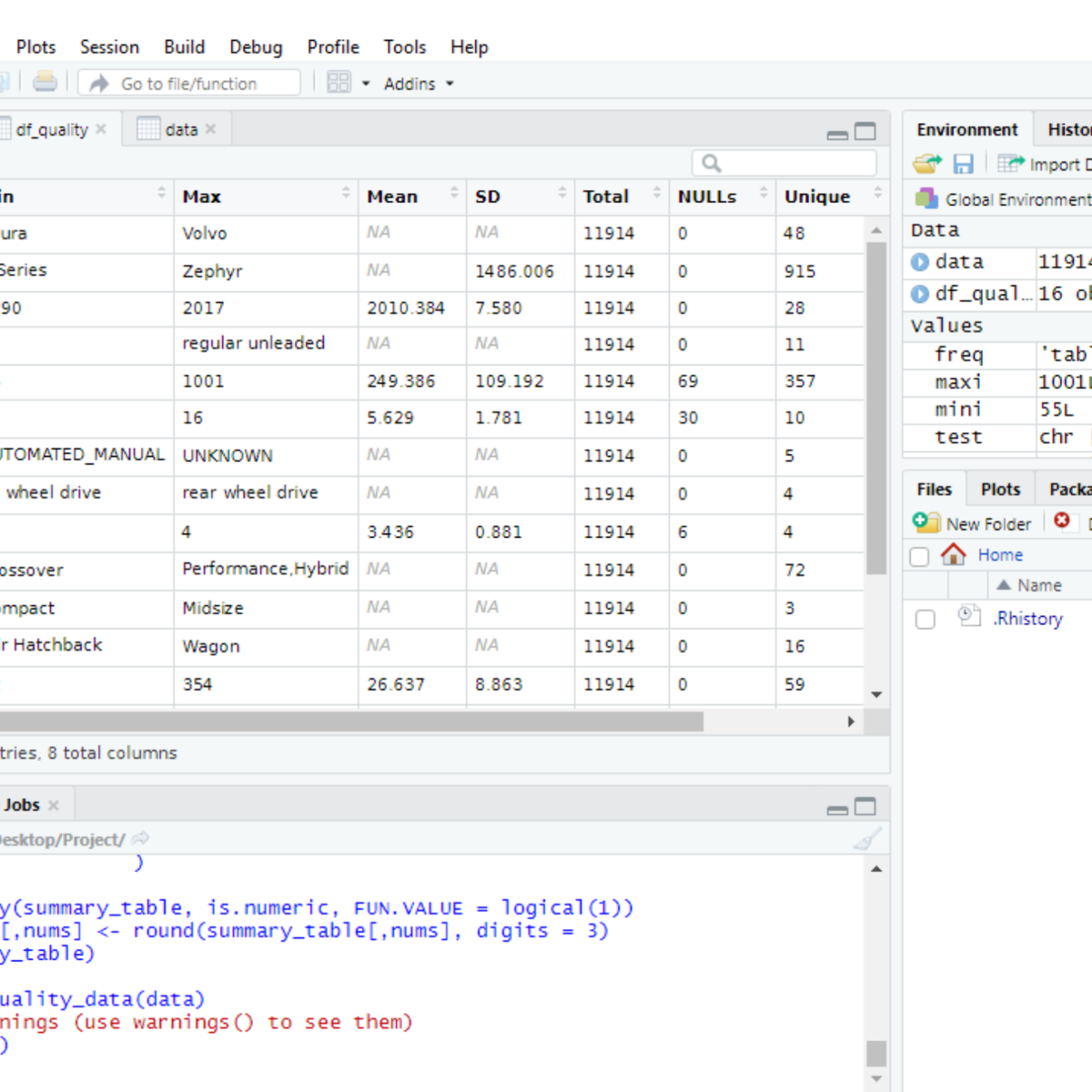
Using Descriptive Statistics to Analyze Data in R
By the end of this project, you will create a data quality report file (exported to Excel in CSV format) from a dataset loaded in R, a free, open-source program that you can download. You will learn how to use the following descriptive statistical metrics in order to describe a dataset and how to calculate them in basic R with no additional libraries. - minimum value - maximum value - average value - standard deviation - total number of values - missing values - unique values - data types You will then learn how to record the statistical metrics for each column of a dataset using a custom function created by you in R. The output of the function will be a ready-to-use data quality report. Finally, you will learn how to export this report to an external file. A data quality report can be used to identify outliers, missing values, data types, anomalies, etc. that are present in your dataset. This is the first step to understand your dataset and let you plan what pre-processing steps are required to make your dataset ready for analysis. Note: This course works best for learners who are based in the North America region. We’re currently working on providing the same experience in other regions.
 EDUCBA
Bash Shell Scripting: Automate, Process & Analyze
By the end of this course, learners will be able to write Bash scripts, configure the Linux shell environment, manipulate variables and strings, apply regular expressions, manage file permissions, and process data using Awk. Through hands-on exercises, they will gain the ability to automate repetitive tasks, perform text and file processing, and analyze system configurations. This course is designed for beginners and intermediate learners who want to strengthen their command-line skills and master the building blocks of Bash scripting. Unlike traditional tutorials, this program integrates real-world use cases such as system administration, file management, and data processing. Learners will not only understand Bash syntax but also apply it effectively to solve practical problems. What makes this course unique is its structured approach: starting from fundamentals, advancing through system configuration, and concluding with powerful data analysis using Awk. By completing this course, learners will acquire industry-relevant scripting skills to improve productivity, streamline workflows, and prepare for roles in DevOps, system administration, and automation.
 University of Colorado Boulder
Fundamentals of Visualization & Design with Tableau
This beginner Tableau course introduces you to Tableau and what makes visualizations interesting and powerful. You'll identify components of visualizations that make easy-to-understand charts, explore and examine the use of visualizations in external media and daily life, and finally you'll build simple visualizations in Tableau. By the end of this course you will have a firm grasp on the Tableau essentials and be perfectly adept at handling basic visualization techniques within the tool. Photo by Bilal Mansuri on Unsplash
 University of California, Santa Cruz
لغة البرمجة C++ لمبرمجي C، الجزء (ب)
هذه الدورة مخصصة لمبرمجي اللغة C ذوي الخبرة الذين يرغبون في البرمجة بلغة C++. تتطلب الأمثلة والتمارين فهمًا أساسيًا للخوارزميات والبرمجيات الموجّهة للكائنات.
 Duke University
Stress First Aid for Healthcare Workers: A Peer Support Tool
Stress First Aid (SFA) is a peer support toolkit designed to preserve life, prevent further harm, and promote recovery. Stress First Aid offers a flexible menu of options for recognizing and addressing stress reactions. It can be used for self-care, to help co-workers with stress reactions, or to help someone seek other types of support. Stress First Aid is a framework of practical actions that can help reduce the likelihood that stress reactions will develop into more severe or long-term problems. Ideally everyone in an organization would learn the vocabulary and basics of Stress First Aid, to share a language and understanding of stress and stress injury. When everyone in an organization is trained in SFA, support could occur wherever and whenever it’s needed. Upon completion of Stress First Aid: A Peer Support Tool, you’ll be eligible for 9.00 credits (AMA PRA Category 1 Credit(s), ANCC, Attendance, JA-Credit-AH) through the Duke University Health System Clinical Education and Professional Development Office.
 Tecnológico de Monterrey
Mentoría: Guiando el Éxito
Sumérgete en el fascinante mundo de la mentoría, un elemento indispensable para conectar con las personas y apreciar su capacidad como seres humanos susceptibles de aprender de cualquier desafío que se presente a lo largo de su vida profesional o laboral. En este proceso, es fundamental tener la generosidad de guiarlos hacia el camino óptimo, es decir, hacia el éxito que les brinda plenitud. Esto, a su vez, les permitirá desarrollar habilidades para adaptarse positivamente a un entorno desafiante, motivándolos a un crecimiento continuo. Considera este curso como un manual para promover el éxito profesional de tus mentees a través del mentoring. Este curso ofrece sugerencias prácticas para mejorar la calidad de la mentoría, tanto en universidades como en empresas.
 EDUCBA
AI & Predictive Analytics with Python
This course provides a comprehensive, hands-on introduction to Artificial Intelligence and Predictive Analytics using Python. Learners will progress from foundational concepts of predictive modeling and ensemble methods to advanced unsupervised clustering techniques like Meanshift, Affinity Propagation, and Gaussian Mixture Models. The course then explores supervised learning algorithms, including Logistic Regression, Naive Bayes, and Support Vector Machines, and transitions into logic programming and problem-solving approaches such as heuristic search, local search, and constraint satisfaction problems. The final module introduces Natural Language Processing (NLP) with Python and NLTK, covering tokenization, stemming, lemmatization, segmentation, information extraction, chunking, Named Entity Recognition (NER), and grammar-based parsing techniques including Context-Free Grammar, recursive descent parsing, and shift-reduce parsing. By the end of this course, learners will be able to: • Apply predictive analytics and machine learning algorithms to real-world problems. • Analyze clustering, classification, and NLP pipelines to process structured and unstructured data. • Evaluate model performance using metrics such as confusion matrices and clustering quality measures. • Construct logic-based AI solutions using rules, constraints, and search strategies. • Design end-to-end workflows for predictive modeling, text mining, and syntactic parsing. This course is ideal for learners seeking to apply, analyze, and evaluate AI methods for data science, predictive analytics, and natural language processing applications using Python.