

The Global Scholarly Directory.
Discover world-class academic programs curated for the modern intellectual. Search through 19877+ degrees and professional certificates.
 Packt
Packt
Bug Bounty from Scratch
This course provides an in-depth guide to understanding and participating in bug bounty programs, where you'll learn the skills needed to identify and report security vulnerabilities. The program covers essential tools, methodologies, and strategies for ethical hackers, helping you contribute to cybersecurity in a structured and rewarding way. You will learn to navigate the bug bounty landscape, exploring program selection, security methodologies, and advanced techniques like enumeration and privilege escalation. By the end, you'll have the hands-on skills to succeed in bug bounty programs and maximize your rewards while contributing to improved cybersecurity. What makes this course unique is its practical approach, blending theory with real-world applications. You’ll gain insights from community-driven security practices, ensuring you’re prepared for actual security challenges. This course is ideal for cybersecurity enthusiasts, ethical hackers, and students aiming to gain practical experience in offensive security. No prior bug bounty experience is needed, though a basic understanding of cybersecurity is recommended.
 Coursera
Model Training & Evaluation
In this short course, you’ll learn how to train and evaluate machine learning models with confidence. You’ll explore how mini-batch training and learning-rate schedulers shape convergence, how to read loss curves and logs to diagnose issues, and how class-imbalance techniques affect F1 scores. Through hands-on PyTorch practice, you’ll train models, investigate instability, and compare weighting and SMOTE. By the end, you’ll understand how to guide models toward stable, reliable performance.
 Duke University
Advanced Data Engineering
In this advanced course, you will gain practical expertise in scaling data engineering systems using cutting-edge tools and techniques. This course is designed for data scientists, data engineers, and anyone with a foundational understanding of data handling who desires to escalate their skills to handle larger, more complex datasets efficiently. Throughout the course, you'll master the application of technologies such as Celery with RabbitMQ for scalable data consumption, Apache Airflow for optimized workflow management, and Vector and Graph databases for robust data management at scale. The course will culminate with hands-on projects that offer real-world experience, where you'll put your acquired skills to test in solving data engineering challenges. You will not only learn to create scalable data systems but also to analyze their performance and make necessary adjustments for optimum results. This invaluable experience in advanced data engineering techniques will prepare you for the demanding tasks of handling massive datasets, streamlining complex workflows, and optimizing data operations for businesses of any scale.
 EDUCBA
Develop a Conference Room Booking System in C# .NET
By completing this course, learners will analyze real-world requirements, design a normalized relational database, implement full-stack functionality using C# .NET, and evaluate system readiness through structured development practices. This hands-on course walks learners step by step through building a Conference Room Booking System (CRBS) from scratch using C# and .NET, focusing on practical, job-ready skills. Learners begin by understanding business requirements and translating them into a well-structured database design. They then move into application development, where they implement controllers, validation, exception handling, and modular architecture. Unlike theory-heavy courses, this program emphasizes real project development, mirroring how enterprise applications are built in professional environments. Each stage of the project is explained in depth, ensuring learners understand not just what to build, but why each design and coding decision matters. By the end of the course, learners will have a complete, working booking system, improved confidence in database-driven application development, and practical experience that can be directly applied to real-world .NET projects and technical interviews.
 Peking University
电磁学下——恒磁场与时变电磁场
《电磁学下》是《电磁学》的第二学习进程,教学内容含恒磁场、磁介质,电磁感应、交流电和电磁场电磁波。虽然《电磁学下》内容比较多,但是处理场的基本方法大家已经熟悉和适应了,应该说,电磁学的前两章是整个电磁学的基础。建议大家学习了第一进程,通过了结业考试以后再进入第二学习进程《电磁学下》的学习。本课程的课程是按照知识点设置模块,《电磁学下》包含6个模块。每个模块又包含几节课,每个模块结束有一个小测,同学们可以自我测试,没有时间限制,大家可以根据自己的需要和时间安排来自主学习,以免一步跟不上,步步跟不上,这对于学习我们这种理论性比较强的课是有利的,已经明白的可以跳过去,不清楚的可以重点学习。 教学大纲 模块一 恒定磁场的基本规律 模块二 磁力 模块三 磁介质 模块四 电磁感应 模块五 交流电 模块六 电磁场电磁波
 EDUCBA
Design and Implement Advanced Puppet Architectures
Learners will be able to design scalable Puppet architectures, implement data-driven configuration management using Hiera, build reusable and maintainable Puppet modules, apply roles and profiles patterns, and generate dynamic configuration files using advanced templating techniques. This advanced Puppet course is designed for professionals who want to move beyond basic configuration management and build production-ready infrastructure automation solutions. Through a structured, hands-on approach, learners gain deep expertise in separating data from code with Hiera, managing hierarchical configuration data, and designing flexible Puppet modules that adapt across environments. The course emphasizes real-world best practices such as class parameterization, defined resource types, and the roles and profiles pattern—skills that are critical for managing large-scale, enterprise infrastructures. Learners also master advanced templating techniques, including conditional logic and data iteration, enabling them to generate dynamic, context-aware configuration files. What makes this course unique is its end-to-end focus on architecture, maintainability, and scalability, rather than isolated features. By the end of the course, learners will be equipped to confidently design, implement, and maintain advanced Puppet solutions that align with industry standards and DevOps best practices.
 Coursera
Code Generation with Amazon Q
This course ‘Amazon Q Developer Essentials: AI-Powered Coding’ will give you a strong grasp of the basics but facilitate your mastery in application. This course begins by introducing learners to Amazon Q Developer and builds up essential skills for integrating AI-powered solutions into their workflows, focusing on software development and troubleshooting. Key aspects include setting up Amazon Q Developer, using it for code enhancements, and optimizing workflows. The course employs short, engaging learner-centric videos of interactive lectures and interesting applications to ensure a comprehensive and practical learning experience. This course is designed for Software Developers, IT Professionals, DevOps Engineers, AWS Solution Architects, and Technical Leads and Managers looking to enhance their workflows using AI tools in AWS environments. It equips learners with the skills to seamlessly integrate Amazon Q Developer into their cloud-based development and operations. Participants should have a basic grasp of AWS services, familiarity with at least one programming language, and a working understanding of AI concepts. These skills ensure readiness to navigate the AWS ecosystem and leverage the AI-driven functionalities of Amazon Q Developer. By the end of this course, learners will be able to recognize and set up Amazon Q Developer within the broader Amazon Q ecosystem, enabling seamless integration with their AWS workflows. They will also be able to identify the key features and capabilities of the tool, leveraging its AI-driven functions to improve code quality and efficiency. Finally, learners will gain hands-on experience applying Amazon Q for code generation, troubleshooting, and optimization, making them proficient in utilizing AI to streamline development processes.
 Packt
Packt
CyberPatriot
Updated in May 2025. This course now features Coursera Coach! A smarter way to learn with interactive, real-time conversations that help you test your knowledge, challenge assumptions, and deepen your understanding as you progress through the course. Gain a comprehensive understanding of cybersecurity through the CyberPatriot program, an initiative designed to educate and train the next generation of cybersecurity professionals. This course introduces key cybersecurity principles, online safety measures, and ethical considerations in the digital world. You'll also explore real-world case studies that highlight the impact of ethical decision-making in cybersecurity. The course begins with an overview of cybersecurity fundamentals, online safety, and cyber ethics. You'll analyze real-life scenarios and current events that challenge ethical decision-making in cybersecurity. As you progress, you’ll delve into core cybersecurity principles such as the CIA Triad, threats and vulnerabilities, and security countermeasures. Next, you'll explore the technical aspects of cybersecurity, including computer basics, virtualization, and networking. You'll gain hands-on experience with Microsoft Windows security tools, security configurations, and account management practices. The course also introduces Linux and Ubuntu, covering system security, command-line fundamentals, and best practices for securing Unix-based systems. This course is ideal for students, educators, and aspiring cybersecurity professionals looking to build foundational knowledge. No prior experience is required, making it accessible to beginners while also providing valuable insights for those looking to enhance their cybersecurity skills.
 EDUCBA
Java Servlets Case Study - Email Marketing Tool
This hands-on course equips learners with the skills to design, construct, and deploy a web-based Email Marketing Tool using Java Servlets, HTML, CSS, JDBC, and the JavaMail API. Through a real-world project, students will begin by outlining the front-end layout and form structure, then proceed to build dynamic servlets that interact with a MySQL database to retrieve employee data. Learners will then develop and integrate both frontend and backend logic to send automated emails, concluding with a working, browser-accessible tool. Emphasis is placed on practical understanding, modular development, and full-stack integration in Java-based web applications. By the end of this course, learners will be able to: • Plan and organize form-driven front-end interfaces for a web-based tool. • Develop servlets that process requests and connect to backend systems. • Apply JDBC techniques to retrieve and manipulate data from a MySQL database. • Integrate the JavaMail API to send customized emails programmatically. • Evaluate output through real-time testing and project walkthroughs.
 LearnQuest
Automate Data Analysis and BI with No-Code AI
Transform raw business data into actionable insights using automated, no-code AI solutions. Forge predictive models, design custom dashboards, and communicate results to maximize professional influence. This course empowers learners to automate time-consuming data processes, visualize trends for decision-makers, and drive change in both emerging and mature markets, including region-specific approaches for India, the USA, and Spanish-speaking learners.
 Johns Hopkins University
Algebra: Elementary to Advanced - Functions & Applications
After completing this course, students will learn how to successfully apply functions to model different data and real world occurrences. This course reviews the concept of a function and then provide multiple examples of common and uncommon types of functions used in a variety of disciplines. Formulas, domains, ranges, graphs, intercepts, and fundamental behavior are all analyzed using both algebraic and analytic techniques. From this core set of functions, new functions are created by arithmetic operations and function composition. These functions are then applied to solve real world problems. The ability to picture many different types of functions will help students learn how and when to apply these functions, as well as give students the geometric intuition to understand the algebraic techniques. The skills and objectives from this course improve problem solving abilities.
 Packt
Packt
Deploying Windows Clients & Managing Identities
Updated in May 2025. This course now features Coursera Coach! A smarter way to learn with interactive, real-time conversations that help you test your knowledge, challenge assumptions, and deepen your understanding as you progress through the course. This course equips you with the skills to deploy, manage, and secure Windows client operating systems. You'll learn to implement device lifecycle management using Microsoft Intune, configure security policies, manage identities with Microsoft Entra ID, and troubleshoot deployments. By the end, you'll be able to streamline provisioning, enforce compliance, and enhance security in enterprise environments. The course begins with Windows client deployment, covering editions, hardware requirements, and installation methods. You'll explore tools like Microsoft Deployment Toolkit (MDT), Autopilot, and provisioning packages to automate deployments. Migration strategies using the User State Migration Tool (USMT) and remote management solutions are also covered. Next, you'll dive into identity and compliance management with Entra ID and Intune, implementing authentication, role-based access control (RBAC), and Conditional Access policies. You'll manage device enrollment, enforce policies, and monitor compliance. Ideal for IT professionals and system administrators, this course requires basic Windows OS and Active Directory knowledge. Whether new to device management or experienced, you'll gain practical, real-world skills.
 Google Cloud
Streaming HL7 to FHIR Data with Healthcare API
This is a self-paced lab that takes place in the Google Cloud console. In this lab, you will explore some of the features of Cloud Healthcare API (HCAPI) to stream HL7v2 messages into HCAPI datastores and convert HL7v2 to FHIR and import the FHIR data into BigQuery for analytical use.
 The University of Notre Dame
Ethics of Technology
This course explores the ethical implications of data analytics. It connects old ideas – privacy, surveillance, power, justice, accountability, corporate responsibility, stakeholder theory – with new technologies and cases, such as the use of machine learning to predict crime. The course will prepare you to evaluate strategic arguments about the ethics of data analytics and to relate data analytics to ethical concepts so that you approach newer, ambiguous capabilities of technology and artificial intelligence with a critical eye.
 Edureka
Optimizing and Deploying LLM Systems
This course advances your skills from building working LLM prototypes to scaling, integrating, and deploying production-grade AI systems. You’ll blend system-level concepts with hands-on engineering to profile performance, integrate real-time data and multimodal sources, and ship secure, cloud-deployed applications. Whether you’re a developer, data scientist, or AI practitioner, this course gives you a clear roadmap to transform optimized LangChain workflows into reliable, observable services that interact with live APIs, structured data, and orchestration frameworks. Through guided lessons, structured demonstrations, and project-based learning, you’ll learn how to profile latency and token usage, design efficient prompts and chains, and evaluate pipelines with LLMOps metrics. You’ll connect external APIs, build hybrid retrieval across text, tables, and images, and orchestrate complex data flows using LlamaIndex and LangGraph. Finally, you’ll containerize and deploy a FastAPI service with authentication, monitoring, and CI/CD, culminating in an end-to-end capstone deployment. By the end of this course, you will be able to: • Profile and optimize LLM pipelines for latency, throughput, and token/cost efficiency. • Design prompt and chain strategies (dynamic templates, caching, auto-tuning) to improve reliability and speed. • Implement memory, tools, and agents to enable contextual, goal-oriented behavior. • Integrate real-world data via secure APIs and hybrid retrieval across structured, unstructured, and multimodal sources. • Orchestrate data and evaluation workflows using LlamaIndex and LangGraph for scalable reasoning. • Build, secure, containerize, and deploy a FastAPI service with JWT/OAuth, monitoring, and CI/CD automation. This course is ideal for AI developers, data scientists, and software engineers ready to move beyond prompt experimentation and deliver production-ready LLM applications. A working knowledge of Python and APIs is recommended; all steps are guided to help you master the deployment stack. Join us to learn the engineering patterns that power modern, scalable generative AI—from optimization and orchestration to secure cloud deployment.
 Coursera
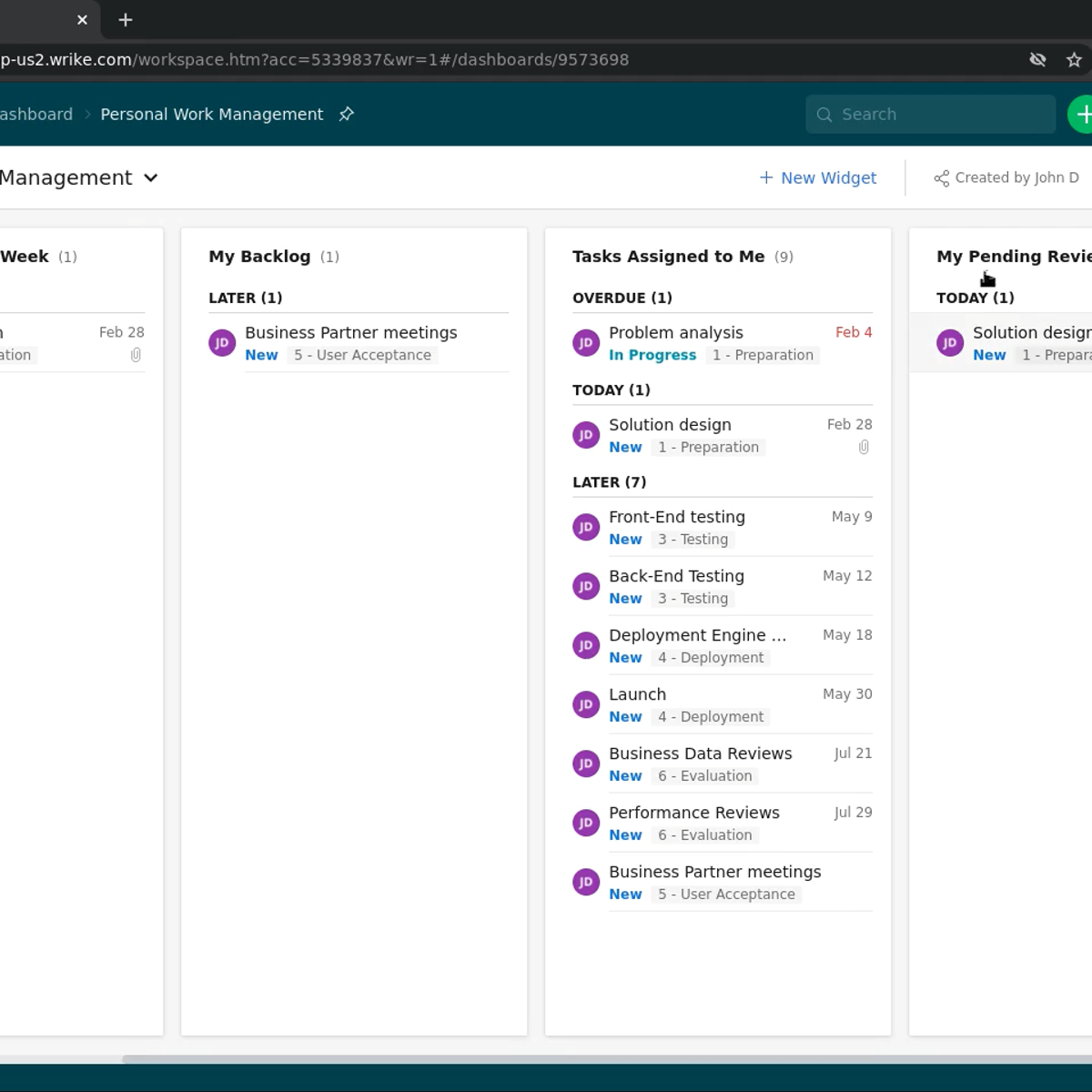
Create and manage a project dashboard with Wrike
In this 2.5-hour long project-based course, you will learn how to create and manage custom dashboards in Wrike to plan, execute and track both your personal work, team actions and multiple projects. You will use system and custom widgets, and create widgets directly from your tasks filtered list views.