

The Global Scholarly Directory.
Discover world-class academic programs curated for the modern intellectual. Search through 19877+ degrees and professional certificates.
 Università Bocconi
International Leadership and Organizational Behavior
Leaders in business and non-profit organizations increasingly work across national borders and in multi-cultural environments. You may work regularly with customers or suppliers abroad, or be part of a globally dispersed cross-functional team, or an expatriate manager on an international assignment. You may be a member of a global online community, or a development aid worker collaborating with an international network of partner organizations. In all of these contexts, your effectiveness as a leader depends on how well you understand and are able to manage individual and collective behaviors in an intercultural context. In this course – together with a team of Bocconi expert faculty and Bocconi alumni – we’ll explore the theory and practice of international and intercultural leadership and organizational behavior. Social science research has revealed systematic ways in which our behavior differs across cultural contexts – enabling us to more effectively work across borders. Insights from psychology, neuroscience, sociology and anthropology, from communication studies and from management scholarship allow us to understand what shapes individual and group decision making, what enhances or weakens team performance, and how we can build and use our social networks. And the shared practical experience of international leaders allows us to identify concrete steps to enhancing intercultural leadership competence, and to be cognizant of common leadership challenges. Learning about organizational behavior provides a great opportunity to develop your leadership skills and to reflect on your own behavioral tendencies. How do you usually make important decisions? What motivates you and how do you try motivating others? How successfully do you leverage and integrate diverse skills and views in a team? Do you prefer professional relationships with a close-knit group of trusted colleagues, or with a far-flung network of acquaintances from all walks of life? If you really want to learn how organizations behave and take decisions and at the same time develop leadership skills, then this is the course for you. We are looking forward to welcoming you and supporting you on this journey of learning and discovery. COURSE SYLLABUS Week 1 - Leadership Acumen. International perspective on leadership, common traps & challenges, and opportunities of intercultural leadership. Week 2 - Navigating Culture. Impact of cultural differences on organizations, decoding culture, culture classifications and stereotyping, developing intercultural intelligence. Week 3 - Communication. Communication and its impact on leadership identity and relationships, managing communication to improve decision making, steps for developing your intercultural communication skills. Week 4 - Motivation. Views on individual motivation, cultural differences in motivation, developing motivation and commitment in teams. Week 5 - Networking. Patterns of interpersonal relationships in/across organizations, strategically developing social networks and social capital, norms for networking across cultures. Week 6 - Conflict. Effective / defective conflict management approaches, dealing with ethical dilemmas. Thanks to the participation of our alumni and of the Bocconi Alumni Association, participants will have practical insights on international leadership. RECOMMENDED BACKGROUND All are welcome! Some prior exposure to basic issues of organizational behavior (communication, decision making, motivation, etc.) is useful, but not required.
 Google Cloud
Managing Threat Intelligence with Cortex XSOAR
This is a self-paced lab that takes place in the Google Cloud console. Work on a real life threat hunting scenario to learn how to successfully manage your threat intelligence data with Cortex XSOAR TIM and automate response actions using threat intel management playbooks.
 École Polytechnique Fédérale de Lausanne
Planning & Design of Sanitation Systems and Technologies
Do you want to learn how to plan affordable and context-specific sanitation solutions? Be up-to-date on the newest developments in urban sanitation planning and programming? Get to know best practice examples of urban sanitation systems in low- and middle-income countries? If yes, this course is for you! This course provides you with an introduction to integrated sanitation planning, both on a citywide scale and for specific contexts such as informal settlements. You will become familiar with different sanitation planning frameworks as well as different systems and technologies relevant along the sanitation value chain. You will learn why systems’ thinking is crucial for urban environmental sanitation, and how to apply key terminology and important concepts. This course is one of four in the series “Sanitation, Water and Solid Waste for Development". www.eawag.ch/mooc
 EDUCBA
Microsoft Azure - Data Lake
This hands-on course empowers learners to design, implement, and optimize data analytics solutions using Microsoft Azure Data Lake. Through a step-by-step, modular framework, participants will explore the fundamentals of scalable data storage, master U-SQL scripting for data transformation, and gain proficiency in job submission, performance tuning, and cost management using tools like Azure CLI, PowerShell, and Visual Studio. Learners will analyze real-world data scenarios, construct dynamic queries, deploy reusable views and functions, and evaluate job performance through diagnostics, heat maps, and vertex execution views. The course concludes with strategies to organize, secure, and manage data using both graphical and command-line tools, while also interpreting pricing models for efficient cost planning. Aligned with Bloom’s Taxonomy, this course encourages learners to: Understand the architecture and components of Azure Data Lake Apply U-SQL to perform data extraction, filtering, and aggregation Analyze job graphs and performance metrics for optimization Create reusable query logic using views, functions, and stored procedures Evaluate cost efficiency and scalability across access methods Manage data environments using automation and scripting interfaces
 University of Colorado Boulder
Basic Elements of Design: Design Principles and Software Overview
Designing for an organization, while requiring technical skill, is not just about knowing how to use a pagination program such as InDesign or manipulate photos using Photoshop. A designer is a visual storyteller, a person who pairs words with images and typography to best convey information to an audience. Good design evokes emotion and presents the news of the day with clarity and the proper tone. A business card, brochure, or website that has good design provides content that is more inviting, more easily comprehensible and is faster to process. Design isn’t about “making it look pretty,” it’s also about content, layout and audience analysis.
 Google Cloud
Crea data lakes y almacenes de datos en Google Cloud
Si bien los enfoques tradicionales de usar data lakes y almacenes de datos pueden ser eficaces, tienen deficiencias, en particular en entornos empresariales grandes. En este curso, se presenta el concepto del data lakehouse y los productos de Google Cloud que se usan para crear uno. Una arquitectura de lakehouse usa fuentes de datos de estándares abiertos y combina las mejores funciones de los data lakes y los almacenes de datos, lo que aborda muchas de sus deficiencias.
 Universidades Anáhuac
Introducción al Emprendimiento Contexto y Perfil Emprendedor
Este curso te invita a explorar el emocionante mundo del emprendimiento y adquirir los conocimientos fundamentales necesarios para identificar y desarrollar tu perfil emprendedor. El emprendimiento es un fenómeno económico y social en constante crecimiento que impulsa la innovación, el crecimiento económico y la generación de empleo. A lo largo del curso, analizaremos en detalle cómo el emprendimiento ha transformado el panorama empresarial actual y su impacto en la sociedad. Comenzaremos con una introducción al concepto de emprendimiento y su importancia en el contexto empresarial actual. Exploraremos las diferentes formas de emprendimiento, desde startups tecnológicas hasta emprendimientos sociales y empresas tradicionales. Una parte fundamental del curso se centra en el perfil emprendedor. Descubrirás las características y habilidades clave que definen a un emprendedor exitoso. Analizaremos el pensamiento creativo y la capacidad de innovación, la resiliencia frente a los desafíos y la toma de decisiones estratégicas. Al finalizar este curso de nivel básico, estarás equipado con los conocimientos necesarios para comprender el contexto empresarial actual y las habilidades fundamentales del perfil emprendedor así como las principales modelos de emprendimiento. Ya sea que estés interesado en iniciar tu propio negocio, trabajar en una startup o simplemente comprender mejor el mundo del emprendimiento, este curso te brindará una base sólida para dar tus primeros pasos en el emocionante viaje del emprendimiento.
 Coursera
Create a value proposition canvas in Miro
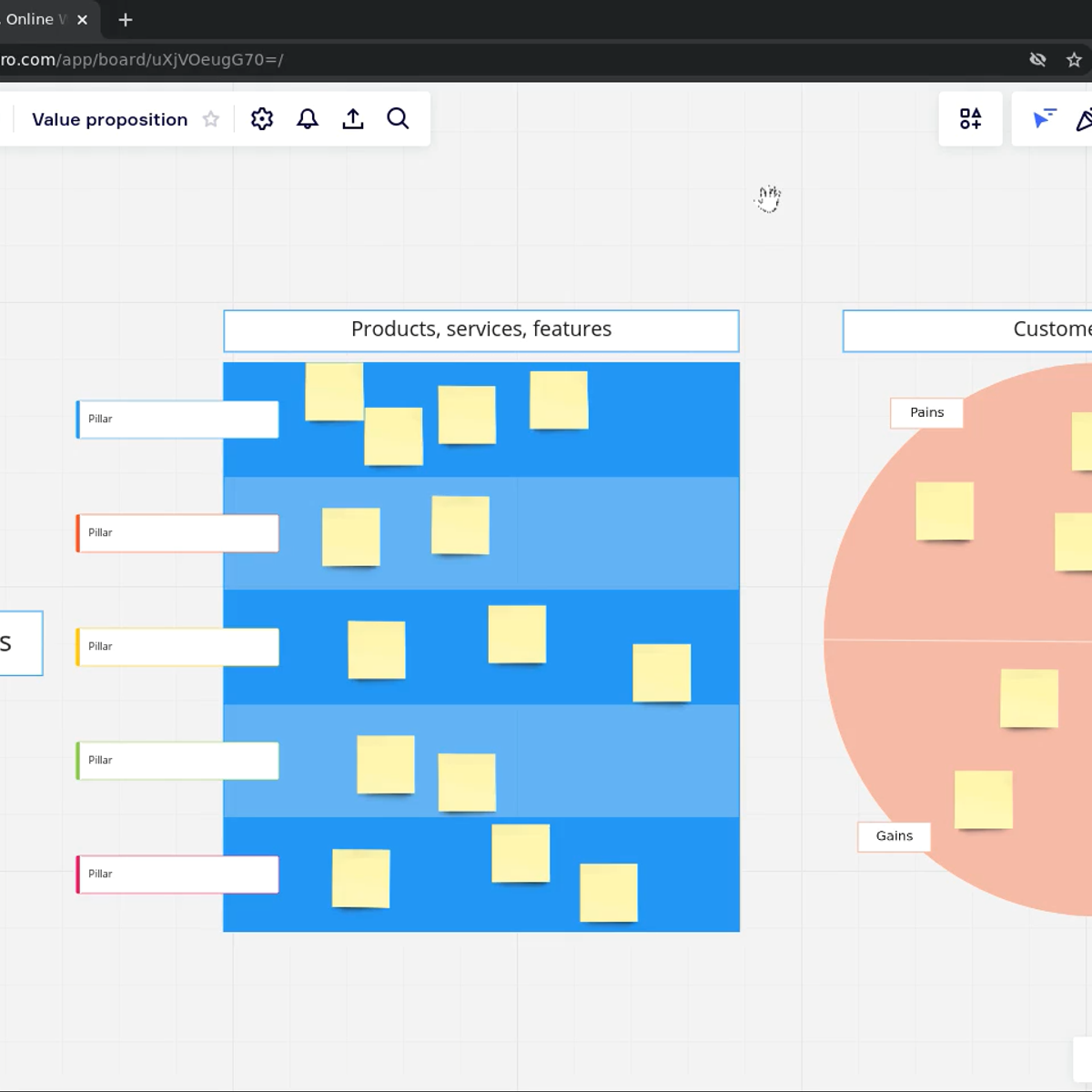
In this 2 hours long project you will create a business value proposition canvas in Miro, categorizing business products, services and features by company pillars, mapping customer gains, pains and tasks with product, adding a competitor comparison and finally exporting slides, PDF and images. You will use frames, sticky notes, shapes and colors, and explore business concepts to create a value proposition team work.
 University of Colorado System
Supporting Parents of a Newborn Baby
In this course, you will learn some core components in supporting parents of newborn babies. The Supporting Parents of Newborn Babies Course will teach you best practices for what to expect in the newborn exam and how to best support parents, partners, and other caregivers. This course examines post-partum depression, early bonding, and touch. This course introduces the important role of supportive partners and parents, in varied households, and what that support looks like. With every household as different, how can we effectively provide support as partners, fathers, co-parents, grandparents, and other guardians? As example, what are special considerations in adoption? We wrap the Newborn Baby Care four course specialization with a guest appearance by a newborn baby, and a live Skills examination performed by course instructor, Dr. Mary Kohn. A newborn baby is an amazing beautiful life filled with hope. There is so much that goes into making sure that babies are born healthy, and so much more to think about after they are born. Whether you are in the health care field, or even a parent, this course is the perfect educational opportunity for you to keep newborn babies healthy in the days and weeks after they are born!
 Fractal Analytics
Python for Data Science
Master Python for data science with hands‑on projects. Learn pandas, statistics, and visualization to solve real‑world business problems. Build job‑ready skills in data wrangling, exploratory data analysis (EDA), and charting with matplotlib/seaborn—no prior experience required. This beginner‑friendly course guides you through cleaning messy data, applying descriptive and inferential statistics, and preparing datasets for machine learning. You’ll design analyses that answer business questions, communicate insights with compelling visuals, and complete challenging assessments aligned to workplace scenarios. By the end, you’ll confidently manipulate data in pandas, automate workflows, and build dashboards that stakeholders understand. Start your data‑driven journey and turn raw data into decisions.
 Packt
Packt
iOS 16 SwiftUI 3 Loan Tracker MVVM, CoreData, and CloudKit
This course features Coursera Coach! A smarter way to learn with interactive, real-time conversations that help you test your knowledge, challenge assumptions, and deepen your understanding as you progress through the course. In this course, you'll develop a robust Loan Tracker app for iOS 16, leveraging SwiftUI 3, CoreData, and CloudKit. By mastering these frameworks, you'll create a dynamic app that can store, display, and sync loan and payment data across devices, ensuring seamless user experiences. The course provides a comprehensive understanding of integrating CoreData for local storage and CloudKit for data syncing, with a focus on the MVVM architecture to maintain clean code. You'll learn to build various features, including loan management, payment tracking, data organization by year, progress calculation, and more. You'll start by setting up the project environment and creating test loans, followed by implementing different views, such as the all-loans view, add-loan view, and payments view. As you progress, you'll delve into CoreData setup, handling data fetching, creating payments, and adding user interactions such as editing and deleting payments. The course also focuses on organizing payments by year, calculating payment progress, and optimizing the app's performance by integrating CloudKit for cross-device synchronization. This course is perfect for iOS developers looking to expand their knowledge of SwiftUI and CoreData while learning to build a practical app from scratch. Whether you're aiming to develop a loan management system or improve your skills in app development, this course provides an ideal foundation. Basic knowledge of Swift and iOS development is recommended, as the course involves some hands-on coding tasks with a moderate difficulty level. By the end of the course, you will be able to create an iOS loan tracker app using CoreData for local data storage, integrate payments with progress calculations, and sync app data across devices using CloudKit.
 University of London
Consumption, Marketing and Culture
What does it mean to be a consumer in a consumer society? In this MOOC we think about marketing in terms of what marketing does rather than how we do it. It's not just a case of how we buy the products that are sold to us, but how we are affected by those products and the services that we encounter. This course prepares students for a more analytical understanding in the role that marketing activities play in shaping our consumer cultures and lives. Rather than pose the question of how ‘we’ can sell more stuff to consumers, this course asks, what does it mean to be regarded as a consumer in this moment of history?
 University of Colorado Boulder
Introduction to FPGA Design for Embedded Systems
This course can also be taken for academic credit as ECEA 5360, part of CU Boulder’s Master of Science in Electrical Engineering degree. Programmable Logic has become more and more common as a core technology used to build electronic systems. By integrating soft-core or hardcore processors, these devices have become complete systems on a chip, steadily displacing general purpose processors and ASICs. In particular, high performance systems are now almost always implemented with FPGAs. This course will give you the foundation for FPGA design in Embedded Systems along with practical design skills. You will learn what an FPGA is and how this technology was developed, how to select the best FPGA architecture for a given application, how to use state of the art software tools for FPGA development, and solve critical digital design problems using FPGAs. You use FPGA development tools to complete several example designs, including a custom processor. If you are thinking of a career in Electronics Design or an engineer looking at a career change, this is a great course to enhance your career opportunities. This course includes specific hardware and software requirements. Please review the FAQ below for complete details.
 EDUCBA
Lean Six Sigma Green Belt: Apply & Master Skills
By the end of this course, learners will be able to define project goals, analyze processes, apply statistical tools, improve workflows, and control outcomes using Lean Six Sigma Green Belt techniques. This comprehensive program equips professionals with the skills to drive process improvements and deliver measurable business impact. Learners will gain practical experience in using tools such as DMAIC, prioritization matrices, SIPOC, process mapping, hypothesis testing, correlation, regression, and Lean methods like 5S, Kaizen, and Poka Yoke. Through engaging lessons, real-world examples, and Excel-based demonstrations, participants will develop the ability to evaluate data, implement improvements, and mitigate risks effectively. What makes this course unique is its balanced integration of theory, practical applications, and step-by-step tool demonstrations, ensuring that learners can confidently apply their knowledge to real organizational challenges. With structured modules and graded practice quizzes, this course ensures mastery of core concepts while building confidence to lead projects that improve quality, efficiency, and customer satisfaction. Ideal for professionals seeking to advance their careers, earn Green Belt certification, and make a tangible impact, this course empowers learners to transform data into actionable solutions.
 University of Michigan
Equitable Stage Makeup and Hair
Go beyond the limitations of mainstream courses and gain a broad overview of inclusive makeup and hair practices, regardless of your experience level. Equitable Stage Makeup and Hair offers highly detailed videos and in-depth practice guides to train you on applying makeup for all skin tones and ways to prepare wigs for a variety of different hair textures. Designed to propel forward your skills, training in applying makeup for all skin tones, and wig preparation for a variety of hair textures, you will learn techniques for applying natural makeup for both on stage and camera, and aging makeup. The course allows you to tailor your learning experience based on your own makeup and hair needs with additional modules on trauma makeup, special effects makeup, or drag makeup. Makeup application techniques are supported by lessons in facial anatomy, color theory, character analysis, and personalized makeup worksheet demonstrations. Hear from renowned makeup artists, performers, and drag queens to learn from their experience in the entertainment and theater industries. By learning inclusive methods of hair and makeup, you can work to build more equitable spaces for everyone.
 Packt
Packt
Advanced AJAX Techniques and Final Projects
Updated in May 2025. This course now features Coursera Coach! A smarter way to learn with interactive, real-time conversations that help you test your knowledge, challenge assumptions, and deepen your understanding as you progress through the course. In this comprehensive section, you will embark on a journey to master the essentials of server-side development using Node.js. Starting with an introduction to setting up your Node.js environment, you will learn how to use Express, a powerful and flexible framework, to create and manage servers effectively. This section emphasizes the importance of understanding the server's role in handling AJAX requests and the basics of RESTful API design. You will dive deep into defining RESTful API endpoints, exploring how different user actions, such as adding, updating, and deleting resources, are processed by the server. Each endpoint will be meticulously crafted to ensure REST compliance, providing you with a solid foundation in API design. Practical examples and detailed explanations will help you grasp the intricacies of route handling and server responses. To enhance your development workflow, you will also learn about essential tools like NPM and Postman. These tools will aid in installing necessary modules, managing dependencies, and testing your API routes. By the end of this section, you will have a robust Node.js server set up with well-defined RESTful API routes, ready to handle complex web applications. This course is ideal for web developers and backend engineers looking to enhance their skills in server-side development. A basic understanding of JavaScript and web development concepts is recommended. Familiarity with Node.js and Express will be helpful but not required.