

The Global Scholarly Directory.
Discover world-class academic programs curated for the modern intellectual. Search through 19877+ degrees and professional certificates.
 Packt
Packt
Advanced Framework Development and Integration
Updated in May 2025. This course now features Coursera Coach! A smarter way to learn with interactive, real-time conversations that help you test your knowledge, challenge assumptions, and deepen your understanding as you progress through the course. This course offers an in-depth exploration of advanced framework development and integration for automation testing professionals. Starting with the Pytest framework, you'll learn its advantages, command-line operations, and grouping mechanisms, along with essential features like fixtures and the conftest file for data-driven testing and HTML report generation. The course covers logging in Python tests, creating reusable logging utilities, and integrating logs into HTML reports. You'll develop an end-to-end Selenium Python framework from scratch, adhering to standards, implementing the page object design pattern, and integrating custom utilities. The course also includes data-driven testing modules for handling multiple datasets efficiently. You'll learn to integrate your framework with Jenkins for automating tasks and setting up parameterized job variables. The final segments cover Excel data-driven testing and version control with Git, teaching you to manage repositories, commits, branches, and resolve merge conflicts. This course is ideal for automation testers, software engineers, and QA professionals with basic knowledge of Python and Selenium, aiming to advance their testing framework skills.
 University of California, Irvine
La comunicación laboral en el siglo XXI
En el acelerado ambiente empresarial de hoy en día, a los empleados de todo nivel se les pide que se encarguen cada vez de más tareas, que cumplan más plazos, que asuman más responsabilidad y que se adapten a más innovación. Además de esos retos está la cuestión de la gran diversidad de personas con las que uno trabaja, y que continuamente están cambiando, por lo que es necesario saber manejar las diferencias generacionales, culturales, de sexo y de edad. La comunicación, tanto verbal como no verbal, constituye la base de todo lo que hacemos y decimos y es trascendental en el entorno laboral del siglo XXI. Afortunadamente, es posible aprender a comunicarse, y con la instrucción adecuada uno puede mejorar. El propósito de este curso es sensibilizar a los alumnos sobre la importancia de la comunicación en el lugar de trabajo y enseñarles nuevas destrezas interpersonales, a fin de que se vuelvan en general mejores comunicadores. Estos son algunos de los temas tratados: proceso y funciones de la comunicación, patrones conductuales, percepción de la realidad, señales verbales y no verbales, confianza, asertividad, tacto, control de la ira, críticas y observaciones positivas, resolución de conflictos, creación de equipos, liderazgo, entrevistas, empleo eficaz de la tecnología (correo electrónico, Skype, mensajes de texto, etc.) para comunicarse.
 Google Cloud
Cloud Run으로 AI 모델 배포 및 확장하기
AI 추론은 학습된 머신러닝 모델로 학습된 패턴을 적용하여 처음 접하는 새로운 데이터로 예측을 수행하는 프로세스입니다. 이 과정은 Cloud Run에 AI 추론 서비스를 빠르게 배포하는 데 관심이 있는 개발자, 데이터 과학자, ML 엔지니어를 대상으로 설계되었습니다. 클라우드 기반 서버리스 애플리케이션 배포 솔루션에는 익숙하지만 Google Cloud 서버리스 제품을 사용하여 AI 추론을 실행해 본 경험이 없는 사용자에게 유용한 과정입니다. 이 과정에는 GPU를 사용해 AI 추론 모델을 배포하고 생성형 AI 앱을 데이터 스토리지 서비스와 통합하는 예시가 포함되어 있습니다.
 EDUCBA
Mastering Python Modules and File Systems
This comprehensive course empowers learners to analyze, implement, and optimize Python-based solutions using built-in modules, file operations, and basic graphical interfaces. Structured into three progressively layered modules, it begins with foundational knowledge on Python modules and system environment configuration. Learners will examine how modules interact with sys.path, explore reusable components through packages, and utilize command-line arguments for automation. The second module deepens understanding by integrating powerful utilities such as heapq, random, and time, and guiding learners to construct and apply regular expressions for dynamic data processing. In the final module, learners will manipulate files using different I/O strategies and develop simple GUI-based interfaces using Python’s standard libraries. This course is ideal for developers, data analysts, and system integrators looking to strengthen their core Python capabilities for practical, real-world applications. By the end of the course, learners will have the ability to: Differentiate between modules, packages, and system configurations. Apply key built-in utilities to solve timing, randomness, and pattern-matching problems. Develop scripts that read, write, and process files efficiently. Design entry-level GUI applications and interface them with system-level operations.
 Logical Operations
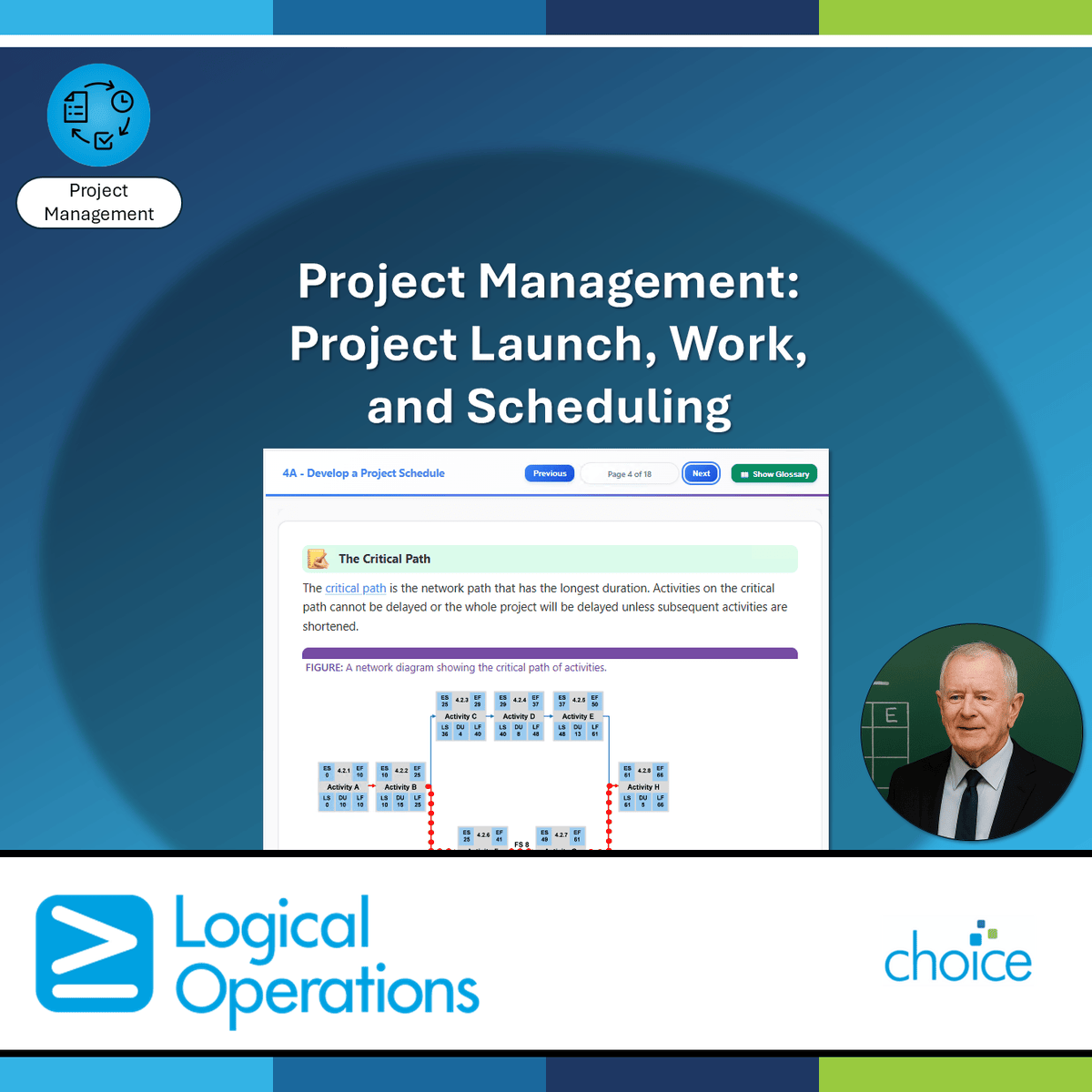
Project Management: Project Launch, Work, and Scheduling
This course will be useful for anyone who might need to perform project management activities in their job roles on either a formal or informal basis, or any individual who wants to build upon their current project management knowledge to be more productively involved on a project team. In this course, you'll define project management basics and identify influencing factors. You'll also identify project stakeholders, authorize a project, and identify the project scope. Then, you'll develop a Work Breakdown Structure (WBS), identify activity resources, estimate time, plan an adaptive project, develop a project schedule, and create an initial release plan. This is the first course in a multi-course Specialization. All of the courses in this Specialization require that you have a recent version of Microsoft Word and Excel installed in order to open the course data files. The course setup instructions provided in the first module of this course go into more detail about the hardware and software requirements.
 LearnQuest
Fundamentals of Data Warehousing
Welcome to Fundamentals of Data Warehousing, the third course of the Key Technologies of Data Analytics specialization. By enrolling in this course, you are taking the next step in your career in data analytics. This course is the third of a series that aims to prepare you for a role working in data analytics. In this course, you will be introduced to many of the core concepts of data warehousing. You will learn about the primary components of data warehousing. We’ll go through the common data warehousing architectures. The hands-on material offers to add storage to your cloud environment and configure a database. This course covers a wide variety of topics that are critical for understanding data warehousing and are designed to give you an introduction and overview as you begin to build relevant knowledge and skills.
 Packt
Packt
Advanced PyTorch Techniques and Applications
Updated in May 2025. This course now features Coursera Coach! A smarter way to learn with interactive, real-time conversations that help you test your knowledge, challenge assumptions, and deepen your understanding as you progress through the course. Unlock the full potential of PyTorch with this comprehensive course designed for advanced users. Starting with Recommender Systems, you’ll explore how to build and evaluate these models, incorporating user and item information to enhance recommendations. Moving on to Autoencoders, the course guides you through their fundamentals and practical implementation, providing a solid foundation for dimensionality reduction and data compression tasks. Generative Adversarial Networks (GANs) are covered next, where you’ll learn to implement and apply GANs to various scenarios, sharpening your skills in creating realistic data simulations. The course also delves into Graph Neural Networks (GNNs), teaching you to handle graph data for tasks like node classification. You’ll then explore the Transformers architecture, including its adaptation for vision tasks with Vision Transformers (ViT), providing you with the skills to tackle complex sequence and vision problems. In addition to model building, the course emphasizes PyTorch Lightning for streamlined model development and early stopping techniques to optimize training. Semi-supervised learning methods are also covered, helping you leverage both labeled and unlabeled data for improved model performance. The extensive Natural Language Processing (NLP) section ensures you master word embeddings, sentiment analysis, and advanced techniques like zero-shot classification. The course concludes with essential topics in model deployment, using frameworks like Flask and Google Cloud to bring your models to production. This course is designed for data scientists, machine learning engineers, and AI researchers with a solid foundation in PyTorch. Prerequisites include a strong understanding of machine learning fundamentals, proficiency in Python programming, and prior experience with PyTorch.
 Illinois Tech
Hardware and Operating System Foundations III
This course provides you with the opportunity to learn about OS security. It examines both Windows and Linux operating systems. The career skills acquired in the course introduce the understanding of OS operating system security and its importance in operating system support. At the end of the course, you will be able to: - Explore operating system firewalls. - Demonstrate the use of Operating System logs. - Explore Operating system permissions. Software requirements: Windows and Linux
 Packt
Packt
Protection of Information Assets
This course offers an in-depth exploration of information security auditing principles, tailored for professionals preparing for the CISA certification. Starting with an overview of frameworks, standards, and guidelines, you will understand their critical role in protecting information assets. The course outlines the responsibilities of IS auditors in evaluating security baselines and implementing effective data privacy practices. Key modules focus on physical and environmental controls, ensuring that you are equipped to audit diverse aspects of information systems security, from infrastructure protection to compliance requirements. As you progress, the course delves into access management and data protection strategies. You will learn about identity and access management principles, logical access controls, and common authorization issues that pose risks to information systems. Detailed discussions on audit logging, data loss prevention (DLP), and network infrastructure will provide you with the skills needed to monitor and protect sensitive information effectively. The course also addresses the auditing of applications within networked environments, helping you understand the complexities of securing interconnected systems. In the latter sections, the focus shifts to advanced topics such as cryptography, network security, and cloud computing. You will explore the fundamentals of encryption systems, including symmetric and asymmetric keys, and learn to apply cryptographic principles for robust information security. Modules on PKI, virtualization, and cloud environments will further enhance your ability to assess and mitigate risks in modern IT landscapes. Additionally, the course covers security testing techniques, network penetration testing, and the use of IDS/IPS tools, preparing you to perform comprehensive security audits. By the end of this course, you will have a solid understanding of information security auditing, ready to tackle the CISA exam and advance your career in cybersecurity. This course is designed for IT auditors, security professionals, and individuals preparing for the CISA certification. It is suitable for those with a basic understanding of information systems and security principles. No prior CISA experience is required, but familiarity with IT audit processes will be beneficial.
 Johns Hopkins University
Measuring and Modeling Impact in Evaluations
We want to provide you some information about our course “Measuring and Modeling Impact in evaluations”. The purpose of this course is to give you a better understanding of different measures of impact that could be used in the evaluation of a program in the areas of maternal and child health and nutrition. For each of the measures presented, we will discuss current sources of data you might draw on as well as describe the methods that can be used to measure these. When we describe the methods, we also try to identify the strengths and weakness of the methods as well as their suitably for use in an evaluation. The course also discusses how modeling can be used in evaluations as either a replacement for measuring impact or to supplement measured impact. The last two lessons in this course focus on giving you an introduction and training on how the Lives Saved Tool (LiST) works and how to use it. This model can be used to estimate most – if not all – of the impact measures we describe in the course and can be an important part of both planning and estimating impact in an evaluation of a large-scale program. While this course is self-contained, it is also linked to other courses on evaluation. We developed this course for public health program managers and evaluators and assume the students in the course will have a background in public health with a focus on maternal and child health in low- and middle-income countries. The development of this course was supported by a grant from Government Affairs Canada (GAC) for the Real Accountability, Data Analysis for Results (RADAR) project.
 University of Michigan
Leading Teams
In this course, you will learn how to build your team, improve teamwork and collaboration, and sustain team performance through continuous learning and improvement. Specifically, you will learn best practices for composing a team and aligning individual and team goals. You will also learn how to establish roles, build structures, and manage decision making so that your team excels. This course will also help you manage critical team processes such as conflict resolution and building trust that have a profound impact on your team’s performance. You will discuss some of the best ways to harness the productive potential of teams while mitigating the risks and traps of teamwork. In modern organization, most of work is done in teams, yet the results of teamwork are exceptionally mixed. Many teams are poorly designed and structured, fraught with dysfunctional conflict, experience coordination breakdowns and serious motivation challenges. As a result, many teams fail to realize their potential and frequently underperform even individuals working on similar tasks. After completing this course, you will acquire a set of tools and practices that enable you to effectively set up, run, evaluate, and continuously improve your team. Such insights will both make you a more effective team leader but also a standout contributor in team settings.
 The Hong Kong University of Science and Technology
Software Engineering: Implementation and Testing
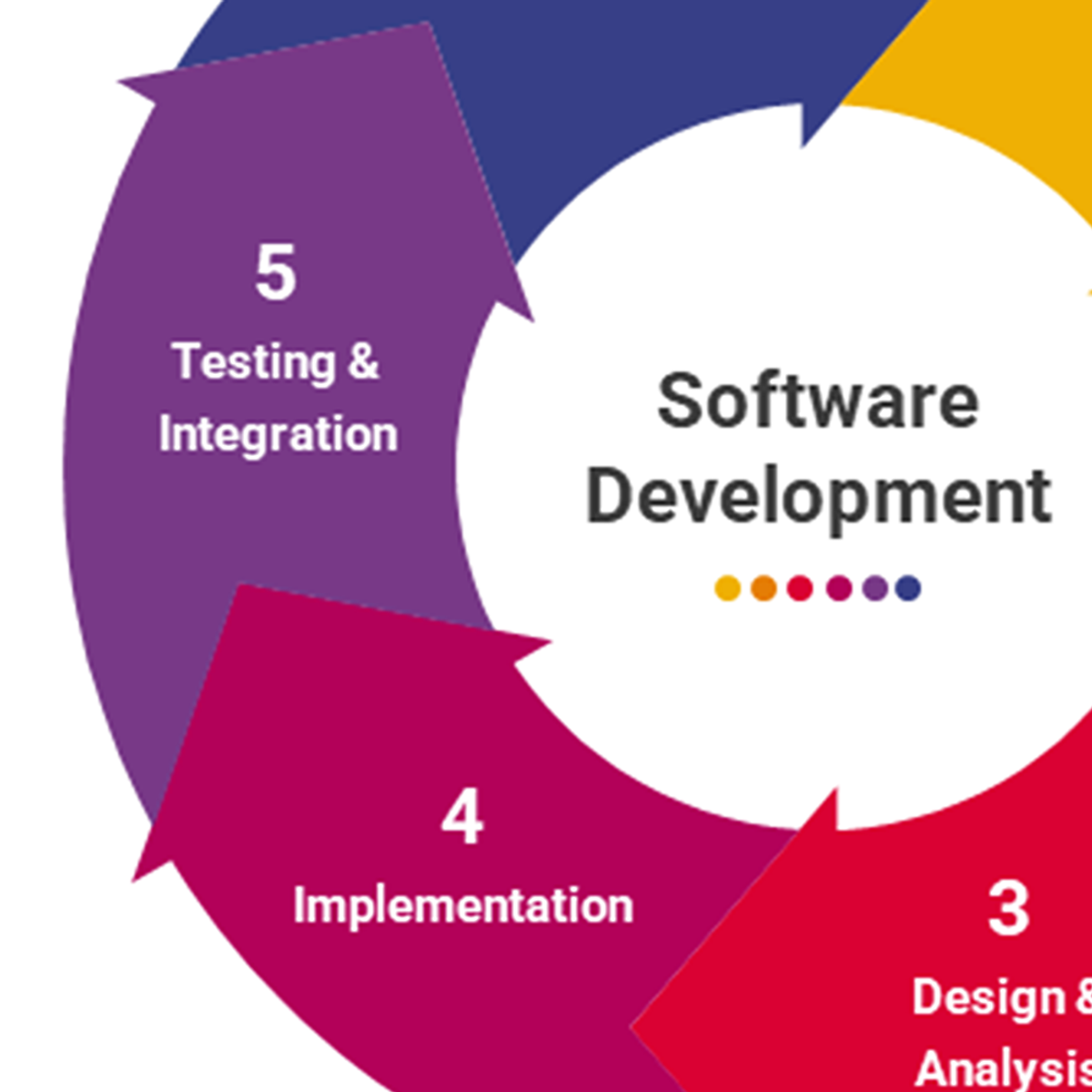
Software Development Life Cycle (SDLC) is the process of developing software through planning, requirement analysis, design, implementation, testing, and maintenance. This course focuses on the implementation and testing phases of SDLC, and you will examine different software development processes for large software systems development, and understand the strengths (pros) and weaknesses (cons) of different software development processes. You will also encounter defensive programming techniques to prevent software bugs during implementation, and learn how to test your system thoroughly using different types of test cases. Basic object-oriented programming (OOP) concepts are required for topics covered in defensive programming and object-oriented testing. Implementation is driven by the UML models derived from requirement analysis. It is recommended to take the course "Software Engineering: Modeling Software Systems using UML" before attempting this course, but it is not a hard requirement.
 University of Pittsburgh
Disaster Preparedness
Have you ever viewed a news report depicting the aftermath of a devastating natural disaster? The damage to human life and property are both staggering and heartbreaking. All parts of the world face the possibility of floods, hurricanes, tornados, fires, landslides, earthquakes, tsunamis, and other natural phenomena. Are you prepared if disaster would strike you? This course will help you prepare! The course is appropriate for any learner who is proactive about developing the core competencies of disaster readiness and survival planning. It is especially useful if you are seeking techniques that can ensure your personal protection, as well as the safety of your family, property, and belongings, during a natural disaster. In addition, it offers essential preparation for a variety of emergency situations and inconveniences, even if you do not live in major tornado, flood, hurricane, tsunami, or earthquake zone. For instance, could you and your loved ones manage without access to potable water, electricity, fuel, and banking facilities? If you are unsure of your ability to respond in any of these possible scenarios, this course is for you! Throughout the course, you will be introduced to the Disaster Cycle, specifically the Mitigation and Recovery phases, and will create an extensive personal preparedness plan for survival in the absence of common amenities, such as food and water, shelter, and communication. You will also acquire practical, easy-to-apply strategies for maintaining a healthy attitude during disaster which can allow you to remain calm, avoid panic, and draw upon inner and outer resources in dire circumstances. Although death may be an inevitable outcome of extreme circumstances, a balanced outlook can provide comfort for all parties involved. Finally, issues of how institutions and governments can aid in disaster are also discussed. If you are interested in this topic you may be interested in other online programs at the University of Pittsburgh School of Nursing. Learn more about those programs by visiting our website: http://www.online.pitt.edu/programs/school-of-nursing/
 École normale supérieure
Approximation Algorithms Part II
Approximation algorithms, Part 2 This is the continuation of Approximation algorithms, Part 1. Here you will learn linear programming duality applied to the design of some approximation algorithms, and semidefinite programming applied to Maxcut. By taking the two parts of this course, you will be exposed to a range of problems at the foundations of theoretical computer science, and to powerful design and analysis techniques. Upon completion, you will be able to recognize, when faced with a new combinatorial optimization problem, whether it is close to one of a few known basic problems, and will be able to design linear programming relaxations and use randomized rounding to attempt to solve your own problem. The course content and in particular the homework is of a theoretical nature without any programming assignments. This is the second of a two-part course on Approximation Algorithms.
 Coursera
Creating Service Innovation Culture in Public Sector
Achieving efficiency, responsiveness, and improved service delivery in the fast changing area of public service depends on encouraging an innovative culture. Inspired by real-world success stories including Estonia's E-Residency program, Barcelona's Smart City initiatives, and Singapore's Smart Nation vision, this course explores the ideas and practices required to foster an innovation-driven culture inside public sector organizations. As Boston's 311 system has transformed public involvement, participants will investigate ways to inspire innovation, overcome bureaucratic challenges, and use technology to propel service enhancements. By means of case studies and real-world examples, students will acquire understanding of the successful execution of service innovations that efficiently and sustainably meet public requirements, therefore reflecting the transforming power of programs like Estonia's digital transformation. Like Singapore's Smart Nation project is doing on a national level, participants will also explore the particular opportunities and difficulties given by public sector innovation and acquire practical skills to turn ideas into real-world improvements for citizens. Inspired by real-world cases of effective service innovation, by the end of this course you will be ready to drive change, promote efficiency, and increase public pleasure via creative ideas. This course targets public sector leaders, managers, policy makers, and innovation officers seeking to embed a culture of service innovation within their organizations. It is equally relevant for government employees, consultants, and academics interested in public administration and service delivery improvements. No specific prerequisites are required for this course. However, a basic understanding of public sector operations and an interest in innovation and service improvement will enhance the learning experience. By the end of this course, learners will be able to identify and examine the foundations of service innovation within their public sector context, develop strategic approaches to overcoming bureaucratic challenges, analyze the use of technology to enhance service delivery, and implement and refine innovative solutions through effective change management and continuous improvement practices.
 Coursera
Generate Insights with LLMs
Transform your data into strategic business intelligence with the power of large language models. This Short Course was created to help data analysts accomplish automated insight generation from complex datasets. By completing this course, you'll master practical LLM applications that turn raw data into compelling executive narratives, build automated reporting pipelines, and optimize model performance for real-world business scenarios. By the end of this course, you will be able to: Generate executive-ready briefs using tuned LLM prompts with measurable quality scores Build end-to-end data-to-text automation pipelines combining SQL, Python, and LLM APIs Fine-tune small language models and evaluate performance improvements through human assessment Conduct cost-benefit analysis comparing open-source and commercial LLM solutions This course is unique because it bridges the gap between technical LLM capabilities and practical business applications, focusing on measurable outcomes and real-world implementation challenges. To be successful in this project, you should have a background in Python programming, SQL queries, and basic understanding of API integrations.