

The Global Scholarly Directory.
Discover world-class academic programs curated for the modern intellectual. Search through 19877+ degrees and professional certificates.
 University of Michigan
Applied Machine Learning in Python
This course will introduce the learner to applied machine learning, focusing more on the techniques and methods than on the statistics behind these methods. The course will start with a discussion of how machine learning is different than descriptive statistics, and introduce the scikit learn toolkit through a tutorial. The issue of dimensionality of data will be discussed, and the task of clustering data, as well as evaluating those clusters, will be tackled. Supervised approaches for creating predictive models will be described, and learners will be able to apply the scikit learn predictive modelling methods while understanding process issues related to data generalizability (e.g. cross validation, overfitting). The course will end with a look at more advanced techniques, such as building ensembles, and practical limitations of predictive models. By the end of this course, students will be able to identify the difference between a supervised (classification) and unsupervised (clustering) technique, identify which technique they need to apply for a particular dataset and need, engineer features to meet that need, and write python code to carry out an analysis. This course should be taken after Introduction to Data Science in Python and Applied Plotting, Charting & Data Representation in Python and before Applied Text Mining in Python and Applied Social Analysis in Python.
 IE Business School
Investigación de mercados y comportamiento del consumidor
El primer curso de este especialización consta de dos bloques que te proveerán de los conocimientos necesarios para comenzar tu trayectoria en Marketing. Aprende las herramientas y técnicas para convertir una decisión en una investigación real, esto lo verás en el primer módulo: Investigación de Mercado. Cómo plantear la investigación, analizar los datos recogidos, interpretarlos correctamente y comunicarlos a través de recomendaciones precisas serán algunas de las cuestiones tratadas en este curso. El segundo módulo se enfoca en el proceso de toma de decisiones por parte del consumidor, resaltando los momentos clave en el proceso de compra y consumo de un producto. Adapta tu enfoque “cliente-céntrico” en decisiones de marketing mediante el análisis de cómo tus clientes toman sus decisiones, reflexionando en qué sucede en sus corazones y mentes al momento de tomar decisiones y analizando las variables que son influyentes para tomarlas.
 Coursera
Project Management in Basecamp: Make a project plan
Do you want to learn all that is needed to manage a project in Basecamp, applying some of the major project management methodologies in such a simple, easy-to-use online tool? This Guided Project, created to help project managers of all kinds and levels of seniority to easily set up and manage their projects and teams, will help you learn all that is needed to manage a project in Basecamp. In this one and a half hour long project, you will take on the role of a project manager in a well regarded wildlife and environment organization, project-managing a new AI-based software to protect wildlife and the environment. You will gain the skills to create a project and project team, manage teamwork and collaboration, create and manage tasks progression and completion, using different methologies. More specifically, you will learn how to: create a project and invite a project team in Basecamp; use Basecamp message board and chats to discuss and prioritize ideas and features, especially through the notes, comments and boost functionalities; manage tasks with Basecamp to-do lists, cards and schedule; make resources, documents and files available to the team all in one place in the Basecamp docs and files section. By the end of this project, you will have created a complete project plan, learning all the major functionalities of Basecamp and applying methodologies such as waterfall, scrum, kanban, scrumban and critical path. This project is unique, as you will both learn the tool and project management approach, gaining new skills and applying them to a concrete scenario and practice activities. In order to be successful in this project, you don't need any specific prior skills or background, just a computer and an internet connection!
 Packt
Packt
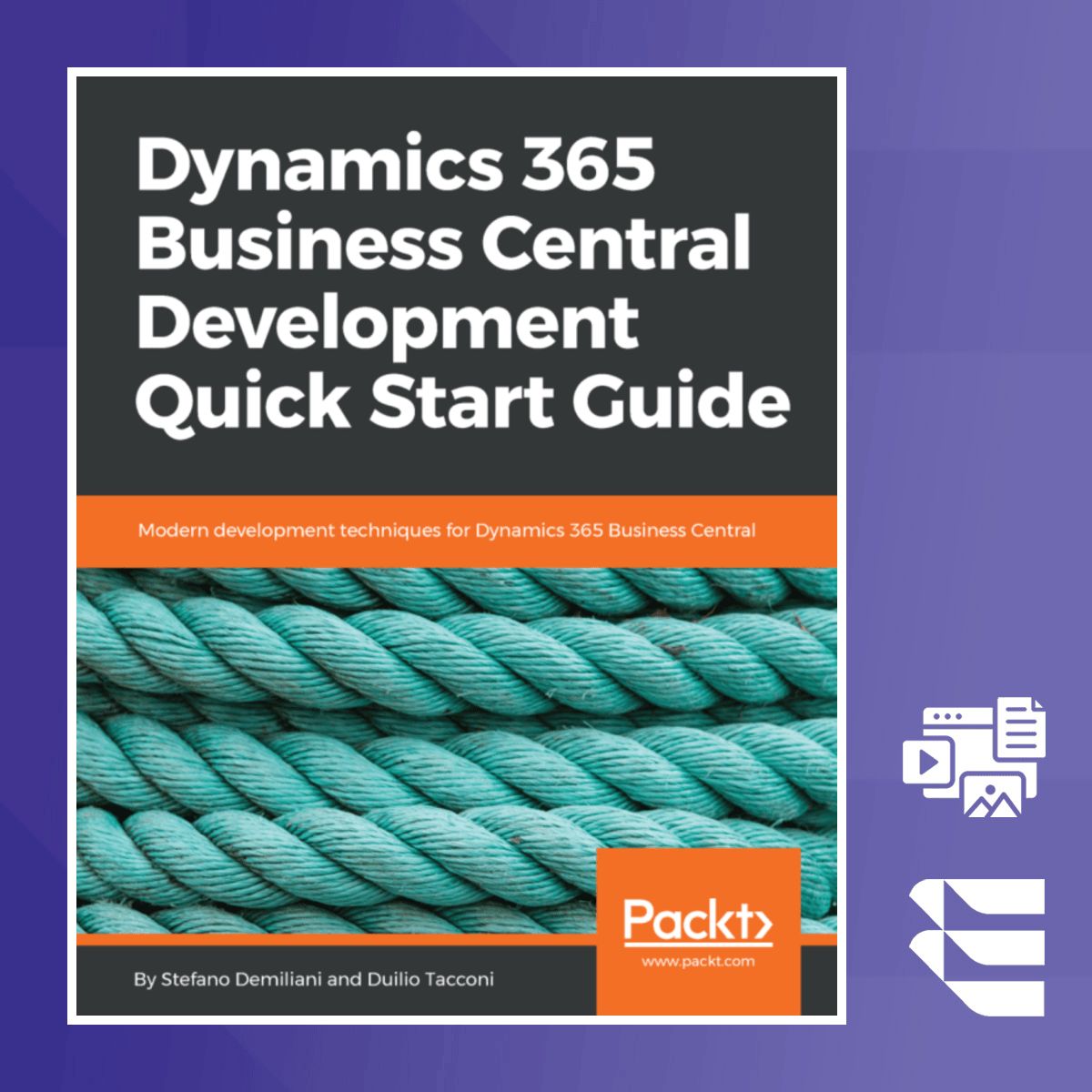
Dynamics 365 Business Central Development Quick Start
This book offers a comprehensive guide to Microsoft Dynamics 365 Business Central, focusing on essential skills for implementing and designing solutions in both on-premise and SaaS environments. It covers modern development practices such as extensions, Docker, and cloud deployment, allowing you to build efficient and scalable ERP systems. The step-by-step guide is designed to get you up and running with Dynamics 365, making it an ideal resource for developers and architects in the Microsoft ecosystem. The course will help you improve your skills by showing how to develop and deploy solutions for Dynamics 365 Business Central, manage extensions, and understand deployment strategies in cloud and on-premise environments. This resource is perfect for professionals who want to build real-world solutions using Dynamics 365. What makes this book stand out is its focus on practical, modern development techniques, blending theory with real-world applications. You will gain hands-on experience using Visual Studio Code, Docker, and understanding the new extension model. This book is aimed at solution developers and architects with experience in Microsoft technologies who want to implement ERP solutions using Dynamics 365. Familiarity with ERP systems and cloud environments is recommended.
 Coursera
Analyze User Research Data with Microsoft Forms
Conducting surveys and analyzing user research data can help businesses gain important insights into the experiences of their users, both current and potential. By understanding the user experience before creating new products and services, business leaders can save time and money by creating the best product the first time around. Learners in this guided project will walk through the steps of creating and analyzing a Microsoft Forms survey and learn the basic methodology of analyzing user research. First, learners will learn how to prepare the objective before creating a survey. Then, learners will be guided step-by-step through each of the Forms question types and when to use each one. Next, learners will discover how to finalize and distribute a survey, and then collect and organize responses. Finally, this project will discuss how to analyze the survey responses and make insightful business decisions.
 Google Cloud
生成式 AI:瞭解基礎概念
「生成式 AI:瞭解基礎概念」是生成式 AI 領導者學習路徑的第二門課程。在本課程中,您將瞭解 AI、機器學習和生成式 AI 的差異,以及各種資料類型如何協助生成式 AI 解決業務難題,進而掌握生成式 AI 的基本概念。您還能深入瞭解 Google Cloud 應對基礎模型限制的策略,以及開發、部署安全且負責任的 AI 技術時面臨的主要挑戰。
 MedCerts
Electronic Health Records
The Electronic Health Records course provides a comprehensive exploration of Electronic Health Records (EHR) and Practice Management (PM) systems, equipping students with the knowledge and skills necessary to manage digital health information effectively. Through five lessons that progress from foundational concepts to advanced applications, students gain a deep understanding of how health data is structured, stored, and utilized within modern healthcare environments. Learning outcomes include the ability to distinguish between administrative and clinical health data, understand the principles of financial management in healthcare settings, and recognize the legal and ethical issues surrounding patient data and information security. Students will also develop practical competencies in database utilization and information management – skills essential for improving care coordination, ensuring compliance, and supporting data-driven decision-making. Students learn the holistic integration of technical, administrative, financial, and legal aspects of EHR systems and, by the end of the course, are prepared to contribute meaningfully to the evolving landscape of digital healthcare management.
 University of Colorado Boulder
The Business, Politics, Policy, & Players of Space Programs
Welcome Course 3 - The Business, Politics, Policy, & Players of Space Programs. If you are here, you have successfully completed both Course 1 and 2 of this specialization. Course 3 has nine lessons spread out over 4 weeks with 31 Learning Objectives. In this course, we will discover who and what funds the exploration that we have enjoyed learning about in Course 1 and 2. We will also focus on a few specific applications of some of the concepts we have learned about so far with two companies, the Global Positioning System, and the an academic program that could be implemented at your institution of higher learning. Week 1 - There are three lessons this week that will cover a range of topics that greatly influence where space exploration has been, is today, and will go. The Politics of Space, with Jack Waldorf and Abby Benson will provide a basic overview of how space missions are funded in the US government. Space Governance with Dr. Zach Donohew and Eric Alston, JD will present the case and justification for how we as species will need to govern what we do in space. The Business of Space with Dr. Dan Baker, will cover the basics of the space industry from the size to the value of doing business in space. These topics will build on many of the others we have covered in the other courses and in the lessons ahead. Week 2 - This week's topic is Space Entrepreneurship and it is broken it into two parts. Both parts involve real-world space entrepreneurs. Part 1 is with Dr. James Stuart who has started many space companies and continues to work with other entrepreneurs as they push the boundary of what we do in space. Part 2 is with Scott Tibbitts, who has a very unique background and path to being a space entrepreneur but that did not stop him and his company from enabling NASA to explore Mars. These lessons will give you a new perspective on the impact entrepreneurs have in space exploration. Week 3 and Week 4 are application lessons where we take a deep dive into a few of the many examples where space is used in our daily lives and how companies and academic programs are helping to bring access to space to everyone. The Global Positioning System (GPS), with Dr. Penny Axelrad, is so ingrained in our daily lives that we may not even realize we are using it. We will discuss how it came to be and how it will be used for years to come. David Ferguson and I will discuss SpaceX's Starship and Starlink programs and how one company is changing our vision for how we explore and use space. The Access to Space for All with Sierra Space, with Dr. Janet Kavandi, covers how one company, that many may not have heard of, has big plans for science and tourism in space. Dr. Kavandi also has some interesting space experience! The last lesson of this course covers an academic program at the University of Colorado Boulder call the Space Minor. Ashleigh Bailey and I discuss this unique program that allows students of all majors to minor in space. This program is a model of other institutions of higher education around the world. So please consider enrolling and then let's hit the trail.
 EDUCBA
Intermediate Python Game Development with Pygame
By the end of this course, learners will be able to capture and process input devices, create and transform images, apply advanced graphical effects, design engaging visual elements, animate objects, and implement player-controlled movements to build interactive games using Python and Pygame. This Intermediate Python Game Development course is designed for learners who have already mastered the basics and are ready to advance their skills. The course focuses on practical, project-based learning, ensuring that every concept—from input handling to object control—is applied in real game scenarios. Learners will explore how to manipulate images, implement Laplacian transforms, and bring objects to life with smooth animations and dynamic controls. What makes this course unique is its hands-on, incremental structure: each lesson builds directly on the previous one, guiding learners from fundamental input/output concepts to professional-level design and animation techniques. By the end, learners will have not only strengthened their coding proficiency but also gained the confidence to design and deliver engaging, interactive Python games that reflect industry practices.
 Coursera
Introduction to OSHA: Safety Standards and Compliance
This course offers an in-depth introduction to the Occupational Safety and Health Administration (OSHA), its standards, and enforcement mechanisms. You’ll explore the essential OSHA regulations and understand how they help ensure a safe and healthy workplace. By delving into employer and worker responsibilities, OSHA’s enforcement strategies, whistleblower protections, and valuable worker resources, this course equips you with practical knowledge to implement OSHA principles effectively. This course is designed for team leaders, supervisors, managers, directors, executive leadership, business owners, and anyone interested in understanding occupational safety and health requirements in the United States. Whether you manage a small team or run a large organization, this course will enhance your ability to ensure compliance with OSHA regulations and foster a safer work environment. There are no formal prerequisites for this course. A basic understanding of workplace safety concepts and familiarity with general business operations will help you get the most out of the material. By the end of this course, learners will be able to explain OSHA’s role in promoting workplace safety and health. They will analyze OSHA standards, understand employer responsibilities and workers’ rights, and evaluate OSHA's enforcement strategies, including inspections and whistleblower protections. Through this course, participants will gain actionable knowledge to implement OSHA standards in their workplaces and ensure compliance.
 Tecnológico de Monterrey
Desarrollo de tu marca personal
El Marketing y branding de tu persona puede cambiar tu carrera y vida. El desarrollo de habilidades de mercadotecnia aplicadas a nuestra persona nos puede dar un alto nivel de competitividad en todo tipo de actividades profesionales ya sea como emprendedores-deportistas-artistas o bien, para crear una reputación sólida en el mercado de trabajo o en el desarrollo, promoción y difusión de nuestros productos y servicios como empresarios de todo tamaño. En este curso los objetivos generales son los siguientes: • Comprender los procesos básicos del marketing acompañados de una buena estrategia e implementación. • Definir estrategias adecuadas para lograr el impacto en el diseño de tu marca preferida: Tu persona. • Conocer los diferentes elementos que te permitan lograr un alto nivel de competitividad para alcanzar una reputación sólida en el mercado de trabajo.
 University of Amsterdam
Alternative Mobility Narratives
Ready to imagine a radically different mobility future? This course is about the stories that we tell ourselves about why and how we move. By critically examining our current narratives, we help you think about mobility in a new way. Using systems dynamics modelling, we explore how a mobility innovation (of your choice) impacts our mobility system as a whole, for better or for worse. This course will invite you to reflect on our mainstream mobility narrative built on engineering and economics. But warning: you may end up never looking at mobility in the same way again! This online course is supported by the EIT Urban Mobility’s Competence Hub. EIT Urban Mobility is an initiative of the European Institute of Innovation and Technology (EIT) that has been working since January 2019 to encourage positive changes in the way people move around cities in order to make them more sustainable and liveable places.
 University of Colorado Boulder
Aplicar Atividades PhET para Educação STEM
O projeto Simulações Interativas PhET (https://phet.colorado.edu/pt_BR), da Universidade do Colorado em Boulder, oferece simulações de ciências e matemática divertidas, gratuitas e interativas baseadas em pesquisa para uso no ensino fundamental, médio e superior. Cada simulação foi extensivamente testada e avaliada para garantir que seja adequada para fins educacionais. Além disso, todas as simulações são de código aberto e gratuitas, tanto para alunos como para professores. Neste curso, você aprenderá como planejar com eficácia uma sequência de aprendizagem usando simulações PhET para matemática e ciências e como levá-las para a sala de aula. Para concluir este curso, você deve concluir duas tarefas revisadas por pares: 1) elaborar um Guia de Ensino baseado em investigação que integre simulações PhET e 2) aplicar seu Guia em sua aula e refletir sobre os resultados com as Ferramentas de Reflexão PhET. Este curso é o quarto e último dos quatro cursos que compõem o programa de cursos integrados “Aprendizagem Ativa em STEM com Simulações Interativas PhET”. Este curso também está disponível em inglês como “Implementation of PhET Activities for STEM Education” e em espanhol como "Implementación de Actividades PhET para la Educación STEM".
 University of Michigan
Introduction to Machine Learning in Sports Analytics
In this course students will explore supervised machine learning techniques using the python scikit learn (sklearn) toolkit and real-world athletic data to understand both machine learning algorithms and how to predict athletic outcomes. Building on the previous courses in the specialization, students will apply methods such as support vector machines (SVM), decision trees, random forest, linear and logistic regression, and ensembles of learners to examine data from professional sports leagues such as the NHL and MLB as well as wearable devices such as the Apple Watch and inertial measurement units (IMUs). By the end of the course students will have a broad understanding of how classification and regression techniques can be used to enable sports analytics across athletic activities and events.
 Coursera
How to Create a Program Evaluation for Your Non-Profit
In this 1.5 hour long project-based course, you will learn how to create a program evaluation plan for your non-profit. By the end of the course, you will understand the importance of program evaluation, how to use Logic Models, how to write SMART goals for your program, and how to formulate good questions to gather the data you need. Learning Objectives: Task 1: Understand why evaluation is valuable for your program or organization. Task 2: Learn how to identify and define the typical components of a Logic Model. Task 3: Write SMART goals for a program outcome. Task 4: Identify different measurement tools and how they will be helpful in the evaluation process. Task 5: Understand what makes a good question, identify different types of questions, and practice writing good questions. Note: This course works best for learners who are based in the North America region. We’re currently working on providing the same experience in other regions.
 University of Illinois Urbana-Champaign
3D Printing Applications
This course will help you understand how 3D printing is being applied across a number of domains, including design, manufacturing, and retailing. It will also demonstrate the special capabilities of 3D printing such as customization, self-assembly, and the ability to print complex objects. In addition to business applications, this course will also examine how individuals, including those in developing countries, are using this technology to create solutions to the problems they face. This course will also provide an overview of design thinking and how you can use this framework to develop ideas that can be turned into objects. Learners who complete this course will obtain a rich understanding of the capabilities of 3D printing and how to think about designing objects for this new technology.