

The Global Scholarly Directory.
Discover world-class academic programs curated for the modern intellectual. Search through 19877+ degrees and professional certificates.
 Whizlabs
Microsoft Fabric: Ingest and Transform Data
Welcome to Microsoft Fabric: Ingest and Transform Data, a hands-on course designed to help data professionals, engineers, and analytics practitioners build reliable and scalable data processing workflows in Microsoft Fabric. This course focuses on both batch and real-time data ingestion, transformation, and pipeline orchestration using Fabric components such as Eventstreams, KQL, Spark, Dataflows, and Pipelines. You’ll learn how to integrate structured and streaming data sources, apply data transformation logic, and prepare analytics-ready datasets for reporting and insight generation. Through guided demos and practical exercises, this course bridges the gap between data processing concepts and real-world implementation. This course delivers approximately 3+ hours of structured video instruction, combining conceptual foundations with hands-on demonstrations. The learning path is organized into two major modules, each focused on practical implementation techniques. To support reinforcement and skill retention, each module contains in-video checkpoints and short quizzes. Enroll in Microsoft Fabric: Ingest and Transform Data, and gain the practical skills needed to build data workflows that are reliable, real-time, and optimized for analytics and reporting. Course Modules: Module 1: Data Loading and Real-Time Processing in Microsoft Fabric. Learn how to design batch and streaming data loading patterns, ingest real-time data, perform filtering and aggregation, and create live dashboards using Fabric Eventstreams, KQL, and Spark. Module 2: Data Ingestion and Transformation in Microsoft Fabric. Build end-to-end data processing pipelines by choosing appropriate data stores, transforming data with PySpark/SQL/KQL, managing shortcuts, pipelines, mirroring, and applying data quality and governance techniques. By the End of This Course, You Will Be Able To: Design and implement performant batch and incremental data loading patterns in Microsoft Fabric. Ingest and process real-time streaming data using KQL, Eventstreams, and Spark Structured Streaming. Build complete data transformation pipelines using Dataflows, Notebooks, Mirroring, and Fabric Pipelines. Apply data transformation and quality techniques such as windowing, aggregation, deduplication, and denormalization. Deploy scalable, analytics-ready datasets for reporting, dashboards, and downstream insight generation. Who Should Take This Course? Data Engineers / Cloud Data Practitioners Power BI / Fabric Developers Data Analysts transitioning to end-to-end data workflows Professionals preparing for Microsoft Fabric certifications This course is designed for data professionals and cloud engineers looking to ingest, load, transform, and process data efficiently using Microsoft Fabric. You’ll explore how to build scalable data pipelines, integrate streaming and batch data sources, and perform real-time data processing using Fabric components such as Eventstreams, KQL, Spark, Dataflows, and Pipelines.
 Universidad Nacional Autónoma de México
Promoción de Habilidades Socioemocionales
Este MOOC permite a los participantes adquirir un marco de referencia conceptual sobre las habilidades socioemocionales a nivel intrapersonal, interpersonal y sociomoral, así como identificar estrategias y programas exitosos para la promoción de estas habilidades. Durante el desarrollo del MOOC se analizarán estrategias de diseño instruccional y validación de prototipo rápido para que los participantes puedan diseñar sus propios cursos y adecuarlos a las necesidades particulares del contexto en el que se encuentran inmersos (educativo, laboral o social) para promover el sentido de agencia, el bienestar personal y el florecimiento de los seres humanos. El curso también incluye biografías de personajes destacados a través de las cuales se ejemplifica cómo diversas habilidades socioemocionales altamente desarrolladas en ellos, les han permitido lograr el éxito alcanzado en sus vidas. Así mismo, el curso destaca la importancia de evaluar las intervenciones, enfatizando la necesidad de medir el impacto de los programas implementados. También presenta diversos instrumentos de evaluación desarrollados por organizaciones nacionales e internacionales, ofreciendo a las y los participantes opciones para aplicar los más adecuados en sus contextos.
 Google Cloud
VPC Networking: Cloud HA-VPN
This is a self-paced lab that takes place in the Google Cloud console. Set up two VPCs and add a cloud HA-VPN gateway in each, then run two tunnels from each VPN gateway to demonstrate the HA-VPN gateway configuration for 99.99% SLA.
 University of Colorado System
Parenting and More GameMaker Language Code
This course is the fourth course in the specialization about learning how to develop video games using GameMaker on Windows or Mac. Why use GameMaker instead of using C# and Unity or C++ and Unreal*? Learning to develop games with GameMaker is much easier than learning to program in C# or C++ AND learning Unity or Unreal. If you just want to continue learning how to develop games in a more "gentle" way, this is a great starting point. This course assumes you have the prerequisite knowledge from the previous three courses in the specialization. You should make sure you have that knowledge, either by taking those previous courses or from personal experience, before tackling this course. Throughout this course you'll continue building your foundational GameMaker knowledge by exploring more GameMaker and game development topics. This course gives you even more tools to help you build great games with GameMaker! Module 1: Learn about the power of and how to implement parenting in GameMaker Module 2: Explore the selection control structure in more depth Module 3: Learn how to implement the iteration control structure in various ways Module 4: Learn about arrays and explore the optional bonus material * I do have Coursera Specializations called C# Programming for Unity Game Development and C++ Programming for Unreal Game Development for those more advanced topics.
 IESE Business School
Corporate Finance Essentials
This Corporate Finance Essentials course provides a foundational understanding of key financial concepts relevant to companies, investors, and capital markets. You'll learn to interpret financial news, master essential financial vocabulary, and understand core accounting principles. No prior knowledge required. By the end of this course, you will be able to analyze company financial statements, understand basic investment strategies, and apply financial principles to business decision-making. This knowledge will be invaluable for your career in finance or accounting. Limited free materials available.
 Coursera
Discover all the features of ZOOM
At the end of this project, you will have all the basic skills to discover the features of Zoom an online video conferencing software. You will be able to interact virtually with your colleagues either by webcam or audio only. You will be able to discover the various features of Zoom. This project is intended for intermediaries and all people who wish to communicate virtually through Zoom.
 Coursera
TensorFlow Prediction: Identify Penguin Species
In this project, learners will gain the skill of building and evaluating machine learning models using TensorFlow Decision Forests to accurately classify penguin species based on physical measurements. They will construct a comprehensive machine learning model under the guidance of the instructor. Learners will master specific skills including data preprocessing and cleaning, feature selection and importance analysis, and model evaluation using performance metrics. These skills will enable learners to handle real-world data challenges effectively. The benefit of taking this project is that it provides practical, hands-on experience in applying machine learning techniques to a real-world dataset, enhancing learners' ability to develop accurate and reliable models for ecological and conservation purposes. This project is suitable for TensorFlow beginners with a decent Python background, including knowledge of classes, functions, and some experience with pandas or numpy. While conceptual knowledge related to decision trees and random forests would be helpful, it is not required.
 The University of Notre Dame
Leadership for an Increasingly Diverse World
Geared toward working professionals in both the corporate and nonprofit sectors, Leadership for an Increasingly Diverse World, takes leaders from being passively engaged to being actively engaged in the fight for diversity, inclusion, equity, and justice. To lead effectively in the 21st century workplace and beyond requires cultivating a more connected, more diverse, more inclusive, and more globally reflective organizational culture. This course will help leaders embody a diversity, inclusion, equity, and justice mindset so that they can adapt and respond to a rapidly changing, increasingly diverse, and globally connected world.
 LearnKartS
Advanced Ethical Hacking & Cybersecurity
Step into advanced ethical hacking with a practical, career-focused course built around real attack techniques and modern defense strategies. You’ll discover how security professionals evaluate and protect cloud, mobile, and application environments with industry tools and hands-on demos. Start with cloud and virtualization security, which includes real threat paths, cloud misconfigurations, and container and Kubernetes risks. Learn cloud assessment by watching demos like EC2/GCP enumeration and S3 exposure testing. Then dive into mobile hacking across both Android and iOS, including rooting, jailbreaking, OTP abuse, reverse engineering, and mobile pentesting workflows. Advance your skills with core offensive techniques: • Cryptography, hashing, PKI, SSL/TLS • Steganography with OpenStego • DoS/DDoS and botnet behavior • SQL injection and defense methods Build job-ready skills to identify vulnerabilities and strengthen real systems. Disclaimer: CEH is a trademark of EC-Council. This course is not affiliated with or endorsed by EC-Council.
 Google Cloud
A Tour of Cloud Networking
This is a self-paced lab that takes place in the Google Cloud console. This lab delivers an overview of the key cloud networking building blocks
 Institut Mines-Télécom
Ressources minérales et transition
Ce MOOC sur les ressources minérales et les transitions invite à se questionner sur la soutenabilité de nos choix technologiques. Les transitions énergétiques et numériques sont en effet confrontées aux enjeux d'approvisionnement des ressources minérales et aux impacts que leur cycle de vie génère sur l’environnement et la société. Ce cours s’adresse à vous en tant que citoyen : découvrez les enjeux économiques, environnementaux, géopolitiques et sociétaux de l’extraction, de la transformation et de la fin de vie des ressources minérales. Appréhendez les choix politiques à l’échelle nationale, européenne et internationale afin d’identifier vos leviers d’actions personnels. Ce cours s’adresse aux étudiants et aux professionnels : initiez une réflexion sur votre capacité à imaginer, concevoir et mettre en œuvre les changements et les transitions en mobilisant une compréhension éclairée des impacts de vos actions, à l’échelle locale et globale. Que ce soit dans le monde de l’entreprise, des collectivités locales ou de votre école, ce cours vous aidera à prendre des mesures pour éviter, réduire, ou compenser vos impacts environnementaux liés à l’usage, l'extraction, la transformation, la consommation et la fin de vie des ressources minérales.
 SkillUp
Get Started with Mail and Calendar Applications: Outlook
Mail and calendar applications are an essential productivity tool for business and education. Understanding how to use mail and calendar apps can make you a more efficient and valuable worker. In this mini-course, you will learn the essentials of using mail and calendar apps to stay organized, secure, and effective in a workplace setting. You will learn how to send, sort, store, and search emails and how to add and share calendars. You will gain knowledge on how to make emails secure and confidential, work with contacts, and organize meetings. Throughout this short course, you will complete numerous hands-on labs to gain practical experience. Once complete, you will take a graded assessment to demonstrate your knowledge of mail and calendar apps. Demonstrations in this course use Microsoft Outlook for the web. The skills learned from Outlook for the web can be applied to other mail and calendar applications, such as the desktop version of Outlook, Google Mail, Google Calendar, and others. This course is designed for beginners who want to get started with the basics of mail and calendar applications such as Microsoft Outlook. It is appropriate for those looking to level up their skills and work more productively and efficiently. Completion of this course will prepare you to work with emails, calendars, and meetings in an office setting. This mini-course is one of a series of courses aimed at helping learners become more proficient in using office productivity applications.
 Google Cloud
Build Generative AI Apps with Firebase Genkit
This course equips app developers with the skills to integrate generative AI features into their applications using Firebase Genkit. You learn how to leverage Firebase Genkit's capabilities for backend flows and seamless model execution, all using Node.js. The course guides you through the entire process, from prototyping to production, providing a pattern for building next-generation AI-powered applications.
 Coursera
Hexavalent Chromium: Regulations, Risks, and Sustainability
Imagine a substance so powerful it can strengthen steel, add vibrant color to paint, and prevent corrosion—but at the same time, it's toxic enough to cause cancer, contaminate drinking water, and devastate communities. This is hexavalent chromium! You might recognize it from the film Erin Brockovich, where it played the villain in a real-life environmental scandal. But the story doesn’t stop there. Today, hexavalent chromium remains a critical yet controversial chemical in industries around the world. Many industries, specifically the auto industry, continuously work with and are exposed to dangerous chemicals like hexavalent chromium. However, many do not understand the toxic characteristics of hexavalent chromium and the potential health hazards associated with this element. Hexavalent chromium, or Cr(VI), is a highly toxic form of the element chromium in its +6 oxidation state. It is widely used in various industrial processes, including chrome plating, stainless steel production, pigment manufacturing, and wood preservation. Unlike its less harmful counterpart, trivalent chromium (Cr(III)), Cr(VI) is both chemically reactive and a known human carcinogen. In this course, we’ll explore what hexavalent chromium is, where it’s commonly found, and why it has been widely used—while shining a spotlight on the serious risks it presents to both human health and the environment. You’ll gain a clear understanding of the dangers associated with hexavalent chromium, learn about the key regulations governing its use, and discover how to identify hazards and implement effective safety controls when working with it. Plus, we’ll examine promising alternatives that offer safer, more sustainable solutions for the future. This course is ideal for team leaders, supervisors, managers, directors, executive leaders, business owners, and anyone in the automotive or related industries seeking a clear understanding of hexavalent chromium’s uses and impacts. You’ll gain insights tailored to decision-makers who must balance production needs with health and environmental responsibilities. Participants should have a general familiarity with hexavalent chromium—its common applications and basic chemical behavior—to get the most from the safety, regulatory, and alternatives content. No advanced chemistry background is required, though a willingness to engage with technical material will enhance your learning experience. By the end of this course, you’ll be able to describe Cr(VI)’s hazardous health risks, explain the key regulatory standards and exposure limits, identify high-risk workplace sources and control measures, and evaluate remediation methods alongside sustainable alternatives. These competencies will empower you to implement effective safety controls and advocate for safer, more sustainable practices in your organization. You’ll also be prepared to lead stakeholder training and drive continuous improvement in industrial safety protocols.
 Northeastern University
An Overview of the U.S. Healthcare System
This is the first part of a two part course on the U.S Healthcare System. This course will offer you an opportunity to examine concepts and topics related to understanding how the healthcare ecosystem works in the United States. During this course, you will have an opportunity to explore concepts and topics related to funding, payment, service delivery, and outcome structures of the American healthcare system. You will be given the opportunity to study the opportunities and challenges presented in improving the cost, quality, and accessibility of healthcare and expanding adequate coverage to all. Throughout this course, you will be asked to look at healthcare through a global lens, comparing different healthcare models for countries world wide and to consider the complexities and challenges countries face when creating healthcare delivery models. You will demonstrate an understanding of the American healthcare system through completing a series of assignments that encourage you to reflect on course concepts, your personal experiences, current events, and discussions with your colleagues in this course.
 Coursera
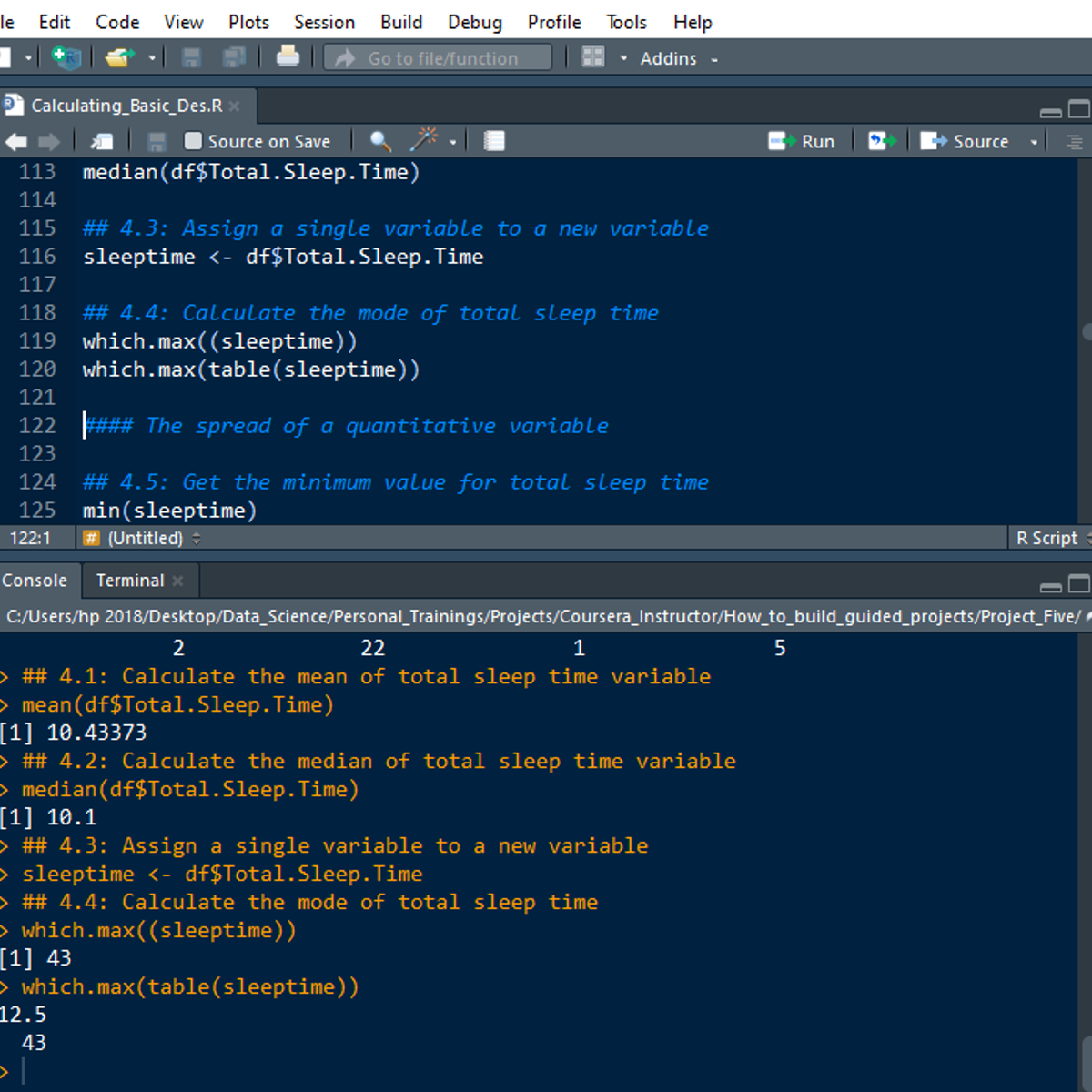
Calculating Descriptive Statistics in R
Welcome to this 2-hour long project-based course Calculating Descriptive Statistics in R. In this project, you will learn how to perform extensive descriptive statistics on both quantitative and qualitative variables in R. You will also learn how to calculate the frequency and percentage of categorical variables and check the distribution of quantitative variables. By extension, you will learn how to perform univariate and bivariate statistics for univariate and bivariate variables in R. Note: You do not need to be a Data Scientist to be successful in this guided project, just a familiarity with basic statistics and using R suffice for this project. If you are not familiar with R and want to learn the basics, start with my previous guided project titled “Getting Started with R”.