

The Global Scholarly Directory.
Discover world-class academic programs curated for the modern intellectual. Search through 19877+ degrees and professional certificates.
 Goldman Sachs
Fundamentos de las Ventas y el Marketing con Goldman Sachs 10,000 Women
Este curso online gratuito es uno de los 10 cursos disponibles en la colección Goldman Sachs 10,000 Women, diseñado para emprendedoras listas para llevar su negocio al siguiente nivel. Este curso te ayudará a desarrollar tus estrategias de marketing y a construir tu marca a medida que tu negocio crezca. También examinarás una gama de herramientas sobre marketing y aprenderás cómo utilizar métricas útiles para tu empresa. Comprenderás claramente y a fondo el ciclo de ventas y marketing. Utilizarás este ciclo como base para desarrollar tus planes de marketing y proceso de ventas. Al final de este curso, comprenderás cómo identificar las herramientas de marketing adecuadas para llegar a tu público objetivo, y cómo un plan de marketing efectivo puede convertirse en ventas e ingresos para tu negocio. La colección de cursos 10,000 Women ofrece una experiencia de aprendizaje en línea verdaderamente flexible. Tendrás la libertad de acercarte al programa de cualquier manera que funcione para ti: toma cualquier curso o combinación de cursos para adaptar tu viaje de aprendizaje a las necesidades individuales de crecimiento de tu negocio. Si eliges tomar los 10 cursos, explorarás todos los elementos clave de tu negocio y desarrollarás un plan exhaustivo para el crecimiento de tu negocio. Obtén más información sobre la colección Goldman Sachs 10,000 Women en las preguntas frecuentes.
 University of Toronto
Transformational Leadership for Inclusive Innovation
Gender Analytics underpins inclusive innovation, and inclusive innovation will require organizational transformation. The missing link between insights and actions is change leadership. How can you get people to collaborate? How can you overcome resistance to change? How can you embed intersectional, gender-based insights in everything an organization does? In this course, you will learn to be an inspiring and effective change agent by developing a toolbox of leadership skills for building and managing diverse teams. You will hear from experts who have led Gender Analytics in various settings from companies, to non-profits, to the government. In short, this course will help you develop skills to be a transformational leader as you work towards creating inclusive products, services, processes and policies. This is the fourth course of the Gender Analytics Specialization offered by the Institute for Gender and the Economy (GATE) at the University of Toronto's Rotman School of Management. It is great on its own, and you will get even more out of it if you take it as part of the Specialization.
 Google Cloud
Vertex AI Studio'ya Giriş
Bu kursta Vertex AI Studio tanıtılmaktadır. Bu araç, üretken yapay zeka modelleriyle etkileşime geçmek, kurumsal fikirlerin prototipini oluşturmak ve bunları gerçek hayatta uygulamak için kullanılır. Gerçek hayattan kullanım alanları, etkileşimli dersler ve uygulamalı laboratuvarlar aracılığıyla, ilk istemden son ürüne uzanan yaşam döngüsünü keşfedecek ve çoklu format destekli Gemini uygulamaları, istem tasarımı, istem mühendisliği ve model ayarlama konularında Vertex AI Studio'dan nasıl yararlanabileceğinizi öğreneceksiniz. Bu kursun amacı, Vertex AI Studio'yu kullanarak projelerinizde üretken yapay zekadan yararlanabilmenizi sağlamaktır.
 Starweaver
Verbal Communications and Presentation Skills
This course equips you with practical verbal communication skills to express ideas clearly, engage audiences, and build confidence in any setting. In just 90 minutes, you’ll learn essential techniques for speaking persuasively, delivering impactful presentations, and adapting your message for colleagues, clients, and leaders. Designed for both beginners and experienced professionals, the course is ideal for anyone seeking to improve workplace communication—whether in one-on-one conversations, team meetings, or public speaking situations. You’ll practice using video to refine delivery, strengthen clarity, and leave a positive impression. By the end, you’ll be able to communicate with confidence, tailor messages to different audiences, and apply proven speaking strategies to succeed in diverse professional and personal interactions. These skills will help you navigate workplace challenges and connect effectively in today’s fast-paced business environment.
 Duke University
Decentralized Finance (DeFi) Infrastructure
Decentralized Finance: The Future of Finance is a set of four courses taught by Campbell R. Harvey (Professor of Finance at the Fuqua School of Business, Duke University, and a Research Associate of the National Bureau of Economic Research) that focus on decentralized finance (DeFi). In this first course, we begin by exploring the origins of DeFi and take a broad historical view from the earliest barter economies, such as the first peer-to-peer exchanges of bartering, to present day. The course also looks at historical examples of money having value even though it is not officially backed. We then focus on the key infrastructure components: blockchain, cryptocurrency, smart contracts, oracles, stablecoins and decentralized applications (or dApps). This includes discussion of the mechanics of the Ethereum and Bitcoin blockchains including cryptographic hashing. Next, we focus on the specific problems that DeFi is designed to solve: inefficiency (costly, slow, and insecure today), limited access (1.7 billion are unbanked), opacity (we need to trust regulators to monitor banks and the regulators have mixed records), centralized control (financial system is oligopolistic imposing higher fees than we would have in a competitive market) and lack of interoperability (it is difficult to move funds from one financial institution to another today). The course closes by exploring many of the myths about the crypto space.
 Coursera
Design Stunning Maps
Design Stunning Maps is a beginner-friendly course for data analysts and professionals who want their maps to communicate clearly, accurately, and professionally. Many maps fail not because the data is wrong, but because design choices around color, layout, and emphasis make them hard to read. This course shows you how to fix that. You’ll learn core cartography principles that help maps tell a clear story—how to apply color theory to thematic data, place essential map elements correctly, and evaluate maps for strong visual hierarchy. Through short videos, practical readings, hands-on labs, and realistic review scenarios, you’ll practice diagnosing common design problems and making targeted improvements. By the end of the course, you’ll be able to confidently critique and refine maps for real-world use, including reports and presentations. You’ll finish with the skills needed to deliver a publication-ready map suitable for an annual report, ensuring your work is not only accurate, but clear, trustworthy, and easy for others to understand.
 University of Illinois Urbana-Champaign
Operations Management: Quality and Supply Chain
In this course you will focus on process improvement. You will learn how to set organizational priorities for continuous process improvement, how to execute process improvement projects, and how to sustain the initiative for continuous improvements. You will be able to: • Relate underlying principles to frameworks and techniques used for process improvement • Synthesize information to make decisions for organizational initiatives and process improvement • Apply analytical techniques for tactical decisions in a process improvement project This course is part of Gies College of Business’ suite of online programs, including the iMBA and iMSM. Learn more about admission into these programs and explore how your Coursera work can be leveraged if accepted into a degree program at https://degrees.giesbusiness.illinois.edu/idegrees/.
 University of California, Davis
Introduction to Process Safety and Risk Analysis
This course aims to provide process safety experience for engineers, particularly relevant to chemical engineering but applicable to any field involving process operations. This course introduces you to the important, practical, value-added skills and information that will aid your career, or preparation for a career, in chemical process engineering. These skills include an understanding of how to identify, evaluate, assess, and mitigate hazards or risks in the chemical process industry. You will gain insight and skills as you study mistakes of the past and discover how risk and safety will become a bigger and more important part of your decision-making process, both at work and at home.
 Logical Operations
Project Management: Costs, Risk, Quality, and Compliance
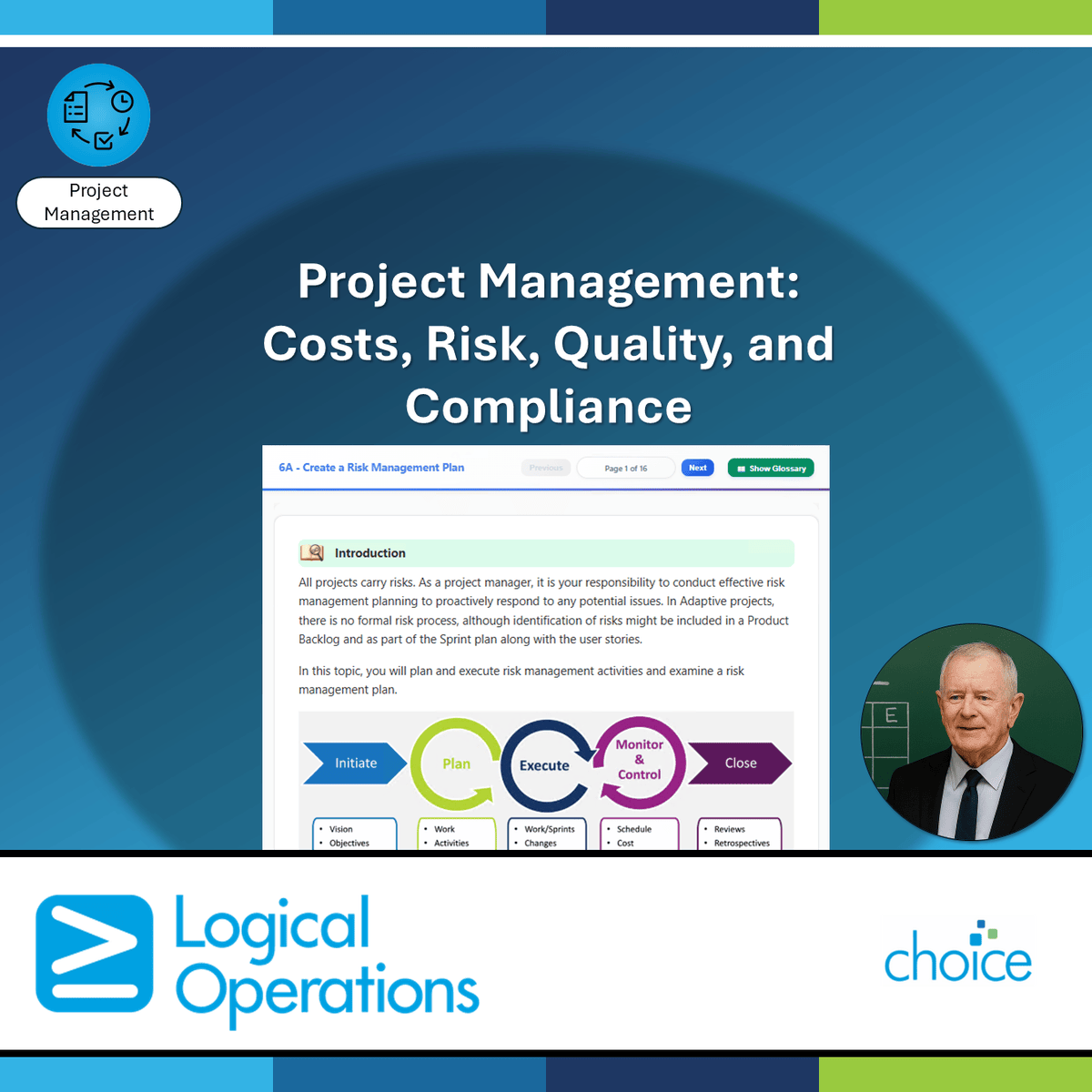
In this course, you'll continue developing your project management skills by establishing project costs and cost baselines, reconciling funding and costs, and determining the burn rate for adaptive teams. You'll also create a risk management plan, identify risks and triggers, analyze risks, and develop a risk response plan. Then, you'll deliver project results and verify compliance requirements. This is the second course in a multi-course Specialization. All of the courses in this Specialization require that you have a recent version of Microsoft Word and Excel installed in order to open the course data files. The course setup instructions provided in the first course go into more detail about the hardware and software requirements.
 University of California San Diego
Human-Centered Design: an Introduction
In this course, you will learn how to design technologies that bring people joy, rather than frustration. You'll learn several techniques for rapidly prototyping (such as Wizard of Oz Prototyping) and evaluating multiple interface alternatives -- and why rapid prototyping and comparative evaluation are essential to excellent interaction design. You'll learn how to conduct fieldwork with people to help you get design ideas. How to make paper prototypes and low-fidelity mock-ups that are interactive -- and how to use these designs to get feedback from other stakeholders like your teammates, clients, and users. Armed with these design-thinking strategies, you’ll be able to do more creative human-centered design in any domain. This is the first course offered in the interaction design specialization series. Browse through previous capstone projects for some inspiration here: https://medium.com/capstone-projects/capstone-projects-2019-abc67d3f6f26
 Novartis
Pharmacokinetics
This course begins with a review of routes of administration, ADME (absorption, distribution, metabolism, & excretion), and the use of in vivo drug concentration-time data to determine key pharmacokinetic parameters, like volume of distribution, half-life and clearance. The course then emphasizes in vitro assays that allow rapid prediction of ADME and PK properties for evaluation of new compounds. The later stages of the course focus on how drug discovery teams study this PK/PD relationship, as well as dose size and frequency predictions which ultimately assist in selection of a compound for advancement into the clinic. This course is suitable for life scientists, clinicians, and individuals from fields that support drug discovery (e.g., patents, finance, licensing, etc.) interested in learning more about the pharmaceutical/biotechnology sector. Advanced undergraduate coursework or practical familiarity/working knowledge in biological sciences and organic chemistry is recommended.
 Coursera
A Start Guide: Product Marketing Using G Suite
In this 1-hour 40-minutes long project-based course, you will be able to identify your product mix, draw your product hierarchy levels as well as analyzing the sales performance of your product item or what we call stock-keeping unit (SKU). You will learn how to build successful product lines by identifying the problems and finding solutions for each product item or the stock-keeping unit ( SKU). Note: This course works best for learners who are based in the North America region. We’re currently working on providing the same experience in other regions.
 University of Alberta
Arctic Development
Welcome to Arctic: Development! In this third in a series of Arctic MOOCs, brought to you by a unique partnership between the University of Alberta and UiT The Arctic University of Norway, we will be exploring regional development in a changing arctic. In this 4-week course, you will investigate the role that natural resources play across the Indigenous, Nordic, Russian and North American Arctics, different strategies for resource management in different regions, and how these affect community planning and development efforts in an increasingly populated part of the world. We'll also see how climate change is dramatically impacting the Arctic, and examine a number of adaptations that different arctic communities are implementing to combat rapid, climate-influenced change. By the end of this course, you will have an idea of the opportunities presented to and difficulties faced by members of northern communities, and gain an understanding of just what regional development looks like in a changing Arctic.
 Rice University
Principles of Economics: Microeconomics - Down to Business
In this second portion of the three-course specialization covering economics, we're going to be focusing on Microeconomics or the business side of things. This course is also based heavily on my ECON 100 course that I teach here at Rice University. Through lectures, short quizzes, problem sets, and discussions we're going to take a look at subjects such as, costs of production, perfect competition, monopolies, monopolistic competition, oligopolies, and household choices. And you'll still get all the unsolicited food and cooking advice sprinkled in there too :) Although this course is intended for anyone with an interest in economics, we will occasionally be using some basic math. I would also recommend that you take the first course, "A Story of Economics: Getting to Know You" before enrolling in this course. Things you should learn by the end of this course: 1. Identify how Opportunity Costs affect economic decisions. 2. Identify how economic decision makers compare marginal benefits to marginal costs to make optimal choices. 3. In a graph, identify the gains from trade. 4. Describe the relationship between prices, market demand, and market supply. 5. Calculate and interpret the meaning of an elasticity coefficient. 6. Evaluate the effects of government policy on supply and demand. 7. Calculate and interpret the meaning of market efficiency. 8. Evaluate the effects of externalities and the policies associated with them, and identify how they are related to different types of goods. 9. Identify the costs of production and interpret their shapes. 10. Communicate how different degrees of competition in a market affect pricing and output. 11. Identify the prisoner’s dilemma in the context of an application. 12. Explain the interaction between budget constraints and indifference curves.
 Johns Hopkins University
Summary Statistics in Public Health
Biostatistics is the application of statistical reasoning to the life sciences, and it is the key to unlocking the data gathered by researchers and the evidence presented in the scientific literature. In this course, we'll focus on the use of statistical measurement methods within the world of public health research. Along the way, you'll be introduced to a variety of methods and measures, and you'll practice interpreting data and performing calculations on real data from published studies. Topics include summary measures, visual displays, continuous data, sample size, the normal distribution, binary data, the element of time, and the Kaplan-Meir curve.
 EDUCBA
Human Resource Management: Apply & Analyze Skills
By completing this course, learners will be able to define Human Resource Management (HRM) concepts, analyze organizational contexts, evaluate HR strategies, apply analytical tools like SWOT and PESTLE, and implement talent transformation, performance, and career management practices. This course offers a comprehensive journey into HRM through an engaging case study approach, enabling learners to bridge the gap between theory and practice. Beginning with the fundamentals of HRM and organizational context, learners gain clarity on vision, mission, and strategic objectives. The course then advances into powerful frameworks such as IRIC Mileposts, Service Verticals, Key Observations, and Audits, helping learners build a robust analytical mindset. By the end, participants will confidently apply Talent Transformation, Performance Management, and Career Management strategies to align workforce development with organizational goals. What makes this course unique is its structured, case-based methodology, which not only illustrates real-world HR challenges but also equips learners with decision-making and problem-solving skills relevant to diverse industries. Whether you are an aspiring HR professional, a manager, or a business leader, this course empowers you to analyze, evaluate, and implement HR strategies for sustainable growth.