

The Global Scholarly Directory.
Discover world-class academic programs curated for the modern intellectual. Search through 19877+ degrees and professional certificates.
 Packt
Packt
Interview Questions and Real-World Applications
Master the essential data structures and algorithms that form the foundation of programming problem-solving. In this practical, project-driven course, you’ll work through real-world interview questions and coding challenges to strengthen your logic, sharpen your skills, and build the confidence to tackle technical assessments and professional projects. Your journey begins with core data structures like stacks, queues, and linked lists, exploring both their implementation and application. You’ll then move into classic interview-style problems such as Two Sum, Min Stack, Max Stack, and linked list reversal, learning the underlying coding patterns and strategies that make these solutions efficient and reusable. As the modules progress, you’ll dive into binary trees and binary search trees, practicing both construction and inversion, before advancing to string manipulation problems such as Detect Capital, reverse strings, and longest palindromic substring. Each step includes hands-on demonstrations and guided explanations to ensure you not only understand the algorithms but also know how to apply them under pressure. By the end of this 13-module course, you will have: - Implemented and practiced essential data structures from scratch. - Solved classic algorithmic problems with confidence and clarity. - Built expertise in binary trees, search trees, and string manipulation. - Developed a strong foundation for technical interviews and real-world coding challenges. This course is ideal for aspiring software developers, computer science students, and professionals preparing for interviews. A basic knowledge of programming in Python, Java, or C++ is recommended, and the intermediate-level design ensures a balance of foundational learning and advanced problem-solving practices that will help anyone looking to perform better in their next programming interview.
 University of Michigan
AI Ethics, Responsible Use, and Creativity
“AI Ethics, Responsible Use, & Creativity” explores ethics and responsible use of generative AI tools for creative work. After completing this course, you will learn how to engage with generative AI tools with an eye toward intentionality, sustainability, and responsibility. You will learn the SIFT (Specify, Identify, Focus, Trust) process for evaluating AI tools. This compact method helps learners employ AI successfully and sustainably by realistically approaching the technology and prioritizing intentional decision-making for individuals and enterprises. You will learn the practical application of the SIFT framework by using it to evaluate tools and creative work developed in the first course. You will also learn about the reputational and legal risks of using AI in creative fields. You will explore issues of environmental cost, cultural bias, and data risks of contemporary GenAI tools through readings and a guest lecture by expert Justin Joque. This is the second course in “AI for Creative Work,” a series exploring how artificial intelligence can enhance the work of creatives.
 Google Cloud
Concepts fondamentaux de Google Cloud VMware Engine
Dans ce cours, vous allez commencer par créer une infrastructure robuste en exploitant les concepts de base de Google Cloud VMware Engine (GCVE). Ensuite, vous allez découvrir l'architecture unique et les composants de GCVE en apprenant à préparer, déployer et examiner des VM dans un environnement de cloud privé. Ce cours va vous expliquer comment gérer et surveiller votre cloud privé, configurer la mise en réseau et les composants de stockage, et connecter GCVE à l'écosystème plus vaste de services Google Cloud et à Internet.
 Packt
Packt
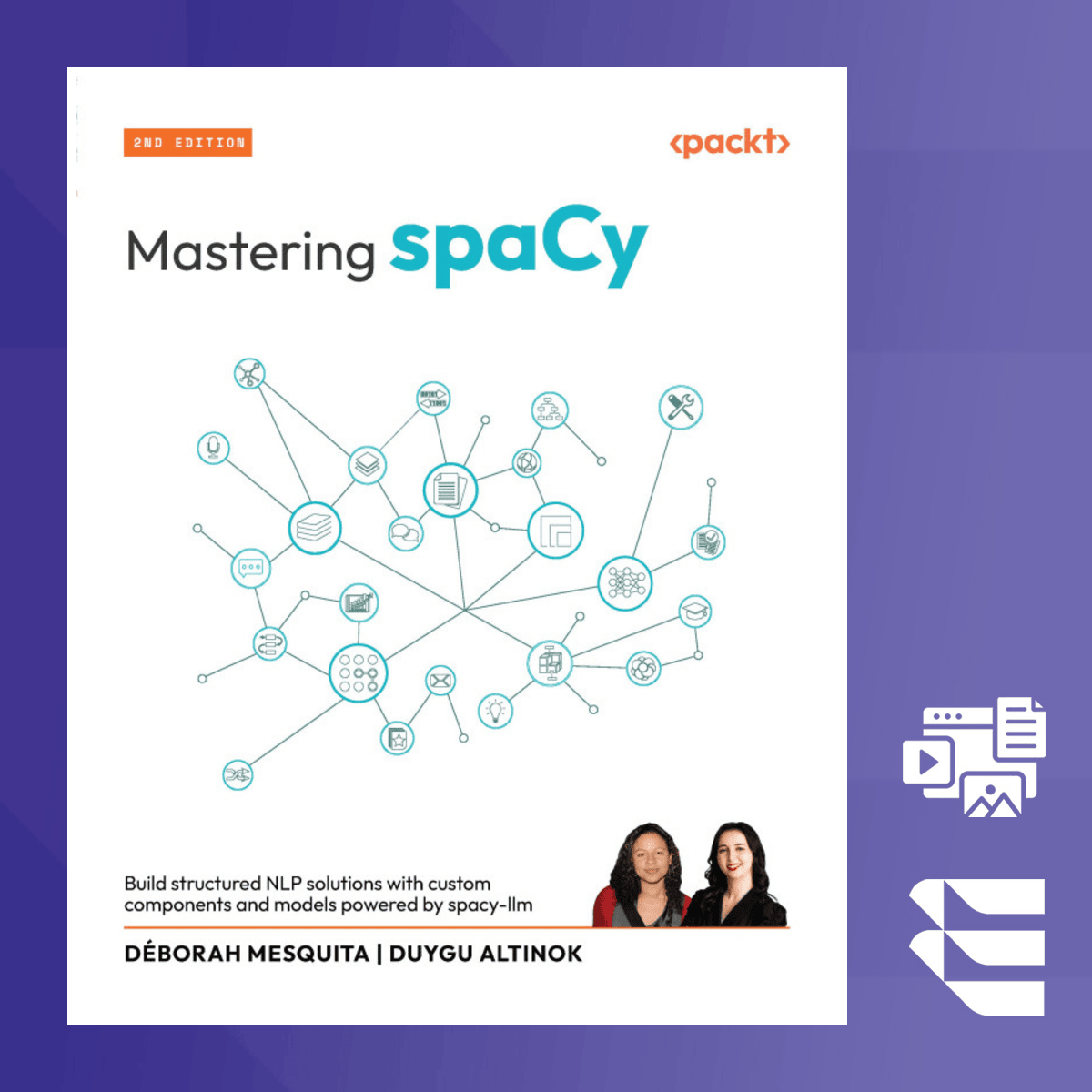
Mastering spaCy
This course teaches advanced techniques in Natural Language Processing (NLP) using spaCy and spaCy-LLM. You’ll learn how to integrate LLMs into your NLP workflows, creating custom components and models. Designed for both beginners and experienced developers, this course provides hands-on examples to help you master spaCy’s core functionalities. It equips you to apply transformer models and fine-tune them for specialized NLP tasks. What sets this course apart is its practical approach. You’ll learn to build end-to-end NLP workflows and gain skills in deploying production-ready solutions, making it ideal for real-world applications. This course is perfect for NLP engineers, machine learning developers, and software engineers. A basic understanding of Python and NLP concepts is recommended for the best experience.
 Packt
Packt
JUnit and Mockito Unit Testing for Java Developers
Updated in May 2025. This course now features Coursera Coach! A smarter way to learn with interactive, real-time conversations that help you test your knowledge, challenge assumptions, and deepen your understanding as you progress through the course. Are you looking for a simple guide to learning unit testing? This video course is perfect for you. It includes hands-on exercises and best practices to help you understand JUnit and Mockito unit testing with ease. -The course starts with an introduction to unit testing and the importance of JUnit. -You'll create a Java project using JUnit and follow best practices for writing and running unit tests with JUnit and IntelliJ IDEA. -You'll also write mock object-based unit tests with Mockito and make powerful assertions using the Hamcrest assertions library included with JUnit. -By the end, you'll have the skills to write better unit tests using JUnit, Mockito, and Hamcrest. This course is suitable for Java developers and testers with basic Java knowledge who want to write unit tests using JUnit, Mockito, and Hamcrest. Learn modern unit testing concepts, run tests in the IDE, analyze code for quality tests, and compose readable assertions.
 Google Cloud
Introduction to Image Generation - Italiano
Questo corso introduce i modelli di diffusione, una famiglia di modelli di machine learning che recentemente si sono dimostrati promettenti nello spazio di generazione delle immagini. I modelli di diffusione traggono ispirazione dalla fisica, in particolare dalla termodinamica. Negli ultimi anni, i modelli di diffusione sono diventati popolari sia nella ricerca che nella produzione. I modelli di diffusione sono alla base di molti modelli e strumenti di generazione di immagini all'avanguardia su Google Cloud. Questo corso ti introduce alla teoria alla base dei modelli di diffusione e a come addestrarli ed eseguirne il deployment su Vertex AI.
 University of Colorado Boulder
Statistics and Data Analysis with R
This course is the third course in a 3-part specialization entitled "Statistics and Applied Data Analysis." The course is meant for those familiar with statistics but unfamiliar with the programming language R. The purpose of this course is to teach learners how to use the popular open-source (and thus, free) integrated development environment RStudio to perform basic and complex statistical calculations. After an introduction to basic calculations, vector, matrices, data frames, and how to import data from common file types (.xlsx, .csv, .txt), learners are taught how to solve probability and counting problems in R, followed by discrete and continuous probability distribution calculations, one-sample hypothesis tests, and two-sample hypothesis tests (comparisons). Finally, participants will learn how to create regression models in R and perform analysis of variance (ANOVA). One of the most beneficial aspect of the course are the programming assignments, which are completed online in the R programming language in Jupyter notebooks.
 Universitat Politècnica de València
Cybersecurity basics for everyone
Computers and smartphones connected to the network are the foundation of our daily and professional lives, but this connection that makes life easier can turn into a nightmare. The digital danger is real: cybercrime has evolved into a multi-billion dollar "economy," with revenues comparable to those of drug trafficking. Do you know how to protect yourself? In this cybersecurity training, we will dissect the most common threats you face and provide you with an arsenal of defenses and preventive measures. The content includes lessons illustrated with practical examples and easy-to-apply tips to secure your online life.
 Coursera
Multi-Agent Systems and Orchestration
The Multi-Agent Systems and Orchestration course teaches learners how to design and coordinate AI agents that work together as collaborative systems. Starting with the OpenAI Agents SDK, participants explore how to structure planner–executor architectures, enabling agents to break down complex tasks into coordinated subtasks. The course emphasizes orchestration strategies such as multi-agent collaboration, workflow delegation, and state sharing across agents, supported by design principles for efficiency and reliability. Learners also examine observability and monitoring techniques to track agent decisions, as well as fault tolerance strategies to handle errors gracefully in production settings. Advanced modules introduce hybrid human–agent workflows, parallel execution patterns, and enterprise-level orchestration for scalability. Through hands-on labs and guided projects, learners will build an Automated Research Team, demonstrating how multiple agents can gather information, analyze data, and synthesize findings. By course completion, participants will have the skills to design multi-agent systems that deliver scalable, reliable, and coordinated AI-driven solutions.
 DeepLearning.AI
Quantization in Depth
In Quantization in Depth you will build model quantization methods to shrink model weights to ¼ their original size, and apply methods to maintain the compressed model’s performance. Your ability to quantize your models can make them more accessible, and also faster at inference time. Implement and customize linear quantization from scratch so that you can study the tradeoff between space and performance, and then build a general-purpose quantizer in PyTorch that can quantize any open source model. You’ll implement techniques to compress model weights from 32 bits to 8 bits and even 2 bits. Join this course to: 1. Build and customize linear quantization functions, choosing between two “modes”: asymmetric and symmetric; and three granularities: per-tensor, per-channel, and per-group quantization. 2. Measure the quantization error of each of these options as you balance the performance and space tradeoffs for each option. 3. Build your own quantizer in PyTorch, to quantize any open source model’s dense layers from 32 bits to 8 bits. 4. Go beyond 8 bits, and pack four 2-bit weights into one 8-bit integer. Quantization in Depth lets you build and customize your own linear quantizer from scratch, going beyond standard open source libraries such as PyTorch and Quanto, which are covered in the short course Quantization Fundamentals, also by Hugging Face. This course gives you the foundation to study more advanced quantization methods, some of which are recommended at the end of the course.
 Infosec
Laravel Additional Security
This course focuses on ways to keep your Laravel database secure. It starts with supporting request and response security. First, we’ll discuss how Laravel supports semantic request verbs while still being compatible with browsers. Then, tools to protect against cross-site request forgery and cross-site scripting protection are examined. Then it describes the best practices for applying specific security-related headers to responses are reviewed. We then move on to the two types of scanning tools that can be used on a Laravel application: developer code-scanning tools and hacker attack tools. In this course, we talk about what tools you should run to scan your code and configuration for security holes and vectors of attack. Additionally, we discuss other tools that a bad actor might use against your website, so you can learn to use them against yourself first and protect yourself proactively. This course also covers two ways of interacting with bad actors: honeypots and tripwires. Tripwires, functionality that matches a specific restricted access and then actively alerts or blocks access, are discussed and demonstrated. Honeypots, functionality attached to the app to monitor suspected bad activity and report on it later, are also reviewed. Closing out this learning path, we’ll talk about what next steps to take to secure your Laravel application and stay connected with the community. You’ll learn how to stay in the know and see what new security weaknesses are out there and whether you’re affected. e.g. This is primarily aimed at first- and second-year undergraduates interested in engineering or science, along with high school students and professionals with an interest in programming.
 EDUCBA
Apply Advanced Cassandra Collections for Scalable Models
By the end of this course, learners will be able to analyze Cassandra collection data types, apply Lists, Sets, and Maps effectively, and design performant NoSQL data models using best practices. This advanced-level Cassandra course is designed for developers, data engineers, and database professionals who want to move beyond basics and gain practical mastery over Cassandra collections. Learners will explore how Lists, Sets, and Maps work internally, when to use each collection type, and how to avoid common performance pitfalls associated with unbounded or poorly modeled collections. Through structured lessons and real-world examples, the course demonstrates how to store ordered data, enforce uniqueness, and model dynamic key-value attributes efficiently in distributed environments. Special emphasis is placed on performance considerations, update behavior, and schema design decisions that directly impact scalability and reliability. What makes this course unique is its collection-focused, design-first approach, combining conceptual clarity with practical modeling guidance. Instead of generic theory, learners gain actionable skills they can immediately apply to production-grade Cassandra systems. Completing this course equips learners with the confidence to build optimized, scalable, and maintainable Cassandra data models aligned with real-world NoSQL use cases.
 EDUCBA
XML Practical - Style Sheets with CSS and XSL
This course equips learners with the skills to design, apply, and transform XML documents using CSS and XSLT. Beginning with foundational style sheet concepts, the course introduces learners to CSS syntax, selectors, and how to link stylesheets to XML. It then progresses into the principles of XSL, covering templates, XPath, sorting, and pattern matching. Through progressively structured lessons, learners will build their ability to construct dynamic transformations, generate styled HTML output, and integrate CSS formatting with XSL logic. Emphasis is placed on hands-on examples that simulate real-world document styling and transformation scenarios. By the end of this course, learners will be able to: • Apply CSS to structure and format XML content • Implement XSLT templates to transform XML into styled output • Construct dynamic XML-based web documents using XPath and conditional logic • Generate HTML output by integrating XSL and CSS
 Google Cloud
Preparing for Professional Data Engineer Journey - Português
Este curso ajuda estudantes a criar um plano de estudo para o exame de certificação PDE (Professional Data Engineer). É possível conferir a amplitude e o escopo dos domínios abordados no exame. Os estudantes também podem acompanhar os preparativos para o exame e criar planos de estudos individuais.
 Skillshare
Writing for Inner Calm: Mindset, Methods, and Daily Exercise
“This isn’t just a class that you take, it’s a way of life that you’re embarking on.” Best-selling author and memoirist Dani Shapiro (Inheritance, Still Writing) invites you into her home (and her writing room) to discover what it truly means to cultivate the life of a writer. Whether you’ve set a goal to get published or are simply looking for a creative outlet, writing can be a healing ritual for all of us. With a calming mindset and easy methods that Dani uses herself, you’ll learn how to care for your gift, honor your need for self-expression, and create a lifelong, sustainable relationship with writing. Explore the three elements of the writing life with Dani: * The Mindset: Unlock the confidence to call yourself a writer and overcome any writer’s block, whether you’re published (yet!) or not. * The Craft: Discover tools and ways of thinking to hone your skills as a writer, and get more words down on the page. * The Practice: Create a ritual around writing that works for you, and learn to prioritize your writing as a sacred space in your life. Plus, each element is paired with a daily writing exercise that you are welcome to adopt in your own practice. Dani even guides you through a brief meditation in real time to help center your mind and jumpstart your writing day. Whether you’re sitting down with pen and paper for the very first time or have been writing steadily for years, this peaceful class will act as a respite for your creativity—a place to reset and recharge, find inspiration, and set your intentions—before you turn to a fresh sheet of paper and begin. Welcome to the writer’s life. This class is open to students of all levels. No writing (or meditation) experience needed—just a pen and paper. Instructor bio: Dani Shapiro is the author of the instant New York Times best selling memoir, Inheritance, which was published in January 2019 by Knopf. Her other books include the memoirs Hourglass, Still Writing, Devotion, and Slow Motion, and five novels including Black & White and Family History. Along with teaching writing workshops around the world, Dani has taught at Columbia and New York University, and is the cofounder of the Sirenland Writers Conference in Positano, Italy. In February of 2019, Dani launched an original podcast, Family Secrets, in collaboration with iHeartMedia. An iTunes Top 10 podcast, the series features stories from guests who—like Dani— have uncovered life-altering and long-hidden secrets from their families’ past. She lives with her family in Litchfield County, Connecticut.
 SAS
SAS
Advanced SAS Programming Techniques
In this course, you learn advanced techniques within the DATA step and procedures to manipulate data. “By the end of this course, a learner will be able to…” ● Use additional functions (LAG, FINDC/FINDW, and COUNT/COUNTC/COUNTW). ● Perform pattern matching using PRX functions. ● Process repetitive code, rotate data, and perform table lookups using arrays. ● Perform table lookups and sort data using hash and hash iterator objects. ● Create numeric templates using the FORMAT procedure. ● Create custom functions using the FCMP procedure.