

The Global Scholarly Directory.
Discover world-class academic programs curated for the modern intellectual. Search through 19877+ degrees and professional certificates.
 University of California, Davis
Quantitative Research
In this course, you will obtain some insights about marketing to help determine whether there is an opportunity that actually exists in the marketplace and whether it is valuable and actionable for your organization or client. Week 1: Assess methods available for creating quantitative surveys, along with their advantages and disadvantages. Identify the type of questions that should be asked and avoid unambiguous survey questions. Week 2: Design, test, and implement a survey by identifying the target audience and maximizing response rates. You will have an opportunity to use Qualtrics, a survey software tool, to launch your own survey. Week 3: Analyze statistical models that can be applied to your marketing data, so that you can make data-driven decisions about your marketing mix. Week 4: Predict most likely outcomes from the marketing decisions and match the type of analysis needed for your business problem. Take Quantitative Research as a standalone course or as part of the Market Research Specialization. You should have equivalent experience to completing the second course in this specialization, Qualitative Research, before taking this course. By completing the third class in the Specialization, you will gain the skills needed to succeed in the full program.
 National Taiwan University
用 Python 做商管程式設計(二)(Programming for Business Computing in Python (2))
接續用 Python 做商管程式設計(一)的內容,我們將在這個課程中繼續探討Python語言中的許多核心觀念,包含函數、字串、常用的資料結構、檔案讀寫、例外處理等。最後以一個財金資料分析的例子總結。完成本次課程之後,你將會對Python有更深入的了解,並且可以利用Python實際處理一些簡單的資料分析問題。
 LearnKartS
Core Java - Multithreading and Classes
Welcome to the Core Java - Multithreading and Classes course! The course delves into the intricacies of Java Multithreading and Core Classes, equipping participants with essential skills for proficient Java programming. Learners will explore these important aspects and learn to leverage Java's multithreading capabilities and core class functionalities to elevate their programming expertise. This course requires a good understanding of core Java concepts like classes, objects, methods, inheritance, and polymorphism. By the end of this course, you will be able to: - Understand multithreading in Java, including thread life cycle, priority, daemon threads, scheduling, and synchronization - Utilize wrapper classes and concepts like autoboxing and unboxing effectively - Demonstrate multithreading concepts through practical demonstrations - Master key classes in 'java.util' and 'java.lang', such as String, StringBuilder, StringTokenizer, Math, and Locale, for efficient programming This course contains engaging videos, demos, and knowledge checks for a high-quality learning experience.
 EDUCBA
Analyze and Manage Stakeholder Communications Effectively
By the end of this course, learners will be able to identify stakeholders, analyze their influence and expectations, design targeted communication strategies, apply engagement tools, manage change, and evaluate the long-term business value of effective stakeholder communication. This course provides a structured, practical approach to stakeholder communications management, aligned with real-world project environments. Learners will gain the skills needed to systematically identify and organize stakeholders, assess power and influence, and apply proven tools to engage stakeholders effectively throughout the project lifecycle. The course emphasizes clear, targeted communication, customer expectation management, and continuous review to ensure alignment as projects evolve. Participants will benefit by improving their ability to reduce resistance, manage risks, and build strong stakeholder relationships that support successful project outcomes. Through focused lessons and scenario-driven explanations, learners will develop leadership and communication capabilities that extend beyond a single project and contribute to long-term organizational success. What makes this course unique is its end-to-end focus on stakeholder communication—from identification and analysis to engagement, leadership, and closeout—combined with practical frameworks, PMI-aligned concepts, and actionable techniques that can be immediately applied in professional project settings.
 Coursera
GenAI for Underwriters: Enhancing Application Reviews
Welcome to this transformative course designed to help you revolutionize your underwriting process through the power of Generative AI (GenAI). In this course, you’ll learn how to streamline application reviews, enhance decision-making accuracy, and automate repetitive tasks to save valuable time. With no technical experience required, you’ll be able to apply cutting-edge AI tools to improve your underwriting workflow efficiently and responsibly, all while maintaining compliance and ethical standards. This course is ideal for a variety of professionals in the underwriting and insurance fields. Whether you're a beginner underwriter eager to integrate AI into your workflow or an experienced underwriter looking to optimize your application reviews with advanced tools, this course has something for you. It’s also perfect for risk assessment professionals who want to enhance their decision-making accuracy using AI, and compliance officers or industry professionals interested in understanding the ethical and regulatory aspects of AI in underwriting. To get the most out of this course, learners should have a basic understanding of underwriting principles and workflows, as well as experience with interpreting application data and assessing risk factors. A basic knowledge of AI tools, such as ChatGPT, will be helpful but not required—this course is designed to be beginner-friendly and will guide you through the practical use of AI without any advanced technical knowledge. By the ending this course, you'll not only gain a solid understanding of how Generative AI can streamline your underwriting processes, but you'll also be equipped with the tools and strategies to apply AI effectively in real-world scenarios. Whether you're looking to reduce review times, improve risk assessments, or ensure compliance with ethical standards, you'll have the knowledge and confidence to integrate AI into your workflows. Stay ahead of the curve, future-proof your career, and lead the way in transforming the underwriting industry with AI.
 The Museum of Modern Art
Art & Ideas: Teaching with Themes
Develop connections between your curriculum, students’ experiences, and accessible themes in art. Themes include Places and Spaces, Art and Identity, Transforming Everyday Objects, and Art and Society.
 Google Cloud
Offloading Financial Mainframe Data into BigQuery and Elastic Search
This is a self-paced lab that takes place in the Google Cloud console. In this hands-on lab, you will import synthetic data* representing financial records offloaded from a bank’s mainframe.
 Coursera
Create a Product Design Brainstorming with Miro
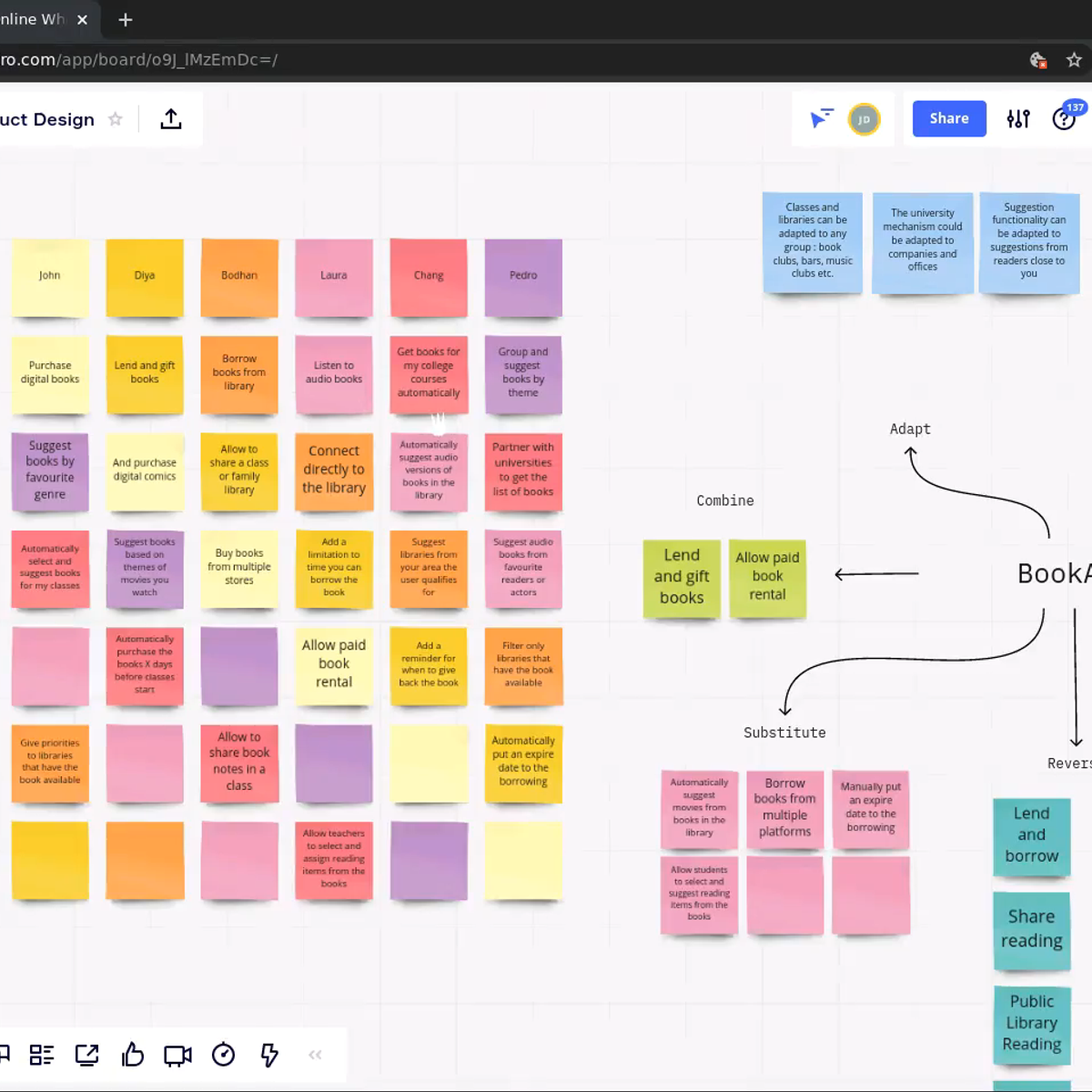
In this 1-hour long project-based course, you will learn how to create a product design brainstorming with Miro as an online collaborative interactive tool, using different whiteboard and team work techniques and models such as brainwriting and SCAMPERS, utilize user personas and action based approaches in order to design and finally streamline ideas into an action plan with a timeline workflow. Note: This course works best for learners who are based in the North America region. We’re currently working on providing the same experience in other regions.
 Berklee
How to Make Money with Your Music Copyrights
If you want to learn how to make a living with your music, this is the course for you. How to Make Money with Your Music Copyrights will provide an overview of basic copyright principles and their relationship to music publishing as well as the primary revenue streams available to independent songwriters and artists. Taught by the experienced entertainment attorney and record label executive turned Berklee instructor, Professor Tonya Butler J.D., LL.M., you will learn how to utilize the different copyrights available in the US copyright law for musical works in order to access the four primary revenue streams. You will start by learning the basics of US copyright law and the difference between a musical work and a sound recording. Then, you will learn about the four primary revenue streams and hear from industry professionals and their tips on achieving success in the music industry. Finally, you will learn how music artists can make money as the owners of their own sound recordings. By the end of this course, you will have a better understanding of the different ways and the various organizations that can help you get paid for your music.
 Northeastern University
Applied Natural Language Processing in Engineering Part 2
This course is best suited for software engineers, data scientists, and graduate students in computer science or engineering fields who wish to develop expertise in building and deploying natural language processing systems to solve real-world language understanding challenges. You will master core NLP tasks such as Part-of-Speech tagging, Named Entity Recognition, sentiment analysis, and Neural Machine Translation while implementing various neural architectures from Recurrent Neural Networks and bidirectional RNNs to Conditional Random Fields and state-of-the-art transformer models. The course emphasizes practical application through extensive laboratory work and projects, where you will develop complete NLP pipelines using frameworks like PyTorch and Hugging Face, learning to preprocess data, train models, and evaluate performance using industry-standard metrics. By the end of the course, you will be equipped with both theoretical understanding and practical skills to design, implement, and optimize NLP solutions for real-world engineering applications, from chatbots and translation systems to information extraction and text analysis tools. The curriculum culminates in a comprehensive capstone project where you will apply multiple techniques learned throughout the course to solve a complex language processing challenge. You will be equipped with both theoretical knowledge to tackle complex language processing problems in industry settings, enabling you to build production-ready NLP applications that can understand, interpret, and generate human language effectively.
 Johns Hopkins University
Project Execution and Control
The course "Project Execution and Control" delves into the advanced stages of project execution and control, equipping learners with the tools needed to ensure projects stay on track and meet their objectives. From defining project objectives to managing risks and resolving conflicts, this course offers a comprehensive insight into the strategies effective Project Managers use to maintain momentum and achieve success. You’ll explore key topics like design reviews, configuration management, quality control, and Earned Value Management (EVM), gaining practical knowledge on implementing and adjusting project plans in real-time. What sets this course apart is its focus on hands-on application, enabling you to practice the skills you learn through exercises and scenarios that mirror actual project challenges. By mastering communication strategies, managing quality assurance, and collaborating with executives, you’ll be well-prepared to execute and monitor projects in diverse, high-stakes environments. Whether you’re new to project management or advancing your skills, this course offers invaluable techniques to elevate your project execution and control expertise.
 Packt
Packt
Ultimate Graphic Design Course: Create 40 Practical Projects
Updated in May 2025. This course now features Coursera Coach! A smarter way to learn with interactive, real-time conversations that help you test your knowledge, challenge assumptions, and deepen your understanding as you progress through the course. Unlock your creative potential with this comprehensive graphic design course packed with 40 practical projects. You’ll build an in-demand skill set as you master the design principles and tools professionals use, including Photoshop. By the end, you’ll know how to create powerful visual content that’s not only stunning but also strategic. The course begins with a foundational module that demystifies graphic design and introduces essential resources, tools, and techniques. From there, you'll progressively take on real-world projects, starting with Facebook covers and YouTube thumbnails, moving on to Instagram posts, business cards, resumes, and even animated newsletters. Each project is broken down into detailed steps to help you learn by doing. You’ll explore advanced techniques in packaging design, Facebook ads, personal branding visuals, and print-ready materials like product catalogs and indoor banners. By analyzing real design critiques and experimenting with modern typography, mockups, and composition tricks, you’ll build a diverse and professional portfolio. Ideal for aspiring graphic designers, freelancers, marketers, and content creators, this course assumes no prior experience but also includes challenges for those looking to sharpen their skills. With a beginner-friendly structure and a practical, hands-on approach, it's perfect for learners ready to make real progress.
 Edureka
Financial Automation with Generative AI
This program explores how AI modernizes Financial Operations, helping finance professionals design effective AI-enabled workflows. You’ll start by learning core AI strategy principles, aligning initiatives with financial goals, assessing ROI, and planning change supported by strategic development in Notion AI and system insights using Retool. You’ll then apply No-Code AI Automation with Zapier, n8n, and Contextual AI to streamline financial close, reporting, expense processing, and research. Practical demos show how to build automated file workflows, AI-powered calendars, and data extraction processes that reduce manual work. Next, you’ll examine Ethics, Security, and Responsible AI in Finance, focusing on bias prevention, transparency, data protection, compliance, and auditability to ensure safe and trustworthy AI-driven operations. By the end of this program, you will be able to: - Define strategic AI opportunities and their impact on financial operations. - Build financial AI plans using Notion AI and integrate systems using Retool. - Automate financial close, reporting, and expense workflows using Zapier, n8n, and Contextual AI. - Monitor and improve AI-driven workflows for speed, accuracy, and scalability. - Apply ethical, secure, and compliant AI practices in finance. - Design and implement a comprehensive AI-driven financial transformation strategy. This program is designed for finance teams, operations leaders, analysts, and transformation managers aiming to modernize financial workflows through AI. A foundation in financial processes and enterprise tools will help maximize your learning experience. Learners need a reliable internet connection, a modern web browser, and access to commonly used AI and productivity tools; no specialized hardware or software setup is required. Join us to unlock the full potential of AI in Financial Operations, and transform the way your organization plans, automates, and governs finance with next-generation AI systems.
 Coursera
Java Primitive Types to Calculate Expenses
In this project you will create an application that calculates a monthly expense estimation using a calculated monthly house payment and grocery bills using Java. Java is an Object-Oriented language that contains many Classes but also contains what are called Primitive Data Types. These primitive data types are used to store numbers and characters in Java and have all the Arithmetic operations needed to perform various calculations. To get started with Java, it is important to know how to use these built in data types as they are found throughout the language. The primitive data types take up much less space than objects do and can make a program much more efficient when used properly. Note: This course works best for learners who are based in the North America region. We’re currently working on providing the same experience in other regions.
 Coursera
Design Online Course Printables using Canva
By the end of this course, you will create a variety of templates for course printables that you can offer for free or sell in the marketplace using Canva. You will be able to incorporate a color scheme, images, and other design elements for aesthetically pleasing and value added business marketing collateral. This course will include intermediate to advanced level skills using the free version of Canva. Creating high quality printables is the perfect way to offer a free digital product or market your business to build business. Note: This course works best for learners who are based in the North America region. We’re currently working on providing the same experience in other regions.
 University of Michigan
مقدمة عن CSS3
لا يمكن التعرف على الويب اليوم تقريبًا منذ الأيام الأولى لاستخدام white pages مع قوائم blue links. الآن، صُممت المواقع بتصميمات معقدة للصفحات وخطوط فريدة وأنظمة ألوان مخصصة. سيوضح لك هذا المساق أساسيات أوراق الأنماط المتتالية (CSS3). سيكون التركيز على تعلم كيفية كتابة قواعد CSS ، وكيفية اختبار الرمز، وكيفية إنشاء عادات برمجة جيدة. عندما يتحقق بشكل صحيح، يمكن أن يؤدي تصميم صفحة الويب إلى تطوير صفحتك. عند القيام بذلك بطريقة غير صحيحة، قد تكون النتيجة أسوأ من عدم وجود تصميم على الإطلاق. . للتأكد من أن مواقعك لا تضع حواجز أمام الأشخاص ذوي الإعاقات المعرفية و / أو الجسدية، سوف تتعلم كيفية تقييم الصفحات باستخدام إرشادات POUR الموحدة لإمكانية الوصول . عند الانتهاء من المساق، سيتمكن المتعلمون من رسم تصميم لصفحة HTML معينة. بفضل استخدام هذا التصميم، سيستخدمون CSS لتنفيذ التصميم عن طريق إضافة الخطوط والألوان وتصميم الصفحات. يُعد هذا المساق الثاني في تخصص تصميم مواقع الويب للجميع. تركز المساقات اللاحقة على زيادة التفاعل مع جافا سكريبت وتطوير التصميم باستخدام التصميم سريع الاستجابة. قد يصعب إكمال هذا المساق إذا لم يكن لديك جهاز حاسوب محمول أو حاسوب مكتبي لأداء الواجب المنزلي.