

The Global Scholarly Directory.
Discover world-class academic programs curated for the modern intellectual. Search through 19877+ degrees and professional certificates.
 University of Michigan
The Power of Object-Oriented Programming
Object-oriented programming (or OOP) is a model that allows you to organize data by classes and objects using attributes. It’s also one of the most popular types of programming, making it an essential skill to help you better communicate with programmers in your organization. In this four-week course from the University of Michigan, you will expand your knowledge of OOP and learn how to write programs with objects from classes and how to write your own classes. You’ll also gain confidence as you learn to understand and modify larger object-oriented programs. This course has a highly stimulating and creative approach to OOP. This includes activities like creating an image collage as well as a model of a real-world object, such as a Magic 8-Ball. Through these activities, you’ll put your programming knowledge into practice using fun and innovative methods. This course will allow you to communicate and work alongside other learners along the journey. With this support, you’ll be able to use knowledge-sharing and teamwork to broaden your understanding and explore the possibilities of OOP together. This course is designed for learners interested in extending their knowledge of Python. It will also be helpful to those wishing to learn a textual programming language or for professionals who work and communicate with programmers but don’t use Python.
 Arizona State University
Inglés Empresarial: Gestión y Liderazgo
Are you a business executive or a manager who uses English in your career? Then you know that good business communication in English requires focus, vocabulary, and specific linguistic structures. In this course, you will follow along a recently promoted manager as she builds and leads her team to success. Together, you will practice the language and styles of communication needed in English for: • Recruiting and training a professional team to work together with integrity and respect • Managing and participating in well-organized meetings • Making telephone conferences more efficient • Writing professional emails that are easy to read The activities in this course will give you the opportunity to share your experience and receive immediate feedback from other business professionals around the world. ¿Es usted un ejecutivo de negocios o gerente que utiliza inglés en su profesión? Entonces Ud. sabe que la buena comunicación empresarial en inglés exige los enfoques, el vocabulario y las estructuras lingüísticas específicas. En este curso, Ud. seguirá, a lo largo con un gerente recién promovido, como ella construye y conduce a su equipo hacia el éxito. Juntos, ustedes practicarán el lenguaje y los estilos de comunicación en inglés necesarios para: · Reclutar y el entrenar a un equipo profesional a trabajar juntos con integridad y respeto · Manejar y participar en las reuniones bien organizadas · Hacer que las conferencias telefónicas sean más eficaz · Escribir correos electrónicos profesionales que sean fáciles de leer Las actividades en este curso le dan la oportunidad de compartir su experiencia y recibir retroalimentación inmediata de otros profesionales empresariales en todo el mundo.
 Packt
Packt
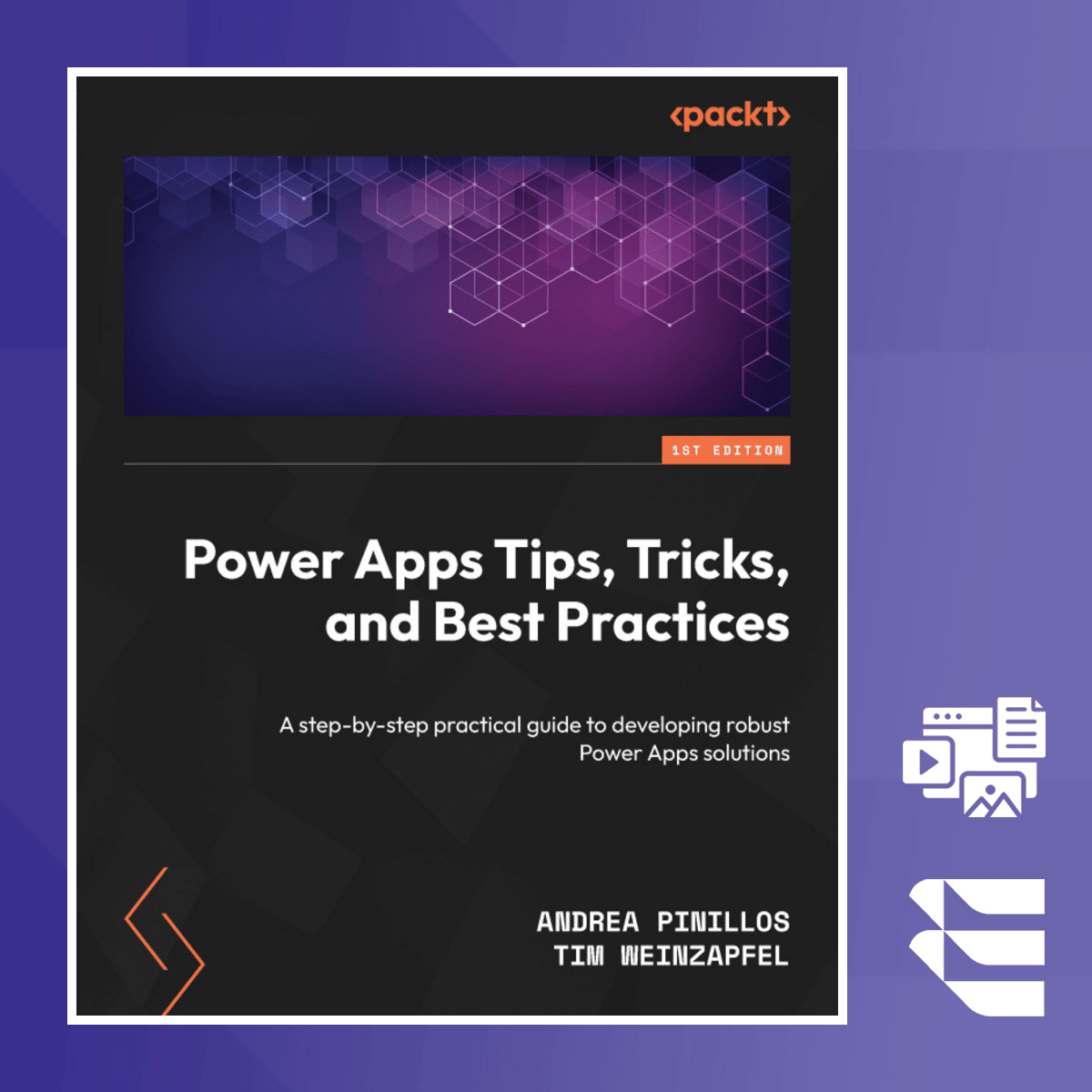
Power Apps Development: Tips, Tricks & Best Practices
Master the art of building efficient and scalable business applications with Microsoft Power Apps. This course empowers professionals to design and develop robust, secure, and user-friendly solutions that transform manual processes into streamlined digital workflows — a critical skill in today’s data-driven workplace. Through a combination of hands-on exercises and expert guidance, learners will gain the ability to plan projects effectively, connect data sources, and implement advanced app logic. By the end of this course, you’ll be able to build and manage Power Apps solutions that integrate seamlessly with tools like Power Automate and Power BI, driving real business impact. Unlike many introductory tutorials, this course blends practical implementation with real-world case studies, offering a comprehensive understanding of Power Apps beyond basic usage. Learners will also explore emerging features such as Copilot Studio to enhance automation and personalization. This course is ideal for business analysts, IT professionals, and developers seeking to elevate their Power Platform expertise. A foundational knowledge of Microsoft 365 or Power Apps is recommended but not mandatory.
 EDUCBA
R: Apply & Analyze K-Means Clustering for Unsupervised ML
This hands-on course equips learners with the foundational knowledge and practical skills to implement K-Means clustering for unsupervised machine learning using the R programming language. Designed for those with a basic understanding of R and statistics, the course guides learners through the process of exploring real-world datasets, preparing data for clustering, and interpreting segmentation results. Learners will begin by describing core clustering concepts and explaining the goals of unsupervised customer segmentation. They will then apply the K-Means algorithm in R and analyze the effects of feature scaling on cluster quality. Emphasis is placed on practical implementation, critical thinking, and performance interpretation—enabling learners to effectively utilize clustering in marketing, behavioral analysis, and other domains involving unlabeled data. By the end of the course, learners will be able to independently construct clustering workflows, evaluate clustering effectiveness, and recommend data-driven grouping strategies in real-world contexts.
 Packt
Packt
JavaScript for Dynamic Web Development
This course features Coursera Coach! A smarter way to learn with interactive, real-time conversations that help you test your knowledge, challenge assumptions, and deepen your understanding as you progress through the course. This course introduces you to JavaScript, the dynamic programming language used for creating interactive, engaging web applications. You’ll start by learning the basics of JavaScript, such as variables, data types, loops, and conditional statements. From there, you’ll move on to more advanced topics, including manipulating the DOM (Document Object Model) to interact with HTML elements and handle user inputs through events. The course emphasizes practical application, with a focus on building real-world projects. Throughout the course, you'll work on projects such as "Guess My Number" and a fully functional web application where you design t-shirts, calculate prices and sizes, and validate forms using JavaScript. Each project builds on the skills learned in previous lessons, culminating in a comprehensive final project where you implement dynamic interactivity and integrate your JavaScript knowledge to enhance the user experience. Ideal for beginners with some prior programming experience, this course will help you develop a strong foundation in JavaScript, empowering you to create interactive and dynamic websites. By the end of the course, you'll be ready to tackle complex JavaScript-driven web projects with confidence.
 Coursera
Data Storytelling for Engaging Presentations
Transform your data into compelling, actionable stories that engage audiences and influence decisions. This short course equips digital marketing professionals with frameworks, practice exercises, and assessment tools to master narrative-driven analytics presentations. By completing this course, you'll be able to structure compelling narratives around data visualizations, create presentations that clearly connect insights to business objectives, and systematically improve your storytelling effectiveness based on audience feedback - skills you can apply immediately in your next quarterly review or client presentation. By the end of this course, you will be able to: • Apply presentation frameworks like SCQA to craft visual narratives from data visualizations • Evaluate audience feedback to improve storyline coherence and engagement This course is unique because it bridges the gap between data analysis and persuasive communication, teaching you not just what story to tell, but how to tell it in a way that transforms insights into influence. To be successful in this project, you should have a background in basic data visualization tools and experience creating business presentations.
 DeepLearning.AI
Data Modeling, Transformation, and Serving
In this course, you’ll model, transform, and serve data for both analytics and machine learning use cases. You’ll explore various data modeling techniques for batch analytics, including normalization, star schema, data vault, and one big table, and you’ll use dbt to transform a dataset based on a star schema and one big table. You’ll also compare the Inmon vs Kimball data modeling approaches for data warehouses. You’ll model and transform a tabular dataset for machine learning purposes. You’ll also model and transform unstructured image and textual data. You’ll explore distributed processing frameworks such as Hadoop MapReduce and Spark, and perform stream processing. You’ll identify different ways of serving data for analytics and machine learning, including using views and materialized views, and you’ll describe how a semantic layer built on top of your data model can support the business. In the last week of this course, you’ll complete a capstone project where you’ll build an end-to-end data pipeline that encompasses all of the stages of the data engineering lifecycle to serve data that provides business value.
 Coursera
Evaluate Vision Errors: Identify Failure Patterns
Transform your ability to diagnose and improve computer vision model performance through systematic error analysis. This course empowers you to move beyond aggregate metrics and conduct detailed failure analysis that reveals the root causes of model errors. You'll master the critical skills of analyzing confusion matrices, categorizing prediction errors into specific failure modes, and visualizing model predictions to identify correlations between errors and data characteristics. By completing this course, you'll be able to: • Evaluate computer-vision model errors systematically to identify failure patterns This course is unique because it provides hands-on experience with real-world error analysis workflows used in enterprise computer vision deployments. To be successful in this project, you should have a background in machine learning fundamentals, Python programming, and basic computer vision concepts.
 Johns Hopkins University
The Social and Technical Context of Health Informatics
Improving health and healthcare institutions requires understanding of data and creation of interventions at the many levels at which health IT interact and affect the institution. These levels range from the external “world” in which the institution operates down to the specific technologies. Data scientists find that, when they aim at implementing their models in practice, it is the “socio” components that are both novel to them and mission critical to success. At the end of this course, students will be able to make a quick assessment of a health informatics problem—or a proposed solution—and to determine what is missing and what more needs to be learned. Who Is This Class For? Physicians, nurses, pharmacists, social workers, and other allied health professionals interested in expanding their understanding of digital health, big data, health information systems, and the unintended consequences of disruptive innovation in the healthcare system. The course is also aimed at those with technical, engineering, or analytics backgrounds who want to understand the nuances of those topics when it comes to healthcare.
 University of California, Irvine
Budget- und Terminplanung von Projekten
Ein guter Projektplan hilft allen Teammitgliedern bei der Zusammenarbeit, um die Projektziele zu erreichen. Ein Projektbudget mit realistischen Kostenbeschränkungen ist ebenfalls eine essentielle Grundlage jedes Projekts. In diesem Kurs lernen Sie, Zeit- und Kostenbeschränkungen einzuplanen und einzuhalten, um den Erfolg Ihrer Projekte sicherzustellen. Nach Abschluss dieses Kurses werden Sie in der Lage sein: 1. den Ressourcenbedarf des Projekts zu ermitteln 2. Projektpackages in Aktivitäten zu zerlegen 3. zu definieren, was zur Schätzung der Aktivitätsdauer erforderlich ist 4. Meilensteine zu definieren und einen Meilensteinplan zu erstellen 5. den kritischen Pfad zu bestimmen und Puffer zu berechnen 6. den Zweck der Verwendung von Vorsprüngen und Verzögerungen in einem Projektplan zu beschreiben 7. die Mengen und Kosten der Ressourcen zu schätzen, die für die Durchführung der Projektaktivitäten erforderlich sind 8. eine von drei gängigen Techniken zur Kostenschätzung auszuwählen, um ein Projektbudget zu ermitteln 9. eine Matrix zur Aufgabenverteilung zu verwenden, um Verantwortungen zuzuweisen 10. die Komponenten des Qualitätsmanagementplans eines Projekts zu erkennen
 Johns Hopkins University
Chatbots
The course "Chatbots" offers a deep dive into the world of chatbots, equipping learners with the skills to design, build, and optimize conversational interfaces. You will explore the evolution of chatbot technology and understand the fundamental mechanics that drive their functionality. Through hands-on projects using Amazon Lex and AWS, you'll not only learn to create chatbots but also how to evaluate their performance using machine learning classifiers. What sets this course apart is its practical approach, allowing you to apply theoretical knowledge in real-world scenarios. Collaborating with peers, you’ll tackle challenges together, enhancing your problem-solving skills while fostering a supportive learning environment. By the end of the course, you’ll have the confidence to develop functional chatbots tailored for various applications, from customer service to personal assistants. Whether you are a novice looking to enter the tech field or an experienced professional aiming to expand your skill set, this course provides invaluable insights and practical tools to advance your career in the rapidly growing chatbot landscape. Join us to unlock the potential of conversational AI!
 Coursera
Aerospace 3D Printing: Additive Manufacturing
Complex aerospace components that once took months to manufacture are now printed in days. Major aerospace companies like GE Aviation and Airbus have revolutionized production through additive manufacturing, achieving 50% weight reductions while exceeding performance standards. This transformation represents the industry's shift to mission-critical 3D printing capabilities. This comprehensive course equips engineers with essential additive manufacturing knowledge tailored for aerospace applications. You'll master AM principles, from layer-by-layer fabrication to aerospace-specific material science, strategic advantages of AM in aerospace, materials selection and process optimization, and advanced design methodologies including topology optimization. Through real-world case studies, you'll analyze successful implementations and navigate challenges in quality control and certification. This course is for aerospace, mechanical, and manufacturing engineers, as well as R&D and design professionals aiming to apply 3D printing in aerospace. It also suits advanced learners seeking to connect engineering design, materials, and additive manufacturing technologies. Learners should have a basic understanding of 3D printing, CAD, and common aerospace materials. They should also be familiar with core aerospace engineering concepts and general manufacturing processes. By course completion, you'll evaluate components for AM suitability, select optimal materials and processes, and apply lightweight design strategies. You'll also master SLM, EBM, and DED techniques, preparing you to lead AM initiatives while ensuring aerospace compliance.
 Georgia Institute of Technology
Materials Data Sciences and Informatics
This course aims to provide a succinct overview of the emerging discipline of Materials Informatics at the intersection of materials science, computational science, and information science. Attention is drawn to specific opportunities afforded by this new field in accelerating materials development and deployment efforts. A particular emphasis is placed on materials exhibiting hierarchical internal structures spanning multiple length/structure scales and the impediments involved in establishing invertible process-structure-property (PSP) linkages for these materials. More specifically, it is argued that modern data sciences (including advanced statistics, dimensionality reduction, and formulation of metamodels) and innovative cyberinfrastructure tools (including integration platforms, databases, and customized tools for enhancement of collaborations among cross-disciplinary team members) are likely to play a critical and pivotal role in addressing the above challenges.
 University of Michigan
Ethics in Engineering
Explore unique case studies in engineering ethics. In this four-week course, you’ll examine different historical case studies and understand how they led to classic engineering failures. Though each case is unique and has a distinct context, they all share common themes; a backstory, a disastrous event, a post-event with ramifications, and outcomes. For each case, you’ll watch and hear video lectures and explore foundational literature. You’ll also have the opportunity to discuss the case in detail and check your knowledge through quizzes and reflections on your understanding of the case. This format will help you develop a working knowledge of ethical foundations. Delve into four case studies, including the VW emissions scandal, the failure of the Denver airport baggage system, the fatal case of the Therac 25 radiation machine, and the software failure of the Ariane 5 rocket launch. With each case, you’ll identify key aspects that led to the engineering failures and discuss the outcomes of the failures. You’ll also explore the significance of each case and how they led to corrective actions. Develop your knowledge of engineering alongside experts in the industry. The course will help you reflect on engineering as a design discipline and its impact on humans. You’ll be guided by Dr. David Chesney, an expert in both industry and academics with 20 years of experience at General Motors Corporation and 20 years working at the University of Michigan. Dr. Chesney’s background is in Mechanical Engineering, Biomedical Engineering, and Computer Science and he is the Toby Teorey Collegiate Lecturer in Electrical Engineering and Computer Science at the University of Michigan College of Engineering. This course will be particularly useful for engineering students and professionals, although no prior experience is required.
 University of Michigan
Human Capital: Foundations and Essentials
Unlock the potential of your HR career with “Human Capital: Foundations and Essentials.” Dive into the evolution of HR roles, from traditional titles like Personnel Director to modern designations such as Human Capital Manager and People Operations Leader. This course equips you with the skills to evaluate and implement effective communication and leadership strategies that span the entire people space. Throughout the course, you’ll analyze and reflect on mini-case studies based on real-world scenarios to bridge course content with your own professional experiences. Explore the legal and strategic aspects of HR as you transition from conventional methods to contemporary practices that prioritize employee engagement, well-being, and workforce development. With an overview of the Human Capital Management Framework and its implications on beliefs, values, and health and safety, this course ensures you are well-rounded in the fundamental and cutting-edge elements of human capital management. Immerse yourself in this dynamic field and emerge with the expertise to drive meaningful change in your organization. This is the first course in “Extraordinary Human Capital Management,” a course series for human resource professionals interested in advancing their skills to align with organizational and employee needs.
 Packt
Packt
GRC Fundamentals - Learn Governance, Risk, and Compliance
This course features Coursera Coach! A smarter way to learn with interactive, real-time conversations that help you test your knowledge, challenge assumptions, and deepen your understanding as you progress through the course. In this course, you will explore the core principles of Governance, Risk, and Compliance (GRC) and learn how these concepts work together to improve organizational effectiveness. You will gain a comprehensive understanding of information security governance, risk management frameworks, and compliance standards, and how they help manage and mitigate risks in an organization. Through real-world case studies and hands-on exercises, you’ll dive into GRC frameworks, risk assessments, audit readiness, and compliance strategies. The course will take you step by step through the essentials of GRC, teaching you the importance of effective governance frameworks, risk management lifecycles, and compliance regulations. You’ll also gain insights into communication strategies for managing risks and audits, and discover tools for tackling challenges in risk management. This course is ideal for professionals interested in learning about GRC frameworks, compliance, and risk management strategies. Basic knowledge of organizational operations and business management is recommended. By the end of this course, you will be able to implement a GRC program, navigate compliance standards, conduct risk assessments, and apply best practices for GRC integration and continuous improvement in any organization.