

The Global Scholarly Directory.
Discover world-class academic programs curated for the modern intellectual. Search through 19877+ degrees and professional certificates.
 Packt
Packt
Blockchain Basics and Smart Contract Foundations
Updated in May 2025. This course now features Coursera Coach! A smarter way to learn with interactive, real-time conversations that help you test your knowledge, challenge assumptions, and deepen your understanding as you progress through the course. Unlock the potential of blockchain and smart contracts in this comprehensive course designed to guide you from the fundamentals to creating decentralized applications (DApps). Learn how blockchain technology revolutionizes industries and how smart contracts drive innovation. Gain hands-on experience with tools like Remix: Ethereum IDE and discover the power of Solidity programming. Your journey begins with an introduction to blockchain and DApps, exploring the key concepts of decentralization and their impact. Dive into the practicalities of smart contract development, mastering Solidity basics, pragma directives, operators, and functions. Exercises and coding challenges ensure a solid grasp of these essential skills. Advance to building your first DApp and crafting custom crypto tokens. Learn to integrate advanced Solidity features like modifiers, mappings, and arrays while implementing secure, functional smart contracts. Explore optional NFT concepts and marketplaces for insights into digital assets and creative applications. Whether you're a developer, blockchain enthusiast, or aspiring innovator, this course is tailored for all skill levels. A foundational understanding of programming is helpful but not required. Join us and become part of the decentralized revolution!
 Dubai College of Tourism
Cross-Cultural Communication in the Hospitality Sector
Welcome to Cross-Cultural Communication in the Hospitality Sector, a course designed to help you thrive in Dubai’s globally diverse hospitality sector. Every day in this sector, you’ll interact with people from a wide range of cultures, languages and backgrounds. Understanding how to communicate effectively and respectfully in such a rich environment is one of the most valuable skills you can develop. This course will give you the tools to build cultural intelligence and awareness, helping you understand the values, behaviours and perspectives of others. You’ll explore how culture shapes communication styles and workplace dynamics, and how to adapt your approach when working with colleagues or serving guests from around the world. Through practical insights, reflection and real-world scenarios, you’ll learn how to build meaningful professional relationships, avoid misunderstandings and create inclusive experiences that leave a lasting impression.
 EDUCBA
Create Professional 3D Product Models
By the end of this course, learners will be able to model professional-quality products, create clean UV layouts, apply realistic textures and materials, and render polished product visuals using Maya. MAYA Practical – Product Modeling is a hands-on course designed to guide learners through the complete 3D product creation workflow. Starting from reference-based modeling, learners progressively build accurate geometry using industry-standard subdivision techniques. The course then transitions into UV mapping and unwrapping, ensuring models are fully prepared for texturing without distortion. Learners gain practical experience creating textures in Photoshop, applying materials, and developing realistic shaders. Studio lighting techniques and test rendering workflows are introduced to evaluate surface quality and visual balance. The course concludes with final shader tuning, texture refinement, and high-quality rendering for professional presentation. What makes this course unique is its end-to-end, project-based approach, where every step builds toward a complete, production-ready product model. Ideal for beginners and aspiring 3D artists, this course emphasizes real-world workflows used in product visualization, portfolio development, and commercial rendering.
 UNSW Sydney (The University of New South Wales)
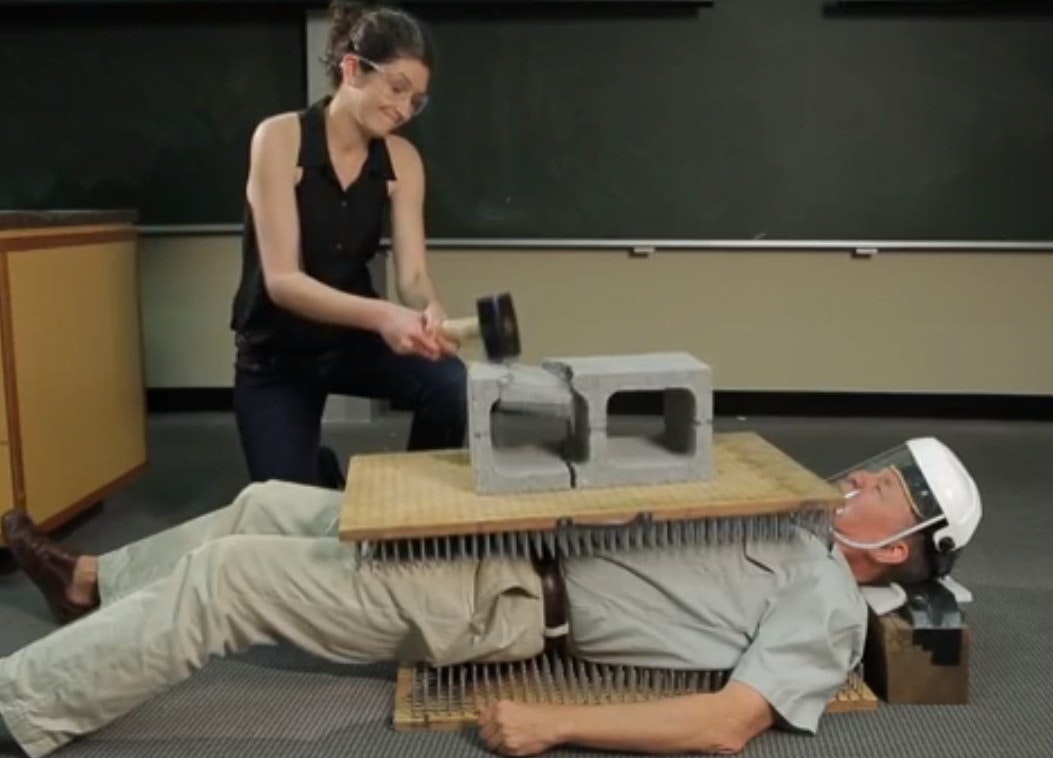
Mechanics: Motion, Forces, Energy and Gravity, from Particles to Planets
Most of the phenomena in the world around you are, at the fundamental level, based on physics, and much of physics is based on mechanics. Mechanics begins by quantifying motion, and then explaining it in terms of forces, energy and momentum. This allows us to analyse the operation of many familiar phenomena around us, but also the mechanics of planets, stars and galaxies. This on-demand course is recommended for senior high school and beginning university students and anyone with a curiosity about basic physics. (The survey tells us that it's often used by science teachers, too.) The course uses rich multimedia tutorials to present the material: film clips of key experiments, animations and worked example problems, all with a friendly narrator. You'll do a range of interesting practice problems, and in an optional component, you will use your ingenuity to complete at-home experiments using simple, everyday materials. You will need some high-school mathematics: arithmetic, a little algebra, quadratic equations, and the sine, cosine and tangent functions from trigonometry. The course does not use calculus. However, we do provide a study aid introducing the calculus that would accompany this course if it were taught in a university. By studying mechanics in this course, you will understand with greater depth many of the wonders around you in everyday life, in technology and in the universe at large. Meanwhile, we think you'll have some fun, too.
 Ei4Change
Personality: How To Get On With Anyone
This course is primarily aimed at anyone who wants to build relationships with a wide range of different types of people. From time to time, everyone finds themselves in awkward situations and having to deal with difficult people. What if you could learn the secrets of dealing with ANY type of behavioural response and social interaction style to improve your interactions, build your confidence and change your life? This course will give you the knowledge around the principles and the skills that you need to improve your interactions, build your confidence and change your life. The course reveals insights into motivation and how people perceive situations. As it unlocks the secrets of human nature, you'll learn how to inspire top performance, gain trust, win confidence and build lasting relationships - more effectively and with great results. Everybody has their own Social Interaction Style based around their behavioural preferences. Each person instinctively acts according to their inherent style. - Team members will act out their styles in team working. - Customers will act out their styles in buying situations. - Salespeople will feel more comfortable selling according to their natural style. Being able to identify the Social Interaction Style of other people will give you valuable insights that you can use to establish rapport, open lines of communication, build trust, motivate and influence. Ways to work with each Social Interaction Style will be explored along with techniques to enhance and improve your interactions leading to better communication. Provided within the course is a questionnaire to determine your Social Interaction Style that will enable you to understand your own behavioural reactions in more detail. The course will help you change the way you think about yourself and the way you work with and interact with other people inside and outside of work. This course will help you to get on with anyone. By completing this course, you will be able to: - identify the four different Social Interaction Styles and understand how all four styles operate - recognise the Social Interaction Styles of others to understand how to get on with different styles more effectively - determine where, when and why conflict and problems may arise - assess strategies for typical situations that require you to influence and communicate with all the Social Interaction Styles - examine ways to increase your power and control when interacting with different types of people
 Packt
Packt
Deep Learning - Computer Vision for Beginners Using PyTorch
This course features Coursera Coach! A smarter way to learn with interactive, real-time conversations that help you test your knowledge, challenge assumptions, and deepen your understanding as you progress through the course. This hands-on course will immerse you in the world of deep learning and computer vision using PyTorch. You'll gain a solid understanding of how PyTorch works, with a focus on creating deep neural networks, performing convolution operations, and working with various datasets such as CIFAR10. By the end of the course, you'll be proficient in building and training computer vision models, leveraging the power of CNNs and the LeNet architecture. You'll also explore advanced topics like CUDA, GPU acceleration, and AutoGrad. Throughout the course, you'll start with the basics of PyTorch, including tensor creation, manipulation, and the integration of NumPy arrays. You'll also work on practical implementations, such as building your first neural network and creating deep neural networks. The course's journey will guide you through CNNs and their application in image classification, where you'll use PyTorch to construct deep learning models that can learn from large image datasets. The course is designed for anyone interested in starting a career in deep learning or computer vision. It’s ideal for beginners who want to learn the foundational aspects of PyTorch and neural networks. No prior deep learning knowledge is required, but a basic understanding of Python will be beneficial. With a mix of theory and practical exercises, the course is suitable for those who want to enhance their skills in deep learning and computer vision.
 Duke University
人体生理学导论(中文版)
在本课程中,学生将学习认识和应用说明人体九个器官系统中整体人体机能(作为完整有机体)的基本概念。
 Yale University
Introduction to Medical Software
In this class, we present a broad overview of the field of medical software. You will learn from Yale professors and a series of industry experts who connect the course concepts to their real world applications. We begin by discussing medical device regulatory structures, data privacy and cybersecurity regulations, and key support technologies such quality management systems and risk management. We then take a detailed look at the medical software life cycle, starting with identifying user needs, mapping these to system requirements and then the process of software design, coding, testing and validation. We continue by exploring issues related to the use of machine learning techniques in medical applications from both a software engineering and a regulatory perspective. We conclude with a discussion of the business and management issues in this area focusing on the impact on digital health on modern healthcare and issues related to starting new ventures. This is a class aimed at either third- or fourth-year undergraduates in computer science, biomedical engineering, and related fields, and to junior software engineers currently either working in, or interested in moving to, the medical device industry.
 Coursera
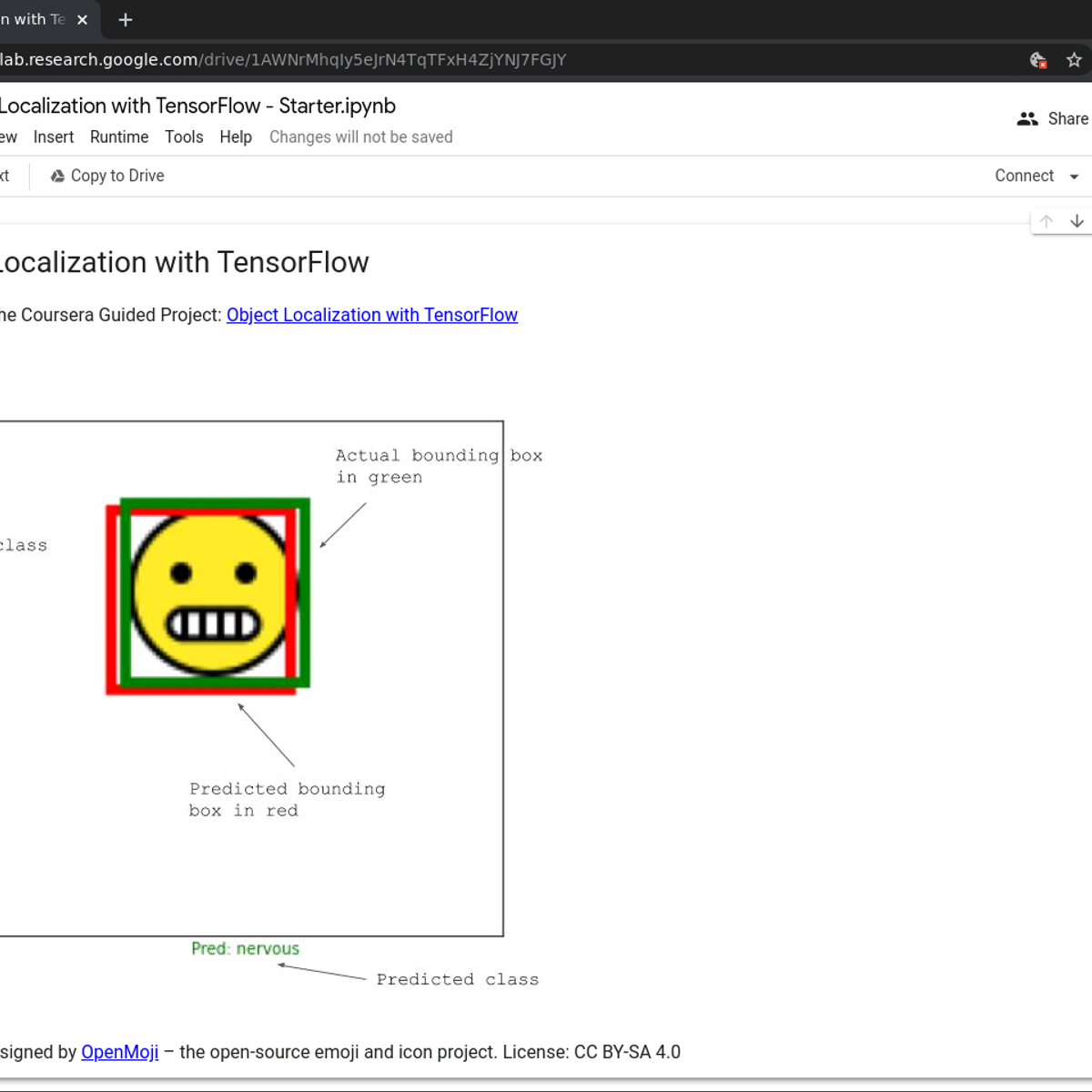
Object Localization with TensorFlow
Welcome to this 2 hour long guided project on creating and training an Object Localization model with TensorFlow. In this guided project, we are going to use TensorFlow's Keras API to create a convolutional neural network which will be trained to classify as well as localize emojis in images. Localization, in this context, means the position of the emojis in the images. This means that the network will have one input and two outputs. Think of this task as a simpler version of Object Detection. In Object Detection, we might have multiple objects in the input images, and an object detection model predicts the classes as well as bounding boxes for all of those objects. In Object Localization, we are working with the assumption that there is just one object in any given image, and our CNN model will classify and localize that object. Please note that you will need prior programming experience in Python. You will also need familiarity with TensorFlow. This is a practical, hands on guided project for learners who already have theoretical understanding of Neural Networks, Convolutional Neural Networks, and optimization algorithms like Gradient Descent but want to understand how to use use TensorFlow to solve computer vision tasks like Object Localization.
 Packt
Packt
Mastering the Art of Isometric Room Design in Blender 3
This course features Coursera Coach! A smarter way to learn with interactive, real-time conversations that help you test your knowledge, challenge assumptions, and deepen your understanding as you progress through the course. Dive into the world of 3D isometric design with Blender, mastering the techniques to create and texture a detailed isometric room from scratch. This course guides you step by step through the essential concepts of 3D modeling, starting with the basics and progressing to more complex elements such as physics simulations, lighting, and rendering. You'll learn to design assets like windows, furniture, and decor elements while working with Blender's powerful tools and physics engine to add realism to your scene. You'll explore Blender's interface, modeling techniques, and the best practices for organizing your projects. Key lessons include creating custom textures, adding environmental props, and simulating physics for realistic interactions. As you move forward, you will learn to optimize your workflow, utilize the Blender Asset Manager, and render your scene to perfection, making your isometric room come to life. This course is perfect for anyone interested in creating 3D models and environments. Whether you're a beginner or have some experience with Blender, this course will guide you through every step to create impressive isometric scenes. No prior knowledge of 3D modeling is required, but a basic understanding of Blender’s interface will help you make the most of the content. By the end of the course, you will be able to model and texture a full 3D isometric room, simulate realistic physics, create detailed props, and render stunning visuals using Blender.
 University of Colorado Boulder
Computing, Ethics, and Society Foundations
Computing systems and technologies fundamentally impact the lives of most people in the world, including how we communicate, get information, socialize, and receive healthcare. This course is the first of a three-course sequence that examines ethical issues in the design and implementation of computing systems and technologies and reflects upon the broad implication of computing on our society. It covers ethical theories, privacy, security, social media, and misinformation. This course can be taken for academic credit as part of CU Boulder’s MS in Computer Science degrees offered on the Coursera platform. These fully accredited graduate degrees offer targeted courses, short 8-week sessions, and pay-as-you-go tuition. Admission is based on performance in three preliminary courses, not academic history. CU degrees on Coursera are ideal for recent graduates or working professionals. Learn more: MS in Computer Science: https://coursera.org/degrees/ms-computer-science-boulder
 Packt
Packt
Advanced Kitbashing and Prop Creation
This course features Coursera Coach! A smarter way to learn with interactive, real-time conversations that help you test your knowledge, challenge assumptions, and deepen your understanding as you progress through the course. Unlock your potential as a 3D environment artist by mastering the art of kitbashing, modular asset design, and prop creation using Blender. In this hands-on course, you’ll build a richly detailed Aztec city, gaining practical skills in architectural modeling, texturing, and shader animation. You’ll learn how to bring environments to life with optimized workflows that balance creativity and technical precision. The course begins with prop creation—windows, bridges, floors—and expands into building a prop pack filled with narrative-driven objects like vases, barrels, and decorative pieces. You'll then move into advanced topics like UV mapping, shader animation, and water simulations for pools, fountains, and waterfalls, enhancing realism with every step. As the course progresses, you'll craft temples, markets, rooftops, and intricate environmental details like cloth simulations, rooftop variations, and torch elements. You’ll also learn best practices in modular design, optimization, and maintaining visual consistency across large-scale projects. This course is ideal for intermediate Blender users, aspiring 3D artists, and game environment designers who want to build cinematic worlds with high visual fidelity. A solid understanding of Blender’s interface and basic modeling is recommended, though no prior experience in kitbashing is required. By the end of the course, you will be able to create modular, optimized, and visually rich 3D environments using Blender—from props to complete architectural scenes ready for games, animation, or cinematic production.
 University of California, Davis
Quantity Take-off (QTO) and Estimating Trades
In this course, you’ll move from estimating fundamentals to applied practice, learning how estimators measure and interpret work across multiple construction trades. You’ll explore how takeoffs for site and earthwork, concrete, metal, masonry, and carpentry are performed and how each trade contributes to the overall project cost. Through detailed demonstrations and real-world examples, you’ll see how professional estimators use digital tools like On-Screen Takeoff (OST) and Bluebeam Revu to perform accurate, efficient quantity takeoffs. Even without direct software access, you’ll gain a clear understanding of how technology supports modern estimating workflows. Finally, you’ll connect quantity data to productivity and time, analyzing how labor rates, crew efficiency, and scheduling impact the total estimate. By the end of this course, you’ll be able to interpret trade drawings, understand digital takeoff processes, and evaluate how productivity influences cost—all essential skills as you advance toward presenting and defending a professional construction estimate.
 Microsoft
Copilot for Cybersecurity
This course portrays how Copilot can be leveraged for cybersecurity. It provides a general overview as well as detailed use case demonstrations for Cybersecurity practitioners who want to augment their skills with Generative AI.
 Alibaba Cloud Academy
Big Data Analytical Platform on Alibaba Cloud
Course Description Building an Analytical Platform on Alibaba Cloud can empower how you take in, analyze, and demonstrate clear metrics from a set of Big Data. This course is designed to teach engineers how to use Alibaba Cloud Big Data products. It covers basic distributed system theory and Alibaba Cloud's core products like MaxCompute, DataWorks, E-MapReduce as well as a bundle of ecosystem tools. To earn an official Alibaba Cloud certificate please join the Cloud Native courses on the Academy's website: Big Data Analysis Specialty: https: //edu.alibabacloud.com/course/317 Machine Learning Specialty: https://edu.alibabacloud.com/course/318 Alibaba Cloud Big Data - Data Integration: https://edu.alibabacloud.com/certification/clouder_bigdatainteg
 Universidad Nacional de Colombia
Identidad digital: ¿Cómo tener visibilidad académica?
Este curso, dirigido a todas las personas interesadas en adquirir conocimientos relacionados con la identidad digital y la creación de perfiles en ORCID, Scopus, Google Scholar y ResearchGate, resulta fundamental en un contexto donde la identidad digital cobra cada vez más relevancia. La identidad digital, que abarca la presencia en línea y la reputación establecida en el entorno digital, abarca elementos diversos como perfiles en redes sociales académicas, páginas de perfil en plataformas de investigación y académicas, blogs o sitios web personales, participación activa en foros y comunidades en línea, y contribuciones a repositorios de datos y publicaciones científicas en línea. En consonancia con esta creciente importancia, es crucial para los investigadores gestionar su identidad digital de manera activa y responsable. Esto implica garantizar que la información y los datos asociados sean precisos y estén actualizados, contribuyendo así a forjar una sólida reputación académica y a fomentar la colaboración con otros profesionales en la comunidad científica. Asimismo, esta administración cuidadosa de la identidad digital es esencial para promover su trabajo y contribuciones en este ámbito. Sin embargo, esta tarea también demanda una comprensión de los posibles riesgos, como la preocupación por la privacidad en línea, junto con el compromiso de mantener una conducta ética en el uso de la identidad digital en el contexto de la investigación. Desde la perspectiva de las universidades, la identidad digital adquiere un papel de suma relevancia. Esta es una herramienta clave para posicionar a las instituciones en rankings internacionales y, de manera primordial, para asegurar financiación destinada a proyectos de investigación. En un entorno académico donde la comunicación y la colaboración en línea se vuelven cada vez más comunes, la habilidad de manejar la identidad digital de forma eficaz se convierte en un recurso esencial para el éxito institucional y la consecución de objetivos en el ámbito de la investigación.