

The Global Scholarly Directory.
Discover world-class academic programs curated for the modern intellectual. Search through 19877+ degrees and professional certificates.
 Alfaisal University | KLD
محاسبة المقبوضات والديون المعدومة
الديون المعدومة (Bad Debts) من أخطر القضايا التي تواجه الشركات حول العالم حيث أنها قد تؤدي إلى الإفلاس، وتتورط الشركات في هذا النوع من الديون حين تلجأ إلى تقديم العديد من التسهيلات الائتمانية في السداد لعملائها، فتُظهر حجماً هائلاً من المبيعات (Sales)، ولكنها تصبح في النهاية غير قادرة على تحصيل مستحقاتها كاملة والتي تتحول نسبة كبيرة منها إلى ديون معدومة (Bad Debts). هذه الدورة هي دورة تمهيدية؛ فهي تلقي الضوء على أساسيات الموضوع بشكل عام بهدف التعريف به وبمحاوره الأساسية التي يجب الإلمام بها. إذا كنت من المهتمين بإتقان التعامل مع الديون المعدومة، أو كان مجال عملك يتطلب فهم هذا المجال وتوظيفه في سياق عملك، فهذه الدورة ستكون مثالية لإغناء خبرتك وتطوير مهاراتك بشكل فعال ومؤثر ينعكس بنتائج ملموسة على أعمالك. حيث ستزودك هذه الدورة باطلاع واسع ودقيق على مجموعة من المحاور المتعلقة بهذا الموضوع، مثل: المقصود باضمحلال حسابات العملاء، القيام بتحليل حسابات العملاء وأوراق القبض، أنواع الديون، حسابات العملاء.
 Google Cloud
Using BigQuery in the Google Cloud Console
This is a self-paced lab that takes place in the Google Cloud console. This lab shows you how to query public tables and load sample data into BigQuery using the GCP Console. Watch the following short video Get Meaningful Insights with Google BigQuery.
 University of Colorado System
Mathematical Foundations for Cryptography
Welcome to Course 2 of Introduction to Applied Cryptography. In this course, you will be introduced to basic mathematical principles and functions that form the foundation for cryptographic and cryptanalysis methods. These principles and functions will be helpful in understanding symmetric and asymmetric cryptographic methods examined in Course 3 and Course 4. These topics should prove especially useful to you if you are new to cybersecurity. It is recommended that you have a basic knowledge of computer science and basic math skills such as algebra and probability.
 FAIR Institute
Advancing FAIR™ within Risk Management Programs
This comprehensive course is designed to guide executives in effectively integrating the FAIR model into their cyber risk management programs, ensuring their strategies remain adaptable in the face of evolving threats. Participants will learn how to leverage FAIR to evaluate new technologies, enhance existing risk assessment frameworks, and build robust, effective risk management strategies. The course delves into the nuances of various risk management frameworks, distinguishing between technical and governance approaches. Additionally, participants will explore ancillary FAIR standards for controls, third-party risk, and automation, gaining insights into how these can complement and strengthen their overall risk management efforts. The course concludes with strategies for continuously improving cyber risk management programs, ensuring they evolve to meet emerging threats and organizational needs. This course is tailored for senior executives and decision-makers overseeing or guiding cyber risk management within their organizations. Ideal participants will have: Leadership and Strategic Oversight: Participants should hold or aspire to hold leadership roles such as Chief Executive Officer (CEO), Chief Information Security Officer (CISO), Chief Risk Officer (CRO), or senior management positions where they are responsible for setting and implementing risk management strategies. Experience with Financial or Business Risk: Executives with experience managing financial risk or business continuity planning will find the course particularly valuable, as it covers the intersection of cyber risk and financial decision-making. Commitment to Continuous Improvement: A mindset geared toward continuous improvement in risk management practices, willing to explore and adopt new methodologies, such as the FAIR model, to enhance their organization's cyber resilience. This course will equip senior leaders with the practical skills and insights necessary to integrate the FAIR model into their organization’s broader risk management strategy, ensuring a more quantitative and business-aligned approach to managing cyber risks.
 Yale University
The Science of Well-Being
NEW TEEN VERSION AVAILABLE HERE: https://www.coursera.org/learn/the-science-of-well-being-for-teens In this course you will engage in a series of challenges designed to increase your own happiness and build more productive habits. As preparation for these tasks, Professor Laurie Santos reveals misconceptions about happiness, annoying features of the mind that lead us to think the way we do, and the research that can help us change. You will ultimately be prepared to successfully incorporate a specific wellness activity into your life. THE SCIENCE OF WELL BEING WAS PRODUCED IN PART DUE TO THE GENEROUS FUNDING OF THE DAVID F. SWENSEN FUND FOR INNOVATION IN TEACHING.
 Packt
Packt
Cisco CCT Routing and Switching (100-490)
Updated in May 2025. This course now features Coursera Coach! A smarter way to learn with interactive, real-time conversations that help you test your knowledge, challenge assumptions, and deepen your understanding as you progress through the course. By the end of this course, you’ll master essential networking skills, including identifying Cisco hardware, configuring and managing IOS devices, and troubleshooting network issues using industry-standard tools. You’ll also learn to maintain and upgrade Cisco routers and switches, empowering you to excel as a field technician. The course is structured into four core modules. First, you’ll explore general networking concepts, including hardware identification, addressing protocols, and network utilities. Then, you’ll dive into Cisco-specific equipment, learning to identify devices, components, ports, and their memory functions, along with practical guidance on device replacement. The third module focuses on mastering Cisco IOS, from basic commands to startup configuration and IOS-XE modes. The final module equips you with essential servicing skills, such as troubleshooting with Windows tools, performing password recovery, upgrading Cisco IOS, and executing factory resets. Throughout, you’ll build hands-on expertise to confidently handle real-world networking challenges. This course is perfect for beginner and intermediate-level IT professionals aiming to enhance their skills with Cisco devices. A basic understanding of networking concepts is recommended but not required.
 Packt
Packt
Linux Command Line for Beginners
This course features Coursera Coach! A smarter way to learn with interactive, real-time conversations that help you test your knowledge, challenge assumptions, and deepen your understanding as you progress through the course. This course offers a practical introduction to Linux, providing a solid foundation for beginners. By the end, you'll be comfortable using the command line to manage a Linux system and perform key administrative tasks, such as managing files, users, and processes. You'll gain valuable skills in file system navigation, file maintenance, and user account management, along with knowledge of system utilities and shell scripting. The course is divided into two main sections: Basic and Advanced Linux Administration. The first section covers Linux installation, virtual machines, essential file system navigation commands, and working with files and directories. You’ll also learn how to handle file permissions and ownership, and use various commands to add text to files and access help. In the second section, the course deepens your Linux skills. You’ll learn advanced commands for file maintenance and display, system information retrieval, user management, and process scheduling. Additionally, you’ll explore system monitoring tools, basic shell scripting, and network-related commands. The course culminates with system maintenance tasks such as updates and managing repositories. This course is ideal for anyone who is new to Linux, including those working in IT support or aspiring to manage Linux systems. There are no prerequisites, and the course is designed to be beginner-friendly, with a hands-on approach to learning.
 Logical Operations
Microsoft Word for Office 365 (Desktop or Online): Part 2
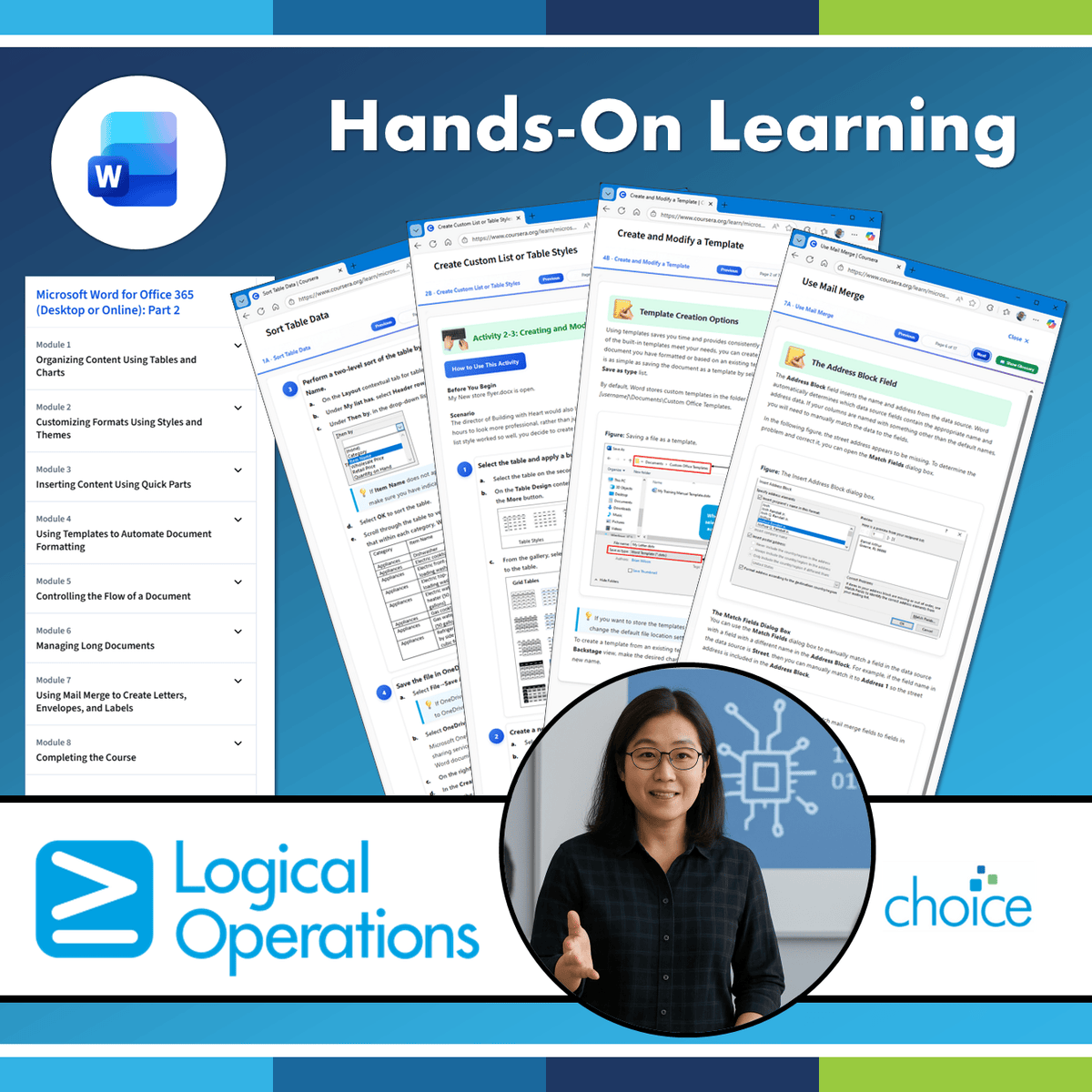
After you master the basics of using Microsoft® Word such as creating, editing, and saving documents; navigating through a document; and printing, you're ready to move on to tackling the more advanced features. These features enable you to create complex and professional documents with a consistent look and feel. They also enable you to automate tedious tasks such as preparing a letter to send to every customer of your organization. Creating professional-looking documents can help you give your organization a competitive edge. Implementing time-saving features such as document templates and automated mailings helps your organization reduce expenses. Mastering these techniques will make you a valued employee in your organization. Note: Most Office users perform the majority of their daily tasks using the desktop version of the Office software, so that is the focus of this training. The course material will also enable you to access and effectively utilize many web-based resources provided with your Microsoft 365 subscription. This includes brief coverage of key skills for using Word for the Web and OneDrive®. Helpful notes throughout the material alert you to cases where the online version of the application may function differently from the primary, desktop version. This course may be a useful component in your preparation for the Microsoft Word (Microsoft 365 Apps): Exam MO-110 and Microsoft Word Expert (Microsoft 365 Apps): Exam MO-111 certification exams. This course is designed for students who wish to use Microsoft Word to create and modify complex documents and use tools that allow them to customize those documents. In this course, you will learn fundamental Word skills. You will: • Organize content using tables and charts. • Customize formats using styles and themes. • Insert content using Quick Parts. • Use templates to automate document formatting. • Control the flow of a document. • Simplify and manage long documents. • Use mail merge to create letters, envelopes, and labels. This course requires that you have Microsoft Word installed on a Windows PC. The course setup instructions provided in the first module of the course go into more detail about the hardware and software requirements.
 Automatic Data Processing, Inc. (ADP)
The Payroll Cycle
Welcome to The Payroll Cycle, the second course in ADP's Entry-level Payroll Specialist Professional Certificate program. This course explores the end-to-end payroll processing cycle, from data collection to net pay. Students will gain insights into the step-by-step process, including time tracking methods, leave management, new hire onboarding tasks, and potential bottlenecks. This is an entry-level course intended for beginner learners interested in learning the fundamentals of payroll, those pursing an entry-level Payroll Specialist role, and more experienced professionals looking to shift their career to purposefully focus on the area of a Payroll Specialist.
 Alfaisal University | KLD
أخلاقيات وآداب السلوك في الأعمال
غالباً ما يرتبط النجاح المهني بمدى توفر المؤهلات اللازمة لمواجهة المتطلبات الوظيفية، لكن ثمة جانب مؤثر في هذا النجاح لا يقل أهميةً عن توفر المؤهلات، وهو مدى توفر الصفات التي تجعلُ منك موظفاً أخلاقياً (Ethical Employee) لا يُخلُّ بواجبات ومسؤوليات عمله ومجتمعه، هذا بالإضافة إلى إمكانية تعزيز هذا النجاح عن طريق معرفة وإتقان كثيرٍ من سلوكيات العمل (Business Etiquette) المتحضرة. هذه الدورة هي دورة تمهيدية؛ فهي تلقي الضوء على أساسيات الموضوع بشكل عام بهدف التعريف به وبمحاوره الأساسية التي يجب الإلمام بها. إذا كنت من المهتمين بفهم أخلاقيات وآداب السلوك في الأعمال، أو كان مجال عملك يتطلب توظيف ذلك في سياق عملك، فهذه الدورة ستكون مثالية لإغناء خبرتك وتطوير مهاراتك بشكل فعال ومؤثر. حيث ستزودك هذه الدورة باطلاع واسع ودقيق على مجموعة من المحاور المتعلقة بهذا الموضوع، مثل: فهم كيفية تحقيق النجاح من خلال الالتزام بمبادئ آداب السلوك في الأعمال، شرح أهم آداب العمل، استعراض أخلاقيات العمل الأساسية، تبيان مفهوم أخلاقيات وآداب السلوك في الأعمال والفرق بينهما.
 Coursera
Automate Data Deployments with CI/CD Pipelines
Transform your data deployment process from manual to automated with enterprise-grade CI/CD pipelines. In today's fast-paced data environment, manual deployments are error-prone, time-consuming, and simply unsustainable at scale. This Short Course was created to help data management and engineering professionals accomplish seamless, reliable data pipeline deployments through automation. By completing this course, you'll be able to configure GitHub Actions workflows that automatically run unit tests, build Docker images, push to registries, and trigger production deployments - skills you can implement immediately in your next project. You'll master the essential automation techniques that separate junior practitioners from seasoned professionals who build production-grade data systems. By the end of this course, you will be able to: Apply CI/CD pipelines to promote data pipeline artifacts between environments safely and reliably This course is unique because it focuses specifically on data pipeline deployment automation, bridging the gap between traditional software CI/CD practices and the unique requirements of data engineering workflows. To be successful in this project, you should have a background in basic data pipeline concepts, familiarity with Git version control, and understanding of Docker fundamentals.
 University of Maryland, College Park
PMP Exam Prep: Gaining Business Acumen for Project Managers
Pass the PMP® Exam. This course connects projects to organizational strategy and aligns with the Strategic and Business Management skill area of the PMI Talent Triangle®, helping you earn contact hours for the PMP Exam. In this course, you will learn to apply your understanding of your industry and organization to merge project goals seamlessly with broader company objectives. This alignment isn’t just about checking boxes—it’s the catalyst for improved performance and achieving meaningful business results. You’ll discover how project objectives connect to overarching strategy, ensuring that every project you lead has a clear business impact. The course will guide you through the complex world of compliance, showing you how regulatory requirements influence each project phase, and helping you see the larger picture—how internal changes, external market shifts, and new regulations continually shape your projects’ pathways to success. Becoming an Exceptional Project Professional : As a project professional, you’re called to constantly assess whether your key decisions and efforts are truly advancing your company’s mission, all while meeting necessary compliance standards. You won’t just learn what influences your project—you’ll discover how to interpret both industry-wide trends and company-specific factors, empowering you to enhance planning, delivery, and business value. You’ll explore ways to anticipate and address compliance needs early, allowing you to adapt your project plans before roadblocks arise. Mastering Strategy, Compliance, and Adaptability Throughout the course, you’ll gain practical guidance on structuring your projects to be both strategic and compliant. You’ll consider the impact compliance has on cost, risk, and timelines and learn leading strategies to keep your work within regulations—no matter how priorities shift. When the inevitable project changes occur, you’ll be equipped with tools to quickly evaluate how those changes affect constraints like budget or resources. You’ll see how adaptability becomes your competitive edge, enabling your team to move confidently through shifting circumstances. By the course’s conclusion, you’ll be ready to skillfully align project work with business strategy and regulatory standards. You’ll have the insight to monitor internal and external factors, adapt to change, and lead teams toward better outcomes, even in the face of complexity. This course is designed to empower you—so every decision propels both your team and your organization forward.
 Universitat Autònoma de Barcelona
Sustainability of Social-Ecological Systems: the Nexus between Water, Energy and Food
In this course you will become familiar with the ideas of the water-energy-food nexus and transdisciplinary thinking. You will learn to see your community or country as a complex social-ecological system and to describe its water, energy and food metabolism in the form of a pattern, as well as to map the categories of social actors. We will provide you with the tools to measure the nexus elements and to analyze them in a coherent way across scales and dimensions of analysis. In this way, your quantitative analysis will become useful for informed decision-making. You will be able to detect and quantify dependence on non-renewable resources and externalization of environmental problems to other societies and ecosystems (a popular ‘solution’ in the western world). Practical case studies, from both developed and developing countries, will help you evaluate the state-of-play of a given community or country and to evaluate possible solutions. Last but not least, you will learn to see pressing social-ecological issues, such as energy poverty, water scarcity and inequity, from a radically different perspective, and to question everything you’ve been told so far. ACKNOWLEDGEMENT Part of the results and case studies presented have been developed within two projects: MAGIC and PARTICIPIA. However, the course does not reflect the views of the funding institutions or of the project partners as a whole, and the case studies were presented purely with an educational and illustrative purpose.
 Starweaver
Procurement for Governments
This course offers an in-depth exploration into the complexities and strategies of government procurement processes. Participants will gain insights into foundational concepts and frameworks that govern public procurement, moving into specific applications that enhance efficiency, transparency, and value for money. The course context emphasizes the critical role procurement plays in public sector governance and its impact on economic and social outcomes. Through real-world examples and concrete skills development, learners will be equipped to navigate and improve procurement practices within government entities. This course is designed for government procurement officers, policy makers in public finance, legal advisors in the public sector, public administration academics, and NGO advocates for transparency. Each group will gain valuable insights and practical skills to enhance and optimize procurement processes in government settings. Participants should have a basic understanding of public sector operations, familiarity with general procurement processes, an interest in public policy and governance, and introductory knowledge of legal frameworks in public procurement.
 Illinois Tech
Hardware and Operating System Foundations II
This course provides you the opportunity to examine the features of the Linux operating system. You will also focus on the management of the operating system. The career skills acquired in this course introduce the open-source operating system Linux and its operation and support. At the end of this course, you will be able to: - Demonstrate the use of command line tools. - Explore key features of the Linux OS. - Explore service management of the Linux OS. Software requirements: Any Linux distro
 Google
Le nettoyage de données
Il s’agit du quatrième cours du Google Data Analytics Certificate. Ces cours vous permettront d’acquérir les compétences dont vous avez besoin pour postuler les emplois d’analyste de données de niveau junior. Dans ce cours, vous continuerez à approfondir votre compréhension de l'analytique des données et des concepts et outils utilisés par les analystes de données dans leur travail. Vous apprendrez comment vérifier et nettoyer vos données à l'aide de feuilles de calcul et de SQL, ainsi que comment vérifier et créer des rapports de vos résultats de nettoyage de données. Des analystes de données actuellement chez Google vous instruiront et vous fourniront des moyens pratiques d’accomplir les tâches courantes des analystes de données, avec les meilleurs outils et ressources. Les participants qui terminent cette formation certifiante seront préparés à postuler à des emplois d’analyste de données de niveau junior. Aucune expérience préalable n’est nécessaire. À la fin de ce cours, vous aurez : - Appris comment vérifier l'intégrité des données. - Découvert les techniques de nettoyage de données à l'aide de feuilles de calcul - Développé des requêtes SQL de base pour une utilisation sur les bases de données. - Appliqué les fonctions SQL de base pour le nettoyage et la transformation des données. - Compris comment vérifier les résultats du nettoyage de données. - Exploré les éléments et l'importance des rapports de nettoyage de données.