

The Global Scholarly Directory.
Discover world-class academic programs curated for the modern intellectual. Search through 19877+ degrees and professional certificates.
 IBM
IBM
Databases and SQL for Data Science with Python
Working knowledge of SQL (or Structured Query Language) is a must for data professionals like Data Scientists, Data Analysts and Data Engineers. Much of the world's data resides in databases. SQL is a powerful language used for communicating with and extracting data from databases. In this course you will learn SQL inside out- from the very basics of Select statements to advanced concepts like JOINs. You will: -write foundational SQL statements like: SELECT, INSERT, UPDATE, and DELETE -filter result sets, use WHERE, COUNT, DISTINCT, and LIMIT clauses -differentiate between DML & DDL -CREATE, ALTER, DROP and load tables -use string patterns and ranges; ORDER and GROUP result sets, and built-in database functions -build sub-queries and query data from multiple tables -access databases as a data scientist using Jupyter notebooks with SQL and Python -work with advanced concepts like Stored Procedures, Views, ACID Transactions, Inner & Outer JOINs through hands-on labs and projects You will practice building SQL queries, work with real databases on the Cloud, and use real data science tools. In the final project you’ll analyze multiple real-world datasets to demonstrate your skills.
 Coursera
Copilot for Beginners: Create a Powerpoint Presentation
In this 2-hour long project-based course you will learn how to build a Microsoft PowerPoint presentation using the power of Microsoft Copilot AI. We will do this by creating a product innovation presentation for executive management leveraging Copilot's abilities. You will create and organize content and structure with Copilot, add and generate images, extract and summarize information and insights from other presentation, automatically create slides from a Word document and expand content with AI-augmented information. This project will help you efficiently build any business or educational presentation such as a meeting or project summary, an idea pitch, or a quarterly results review. This course is aimed at learners who are looking to get started with Microsoft Copilot for PowerPoint. Basic familiarity with PowerPoint (create, edit and delete slides) and a valid Microsoft Copilot and Microsoft 365 licenses are required (minimum configuration: Copilot Pro and Microsoft 365 Home licenses).
 Banco Interamericano de Desarrollo
Design de projetos de governo digital
Neste curso, você poderá aprender boas práticas para o design de projetos de governo digital e transformar a realidade do seu país por meio de exemplos de países que são referências internacionais nos impactos da transformação digital. Especialistas em governo digital irão apresentar três pontos fundamentais dos projetos de governo digital: uma estratégia, um diagnóstico e um quadro de monitoramento e avaliação. Você também verá alguns dos componentes técnicos mais comuns, como a simplificação de procedimentos, a modernização da gestão administrativa, a criação de uma visão integrada de dados e o fortalecimento da cibersegurança. Não fique de fora e inscreva-se para aprender sobre o tema com especialistas do Banco Interamericano de Desenvolvimento e referências internacionais que compartilham suas experiências e lições aprendidas neste curso. Este curso faz parte da Especialização em Transformação Digital de Governos, que oferece uma visão mais ampla para a implementação da digitalização em processos, procedimentos e gestões para um melhor serviço à cidadania.
 Johns Hopkins University
Excellence in Online Teaching
This course is aimed at anyone who is teaching online or will be in the future. Learners will come away with ways to improve their online courses and teaching practices today.
 Arizona State University
How Can We Measure and Study Human Error?
Course 2 teaches you how to distinguish between different methods for studying human error. You will also learn about human-centered design and usability, and how to compare and contrast different methodologies for evaluating the usability of products, technologies & systems.
 Packt
Packt
Modern Web Development with Blazor WebAssembly and .NET
This course features Coursera Coach! A smarter way to learn with interactive, real-time conversations that help you test your knowledge, challenge assumptions, and deepen your understanding as you progress through the course. This comprehensive course guides you through modern web development with Blazor WebAssembly and .NET, helping you build dynamic and scalable web applications. You'll learn to set up your development environment, create a Blazor project, and dive into building user interfaces with Blazor components. Throughout the course, you will explore authentication, database management with Entity Framework Core, and integrating REST APIs for data handling. By applying these technologies, you will enhance your web development skills, making you proficient in creating interactive and secure web applications. The course flows from basic setup and creating your first Blazor application to handling authentication and connecting databases, followed by working with REST APIs and understanding architectural patterns. As you progress, you'll develop critical skills like handling data, creating forms, and integrating third-party JavaScript libraries into your projects. You'll also learn how to deploy your final application to Azure for production use. This course is ideal for aspiring web developers and those looking to enhance their skills in Blazor and .NET. A foundational understanding of web development and programming concepts is recommended. It’s suitable for learners at an intermediate level, though beginners in .NET development may also benefit from the clear, structured lessons. By the end of the course, you will be able to create and deploy a Blazor WebAssembly application, implement authentication with Identity Server, work with databases using Entity Framework, integrate REST APIs, and utilize advanced Blazor features for production-ready web apps.
 Banco Interamericano de Desarrollo
Métodos de enseñanza temprana de matemáticas y ciencias
¿Sabes que en el mundo actual, debido a la creciente presencia de alta tecnología en nuestras vidas, la demanda de trabajadores alfabetizados en matemáticas y ciencias es más alta que nunca y no da ninguna señal de que disminuirá en el futuro? Mientras tanto, nuestro mundo está cambiando rápidamente y enfrenta muchos desafíos. Los problemas complejos en la economía, el medio ambiente, la agricultura y la salud a los que nos enfrentamos hoy en día requieren que las nuevas generaciones desarrollen habilidades de pensamiento crítico y creativo sin precedentes. ¿Cómo podemos preparar a los niños y niñas para que puedan desarrollar las habilidades de matemáticas y ciencias que les permitirán tener éxito en la escuela y en el mercado laboral? Una de las piezas de ese rompecabezas es cambiar la práctica tradicional de enseñanza de matemáticas y ciencias, que se centra en la repetición, la memorización y la pregunta-respuesta, hacia una enseñanza temprana centrada en el estudiante. El curso "Enseñanza Temprana de Matemáticas y Ciencias" se basa en el trabajo de reconocidos investigadores y profesionales de la educación en matemáticas y ciencias con amplia experiencia en escuelas y aulas, tanto dentro como fuera de América Latina y el Caribe. A lo largo del curso, introduciremos temas esenciales de la enseñanza centrada en el estudiante. Aprenderás: 1. La importancia de abordar las matemáticas y las ciencias desde una edad temprana. 2. El rendimiento actual de los estudiantes de primaria en matemáticas y ciencias en América Latina y el Caribe. 3. Cómo las prácticas de enseñanza centrada en el estudiante apoyan el desarrollo del pensamiento matemático-científico y el pensamiento crítico. 4. Cómo incorporar la enseñanza basada en la investigación y la resolución de problemas en el aula. 5. Los elementos esenciales de las prácticas centradas en el estudiante para fomentar un mejor aprendizaje. A través de lecturas, videos, actividades prácticas y ejemplos de aulas en América Latina, el curso ayudará a docentes y administradores a cambiar las prácticas de enseñanza temprana en las aulas de matemáticas y ciencias. La evidencia es clara: todos pueden aprender matemáticas y ciencias. ¡En este curso, aprenderás cómo hacer que estas materias sean más motivadoras y significativas para todos los estudiantes!
 LearnQuest
Managing IoT Security in Networks
This course is designed for professionals and students seeking a comprehensive understanding of IoT security. Participants should already have a solid understanding of IoT fundamentals. Learners will delve into the intricate components of the IoT ecosystem, gaining insights into its architecture and interconnections. They will identify and analyze common IoT security challenges, providing the foundation to recognize and explain IoT threats and vulnerabilities in the ever-evolving IoT security threat landscape. Participants will differentiate between various risk assessment methodologies and learn to employ threat modeling techniques effectively. The course also explores IoT security standards and controls, enabling learners to recognize and implement security best practices. Additionally, learners will compare and contrast computing frameworks for IoT, critically analyzing secure IoT architectures and evaluating security implications across different architectural approaches. The course culminates in an examination of secure communication protocols, equipping participants with a comprehensive skill set to navigate the complex field of IoT security confidently.
 DeepLearning.AI
Quantization Fundamentals with Hugging Face
Generative AI models, like large language models, often exceed the capabilities of consumer-grade hardware and are expensive to run. Compressing models through methods such as quantization makes them more efficient, faster, and accessible. This allows them to run on a wide variety of devices, including smartphones, personal computers, and edge devices, and minimizes performance degradation. Join this course to: 1. Quantize any open source model with linear quantization using the Quanto library. 2. Get an overview of how linear quantization is implemented. This form of quantization can be applied to compress any model, including LLMs, vision models, etc. 3. Apply “downcasting,” another form of quantization, with the Transformers library, which enables you to load models in about half their normal size in the BFloat16 data type. By the end of this course, you will have a foundation in quantization techniques and be able to apply them to compress and optimize your own generative AI models, making them more accessible and efficient.
 Packt
Packt
Advanced Blazor – Security, Payments & Deployment
This course features Coursera Coach! A smarter way to learn with interactive, real-time conversations that help you test your knowledge, challenge assumptions, and deepen your understanding as you progress through the course. In this advanced course, you'll master Blazor application security, payment integration, and deployment strategies. You’ll begin with setting up authentication and authorization for both Blazor Server and WebAssembly (WASM) applications. Learn how to implement JWT authentication, scaffold identity, and secure APIs with roles and permissions. As you progress, you'll integrate payment systems like Stripe into your Blazor applications. You'll gain hands-on experience in creating orders, processing payments, and managing transactions. Finally, you will learn how to deploy your Blazor applications on Azure, including setting up Azure SQL databases and deploying both Blazor Server and Blazor Client applications to the cloud. This course is ideal for developers who are ready to tackle the security and deployment aspects of Blazor, along with integrating payment systems to create real-world applications. By the end of this course, you will confidently deploy Blazor applications and securely manage user data and payment processing.
 Coursera
Vulnerability Scanning with Nmap: Network Scanning
The Vulnerability Scanning with Nmap: Network Scanning guided project dives into the use of the Nmap tool, a popular free and open-source tool used for network scanning and security auditing. This project covers how to verify the installation of Nmap and the Nmap version on a system, as well as the basics of network scanning, host discovery, port scanning, service enumeration, operating system detection, version detection, and vulnerability detection using the Nmap tool. We’ll cover practical steps for network scanning that can be used to showcase your skills to a current or future employer. Security professionals, such as Security Analysts or Security Engineers, use Nmap to improve the security of their networks and to identify potential vulnerabilities before they can be exploited by attackers. By completing this project, learners will gain hands-on experience running various Nmap commands in the terminal to perform basic scanning on a target to identify potential vulnerabilities on a network which is helpful to improve network security. A basic knowledge of vulnerability scanning and an understanding of networking concepts, such as IP addresses, ports, and protocols, is recommended.
 University of Colorado Boulder
Deep Learning for Computer Vision
Unlock the power of deep learning to transform visual data into actionable insights. This hands-on course guides you through the foundational and advanced techniques that drive modern computer vision applications—from image classification to generative modeling. You'll begin with the building blocks of deep learning - understanding how multilayer perceptrons (MLPs) work, and exploring normalization techniques that stabilize and accelerate training. You'll then dive into unsupervised learning with autoencoders and discover the magic behind Generative Adversarial Networks (GANs) that can create realistic images from noise. After, you'll master the architecture that revolutionized computer vision by learning how CNNs extract spatial hierarchies and patterns from images for tasks like object detection and recognition. Finally, you'll explore cutting-edge architectures. ResNet introduces residual learning for deeper networks, while U-Net powers precise image segmentation in medical imaging and beyond. Whether you're a data scientist, engineer, or AI enthusiast, this course equips you with the skills to build and deploy deep learning models for real-world vision tasks. With practical examples and guided learning, you'll gain both theoretical understanding and hands-on experience. This course can be taken for academic credit as part of CU Boulder’s MS in Data Science or MS in Computer Science degrees offered on the Coursera platform. These fully accredited graduate degrees offer targeted courses, short 8-week sessions, and pay-as-you-go tuition. Admission is based on performance in three preliminary courses, not academic history. CU degrees on Coursera are ideal for recent graduates or working professionals. Learn more: MS in Data Science: https://www.coursera.org/degrees/master-of-science-data-science-boulder MS in Computer Science: https://coursera.org/degrees/ms-computer-science-boulder
 University of Pittsburgh
Tableau, Networks & Time Series Data Visualization
Unlock the power of data with "Tableau, Networks & Time Series Data Visualization" . This comprehensive program is designed to teach you the essentials of data storytelling through visualizations using Python and Tableau. Starting with the basics of Tableau, you'll learn to create and customize various visualizations, build interactive dashboards, and conduct detailed analytics. Dive into network visualization to understand and depict complex networks and connected data. Using Python libraries, you will create and customize network visualizations that highlight relationships and structures within data. Explore time series data visualization to interpret and present data over time. You’ll master techniques for loading, preparing, and visualizing time series data using Python, enhancing your ability to forecast and analyze trends effectively. By the end of this course, you will have the skills needed to create compelling, insightful, and interactive data visualizations, making complex data more understandable and actionable.
 EDUCBA
Analyze Capital, Basel, Stress Testing, and Resilience
Learners will examine model reliability and data integrity frameworks, evaluate capital strength under adverse scenarios, and assess institutional resilience practices used by large financial organizations. By the end of the course, participants will be able to interpret capital and risk indicators, analyze stress outcomes, and apply resilience principles to real-world risk decisions. This course provides advanced, practice-oriented knowledge for professionals aiming to strengthen decision-making at senior risk levels. Participants develop a structured understanding of capital measurement, internal assessment processes, supervisory expectations, and post-crisis reforms affecting financial institutions. The curriculum also expands beyond capital topics to include operational continuity, technology disruption exposure, external dependency risk, and system-wide stability considerations. The course stands out through its integrated approach, connecting quantitative risk assessment, capital planning, scenario analysis, and resilience oversight into a unified learning experience. Using scenario-driven explanations and regulator-style thinking, learners build the ability to evaluate assumptions critically and support sound strategic decisions in complex financial environments.
 Macquarie University
مهارات Excel للأعمال: المستوى "المتوسط I"
لا تزال برامج جداول البيانات واحدة من أكثر البرامج انتشارًا في أماكن العمل في جميع أنحاء العالم. إن تعلم تشغيل هذا البرنامج بثقة يعني إضافة أصول ذات قيمة عالية إلى مؤهلاتك الوظيفية. في الولايات المتحدة الأمريكية وحدها، يتم نشر الملايين من إعلانات الوظائف التي تتطلب مهارات Excel كل يوم. يُظهر البحث الذي تم إجراؤه من قبل Burning Glass Technologies وCapital One أن المهارات الرقمية تؤدي إلى دخل أعلى وفرص عمل أفضل، في وقت تنمو فيه وظائف المهارات الرقمية بشكل أسرع بكثير من الوظائف غير الرقمية. وفي هذه الدورة التدريبية الثانية من تخصصنا في برنامج Excel، مهارات Excel للأعمال، ستكمل ما بدأته من أسس قوية في دورة "الأساسيات". ستوسع مهارات المستوى "المتوسط I" معرفتك ببرنامج Excel إلى آفاق جديدة. أنت في طريقك لاكتشاف مجموعة كاملة من المهارات والتقنيات التي ستصبح مكونًا قياسيًا في استخدامك اليومي لبرنامج Excel. ستكتسب في هذه الدورة التدريبية مجموعة من المهارات الراسخة الأكثر تقدمًا حتى تتمكن من إدارة مجموعات البيانات الكبيرة وإنشاء تقارير مفيدة. ستتيح لك هذه التقنيات والأدوات الرئيسية إمكانية إضافة مستوى متطور من التشغيل الآلي والكفاءة إلى مهامك اليومية في Excel. مرة أخرى، لقد جمعنا فريق تدريس رائعًا سيكون معك في كل خطوة في طريقك. سيرشدك "براشان" و"نيكي" كل أسبوع (وسأحضر ضيفًا في الأسبوع الخامس لمساعدتك في التعرف على أداتي المفضلة في Excel- صمتًا، لتكن مفاجأة). اعمل خلال كل تحد جديد خطوة بخطوة، وستندهش في وقت قصير من مدى تقدمك. سنتابع هذه المرة محاولات "أوما" ومعاناتها لأنها تحاول أن تضع قدميها في منصب جديد في شركة وهمية هي PushPin. بالنسبة لمن أتم منكم دورة "الأساسيات"، فسيكون على دراية بالشركة بالفعل. سيساعدك العمل خلال تحدياتها الشائعة للغاية، والتي نواجهها كل يوم، على التواصل بسهولة أكبر مع المهارات والتقنيات التي يتم تعلمها في كل أسبوع، وتطبيقها في سياقات مألوفة وجديدة.
 EDUCBA
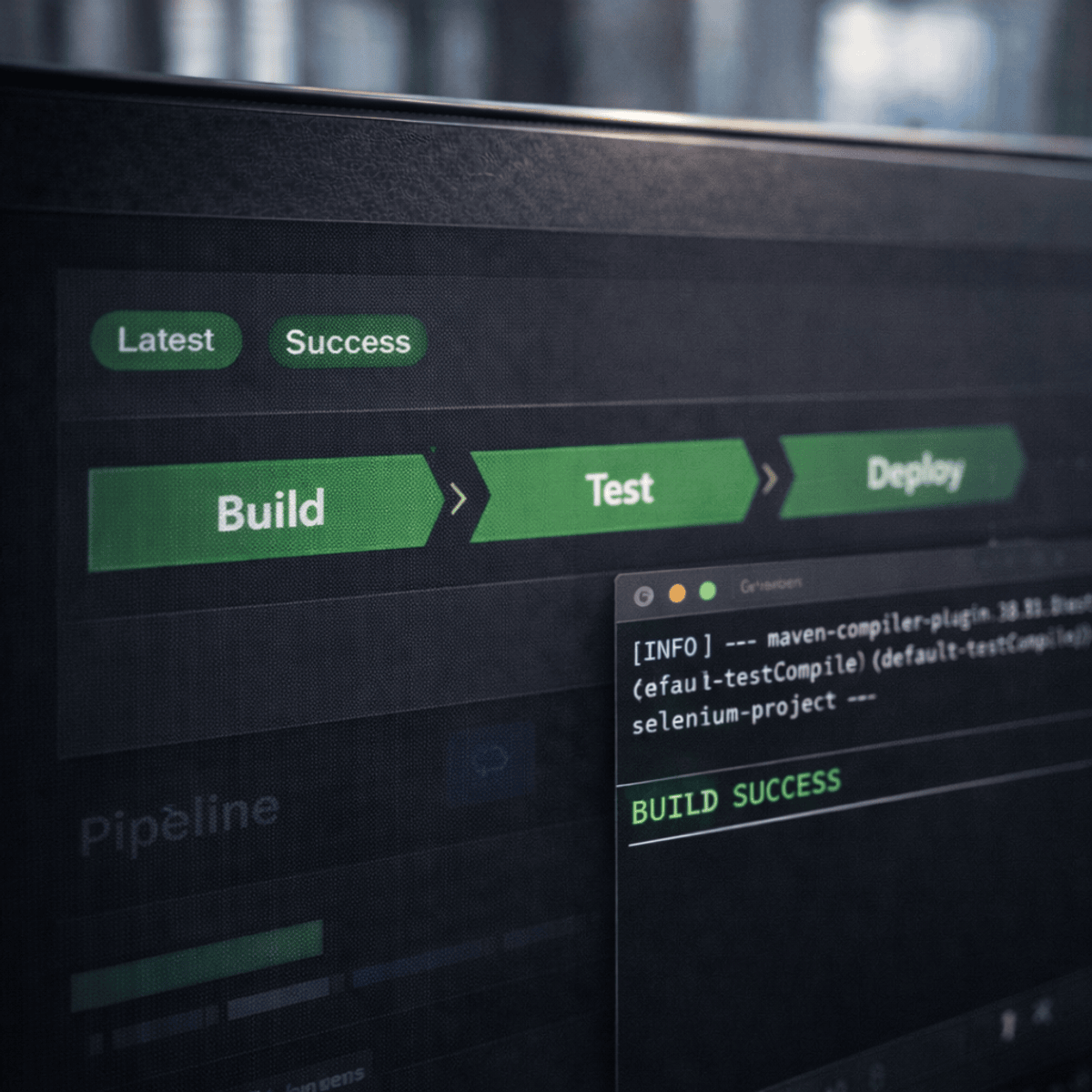
Implement Advanced Selenium CI/CD with Java
Learners will be able to implement advanced Selenium automation workflows, configure CI/CD pipelines using Maven and Jenkins, execute tests in distributed and headless environments, and manage browser sessions effectively through advanced cookie handling techniques. By completing this course, learners will gain the skills required to design, run, and maintain scalable, enterprise-grade Selenium automation solutions aligned with modern DevOps practices. This course benefits learners by bridging the gap between test automation and continuous integration, enabling faster feedback cycles, improved test reliability, and efficient execution across multiple environments. Participants will learn how to integrate Selenium projects into Jenkins pipelines, manage system configuration and security, and optimize execution using Selenium Grid and headless browsers—skills that are highly valued in real-world automation and QA engineering roles. What makes this course unique is its strong focus on production-ready automation. Rather than limiting coverage to scripting alone, the course emphasizes CI/CD readiness, infrastructure awareness, and session management strategies that are critical in large-scale projects. Learners finish the course prepared to implement robust, maintainable, and performance-optimized Selenium automation solutions in professional environments.