

The Global Scholarly Directory.
Discover world-class academic programs curated for the modern intellectual. Search through 19877+ degrees and professional certificates.
 Pontificia Universidad Católica de Chile
Equilibrio, ¿por qué se caen las cosas?
¿Por qué las grúas no se vuelcan al levantar grandes pesos? ¿por qué las mesas sólo necesitan tres patas (no alineadas) para apoyarse? Este curso te guiará paso a paso en los conocimientos básicos para entender el equilibrio de estructuras simples. Aprenderás conceptos básicos de las ecuaciones matemáticas que modelan las condiciones de equilibrio de partículas y de cuerpos rígidos. Además, también aprenderás conceptos como momento, que te ayudarán a entender fenómenos como el volcamiento de estructuras, y a identificar las fuerzas y momentos que actúan sobre un determinado cuerpo, mediante el concepto de diagrama de cuerpo libre. Todo esto te servirá para modelar estructuras simples pero realistas, identificar las distintas fuerzas que actúan sobre ellas, plantear las ecuaciones necesarias para que la estructura se encuentre en equilibrio, y determinar las reacciones de apoyo necesarias para tal condición. Cuando termines el curso serás capaz de generar idealizaciones de estructuras reales simples, identificar las distintas fuerzas y momentos que actúan sobre ella, y plantear y resolver las ecuaciones de equilibrio correspondientes.
 University of California, Davis
Telehealth Best Practices and Uses
Telehealth uses technology tools such as a cellphone or laptop to give patients and doctors the ability to support healthcare communication and services remotely. The field of telehealth has seen tremendous growth, with telehealth use increasing across all specialties and becoming even more accessible. This course is designed for healthcare professionals and employees in organizations that practice telehealth or are aspiring to work within the field. As a leading pioneer in the field of telehealth, UC Davis Health began offering telehealth services in 1992 and providing a formal telehealth academic curriculum in 1999. Go beyond the foundational knowledge of technology tools employed and telehealth applications. Learn about the most effective practices in implementation, regulatory compliance, and how to practice with a health equity lens. With insight from the CEO of UC Davis Health, David Lubarsky, you will leave the course better able to improve your telehealth practice and focus on the elements of telehealth that matter most to your organization and to the patients you serve.
 Coursera
Ensure Visual Consistency
In today's competitive market, a consistent visual brand identity is not just a nice-to-have; it's essential for building and maintaining consumer trust. This 90-minute intermediate-level course, "Ensuring Visual Consistency for Brand Integrity," is designed for marketing professionals, brand managers, and designers who are responsible for upholding a brand's visual identity across all digital touchpoints. You will learn why visual consistency is a cornerstone of brand recognition and loyalty, and how even minor inconsistencies can erode the trust you've worked so hard to build. Through a series of engaging, practical learning items, you will explore the strategic importance of brand guidelines and learn how to apply them effectively to new digital assets. The course will equip you with the skills to conduct a thorough brand audit, identify visual discrepancies, and articulate their impact on consumer perception. Drawing on real-world examples from iconic brands like Coca-Cola, Apple, and McDonald's, this course provides a practical framework for enforcing visual consistency. You will engage in hands-on activities, including a practice brand audit of a sample landing page, and a final graded project where you will create a Brand Consistency Audit report. By the end of this course, you will be able to confidently champion visual consistency within your organization, ensuring that every visual element of your brand works in harmony to create a powerful and unified brand experience.
 Packt
Packt
Advanced Spring Cloud Microservices & Deployment with Docker
This course features Coursera Coach! A smarter way to learn with interactive, real-time conversations that help you test your knowledge, challenge assumptions, and deepen your understanding as you progress through the course. This course empowers learners to master modern microservices architecture using Spring Cloud, Docker, and Kubernetes. You’ll gain a deep understanding of how to build scalable, resilient microservices while managing configuration, service discovery, routing, and observability across distributed systems. The journey begins with building foundational microservices like Currency Exchange and Currency Conversion using Spring Cloud. You’ll explore essential components such as Spring Cloud Config Server, Eureka Naming Server, and API Gateway. With hands-on examples, you'll implement load balancing, fault tolerance with Resilience4j, and centralized configuration using Git integration. Next, the course dives into containerization using Docker. You'll learn to build optimized Docker images, manage multi-container deployments with Docker Compose, and implement distributed tracing with Zipkin and OpenTelemetry. Finally, you’ll deploy your microservices in a Kubernetes environment on Google Cloud Platform (GCP), mastering YAML configurations, autoscaling, service discovery, and observability with GKE. This course is ideal for experienced Java developers, cloud engineers, or DevOps professionals looking to upskill in microservices architecture and cloud-native deployments. Familiarity with Spring Boot and basic cloud concepts is recommended. The course is rated at an Intermediate level due to its technical depth and deployment complexity. By the end of the course, you will be able to design, build, containerize, and deploy enterprise-grade microservices using Spring Cloud, Docker, and Kubernetes, with full observability and resilience.
 University of Colorado Boulder
Approximation Methods
This course can also be taken for academic credit as ECEA 5612, part of CU Boulder’s Master of Science in Electrical Engineering degree. This course teaches commonly used approximation methods in quantum mechanics. They include time-independent perturbation theory, time-dependent perturbation theory, tight binding method, variational method and the use of finite basis set. In each case, a specific example is given to clearly show how the method works. At the end of this course learners will be able to: 1. use time-dependent perturbation theory to obtain first- and second -order corrections to energies and wavefunctions, 2. use time-dependent perturbation theory and obtain transition rates, and 3. use tight binding method, variational method and finite basis set to obtain approximate solutions of various quantum mechanics problems.
 Coursera
Data Management with Databricks: Big Data with Delta Lakes
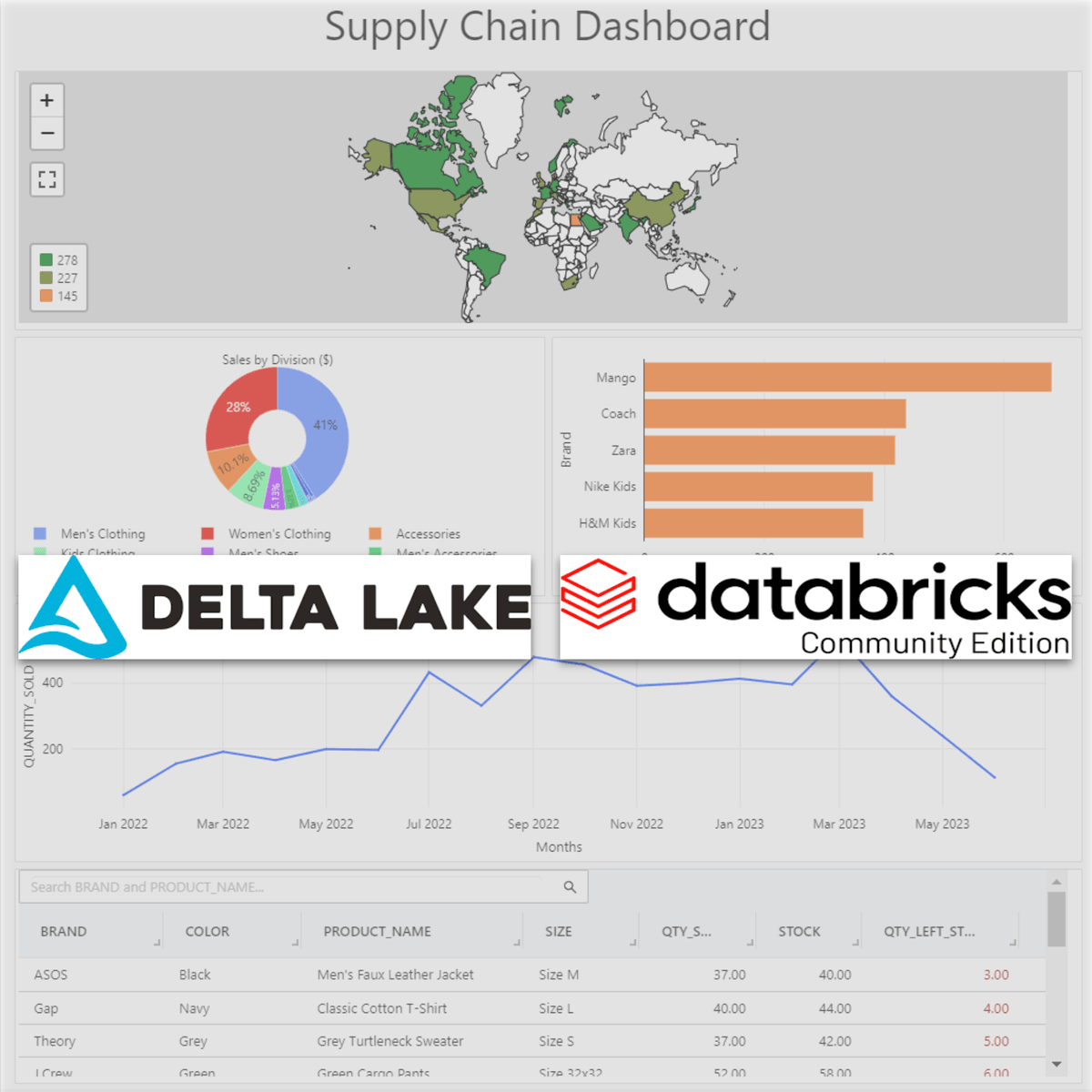
In this 2-hour guided project, "Data Management with Databricks: Big Data with Delta Lakes" you will collaborate with the instructor to achieve the following objectives: 1-Create Delta Tables in Databricks and write data to them. Gain hands-on experience in setting up and managing Delta Tables, a powerful data storage format optimized for performance and reliability. 2-Transform a Delta table using Python and leverage SQL to query the data for creating a comprehensive dashboard. Learn how to apply Python-based transformations to Delta Tables, and use SQL queries to extract the necessary insights for building a Supply Chain dashboard. 3-Utilize Delta Lake's merge operation and version control capabilities to efficiently update Delta Tables. Explore the capabilities of Delta Lake's merge operation to perform upserts and other data updates efficiently. Additionally, learn how to leverage Delta Lake's built-in version control to track and access previous versions of Delta Tables as needed. Throughout a real-world business scenario, you will use Databricks to build an end-to-end data pipeline that integrates various JSON data files and applies transformations, ultimately providing valuable insights and analysis-ready data. This intermediate-level guided project is designed for data engineers who build data pipelines for their companies using Databricks. In order to be successful in this guided project, you need prior knowledge of writing Python scripts including importing libraries, setting-up variables, manipulating data frames, and using functions. You will also need to be familiar with writing SQL queries such as aggregating, filtering, and joining tables.
 Niel Asher Education
Massage Therapy Treatment for Frozen Shoulder
By the end of this course, you will (1) explain the pathology and stages of frozen shoulder and (2) apply massage and soft-tissue techniques tailored to each recovery phase. Guided by Maureen Abson, LMT, this course provides structured, phase-specific protocols for managing pain, improving range of motion, and supporting tissue healing. Studio-filmed demonstrations detail safe positioning, movement progression, and client education strategies. What makes this course unique is its combination of theory, anatomy, and therapeutic technique—offering clear, replicable steps for addressing one of the most challenging shoulder pathologies. Upon completion, learners gain practical tools to confidently manage frozen shoulder from assessment through rehabilitation.
 University of Illinois Urbana-Champaign
Shaping Your Professional Brand
You've thought about who you are and how you want your career to be. You have some soft skills to deal with situations that could cause problems. What about the team around you? How do you build functional and constructive professional relationships? How can you add value? What do employers look for when they are promoting? Skill-building in this course will include asking questions, listening, developing likeability (you’d better be stellar if you’re difficult), identifying cognitive bias, apologizing, receiving apologies, and the basics of whistleblowing. After this course, you will be able to: - assess your own listening and reactions and retune them in advance or on the spot for a more constructive outcome - add value at work by keeping situations easy instead of difficult - manage your own approach - be prepared when things go wrong The prerequisite for this course is Course One of the Specialization "Professional IQ: Preventing and Solving Problems at Work".
 Board Infinity
Fundamentals of Java Programming
Immerse yourself in the world of Java programming with this comprehensive course, consisting of three modules, has been designed for those who are completely new to Java programming and desire to develop a strong foundation in it. In the first module, Java Fundamentals, you'll be introduced to Java programming and its integral components such as the Java Virtual Machine (JVM), the Java Runtime Environment (JRE), and the Java class library. This module also provides an understanding of basic programming constructs and a hands-on experience with Java development tools. Progressing to the second module, Core Java, you'll delve into the fundamental elements of the language. This segment emphasizes key concepts like Java Syntax, Variables, Methods, Operators, and Control Statements, supported by numerous practical assessments to refine your problem-solving skills. Finally, in the third module, OOPS and other essential concepts, advanced aspects of Java programming are unfolded. Here, you'll learn about advanced Object-Oriented Programming (OOP) principles and critical exception handling techniques that enhance code reliability and robustness. By the end of this course, you'll have a robust understanding of Java programming, with the ability to write efficient Java code and the readiness to delve into more advanced Java topics. Disclaimer: This course is an independent educational resource developed by Board Infinity and is not affiliated with, endorsed by, sponsored by, or officially associated with Oracle Corporation or any of its subsidiaries or affiliates. This course is not an official preparation material of Oracle Corporation. All trademarks, service marks, and company names mentioned are the property of their respective owners and are used for identification purposes only.
 Packt
Packt
Secure Software Development
This comprehensive course on Secure Software Development is designed to help IT professionals integrate security at every stage of the Software Development Life Cycle (SDLC), following the CISSP curriculum. The course starts with an introduction to security considerations in software development and how to choose the appropriate development methodology, including process-driven and agile-based approaches. You’ll explore the use of security controls, risk analysis, and methodologies such as the Capability Maturity Model (CMM) and Software Assurance Maturity Model (SAMM) to enhance the security of your development processes. As the course progresses, you’ll dive into secure coding practices, exploring how to minimize programming language risks, use secure development tools, and manage post-deployment software expectations. You’ll learn how to conduct application security testing, manage software configuration, and implement auditing and logging processes to ensure security throughout the software lifecycle. Real-world scenarios will illustrate the critical role of Integrated Product Teams (IPTs) in improving communication, decision-making, and overall software quality. In addition, you’ll examine the security of APIs, cloud services, third-party software, and open-source solutions, learning how to assess and mitigate risks associated with these components. By the end of the course, you’ll have a strong understanding of how to develop, deploy, and maintain secure software, ensuring both compliance and security in modern IT environments. This course is also an excellent preparation for the CISSP certification. This course is designed for software developers, security professionals, and IT managers preparing for the CISSP certification or aiming to integrate security into software development practices. A basic understanding of software development methodologies is recommended.
 University of Michigan
البرمجة للجميع - بدء استخدام بايثون
تهدف هذه الدورة إلى تعليم الجميع أساسيات برمجة أجهزة الكمبيوتر باستخدام بايثون. إننا نغطي أساسيات كيفية إنشاء برنامج من سلسلة من التعليمات البسيطة في بايثون. لا يوجد متطلبات مسبقة للدورة التدريبية وهي لا تستخدم سوى أبسط قواعد الرياضيات. يجب أن يتمكن أي شخص لديه خبرة معتدلة في الكمبيوتر من إتقان المواد في هذه الدورة. تغطي هذه الدورة الفصول من 1 إلى 5 بالكتاب المقرر "بايثون للجميع". بمجرد إكمال الطالب للدورة التدريبية، سيكون جاهزًا لأخذ دورات تدريبية في البرمجة أكثر تقدمًا. تغطي هذه الدورة التدريبية بايثون 3.
 Duke University
Python Scripting
In this 2-hour long project-based course, you will learn how to create command line interface tools using Python. You will use standard library modules like sys and subprocess to parse arguments and run external commands. You will also learn how to process raw command output in Python to filter and format results. By the end, you will be able to build basic but practical CLI utilities using only Python to automate tasks and workflows.
 Knowledge Accelerators
Microsoft 365 Copilot AI: Collaboration & Team Productivity
Work better together with Microsoft Copilot. This course shows you how to use Microsoft Copilot to strengthen collaboration, improve communication, and create more inclusive, productive team workflows across Microsoft 365. Why This Course Matters: Modern teams collaborate across meetings, shared workspaces, tasks, and ideas—often asynchronously. Microsoft Copilot helps teams stay aligned by summarizing discussions, organizing ideas, managing plans, and improving clarity and accessibility across shared content. Career Impact: - Cut meeting overload, coordination friction, and follow-ups with AI-powered collaboration - Gain job-ready collaboration and accessibility skills for AI-driven workplaces - Teams using AI collaboration tools see 20–30% faster task completion and improved focus By the end of this course, you will be able to: - Brainstorm, organize, and summarize ideas using Copilot in Whiteboard - Create, refine, and manage shared content in Microsoft Loop - Prepare meeting agendas, notes, and follow-ups with Copilot - Manage tasks, plans, and priorities using Copilot in Planner - Improve clarity, tone, and accessibility across documents and presentations - Translate, summarize, and analyze content to support diverse teams What Makes This Course Unique: ✔ Focuses on collaboration, teamwork, and shared productivity ✔ Strong emphasis on accessibility and inclusive communication ✔ Covers Whiteboard, Loop, Teams, Planner, and Microsoft 365 collaboration tools ✔ Short, focused learning experience (about 2.5 hours) Who Should Take This Course: - Project managers, team leads, and collaborators - Professionals working in cross-functional or distributed teams - Anyone responsible for meetings, shared content, or task coordination Enroll now to use Microsoft Copilot to collaborate more effectively, support inclusivity, and keep teams aligned and productive.
 Packt
Packt
IT Audit Field Manual: Strengthen Cyber Defense
This course equips IT professionals with the skills to navigate the evolving landscape of cybersecurity and compliance. It provides a structured approach to auditing IT systems, from foundational concepts to advanced techniques, with a focus on real-world applications and practical insights. You will learn how to evaluate cybersecurity across major platforms like AWS, Azure, and GCP using IT auditing principles. Additionally, you will conduct risk assessments to identify vulnerabilities and strengthen your knowledge of IT system auditing. What makes this course unique is its practical, hands-on approach to cybersecurity evaluation, focusing on real-world scenarios that will help you develop essential auditing skills. Through this, you will be prepared to confidently assess cybersecurity measures in various environments. This course is ideal for aspiring IT professionals, especially those interested in security auditing, risk assessment, and compliance across cloud and IT infrastructures. While basic IT knowledge is helpful, no prior auditing experience is required.
 UBITS
UBITS
Líder: utiliza la tecnología a tu favor
Este curso va dirigido a líderes que buscan mantenerse a la vanguardia en un entorno laboral cada vez más digitalizado y que deseen gestionar de manera adecuada a un equipo conformado por centennials y miembros de otras generaciones. Aquí descubrirán cómo utilizar la tecnología a su favor para potenciar su liderazgo y gestionar equipos multigeneracionales; aprenderán a desarrollar estrategias que mejoren la comunicación y la convivencia dentro de la organización; y entenderán cómo aprovechar las herramientas digitales para fomentar la curiosidad y la creatividad entre los miembros del equipo teniendo en cuenta la generación a la que pertenecen. Al finalizar este curso, estarán equipados para identificar y adaptarse a los diferentes hábitos tecnológicos de cada generación, creando un ambiente de trabajo armonioso y colaborativo. Esto no solo fortalecerá la cohesión entre los colaboradores, sino que también contribuirá significativamente al logro de los objetivos organizacionales.
 American Council on Exercise
Getting Ready for Your Exam
Prepare for your next step with ACE Health Coach Exam Prep—a focused review of key concepts like coaching ethics, communication, behavior change, lifestyle medicine, chronic conditions, and professional practice. With targeted reviews and realistic practice questions, you’ll build confidence for exam-style scenarios. You’ll earn a Coursera course certificate, but most employers require an accredited credential—such as the NCCA-accredited ACE Health Coach Certification, the gold standard in the field. To earn it, you’ll need to meet ACE prerequisites and register for the official exam. This course reinforces essential content and helps you focus your final study efforts as you work toward becoming an ACE Certified Health Coach.