

The Global Scholarly Directory.
Discover world-class academic programs curated for the modern intellectual. Search through 19877+ degrees and professional certificates.
 Real Madrid Graduate School Universidad Europea
Tendencias e innovaciones en los medios deportivos
Este curso explora las últimas tendencias e innovaciones emergentes que están moldeando el futuro de los medios deportivos. El alumnado analizará el auge de las plataformas de streaming y OTT, la transición hacia modelos directos al consumidor (D2C) y la creciente demanda de contenido personalizado. A lo largo del curso se abordarán estrategias prácticas para adaptar highlights y mejorar la experiencia del aficionado. También se profundiza en innovaciones inmersivas aplicadas a los medios, como el uso de realidad aumentada y virtual, el contenido detrás de cámaras y la mejora de la experiencia en estadios para seguidores remotos. Finalmente, se examinará cómo los eSports, los nuevos formatos digitales y los modelos de monetización están ampliando el alcance y las posibilidades comerciales de los medios deportivos. Estas herramientas permitirán al alumnado mantenerse al día en un entorno digital en constante evolución.
 Coursera
Как таргетировать группу пользователей в Twitter?
В этом курсе-проекте продолжительностью 1 час вы научитесь таргетировать определенные группы пользователей при настройке рекламы в Twitter. Примечание. Этот курс изначально создан для учащихся из Северной Америки. На данный момент мы адаптируем его и для других регионов.
 LearnKartS
Advanced Kubernetes
Want to create production-grade Kubernetes applications that grow seamlessly and perform consistently? This Advanced Kubernetes course will help you grasp real-world deployment and cluster optimization. This comprehensive course goes beyond the fundamentals, covering namespaces, labels, selectors, volumes, DaemonSets, ConfigMaps, Secrets, Jobs, and CronJobs. You will learn how to safely configure and scale applications with Advanced Kubernetes techniques such as autoscaling, resource reservation, rolling updates, and rollbacks. From engaging demos to real-world assignments, each module is intended to increase your confidence in orchestrating durable Kubernetes applications. You'll learn critical information about workload management, secure settings, and automation techniques that power modern, cloud-native infrastructures. By the end, you'll have a solid understanding of Advanced Kubernetes principles and be able to deploy, optimize, and manage them in complex production situations with ease. Whether you're a Developer, DevOps engineer, or Cloud Practitioner looking to earn the Certified Kubernetes Application Developer (CKAD) certification, or simply want to advance, this course is your ticket to Kubernetes success. Build smarter. Deploy better. Scale quicker with Kubernetes. Enroll now!
 University of Washington
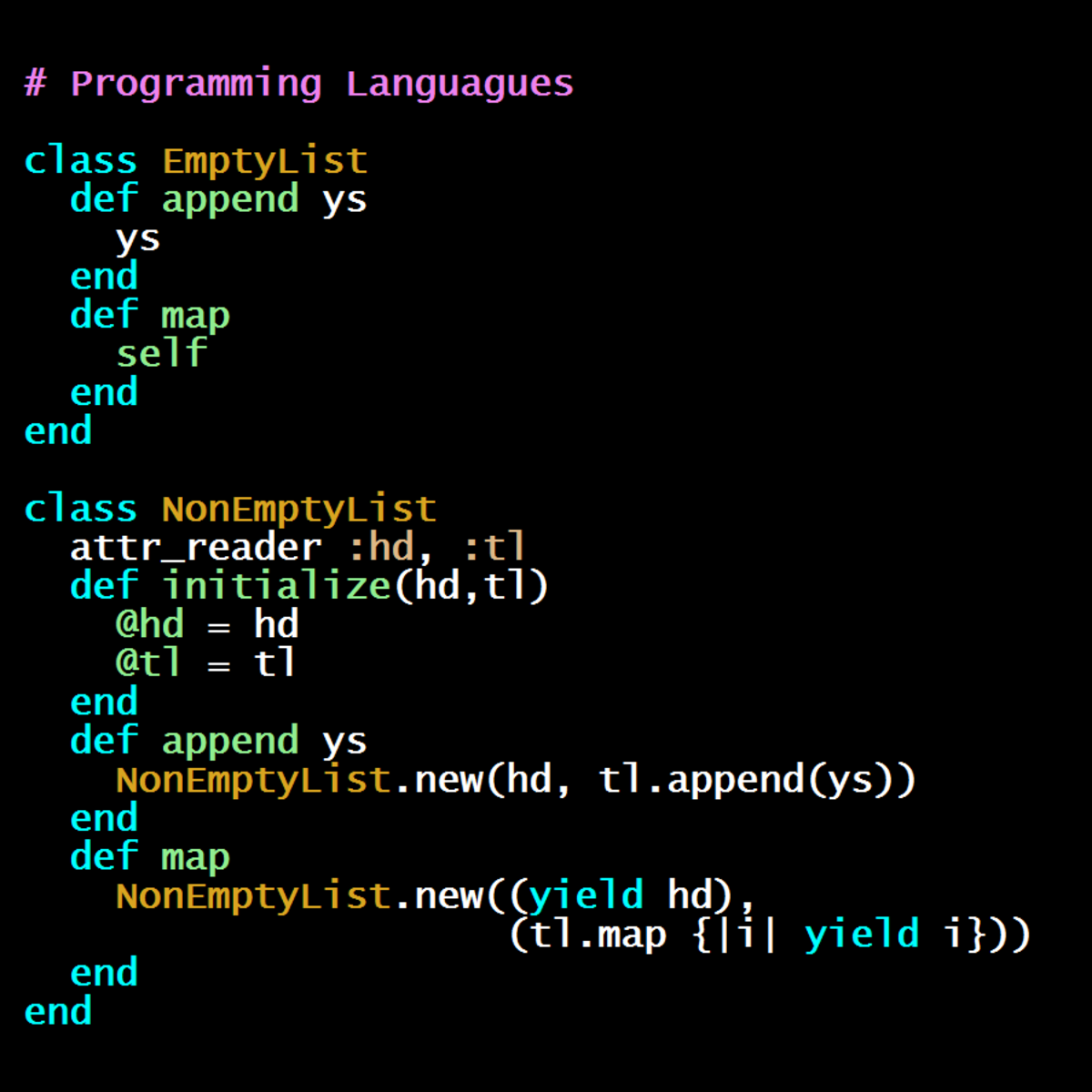
Programming Languages, Part C
[As described below, this is Part C of a 3-part course. Participants should complete Parts A and B first -- Part C "dives right in" and refers often to material from Part A and Part B.] This course is an introduction to the basic concepts of programming languages, with a strong emphasis on functional programming. The course uses the languages ML, Racket, and Ruby as vehicles for teaching the concepts, but the real intent is to teach enough about how any language “fits together” to make you more effective programming in any language -- and in learning new ones. This course is neither particularly theoretical nor just about programming specifics -- it will give you a framework for understanding how to use language constructs effectively and how to design correct and elegant programs. By using different languages, you will learn to think more deeply than in terms of the particular syntax of one language. The emphasis on functional programming is essential for learning how to write robust, reusable, composable, and elegant programs. Indeed, many of the most important ideas in modern languages have their roots in functional programming. Get ready to learn a fresh and beautiful way to look at software and how to have fun building it. The course assumes some prior experience with programming, as described in more detail in the first module of Part A. Part B assumes successful completion of Part A. The course is divided into three Coursera courses: Part A, Part B, and Part C. As explained in more detail in the first module of Part A, the overall course is a substantial amount of challenging material, so the three-part format provides two intermediate milestones and opportunities for a pause before continuing. The three parts are designed to be completed in order and set up to motivate you to continue through to the end of Part C. Week 1 of Part A has a more detailed list of topics for all three parts of the course, but it is expected that most course participants will not (yet!) know what all these topics mean.
 Harvard Business Review
Execute with Focus and Discipline
Focused, disciplined leadership helps you and your team spend time wisely. In this course, you’ll learn how to make smart decisions to make the most of everyone’s time and energy and overcome the obstacles that derail productivity. You’ll learn techniques to ensure meetings are helpful, routines are optimized, and common challenges don’t get in the way of your team’s success.
 Board Infinity
ABAP RESTful Programming Model (RAP) and Extensions
Master the ABAP RESTful Application Programming Model (RAP) to build scalable, full-stack business applications in SAP S/4HANA. This advanced course equips you with the tools and techniques to architect clean, maintainable solutions using CDS views, behavior definitions, EML (Entity Manipulation Language), and SAP Fiori Elements. You'll use Eclipse IDE and SAP Business Application Studio to create enterprise apps that follow modern SAP development practices. Module 1 introduces RAP architecture, behavior layers, metadata extensions, and managed scenarios. You’ll learn to preview Fiori apps within your development flow. Module 2 focuses on real-world business logic—implementing determinations, validations, actions, and side effects for responsive, rule-based behavior. Module 3 covers CRUD operations using EML, ABAP unit testing, and unmanaged scenarios, followed by deployment to the SAP Launchpad. By the end, you will... -Develop full-stack SAP S/4HANA apps using the RAP model -Define behavior-driven business logic and implement validations and actions -Use EML for backend operations and write automated unit tests -Deploy complete applications to the SAP Fiori Launchpad with clean architecture Disclaimer: This course is an independent educational resource developed by Board Infinity and is not affiliated with, endorsed by, sponsored by, or officially associated with SAP SE or any of its subsidiaries or affiliates. This course is not an official preparation material of SAP SE. All trademarks, service marks, and company names mentioned are the property of their respective owners and are used for identification purposes only.
 Google Cloud
Integración de aplicaciones con Gemini 1.0 Pro en GC
Este curso breve sobre la integración de aplicaciones con modelos de Gemini 1.0 Pro en Google Cloud te ayudará a descubrir la API de Gemini y sus modelos de IA generativa. En este curso, aprenderás a acceder a los modelos de Gemini 1.0 Pro y Gemini 1.0 Pro Vision a partir del código. Podrás probar las capacidades de los modelos con instrucciones de texto, imágenes y video desde una app.
 EDUCBA
Chatbots with Keras & NLP: Build & Evaluate
Learners will be able to analyze text data, implement preprocessing techniques, apply vectorization methods, design machine learning and neural models, and evaluate advanced chatbot systems. This hands-on course guides learners step by step through the process of building chatbots with Keras and TensorFlow, ensuring both foundational and advanced skills are developed. The course begins with essential NLP preprocessing techniques, including Bag of Words, TF-IDF, stop word removal, stemming, and lemmatization. Learners then progress to applying classical ML models, TF-IDF, and Word2Vec embeddings before mastering neural networks and generative chatbot architectures. In the final module, learners explore attention mechanisms, advanced architectures, and evaluation strategies to create context-aware, high-performing conversational AI. By completing this course, learners gain practical coding experience, industry-ready workflows, and the ability to confidently design and deploy chatbots for real-world applications. Unlike purely theoretical courses, this program emphasizes hands-on implementation, progressive complexity, and evaluation-driven learning—making it uniquely suited for those who want to design, implement, and assess intelligent chatbots with cutting-edge NLP techniques.
 ISAE-SUPAERO
Flight mechanics - The basis
More than one century after the Wright brothers' first flight, the flight still defy our intuition. You will learn here how to name the different parts of the airplane and how to describe and quantify its geometry. For that, we need now to share a precise vocabulary to describe the airplane's movement and attitude in space, and a refresher on basic general mechanic principles. You will remind how Newton's 2nd law allows you to determine what force must be applied on an apple - or on an airplane, to modify the magnitude and direction of its speed. Coming back on the concepts of kinetic energy and potential energy, you will discover the very useful concept of total height and you will be able to explain how an airplane can quickly exchange speed for altitude, while changes in total height are much slower. In the end, you will discover that only a very small number of forces apply on an airplane in flight and that you will be able to classify those that change its energy state and those that modify its trajectory. You will discover the concept of load factor and understand why the pilot of a combat aircraft can feel a weight nine-time greater than his actual weight! Finally, we will establish the lift and propulsion equations, that form the basis of flight mechanics, and you will be able to compute the lift and thrust necessary to follow a given trajectory at a given speed. This course is for anybody interested in learning more about how planes work, the physics of flying, or flight mechanics. It will be of particular interest to undergraduate students in aerospace engineering, trainees as well as senior pilots, journalists, and professionals in the aeronautics sector. Although some mathematical formalism may be present sometimes. It is always doubled by sketches, figures, and hands-explanations. So that, anybody can skip the formulas without losing the core understanding of the concepts. No apples were harmed in the making of this course... This course is only a foretaste of the mechanics of flight. ISAE-SUPAERO and Eric Poquillon will offer you other courses and the first specialization in autumn 2021. Initially, three courses will be published to answer several questions: Can we fly as high as we want? What is a stall? Why do some planes have propellers and others have jet engines? Is an airplane always stable? How do you control an airplane following an engine failure? All this and more will be covered in this series of flight mechanics courses. This course is a part of the specialization "Fundamentals of Flight mechanics".
 Duke University
Decentralized Finance (DeFi) Opportunities and Risks
DeFi and the Future of Finance is a set of four courses that focus on decentralized finance. The final course is called DeFi Opportunities and Risks. It is essential that you complete the first three courses: I. DeFi Infrastructure; II. DeFi Primitives; and III. DeFi Deep Dive before beginning the fourth course. The course starts with the premise that an analysis of any new technology must clearly gauge the risks and challenges. Given that DeFi is only a few years old there are plenty of risks. The course begins with the most obvious risk: smart contract risk. Smart contracts are foundational for DeFi. The code of these contracts is public - opening a clear attack vector for hackers. That is, in traditional finance, hackers need to break into a system to get access to the code and data. In DeFi, everything is open source.There are many other risks studied including: Governance risk; Oracle risk; Scaling risk; Decentralized Exchange or DEX risk; Custodial risk; Environmental risk; and Regulatory risk.
 University of Michigan
Speaking and Presenting: Conversation Starters
This course will teach you how to build persuasive surprises into your presentations, the kind of surprises that will change how your audience sees a particular situation or proposal and then gets them talking—in a good way. It will also identify several techniques you can use to start (and maintain) your own conversations, whether with a big group, a small group, or even just one-on-one.
 Banco Interamericano de Desarrollo
Education on climate change, energy and ecological footprint
This course explores key concepts of climate change, such as climate, terrestrial systems, and energy. Their relationships are analyzed, and a diagnosis is proposed to promote school awareness of the short-term and long-term causes and effects of climate change. Additionally, the identification of local and global actions to mitigate it is encouraged.
 Yale University
Vyombo vya Habari Dijitali kwa Matokeo ya Afya
The Digital Media for Health Outcomes (DMHO) course will train health communication professionals to leverage social and behavioral insights to design, implement and evaluate health communications online. The course is designed as a comprehensive and evidence-based tutorial on the key tactical steps to develop and implement successful health campaigns on social media, and to evaluate their performance and impact on health behavior. Throughout the course, students will explore best practices for designing relevant messages and campaign creatives. By the end of the course, students will be able to implement a digital communication strategy with actionable campaign objectives, and evaluate its impact through ad metrics, survey data, cost, and coverage indicators. Yale is thrilled to offer this course fully translated in: Arabic - https://www.coursera.org/learn/digital-media-health-outcomes-ar French - https://www.coursera.org/learn/digital-media-health-outcomes-fr Spanish - https://www.coursera.org/learn/digital-media-health-outcomes-es
 Association of International Certified Professional Accountants
Introduction to Data Analytics for Accounting Professionals
This course covers the foundations of data analytics and how to conduct and apply this to projects in your organization. This includes the following: - What does it mean to have a data-driven mindset? Having the right mindset will allow you to understand the problem that needs to be solved and make or recommend appropriate data-driven decisions in the context of the organization’s strategy and technologies. - What are the key considerations when identifying, establishing, and implementing a data analytics project? This course introduces and discusses important concepts and considerations, so you are ready to be effective no matter how your organization or industry changes. This includes everything from framing the problem and defining the scope, to understanding organizational requirements and gaps, to effectively working with key stakeholders. - What is the required technical knowledge you need so that you can understand data? Whether the data you’re looking at is financial or non-financial data, structured or unstructured, you need to understand the language of data analytics so that you can communicate effectively with colleagues and add value when using data analytics in your organization. By completing this course, you will be in a better position to ask the right questions, add greater value, and improve the quality of services to your stakeholders.
 Coursera
Decryption with Python
By the end of this project, you will be able to apply different decryption algorithms and techniques using Python. Moreover, you will apply cryptography concepts through completing several practical exercises to build a solid foundation in decrypting information and data using several renowned industry encryption algorithms. You will write programs that decrypt data using ciphers including the reverse cipher Caesar Cipher and Fernet symmetric and RSA asymmetric encryption algorithms. This project is for intermediate Python programmers who already have a basic familiarity with thePython programming language and are interested in cryptography. This project will provide you with the skills needed to write software that encrypt and decrypt data. We will be using Python for this project . It has quickly become the world’s most popular programming language making it suitable for this project.
 Packt
Packt
Boltnew AI - From Code to App
This course features Coursera Coach! A smarter way to learn with interactive, real-time conversations that help you test your knowledge, challenge assumptions, and deepen your understanding as you progress through the course. Discover how to transform code into a full-fledged app using Bolt.new—a cutting-edge AI-powered development platform. You'll learn how to go from setup to live deployment with ease, mastering workflows that accelerate application delivery and reduce developer effort. The course starts by guiding you through the fundamentals of Bolt.new, from installing the environment to locking files for efficiency. Once comfortable with the platform, you'll dive into practical app-building techniques: deploying to production, managing tokens, adding custom domains, and leveraging powerful undo/rollback tools. You'll then explore deeper functionality such as adding authentication, integrating Firebase and Google Analytics, troubleshooting login issues, and managing databases securely. Bonus modules include enhancing user experience through accessibility tweaks, profile customization, and visual effects like snow and fireworks. This course is perfect for developers, tech entrepreneurs, and makers looking to rapidly build, scale, and manage AI-powered applications. A basic understanding of web development is recommended.