

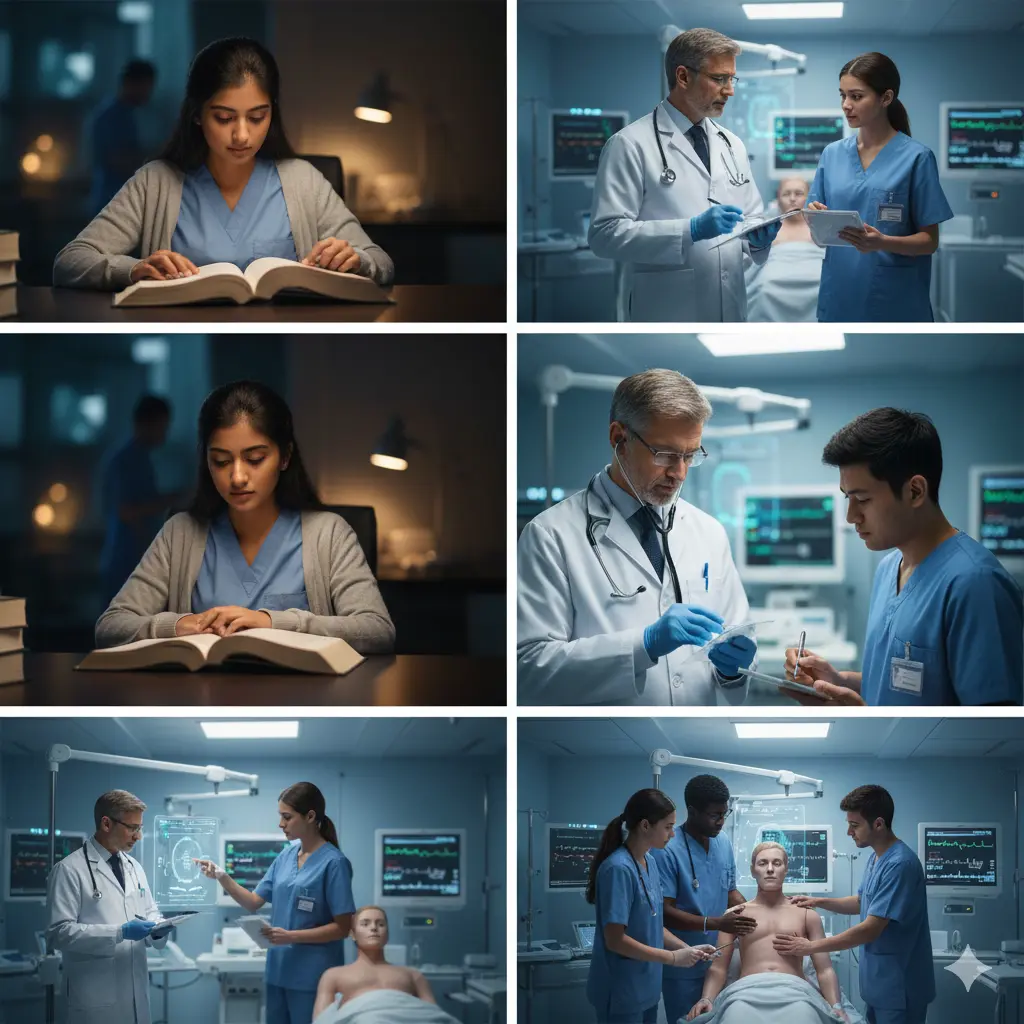
Why MBBS Cannot Be Taught Through Textbooks Alone: The Vital Role of Clinical Mastery
In the world of medical education, there is a famous saying: "To study the phenomena of disease without books is to sail an uncharted sea, while to study books without patients is not to go to sea at all."
While the MBBS curriculum is built on the foundations of Anatomy, Physiology, and Biochemistry, there is a massive chasm between passing an exam and saving a life. Textbooks are essential, but they are merely the blueprint. The actual structure of a doctor is built at the bedside of a patient.
1. The Discrepancy Between "Classic Cases" and Real Patients
Textbooks like Harrison’s Principles of Internal Medicine describe "classic" presentations of diseases. However, real-world patients rarely follow the script. A patient with a heart attack might present with jaw pain instead of chest pain; a child with pneumonia might only show signs of lethargy.
Without physical exposure, a student lacks the "pattern recognition" required to identify atypical presentations that a printed page simply cannot convey.
"A textbook can describe the sound of a heart murmur, but only a stethoscope and a living patient can teach you the rhythm of life."
2. Procedural Muscle Memory and Tactile Learning
Medicine is a high-stakes craft. Can you learn to suture a deep laceration by reading a paragraph? Can you master the delicate angle of a lumbar puncture by looking at a diagram? The answer is no.
Clinical skills require repetitive muscle memory. The tactile feel of a needle entering a vein or the resistance of an abdominal wall during palpation are sensory experiences that no digital screen or paper page can replicate.
3. The Art of the Medical Interview (Communication)
One of the most critical aspects of being an MBBS graduate is "History Taking." A patient’s recovery often depends on the doctor’s ability to ask the right questions at the right time. Textbooks cannot teach you how to:
- Maintain eye contact while taking notes.
- Detect the subtle hesitation in a patient's voice when discussing trauma.
- Deliver devastating news with professional empathy.
4. Developing "Clinical Instinct" Under Pressure
When an emergency patient arrives in the ER, the "textbook" solution doesn't always come to mind first—intuition does. This intuition, or Clinical Instinct, is developed through observing senior consultants, making supervised mistakes, and witnessing the rapid progression of diseases in real-time.
5. Navigating Medical Ethics in Grey Areas
Textbooks provide a framework for ethics, but real life is full of "grey areas." Dealing with limited resources, managing patient consent in unconscious states, and navigating family dynamics require a level of emotional intelligence that can only be forged in the fire of hospital wards.