

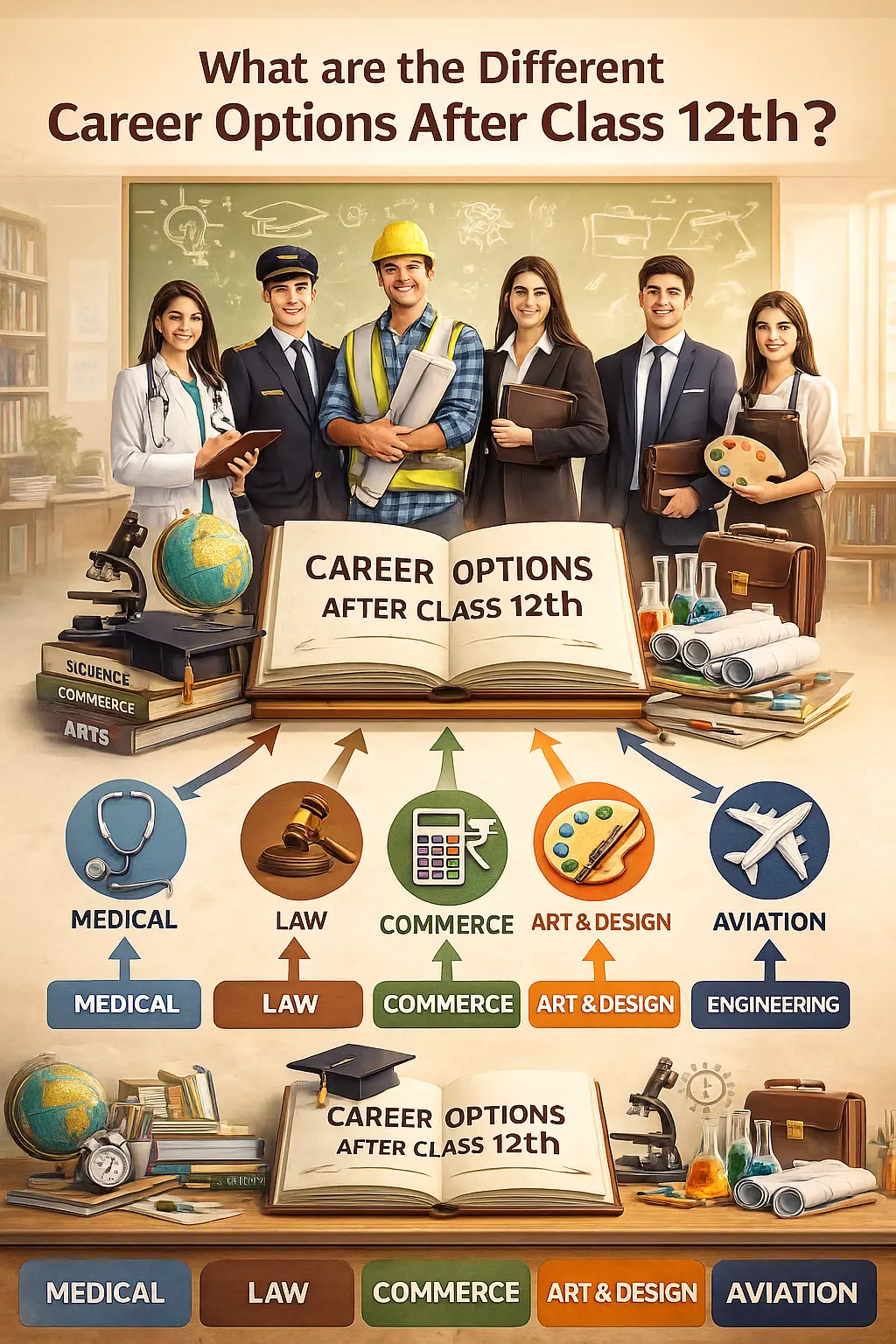
Choosing the right career after Class 12th is one of the most important decisions in a student’s life. This stage can feel overwhelming because there are so many courses, colleges, and career paths available today. The good news is: you don’t have to follow one “fixed” route. Your best career option depends on your interests, strengths, stream (Science/Commerce/Arts), and the type of lifestyle you want in the future.
In this guide, you’ll find a clear overview of the most popular and high-potential career options after 12th, along with practical direction to help you decide confidently.
Career Options After 12th Science (PCM / PCB)
Science students often have the widest set of choices because they can pursue technical, medical, research, and even management careers. Here are the top options:
1) Engineering (PCM)
Engineering is one of the most chosen fields after 12th Science. Students can specialize in Computer Science, Artificial Intelligence, Data Science, Mechanical, Civil, Electrical, Electronics, or Aerospace. If you enjoy problem-solving, technology, and building systems, engineering can open doors to high-paying roles in India and abroad.
2) Medical & Healthcare (PCB)
Students with Biology can pursue MBBS, BDS (Dentistry), BAMS, BHMS, Nursing, Pharmacy (B.Pharm), Physiotherapy (BPT), and Allied Health Sciences. Healthcare careers are respected, stable, and in demand globally—especially as healthcare is continuously growing.
3) Computer & Tech Careers (PCM / Any stream with skills)
Even if you don’t choose a full engineering degree, careers in coding and IT are possible through BCA, B.Sc. Computer Science, and skill-based certifications. Fields like Web Development, Cybersecurity, Cloud Computing, UI/UX Design, Data Analytics, and Machine Learning are booming and offer strong salary growth.
4) Pure Sciences & Research
If you enjoy Physics, Chemistry, Maths, or Biology deeply, you can pursue B.Sc. and move into research with M.Sc. and PhD. Research careers exist in education, labs, biotech firms, and government institutions.
Career Options After 12th Commerce
Commerce students have excellent opportunities in finance, business, accounting, analytics, and entrepreneurship. Many high-income professionals come from this stream.
1) Chartered Accountancy (CA)
CA is one of the most respected and high-earning career options after 12th Commerce. It requires discipline and consistent effort, but it can lead to roles in auditing, taxation, corporate finance, and consulting.
2) Company Secretary (CS)
CS focuses on corporate legal compliance, governance, and company law. If you have interest in law-related business work and corporate operations, CS can be a strong option.
3) B.Com / BBA / Business Management
A B.Com degree can lead to banking, accounting, HR, and finance roles, while BBA is great for students interested in management and entrepreneurship. Many students later pursue MBA for higher growth.
4) Finance, Banking & Investment Careers
Commerce students can also aim for careers in investment banking, stock markets, financial analysis, insurance, and fintech. Courses like CFA (Chartered Financial Analyst) are highly valued for global finance roles.
Career Options After 12th Arts / Humanities
Arts is no longer a “limited” stream. In fact, many fast-growing careers today—like digital marketing, design, psychology, and media—are open to Arts students. The key is choosing the right course and building practical skills.
1) Law (BA LLB)
Law is a powerful career option with opportunities in corporate law, criminal law, civil law, intellectual property, and legal advisory. It also builds strong communication and critical thinking skills.
2) Journalism & Mass Communication
If you enjoy writing, speaking, storytelling, or content creation, careers in journalism, public relations, advertising, and media production can be a great fit. Digital media roles are especially in demand.
3) Psychology & Counseling
Psychology is becoming increasingly popular as awareness of mental health grows. Students can pursue BA/B.Sc. Psychology and later specialize in counseling, clinical psychology, or organizational psychology.
4) Design & Creative Careers
Fields like Graphic Design, UI/UX Design, Fashion Design, Interior Design, and Animation can be strong career paths for creative students. A good portfolio and practical projects matter more than marks in many design careers.
Best Skill-Based & Diploma Courses After 12th (Any Stream)
Not everyone wants a traditional degree immediately. Skill-based courses can help you start earning faster and build a career through real-world projects. Popular options include:
- Digital Marketing (SEO, Social Media, Ads, Content)
- Web Development (Frontend/Backend)
- Data Analytics (Excel, SQL, Power BI)
- Graphic Design & Video Editing
- Hotel Management & Aviation
- Diploma in Computer Applications, Nursing, or Engineering
How to Choose the Right Career After 12th
To choose the best career path, focus on three things: (1) your interest, (2) your strengths, and (3) real job demand. Start by listing what subjects you enjoy and what type of work excites you—technical, creative, analytical, or people-focused. Then research required qualifications, salary ranges, and growth opportunities. If possible, talk to seniors, take aptitude tests, and explore internships or short courses to test your interest.
Final Thoughts
There is no single “best” career option after Class 12th—only the best option for you. Whether you choose Engineering, Medical, CA, Law, Design, or a skill-based path, success comes from consistent learning and building strong practical skills. Pick a direction that matches your personality and goals, and keep improving step by step. Your future is not decided by one decision, but by the effort you put in after choosing your path.